
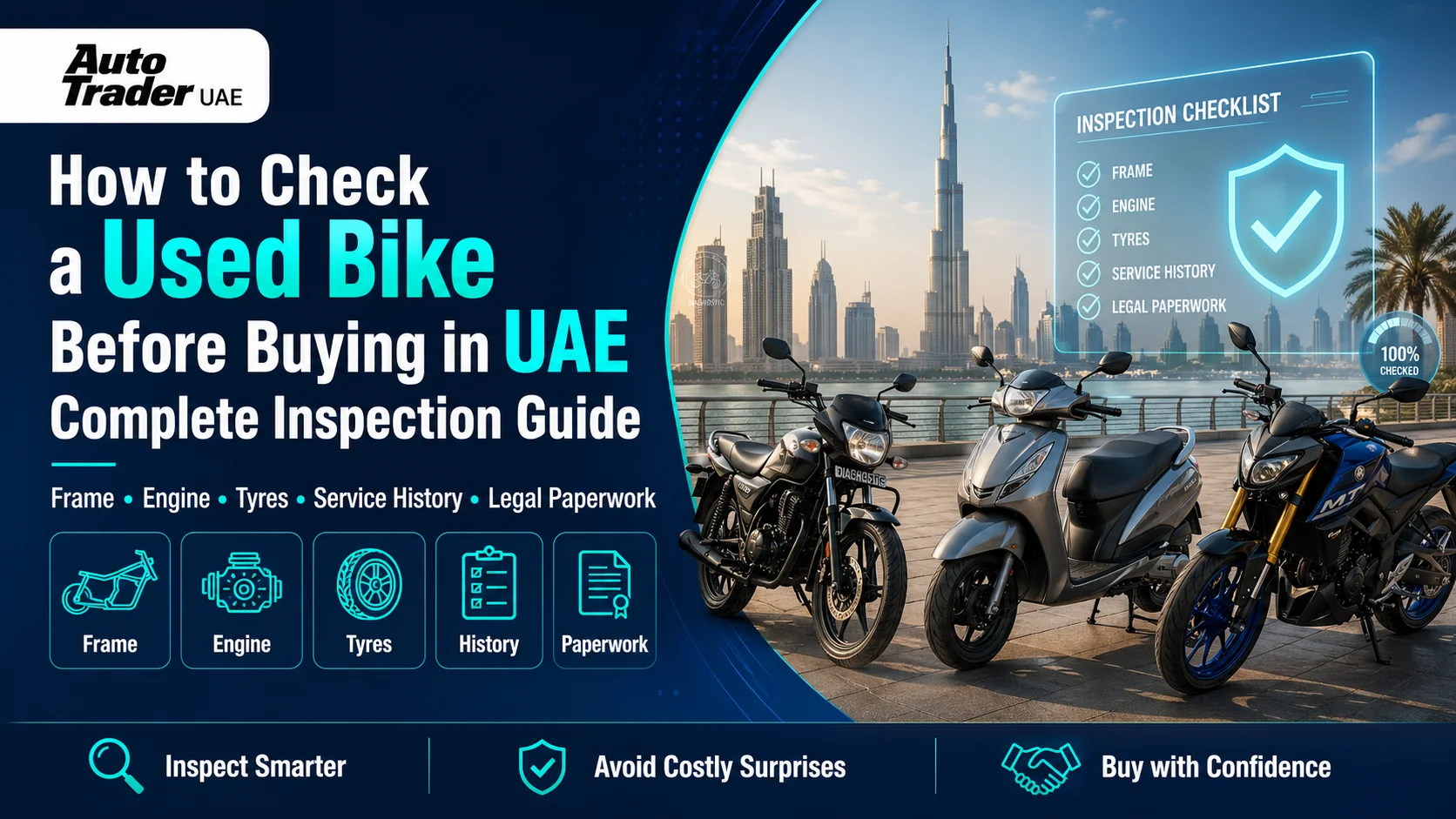
How to Check a Used Bike Before Buying in UAE
Buying a used bike in the UAE can save you a lot of money compared with going brand‑new, but only if you know how to inspect it properly. This guide walks you through how to check a used bike before buying in UAE conditions, from first impressions to paperwork, so you can buy with confidence on platforms like Auto Trader UAE or from a private seller.
1. Decide What You Need Before You Inspect
Before you even look at a bike, be clear about:
- Type of bike: commuter, sport, cruiser, adventure, off‑road, scooter, delivery bike.
- Primary use in the UAE: city commuting, highway runs, weekend rides, off‑road desert riding, delivery work.
- Budget including extras: registration, insurance, basic service, new tyres or battery if needed, riding gear.
Going to view the right type of bike helps you evaluate it more realistically and avoids getting distracted by something that doesn’t suit your daily use in Dubai, Abu Dhabi, Sharjah or the other Emirates.
2. First Checks Before You Visit the Seller
When you see a used bike listing online, do these quick checks before arranging a viewing:
- Photos: Look for clear images from all angles, close‑ups of the engine, odometer, tyres, and any damage.
- Description: A serious seller will list mileage, year, modifications, service history and reason for sale.
- Price vs market: Compare with similar bikes on Auto Trader UAE. If it’s far cheaper, ask why; if it’s far higher, the seller should justify it.
- Location: Bikes near coastal areas can suffer more from corrosion; inspect more carefully for rust.
Ask the owner to keep the bike cold for your visit so you can see how it starts from cold, which is a better test of the engine.
3. Visual Walk‑Around: General Condition
When you arrive, don’t touch anything at first. Just walk around the bike and look:
- Overall impression: Does the bike look well cared for or neglected? Dusty, rusty bikes with mismatched parts can indicate poor maintenance.
- Panel gaps and alignment: Fairings, tank and tail sections should line up evenly. Misaligned panels can suggest past accidents.
- Paint and stickers: Fresh paint on a specific area could be hiding a previous crash or rust repair.
- Leaks on the ground: Check the floor under the bike for oil, coolant or fuel stains.
If the general condition looks poor, it’s usually wiser to walk away rather than try to “save” a bad bike.
4. Frame and Chassis Inspection
The frame is the bike’s backbone. Structural damage can be dangerous and expensive to fix.
4.1 Frame
- Headstock and down tubes: Look for cracks, dents, welds or fresh paint – all can indicate crash damage.
- Subframe (rear): Check for bends or poorly done welds. A noticeably crooked rear seat or tail can be a warning sign.
- Straightness test: Stand a few metres behind and in front of the bike and look along the wheels and frame. The front and rear wheels should be in line.
4.2 Forks and Suspension
- Front forks: Look for oil on the fork legs – leaking fork seals mean extra cost and can affect braking.
- Fork tubes: Check for scratches, pitting or bends. Bent forks indicate a hard impact.
- Rear shock: Inspect for oil leaks and corrosion at the mounting points.
- Bounce test: Sit on the bike and compress the suspension. It should move smoothly and return without bouncing excessively.
5. Engine and Mechanical Checks
The engine is the most expensive part of the bike. Spend extra time here.
5.1 Cold Start Test
Ask the seller not to start the bike before you arrive.
- Start‑up: The bike should start without excessive cranking. Carbureted bikes may need a little choke; fuel‑injected bikes should fire more easily.
- Smoke from exhaust:
- Blue smoke: Burning oil – worn piston rings or valve seals.
- White smoke (continuous): Could indicate coolant entering the combustion chamber.
- Black smoke: Running rich – fueling issues.
- Idle: After warming up, the engine should idle steadily without hunting, stalling or high fluctuating revs.
5.2 Engine Sounds
Listen carefully:
- Normal: Smooth ticking or mechanical whirring.
- Concerning: Loud knocking, heavy tapping, rattling chains or metallic scraping sounds.
Use a gentle blip of the throttle. Noise that increases sharply under light revs can mean worn internal components.
5.3 Leaks and Fluids
- Engine casing: Look around gaskets and covers for oil leaks.
- Coolant: Check the radiator and hoses for stains or dried coolant marks.
- Under the engine: Inspect the sump and drain bolt for fresh oil or damaged threads.
Ask when the last oil change and coolant change were done. In UAE heat, proper fluids are critical.
6. Transmission, Clutch and Final Drive
6.1 Clutch
- Engagement point: The clutch should engage smoothly, not right at the very end of the lever travel.
- Slip test: In a safe area, accelerate firmly in a higher gear. If revs jump but speed doesn’t increase, the clutch may be slipping.
6.2 Gearbox
During the test ride:
- Shift up and down through all gears.
- There should be no heavy crunching, jumping out of gear, or difficulty finding neutral.
6.3 Chain, Sprockets or Belt
Most bikes in the UAE use chain drive:
- Chain condition: Rust, stiff links or excessive slack means replacement is likely soon.
- Sprocket teeth: Worn teeth look sharp or hooked. Good teeth are more even and squared‑off.
- Lubrication: A dry chain suggests poor maintenance.
For belt‑drive bikes, look for cracks, fraying or missing teeth on the belt.
7. Brakes, Tyres and Wheels
7.1 Brakes
- Discs: Check for deep grooves, blue discoloration or heavy rust.
- Pads: Look from above or behind the caliper – there should be visible pad material left.
- Brake feel: Lever and pedal should feel firm, not spongy. Sponginess can mean air in the system or old fluid.
7.2 Tyres
Heat and road surfaces in the UAE can wear tyres quickly.
- Tread depth: Make sure there is enough tread; bald or squared‑off tyres will need replacing.
- Cracks: Look on sidewalls for dry cracking – common on older bikes that sat in the sun.
- Tyre age: Check the four‑digit DOT code (e.g. 2319 = week 23 of 2019). Very old tyres, even with good tread, can be unsafe.
7.3 Wheels
- Alloy wheels: Check for cracks, dents or bends, especially on the rim edges.
- Spoked wheels: Lightly tap spokes with a coin; they should sound similar. Loose or broken spokes need attention.
8. Steering and Handling Checks
8.1 Steering Head Bearings
With the bike on its stand:
- Hold the front brake and rock the bike back and forth. Feel for knocking or play in the steering head.
- Turn the handlebars lock to lock; movement should be smooth, with no tight spots or notches.
8.2 Test Ride Feel
During a short, safe test ride:
- Does the bike pull to one side when you release the bars slightly on a straight road?
- Does it feel stable at low and moderate speeds?
- Any wobbling, shaking or vibration that feels abnormal?
If the seller refuses a test ride, at least ask them to ride the bike slowly while you watch and listen.
9. Electrical System and Electronics
Modern bikes can have complex electronics. Even simple scooters rely heavily on healthy electrics in UAE heat.
- Lights: Test headlight (low/high beam), brake lights, indicators, hazard lights, number plate light.
- Horn: Simple but important for city riding; make sure it works.
- Instrument cluster: All warning lights should come on with ignition, then go off after start if all is healthy.
- Battery: Slow cranking, dim lights at idle or clicking sounds can indicate a weak battery.
- Extra accessories: Check any added items like phone chargers, auxiliary lights or aftermarket alarms for proper operation and tidy wiring.
Messy wiring, twisted joints and exposed cables are red flags for future electrical problems.
10. Signs of Accident Damage or Hard Use
Many used bikes in the UAE may have had a minor drop at low speed, which isn’t always a deal‑breaker if properly repaired. What you want to avoid is serious structural damage or signs of abuse.
- Bar ends, levers and footpegs: Scratches or grinding marks show where the bike hit the ground.
- Engine cases: Deep scrapes or cracks on the side covers can mean a heavier fall.
- Frame and swingarm: Non‑factory welds, obvious bends or twisted components are serious concerns.
- Over‑revving and stunts: Flat‑spotted rear tyres, damaged clutch, or non‑standard rear brake setups can suggest stunt use.
If you find minor cosmetic damage but the bike rides straight and the price reflects it, it may still be a good deal. Just be honest with yourself about future resale value.
11. Service History and Maintenance in UAE Conditions
Service history is almost as important as the physical condition.
- Service book and invoices: Ask for stamped service book or receipts from workshops.
- Regular oil changes: In UAE heat and traffic, frequent oil and filter changes are crucial.
- Coolant and brake fluid: Should have been changed roughly as per the manufacturer schedule.
- Major services: On higher‑mileage bikes, check if valve clearances, timing chain checks and other big jobs were done.
A well‑maintained higher‑mileage bike can be a better buy than a low‑mileage bike with no history and obvious neglect.
12. Legal and RTA Paperwork Checks in the UAE
Never skip the legal side. It protects you from fines, impoundment and ownership issues.
- Mulkiya (registration card): Check that the chassis (VIN) and engine number on the card match the bike.
- Seller’s ID: Ask to see Emirates ID or passport to confirm you’re dealing with the legal owner or an authorised seller.
- Outstanding fines or loans: Ask the seller if there are any fines or finance still on the bike. In some Emirates, this can be checked during the transfer process.
- RTA inspection: For older bikes or transfers between Emirates, an RTA test may be required. Factor in time and cost.
- Modification legality: Loud exhausts, extreme lighting or structural changes can cause registration or inspection problems. If in doubt, assume you may need to revert to stock parts.
Only hand over full payment once you’re confident the bike can be transferred into your name without issues.
13. Test Ride Checklist
If the bike is insured and the seller agrees, do a short, sensible test ride:
- Start‑up and idle: Starts easily, idles steadily.
- Acceleration: Smooth power, no hesitation or flat spots.
- Gears: Clean shifts, no jumping out of gear.
- Brakes: Strong, predictable braking with no pulling to one side.
- Handling: Stable in corners, no wobble or vibration that feels abnormal.
- Temperature: Watch the temperature gauge in traffic; overheating can mean radiator, fan or coolant problems.
Always wear proper riding gear for the test ride, especially on unfamiliar roads.
14. Common UAE‑Specific Issues to Watch For
Riding and parking in the UAE create some specific wear patterns.
- Heat damage: Faded plastics, brittle rubber hoses, cracked seats and grips.
- Sun exposure: Cloudy headlights, faded paint on the top surfaces, dry tyres.
- Dust and sand: Grit in switchgear, air filters, chain and bearings if the bike was used off‑road.
- Coastal corrosion: Rust on bolts, brackets and fasteners if the bike lived near the sea.
A bike stored in a shaded parking or indoors with covers tends to age far better.
15. Negotiating Price and Final Steps
Use what you found during inspection to negotiate fairly:
- List any parts that need replacing soon (tyres, chain, battery, pads, fluids) and estimate the cost.
- Compare the asking price with similar listings on Auto Trader UAE.
- Make a reasonable offer, explaining your reasoning calmly.
Once you agree:
- Write a simple sale agreement/receipt with buyer, seller, bike details, VIN, agreed price and date.
- Go together to the relevant RTA or licensing authority for transfer of ownership.
- Arrange insurance in your name before riding away.
16. When to Walk Away
No matter how attractive the price, walk away if you notice:
- Frame cracks, obvious structural damage or badly bent components.
- VIN number that looks tampered with, re‑stamped or is different from the registration.
- Seller refusing basic checks, test ride (where possible) or paperwork review.
- Multiple warning lights on the dash that won’t clear.
There are many bikes for sale across the UAE on Auto Trader UAE – it’s better to wait for a good one than buy a problem.
17. Should You Get a Professional Inspection?
If you’re new to bikes or buying a higher‑value motorcycle, consider:
- Taking a knowledgeable friend or mechanic with you.
- Paying for a pre‑purchase inspection at a reputable workshop.
A small inspection cost can save you thousands of dirhams in hidden repairs, especially on performance or large‑capacity bikes.
18. Next Steps with Auto Trader UAE
Now that you know how to check a used bike before buying in UAE, you can shortlist models and compare prices more confidently.
- Browse a wide range of used bikes and scooters across all Emirates on Auto Trader UAE.
- Filter by price, mileage, brand and location to quickly find options that match your needs.
- Review our latest buying tips and ownership advice in the Auto Trader UAE blog to stay informed about running costs, insurance and seasonal checks.
- For guidance on budgeting, finance and ownership costs, explore the relevant articles in the Auto Trader UAE money and ownership sections.
By combining a careful physical inspection with smart online research, you can find a used bike in the UAE that fits your budget, your lifestyle and your safety expectations – and enjoy many trouble‑free rides ahead.
Browse used bikes in UAE on Auto Trader UAE to compare live listings, prices, and current market activity more clearly.
Related Links
Buyer Takeaway
When buying a used car in the UAE, focus on vehicle condition, service history, inspection quality, paperwork, and total running costs rather than price alone. Compare options carefully and choose the option that best matches your budget and real needs.
Seller Takeaway
If you are selling a used car in the UAE, present the service history clearly, price the vehicle realistically, and highlight condition, specification, and ownership strengths honestly. A well-prepared listing with accurate details usually attracts more serious buyers.
Conclusion
A careful used car purchase in the UAE starts with research, proper inspection, and clear paperwork before making the final decision.