
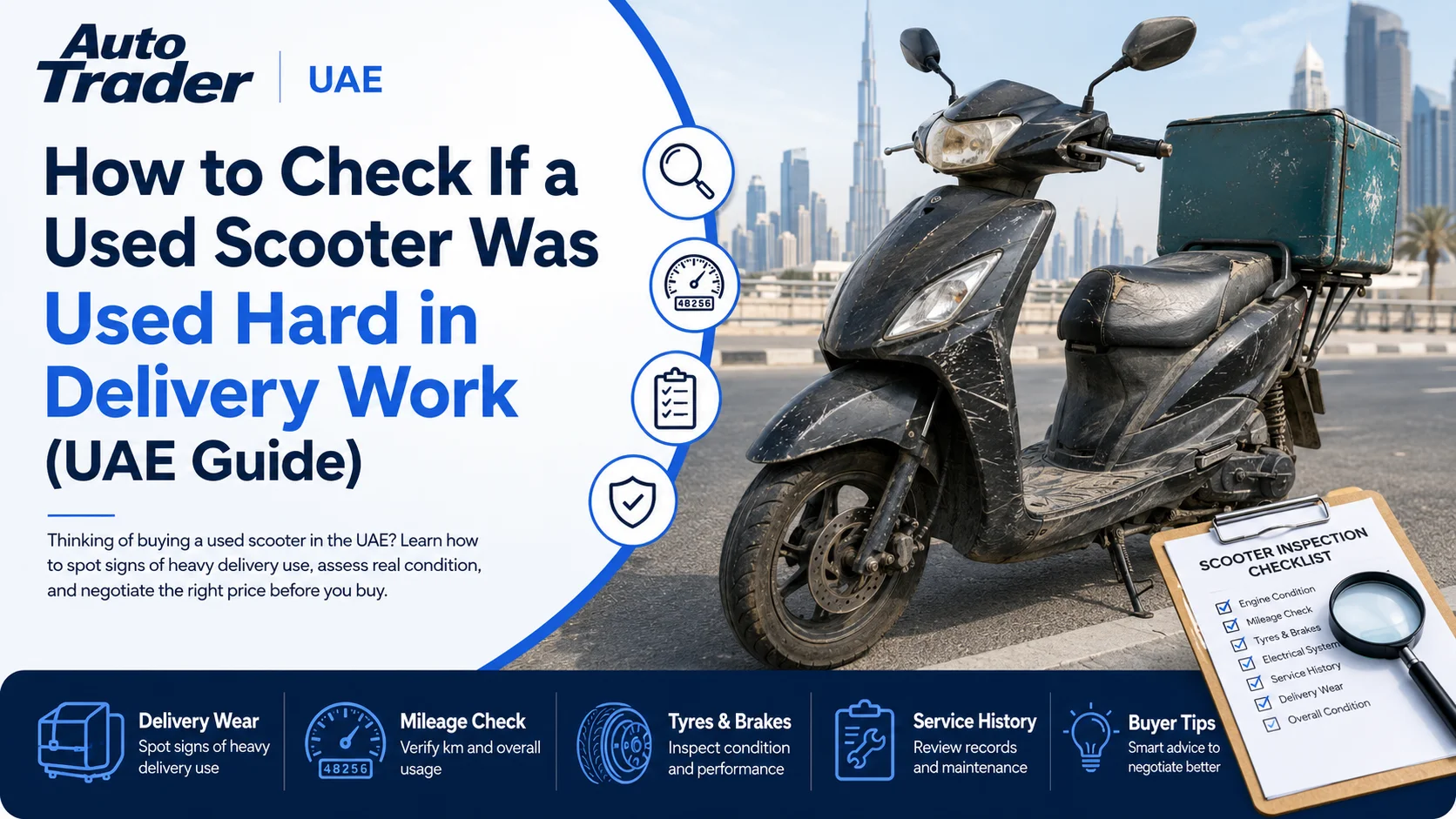
How to Check If a Used Scooter Was Used Hard in Delivery Work in the UAE
Buying a used scooter in the UAE can save you a lot of money, especially for commuting or short city trips. But many scooters in the market have spent years in hard delivery work with riders covering long distances daily, often with minimal maintenance. This guide explains how to check if a used scooter was used heavily for delivery, how to judge its true condition, and how to protect yourself as a buyer on Auto Trader UAE and beyond.
Why Delivery Use Matters When Buying a Used Scooter
Not all delivery scooters are bad buys. Some fleet bikes are well maintained and serviced on time. The key issue is intensity of use:
- Delivery scooters often run almost all day in hot UAE weather.
- They do many short trips, stop–start riding, and heavy braking.
- They frequently carry extra load: rider, top box, and sometimes additional bags.
This can mean:
- Engine wear comes earlier than on a privately used scooter.
- Suspension, brakes, and tyres wear faster.
- Cosmetic damage (scratches, drops, faded plastics) is more likely.
Your goal is not to automatically reject every ex-delivery scooter, but to recognise one, assess its true condition, and make sure the asking price reflects its life history.
1. First Impressions: What to Look For at a Glance
Start with a quick visual check before you dive into details.
Check for Delivery-Specific Fittings
Most delivery scooters in the UAE have or once had:
- Large rear carrier rack – sometimes still installed, sometimes removed but with visible mounting marks.
- Extra brackets or drilled holes on the rear or sides where a box used to be fixed.
- Reinforced rear grab rail or an aftermarket metal frame instead of a standard grab handle.
If you see multiple unused bolt holes, scratch marks on the rear rack area, or mismatched hardware, it may have carried a delivery box.
Look at Overall Wear Versus Age
Compare the scooter’s age to how it looks:
- Very worn grips, seat, and floorboard on a 2–3-year-old scooter suggest intensive daily use.
- Faded paint and plastics on the top surfaces (handlebar, front fairing, top of the box area) show long sun exposure, typical for parked delivery bikes.
- Multiple small scratches and panel touch-ups indicate frequent use in crowded city traffic.
A 4-year-old scooter with “taxi-style” wear is a likely workhorse rather than a weekend commuter.
2. Signs a Scooter Was Used for Delivery Work
Here are more specific signs you’re looking at an ex-delivery scooter.
a) Mounting Points and Rear Area
Inspect the back of the scooter carefully:
- Extra holes in the rear rack or tail section.
- Scratches and dents on the rear side panels where a box may have rubbed.
- Aftermarket heavy-duty rack, especially thicker metal than factory parts.
- Electrical wiring remnants for a delivery box light or company sign.
b) Company Stickers and Paint Shadows
Many delivery scooters carry logos from restaurants, grocery services, or delivery apps. Even when removed, they often leave traces:
- Sticker residue or glue marks on the front shield and side panels.
- Colour difference where stickers protected the paint from the sun (darker patches).
- Faint outlines of numbers, text, or logos when viewed from an angle.
c) Heavy Wear on Rider Contact Areas
Delivery riders get on and off the scooter dozens of times a day. Check:
- Footboard and side edges for worn or polished plastic from boots.
- Seat cover for sagging, tears, or reupholstery on a relatively young scooter.
- Handlebar grips and levers – deep wear patterns or shiny plastic/rubber are common on high-use bikes.
d) Tyres and Wheels
Delivery scooters are usually kept running, so tyres may be changed often. Warning signs include:
- Budget or mixed-brand tyres front and rear – typical of cost-focused fleet maintenance.
- Uneven wear patterns suggesting constant heavy load or poor alignment.
- Scratched wheel rims from frequent kerb contacts during quick stops and loading.
3. Mechanical Clues of Hard Daily Use
Physical wear tells part of the story; mechanical condition is even more important.
Engine and Transmission
On a test ride and inspection, watch for:
- Hard starting when cold or after sitting a while.
- Rough idle, misfiring, or excessive vibration at traffic-light speeds.
- CVT transmission noises – rattles, whining, or jerking when you accelerate.
- Slow or slipping acceleration despite the throttle being open – can mean worn belt or clutch.
Heavy delivery use accelerates wear on:
- Drive belt and variator
- Roller weights
- Clutch and clutch bell
These parts are not extremely expensive on many common scooters, but they do affect safety and performance.
Brakes and Suspension
Delivery work means constant braking and extra weight on the rear. Check:
- Front and rear brake discs for deep grooves, ridges, or a visible lip at the edge.
- Brake pads – if you can see them, check thickness.
- Suspension bounce test – push down on the rear; it should compress and return smoothly without multiple bounces.
- Leaking fork seals at the front – look for oily residue on fork tubes.
A delivery scooter with high kilometres might have tired shocks and worn brakes that need attention.
Frame and Chassis
Some delivery scooters get dropped or hit in low-speed incidents. Inspect for:
- Misaligned panels or gaps between body parts.
- Bent foot pegs or side stand.
- Handlebars not straight when the front wheel is straight.
Any serious misalignment could point to an accident, not just hard use.
4. Odometer vs Real Use: Reading the Numbers Correctly
Mileage is important, but with delivery scooters it needs context.
Typical Delivery Kilometres in the UAE
Many delivery riders can cover 50–150 km per day, depending on area and schedule. Over two to three years, a hard-worked scooter can easily pass 50,000 km or more. If the scooter is:
- 3–4 years old with very low kilometres (for example 10,000–15,000 km) but looks heavily worn, be cautious. Odometer tampering is possible.
- 3–4 years old with 40,000–70,000 km and moderate wear, it may genuinely have been a work scooter.
Cross-Check Odometer With Wear
Ask yourself:
- Do the grips, seat, footboard, and switches match the claimed mileage?
- Does the brake disc wear look like a low-km scooter?
- Are the tyres original or replaced? A 5,000 km scooter shouldn’t be on its third set of tyres.
When in doubt, treat it like a higher-mileage scooter and negotiate accordingly.
5. Paperwork, Service History, and Ownership Clues
Documents can quietly reveal if a scooter had a delivery life.
Registration and Previous Owner
In the UAE, many delivery scooters are registered under:
- Restaurants and cafés
- Courier/delivery companies
- Leasing and fleet companies
If the registration history shows a company or commercial entity, it’s likely a work scooter, even if it has been repainted or sticker-free.
Service Records and Invoices
Ask for any service history, even if it’s only a few invoices:
- Regular, frequent services every 3,000–5,000 km at the same workshop are a good sign of proper maintenance.
- Look for repeated mentions of delivery box, rack, commercial use or similar notes.
- Check for major replacements (engine work, transmission rebuild) – this shows heavy use but also that critical parts were renewed.
If there is no history at all and the scooter otherwise looks like a fleet bike, factor that uncertainty into your price.
6. Questions to Ask the Seller
Be direct, but polite. Honest sellers—especially on Auto Trader UAE—will usually give clear answers.
- “Was this scooter ever used for delivery or commercial work?”
- “Who was the previous owner – private individual or company?”
- “How many riders used this scooter?” (Fleet scooters often have many riders.)
- “How often was it serviced, and where?”
- “What parts were recently replaced?” (belt, brakes, tyres, suspension, battery).
Even if a seller is not fully transparent, their reaction, body language, and level of detail can help you judge how careful they’ve been with the bike.
7. When an Ex-Delivery Scooter Can Still Be a Good Buy
A used scooter with a delivery history is not automatically a bad purchase. It can be good value if:
- The price is clearly lower than an equivalent privately used scooter.
- There is proof of regular servicing and recent parts replacement.
- It passes a test ride without worrying noises, vibrations, or smoke.
- Critical wear items (tyres, brakes, belt) are in good condition.
Delivery scooters are often popular, simple models with easily available parts in the UAE. That makes them cheap to repair, which is a plus for buyers on a tighter budget.
8. What to Inspect Professionally Before You Commit
If you’re seriously considering a scooter that may have been used for delivery, a quick professional inspection is worth it. Ask a workshop or trusted mechanic to check:
- Compression and engine health
- CVT system – belt condition, rollers, clutch, variator
- Brakes – discs, pads, and brake fluid
- Suspension – leaks, play, or weak springs
- Steering and bearings – head bearings, wheel bearings
- Electrical system – lights, indicators, horn, and battery health
Use the mechanic’s report to estimate upcoming costs and adjust your offer.
9. Pricing and Negotiation Tips for the UAE Market
Once you’ve identified signs of heavy delivery use, use that knowledge during negotiation.
Factor in Upcoming Maintenance
Make a list of what the scooter will soon need:
- New tyres
- Brake pads or discs
- Drive belt, rollers, or clutch
- Suspension work
- Battery replacement
Estimate a rough cost with a local workshop and mention this when making your offer.
Compare With Similar Listings on Auto Trader UAE
Before you agree on a price:
- Search similar scooters (same brand, engine size, and year) on Auto Trader UAE.
- Note price differences between obviously private-use scooters and ex-delivery or high-km ones.
- Use those examples to justify your counter-offer.
10. Extra Checks for Buyers Planning Delivery Work
If you are a rider or small business planning to use the scooter for delivery yourself in the UAE, be even more cautious.
- Choose a scooter with a strong parts network and easy service in your emirate.
- Prioritise models known for reliability and fuel economy.
- Budget for a full service after purchase: oil, filters, belt inspection, and brakes.
- Confirm that the scooter can be registered and insured for commercial use if required.
Sometimes it’s worth paying a little more for a healthier base scooter instead of buying the absolute cheapest ex-delivery bike.
Buyer Takeaway
When you’re evaluating a used scooter in the UAE and want to know if it was worked hard as a delivery bike, focus on:
- Physical clues – racks, mounting holes, sticker shadows, and heavy wear.
- Mechanical condition – engine, CVT, brakes, and suspension.
- Paperwork – previous owner type and service history.
- Price – must reflect kilometres, wear, and upcoming maintenance.
Combine what you see with what the seller tells you, and always test ride before you transfer money.
Seller Takeaway
If you’re selling a scooter that was used for delivery work:
- Be honest about its history – buyers appreciate transparency.
- Gather all maintenance records and recent repair invoices.
- Fix small, inexpensive issues (bulbs, basic service, minor adjustments) before listing.
- Price it competitively compared with similar ex-delivery scooters on Auto Trader UAE.
Clear photos and a detailed description will help you attract the right buyers who understand the value of a well-maintained work scooter.
Next Steps on Auto Trader UAE
Whether you’re looking for a budget commuter scooter, a bike for delivery work, or planning to upgrade to a motorcycle, doing your homework pays off.
- Browse a wide range of used bikes and scooters in the UAE.
- Compare prices, years, and conditions to spot fair deals.
- Shortlist a few options, inspect each one carefully using this guide, and then arrange a test ride.
If you later decide to move into four wheels, you can also explore used cars in the UAE and, for city-friendly choices, used cars in Dubai on Auto Trader UAE. Use this checklist every time you view a used scooter, and you’ll be far more confident about whether it has lived a hard delivery life or still has plenty of reliable kilometres left ahead.
Browse used bikes in UAE on Auto Trader UAE to compare live listings, prices, and current market activity more clearly.
Related Links
Conclusion
A careful used car purchase in the UAE starts with research, proper inspection, and clear paperwork before making the final decision.