
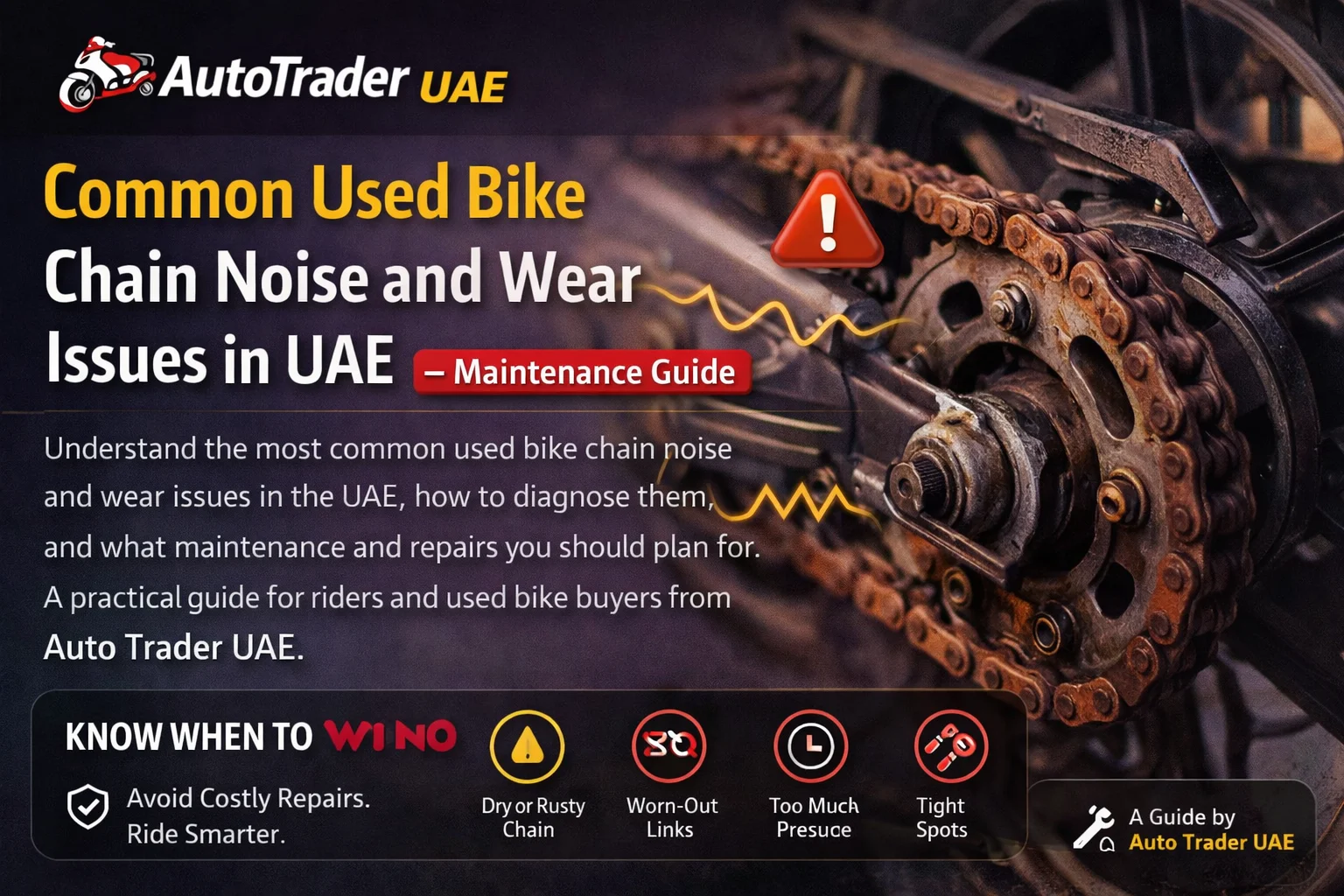
Common Used Bike Chain Noise and Wear Issues in UAE – Maintenance Guide
Owning a used motorcycle or bicycle in the UAE means dealing with heat, dust and stop‑start traffic – all of which are tough on chains. Chain noise and premature wear are among the most common maintenance issues riders face, especially on used bikes. This guide from Auto Trader UAE explains what those noises really mean, what to check before buying a used bike, and how to keep your chain running quietly and safely for longer.
Why Chains Suffer More in the UAE
The UAE environment accelerates chain wear:
- High temperatures: Thin or cheap lubes burn off quickly, leaving the chain dry and noisy.
- Dust and sand: Fine particles stick to the lubricant and turn into an abrasive paste.
- Coastal humidity: In cities like Dubai and Abu Dhabi, moisture plus salt air can promote surface rust if the chain is not protected.
- Urban stop‑start riding: Constant acceleration and engine braking loads the chain more than steady highway cruising.
On a used bike, these factors often show up as chain noise, rough running and uneven wear on sprockets.
Typical Chain Noises and What They Mean
1. Rattling or Slapping Noise
Common symptoms:
- Chain slaps the swingarm or chain guard when you open or close the throttle
- Rattle is worse at low speed or over bumps
Likely causes:
- Chain too loose (incorrect slack)
- Unevenly stretched chain, with tight and loose spots
- Worn chain guides or rubber protectors on the swingarm
Risks if ignored:
- Accelerated chain and sprocket wear
- Possibility of the chain jumping teeth or derailing in extreme cases
- Damage to swingarm paint or aluminium from repeated impacts
2. Whining or High‑Pitched Squeal
Common symptoms:
- Continuous high‑pitched noise at speed
- Often louder when the chain is freshly tightened
Likely causes:
- Chain too tight – not enough slack
- Dry rollers due to lack of lubrication
- Misaligned rear wheel causing the chain to run sideways over sprocket teeth
Risks if ignored:
- Stress on gearbox output shaft and wheel bearings
- Chain and sprocket teeth wearing in a hooked pattern
- In extreme cases, chain failure under load
3. Clicking, Clunking or Knocking
Common symptoms:
- Regular clicking in sync with wheel speed
- Knock or jerk when rolling on and off the throttle
Likely causes:
- Stiff or seized links that don’t articulate freely
- Damaged or missing O‑rings/X‑rings on sealed chains
- Broken teeth or chips on front or rear sprocket
Risks if ignored:
- Chain snatch and harsh power delivery
- Higher chance of chain snapping under load
- Further damage to sprockets and chain guides
4. Grinding or Rough Transmission Feel
Common symptoms:
- Rough feeling through the pegs or seat when accelerating
- Vibration at certain speeds even after wheel balancing
Likely causes:
- Chain heavily contaminated with sand and grit
- Severe sprocket wear – hooked or razor‑sharp teeth
- Old chain that has stretched beyond service limit
Risks if ignored:
- Reduced performance and fuel economy
- Potential damage to gearbox output shaft splines
How to Inspect a Used Bike Chain in the UAE
When viewing used motorcycles or bicycles on Auto Trader UAE, include a chain and sprocket inspection in your checklist.
1. Visual Check
Look for:
- Rust: Light surface rust can sometimes be cleaned; deep, flaky rust usually means replacement.
- Dry, shiny metal: Indicates no lubrication – a sign of neglect.
- O‑ring/X‑ring condition (for sealed chains): Missing, cracked, or flattened seals reduce chain life.
- Sprocket teeth: Healthy teeth are evenly shaped; worn teeth lean in one direction or become pointed.
2. Check Chain Slack
Every bike has a manufacturer‑recommended slack range (usually marked on the swingarm or owner’s manual). As a quick used‑bike test:
- Park the bike on level ground, rear wheel on the ground (or centre stand if applicable).
- Midway along the bottom chain run, move the chain up and down with your fingers.
- Excessive free play or almost no movement both indicate incorrect adjustment.
If the seller cannot show any record of recent chain adjustment or service, budget for a full chain and sprocket service after purchase.
3. Check for Tight Spots
- Rotate the rear wheel slowly.
- Watch the chain slack – if it goes tight in one section and loose in others, the chain is worn unevenly.
Uneven wear is common on bikes ridden in sandy areas or with poor maintenance. It usually means the chain is close to the end of its life.
4. Check Chain Stretch
A basic test:
- At the rear sprocket, pull the chain backwards away from the teeth.
- If you can see a clear gap between the chain and tooth at the back, the chain is stretched.
Many workshops in the UAE can measure chain elongation properly and confirm if replacement is due.
Common Wear Issues in UAE Conditions
1. Accelerated Stretch
Heat, dust and occasional off‑road riding cause quicker elongation. In the UAE, it’s common to replace chains and sprockets sooner than the global average if the bike is used daily.
2. Seized Links
Sand and dried lube cause links to stiffen:
- Often seen on bikes that are washed with high‑pressure water but not relubed afterwards.
- Leads to jerky motion and uneven tension.
3. Hooked Sprockets
Riders who change the chain but keep old sprockets, or ride on a loose chain, often end up with hooked teeth. Once sprockets reach this stage, the only sensible fix is to replace the entire set.
4. Corrosion on Infrequently Used Bikes
In coastal areas and underground parking with humidity, bikes that sit for long periods can show rust on the chain, even with low kilometres. This is especially relevant for weekend or seasonal bikes.
Maintenance Intervals and Service Expectations
Intervals vary by brand and usage, but for UAE riders the following is a practical baseline for typical commuter and leisure bikes:
- Clean and lube: Every 500–800 km for road use, or after any dusty/off‑road ride or wash.
- Adjust slack: Check every 1,000 km or monthly, and after long highway trips or heavy pillion use.
- Full inspection: At every service (5,000–10,000 km) or at least twice a year.
- Replace chain and sprockets: When stretched beyond limit, or when tight spots and hooked teeth appear – many daily‑use bikes in the UAE need this roughly every 20,000–30,000 km, but riding style and care make a big difference.
For bicycles, intervals are generally shorter because bicycle chains are exposed and unsealed:
- Clean and lube: Every 150–300 km, more often for off‑road.
- Replace chain: When the chain checker tool indicates wear (commonly between 0.5%–0.75% elongation for geared bikes).
DIY Chain Care vs Workshop Service
DIY Chain Maintenance
Many UAE riders maintain their own chains. You’ll typically need:
- Bike‑safe chain cleaner or kerosene (for motorcycles)
- Chain brush
- Quality chain lube suitable for hot and dusty climates
- Rear paddock stand (for motorcycles without a centre stand)
Key steps:
- Warm the chain with a short ride if possible.
- Clean with chain cleaner and brush gently.
- Dry with a cloth and let it sit a few minutes.
- Apply lube on the inner side of the chain while rotating the wheel.
- Wipe off any excess to avoid attracting dust.
Workshop Service
Using a workshop in the UAE is recommended when:
- The chain has tight spots or seized links.
- You suspect misalignment or wheel bearing issues.
- You need chain and sprocket replacement.
Many independent workshops and dealer service centres across Dubai, Sharjah, Abu Dhabi and other emirates stock common chain sizes and sprockets for popular brands. Special performance chains or off‑road sprocket sets may need to be ordered but are generally available through local distributors.
Parts Availability and Cost Considerations in the UAE
For most popular motorcycles and bicycles sold in the UAE, chain and sprocket parts are relatively easy to source:
- OEM parts: Available through main dealers; often more expensive but guaranteed fit and quality.
- Aftermarket brands: Common for riders wanting stronger chains or different sprocket ratios. Many UAE shops carry well‑known international brands.
- Bicycle chains and cassettes: Readily available through cycle shops and online platforms.
When buying a used bike, ask the seller:
- When the chain and sprockets were last changed.
- Whether they used OEM or aftermarket parts.
- If there are invoices or service history to support the claim.
If there is no history or the chain clearly shows wear, negotiate the price to cover a new chain and sprocket kit. It’s a relatively modest investment for a major improvement in safety and ride quality.
Practical Tips to Reduce Chain Noise and Wear in the UAE
- Use the right lubricant: Choose a chain lube formulated for hot, dry or dusty conditions rather than wet, cold‑climate products.
- Avoid over‑lubing: Too much lube collects sand. Thin, even coverage is best.
- Clean after dusty rides: Don’t let sand sit on the chain for weeks; it acts like grinding paste.
- Check tension with a load: If you usually ride with a passenger or luggage, set chain tension with that load in mind.
- Replace chain and sprockets together: Fitting a new chain on old sprockets (or vice versa) often causes early noise and wear.
- Listen for changes: Any new or unusual noise from the chain area is a sign to inspect – early action is cheaper than waiting for failure.
How This Affects Used Bike Ownership Costs
Chain and sprocket condition directly influence your real cost of ownership:
- Frequent short trips and dusty routes will mean more cleaning and earlier replacement.
- Good care can stretch the life of a kit by many thousands of kilometres.
- A neglected chain can lead to extra costs: damaged sprockets, swingarm guides, and even gearbox output seals.
When comparing used bikes on Auto Trader UAE, factor in the state of the chain and sprockets as part of your total ownership cost calculation, especially if two similar bikes are priced differently.
Buyer Takeaway
For used bike buyers in the UAE:
- Inspect chain and sprockets carefully before committing to a purchase.
- Use any visible wear, noise or missing maintenance history as a negotiation point.
- Plan an immediate post‑purchase service for bikes with unknown chain maintenance, including cleaning, adjustment and possibly replacement.
- When browsing listings on Auto Trader UAE, give preference to bikes with clear service records and recent chain/sprocket changes.
Seller Takeaway
If you’re selling a used motorcycle or bicycle in the UAE:
- Have the chain cleaned, adjusted and lubricated before advertising the bike.
- Consider replacing a visibly worn chain and sprocket set – it makes test rides smoother and improves buyer confidence.
- Mention any recent drive‑chain work clearly in your Auto Trader UAE listing.
- Keep invoices to show serious buyers; transparent maintenance helps support your asking price.
Conclusion: Ride Quieter, Spend Smarter with Auto Trader UAE
Chain noise and wear are among the most common issues on used bikes in the UAE, but they’re also some of the easiest to manage with regular care and early intervention. Understanding what different noises mean, how to inspect a chain, and when to budget for replacement can save you money and headaches over the life of the bike. Whether you’re searching for your next used motorcycle or bicycle, or preparing your current bike for sale, Auto Trader UAE helps you make better decisions. Browse used bike listings, compare models, and explore more maintenance guides so you can keep your chain – and your ownership costs – under control in UAE conditions.
Before deciding, browse used cars in Dubai and across the UAE on Auto Trader UAE to compare condition, mileage, pricing, and seller details for models that fit your ownership goals.