
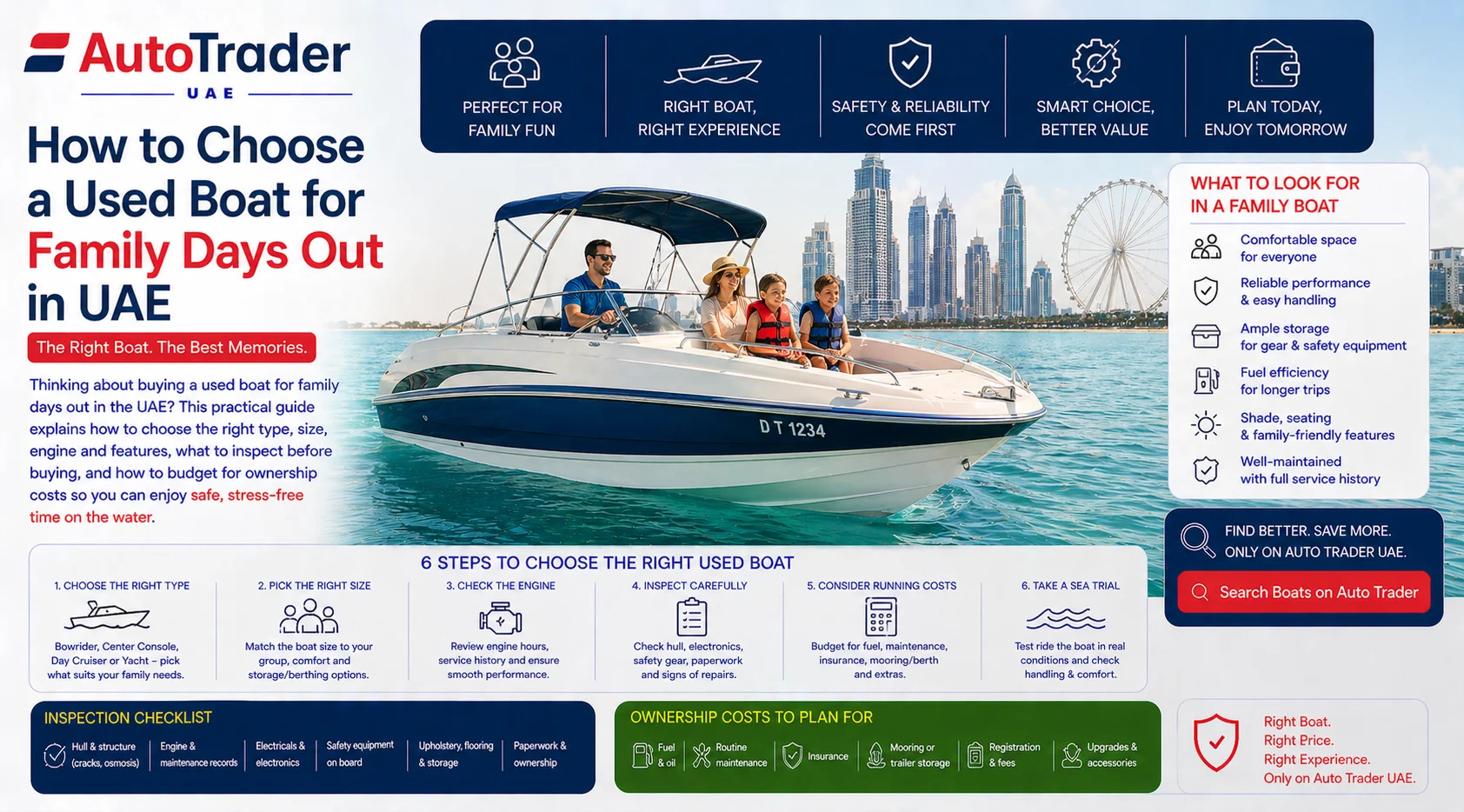
How to Choose a Used Boat for Family Days Out in UAE
Family days out on the water are one of the best ways to enjoy the UAE’s coastline and marinas. Buying a used boat can make that lifestyle far more affordable – if you choose wisely. This guide explains how to choose a used boat for family days out in the UAE, from picking the right type and size to doing proper checks before you buy.
1. Start With How Your Family Will Use the Boat
Before looking at listings, be clear on how you’ll actually use the boat. That will guide every decision after this.
- Calm cruising in marinas and coastal areas (Dubai Marina, Abu Dhabi Corniche, Al Hamra in RAK): look for comfortable family bowriders, deck boats or small cruisers.
- Fishing trips: a centre console or walkaround with good deck space and rod holders.
- Watersports (tubes, wakeboards, kids’ toys): a bowrider or sports boat with strong acceleration and tow points.
- Short overnight trips to nearby islands: a cabin cruiser with sleeping berths and a small galley.
Ask yourself:
- How many people will usually be on board?
- Will we go out only on weekends, or several times a week?
- Do we need shade, toilet, or cabin for kids and older family members?
- Will we use it mainly in marinas, coastal waters, or offshore?
The clearer you are here, the easier everything else becomes.
2. Choose the Right Type of Boat for Family Use
For family days out in UAE waters, some used boat types work better than others.
Bowriders
Best for: day cruising, swimming, light watersports.
- Open bow seating, good for families who like to relax and enjoy the view.
- Usually between 18–28 ft – easy to handle and park in marinas.
- Look for models with bimini tops or hardtops for shade in UAE heat.
Deck Boats
Best for: bigger families and groups.
- Wider, more open deck than bowriders, with plenty of seating.
- Good stability when kids move around.
- Many have swim platforms and ladders – great for stops at sandbars.
Centre Console Boats
Best for: fishing + family cruising.
- Walk-around layout, easy to move from front to back.
- Uncluttered deck for fishing and kids’ activities.
- Choose models with T-top shade and forward seating for family comfort.
Cabin Cruisers
Best for: families who want the option of overnight trips.
- Small cabin, berths, and often a toilet and mini-galley.
- More comfortable in rougher water than small open boats.
- More systems to maintain (AC, pumps, electrics), so inspections matter more.
3. What Size Boat Works Best for UAE Families?
Size affects comfort, safety, marina costs and running costs.
18–22 ft
- Good for couples and small families (up to 4–5 people).
- Easier to learn on, park and tow (if you plan trailer storage).
- Lower fuel use and simpler maintenance.
23–28 ft
- Better for larger families or frequent guests.
- More stable, more storage, often more shade.
- May require a permanent berth in a marina, adding to costs.
Over 28 ft
- Spacious and comfortable, especially for longer trips.
- Often have cabins, toilets and galley areas.
- Higher maintenance, mooring and fuel costs – make sure you’ll use it enough.
Always compare the stated capacity (number of passengers and weight) to your typical family group, not just the maximum you might ever take.
4. Engine Types: Inboard vs Outboard vs Sterndrive
For used boats in the UAE, engine choice has a big impact on running costs and reliability.
Outboard Engines
- Most common on small to mid-size boats.
- Easier to access for maintenance and repair.
- Can tilt fully out of the water, reducing corrosion when moored.
- Good choice for beginners and family boats.
Inboard Engines
- Located inside the hull, usually on larger cruisers.
- Better weight distribution, often smoother in rough water.
- More complex and expensive to repair; must check service history carefully.
Sterndrive (Inboard/Outboard)
- Engine inside, drive unit outside – common on family sports boats.
- Good performance and handling.
- More parts in the water, so in UAE saltwater you must check corrosion closely.
For a used family boat, a well‑maintained outboard is usually the safest and simplest option.
5. Safety and Family-Friendly Features to Prioritise
When children or older family members are on board, certain features make a big difference.
- High, secure rails and gunwales so kids feel protected.
- Non‑slip decking (especially around steps and swim platform).
- Plenty of shade (bimini top, hardtop, or canopy) for UAE summer heat.
- Comfortable seating with backrests and cushions in good condition.
- Swim ladder that’s solid, easy to use, and not too steep.
- Onboard toilet (head) if you plan longer trips with kids.
- Freshwater shower if you’ll swim in the sea and want to rinse off.
- Plenty of storage for lifejackets, snacks, toys, and bags.
Check that the boat includes, or has space for, required safety gear based on UAE regulations (lifejackets for all passengers, fire extinguisher, flares, first-aid kit, etc.).
6. Understand Ownership Costs in the UAE
The purchase price is only part of the picture. Before you commit, estimate the yearly cost of owning a used family boat.
Typical Cost Areas
- Mooring / Marina fees: vary by emirate, marina and boat length. Indoor dry storage can cost more but reduces sun and salt exposure.
- Insurance: based on boat value, age, engine type and how you use it.
- Fuel: larger and faster boats use significantly more fuel on each trip.
- Maintenance: annual service, antifouling (if left in water), polishing, and minor repairs.
- Licensing and registration: you’ll need to register the boat and have the appropriate license with local maritime authorities.
- Safety gear & accessories: lifejackets for all family members, anchor, lines, fenders and basic tools.
Make a simple yearly budget so you buy a boat you can comfortably enjoy, not one that becomes a financial burden.
7. What to Check When Inspecting a Used Boat
If you’ve bought a used car before, the idea is similar: check condition, service history and signs of abuse – but on a boat, water and salt add more risk.
Hull and Structure
- Walk around the hull and deck; look for cracks, repairs, blisters or soft spots.
- Check the keel and chines for impact damage from beaching or hitting objects.
- Inspect all fittings (cleats, rails, ladders) for tightness and corrosion.
Engine and Mechanical
- Ask for full service history and invoices, especially for older outboards and inboards.
- Check engine hours; low hours are not always better if servicing has been neglected.
- Look around the engine for oil leaks, rust, cracked hoses or loose wiring.
- Start the engine from cold; listen for hard starting, smoke or unusual noises.
Electrics and Controls
- Test all switches: lights, pumps, horn, navigation equipment, bilge pumps.
- Check the steering for smooth movement from lock to lock.
- Inspect battery condition and cable connections for corrosion.
Interior and Upholstery
- Lift cushions and inspect storage compartments for mould or damp smells.
- Check seats and coverings for cracks from sun damage.
- Open lockers and hatches to see if seals are intact and dry.
8. Always Do a Sea Trial in Local Conditions
Never buy a used boat without taking it out on the water. During the sea trial:
- Test cold start and warm restart.
- Run at idle, cruising speed and full throttle; listen and feel for vibrations.
- Check that the boat planes easily and doesn’t lean heavily to one side.
- Turn both directions at different speeds; steering should be predictable.
- Watch engine temperature and oil pressure gauges.
- Check for water in the bilge after some time running.
If you’re not experienced, it’s worth paying a qualified marine surveyor or mechanic to be present for the inspection and sea trial, especially for higher‑value boats.
9. Paperwork, Ownership and Legal Checks in the UAE
Before you transfer any money, make sure the paperwork is correct.
- Verify ownership: check the seller’s ID against the registration documents.
- Check for outstanding finance: ensure there are no loans or liens on the boat.
- Confirm registration details: hull identification number, engine numbers and any serials should match the documents.
- Service records: regular servicing by recognised workshops is a good sign.
- Bill of sale: use a clear written agreement showing price, details of the boat and what’s included (trailer, electronics, safety gear, etc.).
Check the latest requirements from maritime authorities in your emirate for licensing, registration and safety equipment – regulations can change.
10. When Buying From Private Sellers vs Dealers
You’ll find used boats in the UAE both from private owners and professional dealers. Each option has pros and cons.
Private Sellers
- Often lower prices and more room to negotiate.
- You can ask directly about how the boat was used and stored.
- Be more careful with inspections and paperwork; there is usually no warranty.
Dealers and Brokers
- May offer some warranty or after‑sales support.
- More boats in one place to compare.
- Prices can be higher, but often reflect checked paperwork and preparation.
On Auto Trader UAE, you can compare listings from both private sellers and dealers, filter by boat type and budget, and shortlist the options that best fit your family’s needs.
11. Negotiating and Closing the Deal
Use your research to negotiate confidently.
- Research similar boats on Auto Trader UAE to understand fair market value.
- Use any needed maintenance or cosmetic work as negotiation points.
- Agree on whether a recent service, new safety gear or antifouling will be included in the price.
- Never skip the sea trial or professional inspection just to save a small amount.
Once you’re happy, complete the bill of sale, transfer registration and update insurance before regular use.
12. Next Steps With Auto Trader UAE
If you’re ready to start looking for a used boat for family days out in the UAE:
- Set your budget, including yearly running costs.
- Choose the type and size that best suits your family and where you’ll use the boat.
- Shortlist a few models and compare condition, history and features.
- Arrange viewings and sea trials before deciding.
On Auto Trader UAE you can:
- Browse a wide range of used boats suitable for family cruising, fishing and watersports.
- Use filters to narrow by price, size, engine type and location.
- Explore more buying advice and ownership tips in the Auto Trader UAE money and ownership guides.
- Stay up to date with the latest guides, reviews and tips on the Auto Trader UAE blog.
Choose carefully, inspect thoroughly and budget realistically – and your used boat can give your family years of safe, memorable days out on UAE waters.
Browse used boats in UAE on Auto Trader UAE to compare live listings, prices, and current market activity more clearly.
Related Links
Buyer Takeaway
When buying a used car in the UAE, focus on vehicle condition, service history, inspection quality, paperwork, and total running costs rather than price alone. Compare options carefully and choose the option that best matches your budget and real needs.
Seller Takeaway
If you are selling a used car in the UAE, present the service history clearly, price the vehicle realistically, and highlight condition, specification, and ownership strengths honestly. A well-prepared listing with accurate details usually attracts more serious buyers.
Conclusion
A careful used car purchase in the UAE starts with research, proper inspection, and clear paperwork before making the final decision.