
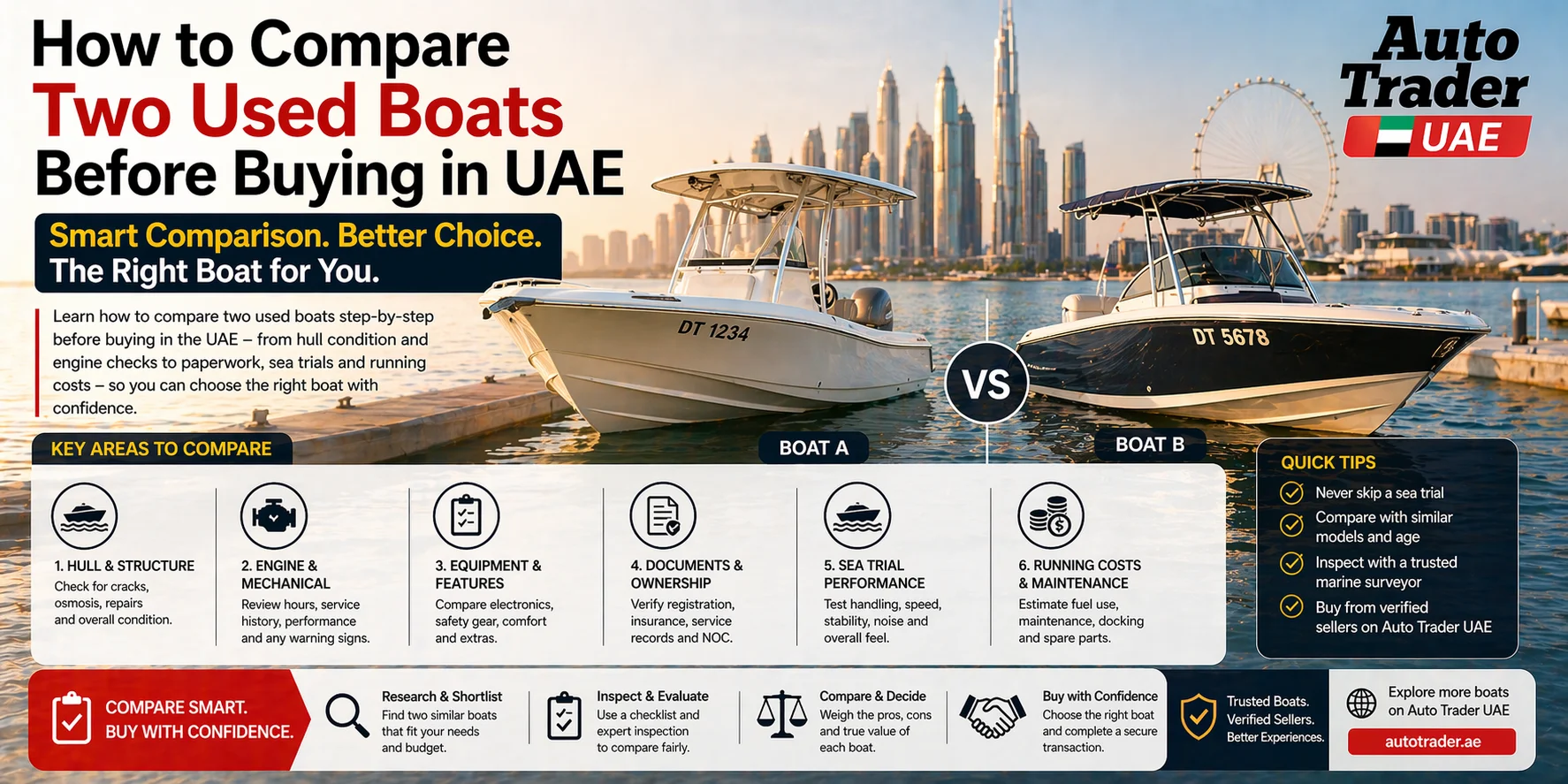
How to Compare Two Used Boats Before Buying in UAE
Choosing between two used boats in the UAE can be harder than choosing between two used cars. Both may look clean and well‑priced, but details like hull condition, service history, and ownership paperwork can make one a smart buy and the other a costly mistake.
This guide from Auto Trader UAE walks you through how to compare two used boats side‑by‑side so you can make a confident decision, whether you’re upgrading from a smaller vessel or moving from cars to boats for the first time.
1. Start With the Right Shortlist
Before you compare two specific used boats, make sure they’re roughly aligned on the basics. It’s like comparing two used SUVs: you want them in the same class.
- Type of boat: centre console, fishing boat, bowrider, wake boat, cabin cruiser, RIB, etc.
- Primary use: fishing, family cruising, water sports, offshore trips, island hopping, or marina leisure.
- Size and capacity: length (feet/metres), passenger capacity, sleeping berths (if any).
- Powertrain: outboard vs inboard vs sterndrive, petrol vs diesel.
- Budget range: not just purchase price but running and mooring costs.
Try to compare boats that serve the same purpose. For example, comparing a 22‑ft centre console fishing boat to a 32‑ft cabin cruiser rarely makes sense unless your needs changed mid‑search.
2. Check Ownership, Paperwork and Legal Status
In the UAE, documentation is critical. Before you fall in love with either boat, confirm the basics:
- Title and ownership: Does the seller have clear proof of ownership (registration card, invoice, or title document)? Any outstanding finance or liabilities?
- Registration authority: Dubai Maritime City Authority (DMCA), Abu Dhabi Maritime, Sharjah, or others. Make sure the documents match the hull identification number (HIN) and engine numbers.
- Usage type: Private, commercial, or charter. Commercially used boats may have more hours and wear.
- VAT and import documentation: For imported boats, ask for customs clearance or import paperwork.
- Service records: Invoices, stamped service booklets, or digital logs from authorised centres or recognised marine workshops.
How to compare: Give each boat a simple score for documentation: complete, partial, or weak. A well‑documented boat is often worth more than a slightly cheaper but poorly documented one.
3. Compare Age, Engine Hours and Usage Profile
Just as mileage matters for cars, engine hours and usage profile matter for boats.
- Model year vs condition: A slightly older boat with gentle use and proper storage can be better than a newer boat that was used hard.
- Engine hours: Fewer hours usually mean less wear, but extremely low hours on an older boat can signal long periods of inactivity, which can also cause issues.
- Usage pattern: Weekend family cruising is typically easier on a boat than constant offshore fishing or rental/charter usage.
- Storage history: Was the boat kept in a dry stack, on a trailer, or in the water all year? Dry storage often equals less hull and corrosion damage.
How to compare: Ask the seller to explain how the boat was used and stored. When comparing two boats, weigh engine hours alongside age, storage, and maintenance, not as a single deciding number.
4. Inspect the Hull and Structure Carefully
The hull is the foundation of any boat. Structural problems are usually expensive to fix, especially in the salty, hot UAE climate.
4.1 Visual Hull Inspection
- Below the waterline: Look for blistering, cracks, previous repairs, and patches. Fresh paint alone is not a guarantee of good condition.
- Above the waterline: Check for gelcoat cracks, fading, or discolouration that may indicate heavy UV exposure.
- Keel and chines: Scan for impact marks from grounding.
- Transom: Look for stress cracks around the engine mounts or trim tabs.
4.2 Structural Feel and Sound
- Walk the deck: Feel for soft spots, flexing, or spongy areas – these can hint at rot or delamination.
- Tap test: Lightly tap around suspect areas with a plastic tool or the handle of a screwdriver; a hollow or dull sound can indicate hidden issues.
How to compare: If one boat shows clear signs of structural repair, fading, or soft decks while the other appears solid with only cosmetic wear, the structurally sound boat nearly always wins, even if it’s slightly older or higher in price.
5. Evaluate the Engine and Mechanical Systems
Engine condition is often the biggest cost factor in a used boat. In the UAE’s marine environment, salt and heat accelerate wear.
5.1 Engine Basics
- Engine type: Outboard, inboard, sterndrive, jet. Outboards are popular and often easier to service.
- Brand and support: Common brands (Yamaha, Mercury, Suzuki, Honda, etc.) tend to have better parts availability and service networks locally.
- Visible condition: Clean, dry engine bay? Corrosion on bolts, clamps, or wiring? Oil leaks?
- Service history: Evidence of regular oil, filter, impeller, and anode changes.
5.2 On‑Land Checks (Before Sea Trial)
- Cold start: Does the engine start easily when cold?
- Smoke: Excessive blue, white, or black smoke is a red flag.
- Idle: Smooth idle, no rattling or knocking sounds.
- Controls: Smooth throttle and gear selection, no grinding noises.
How to compare: If one boat has a full, verifiable service history and a clean engine bay while the other has gaps in records or visible corrosion, expect higher future costs with the latter even if the price is lower.
6. Check Electrical, Safety and Onboard Equipment
Comfort, convenience and safety systems can strongly influence real‑world value, especially for family and leisure use in UAE waters.
6.1 Electrical Systems
- Battery and wiring: Check battery age, secure mounting, tidy wiring, and proper fusing.
- Switches and panels: Test lights, pumps, gauges, horn, and navigation electronics.
- Navigation and fishfinder: Functioning GPS, chartplotter, VHF radio, fishfinder/sonar add value.
6.2 Safety Equipment
- Life jackets for sufficient passengers
- Fire extinguisher(s)
- First aid kit
- Flares and signalling devices (where applicable)
- Bilge pumps (manual and/or automatic)
6.3 Comfort and Convenience
- Seating layout, shade (bimini/T‑top), and storage space
- Sound system condition
- Freshwater shower, toilet/head (if fitted), galley or sink on cruisers
How to compare: List all key equipment on each boat. A slightly higher‑priced boat with modern electronics, more shade, and better safety gear can be a smarter buy than a bare‑bones option that will need immediate upgrades.
7. Interior and Deck Layout: How It Fits Your Use
Two boats of the same size can feel completely different to use. Focus on how each layout matches your lifestyle in the UAE.
- Passenger flow: Is it easy to move from bow to stern, especially with children on board?
- Shade: Critical in the UAE. Compare how much real shade each boat provides while cruising and at anchor.
- Fishing vs leisure: Rod holders, live wells, and open deck space vs comfortable seating and sunpads.
- Storage: For life jackets, coolers, water toys, diving gear or fishing equipment.
- Cabin usability: On cruisers, check headroom, berth size, and ventilation.
How to compare: Walk through each boat imagining a typical day out – launching, cruising, swimming, fishing, returning to the marina. The boat that feels more practical for your actual use usually wins, even if the other one “looks” better in photos.
8. Factor in Running Costs in the UAE
Owning a boat in the UAE involves recurring costs. When comparing two used boats, estimate these for each option:
- Fuel consumption: Larger or more powerful engines usually burn more fuel. Ask the seller for typical litres per hour at cruising speed.
- Mooring and storage: Marina berth vs dry stack vs trailer storage. Charges vary by emirate and marina.
- Service and maintenance: Annual servicing, polishing, antifouling (if kept in the water), and periodic overhauls.
- Insurance: Premiums depend on boat value, age, and usage (private vs commercial).
- Registration and licensing fees: Check current regulations with the relevant maritime authority.
How to compare: A cheaper purchase price can be misleading if one boat costs significantly more in fuel, mooring, and maintenance every year. Compare total cost of ownership, not only the initial price.
9. Arrange a Proper Sea Trial for Both Boats
Never rely on a dockside inspection alone. A sea trial in local UAE conditions (marina exits, wake zones, open water chop) is essential.
9.1 What to Test on the Water
- Cold and hot start: How easily the engine starts before and after running.
- Acceleration and planing: Time to plane, smooth throttle response, no hesitation.
- Steering feel: Straight tracking, no pulling, light but precise steering.
- Vibration and noise: Any unusual vibrations through the hull or wheel; excessive engine noise.
- Handling in turns: Stable, predictable cornering without cavitation.
- Bilge and leaks: Check for water in the bilge during and after the run.
- Electronics and gauges: Confirm accurate readings for temperature, oil pressure, trim, and fuel.
How to compare: Take notes after each sea trial while the experience is fresh. Rate comfort, stability, noise, and confidence. Whichever boat makes you feel more in control and comfortable is usually the better partner long‑term.
10. Use an Independent Marine Surveyor
For higher‑value boats, using a qualified marine surveyor in the UAE can save you from expensive surprises.
- Pre‑purchase survey: A professional inspection of hull, structure, machinery, and systems.
- Comparative report: If you survey both boats, you’ll receive objective findings you can compare directly.
- Negotiation leverage: Survey results can be used to adjust the price or request repairs before purchase.
How to compare: When both boats look similar on paper, a survey often clearly shows which one is the safer, better‑maintained option.
11. Compare Resale Value and Market Demand
Even if you plan to keep the boat for years, thinking like a seller helps you choose wisely today.
- Brand reputation: Well‑known makes with a good track record in the UAE usually hold value better.
- Popular sizes and layouts: Mid‑size family‑friendly boats are often easier to resell.
- Condition and upgrades: A clean, upgraded, well‑maintained boat is more attractive on the used market.
- Market visibility: Check how many similar boats are listed on Auto Trader UAE and at what prices.
How to compare: If one boat is from a widely recognised brand with strong local support and resale demand, it may be a better long‑term investment than a rare or hard‑to‑service model, even at a slightly higher initial cost.
12. Create a Simple Comparison Checklist
To keep your decision objective, put both boats in a side‑by‑side checklist. For example:
| Category | Boat A | Boat B |
|---|---|---|
| Price | ||
| Year / Engine hours | ||
| Service history | ||
| Hull / structure condition | ||
| Engine condition | ||
| Electronics & safety | ||
| Layout & comfort | ||
| Running costs (estimate) | ||
| Resale potential |
Score each area (for example, 1–5) and total the scores. While your feelings from the sea trial matter, a written comparison stops you from ignoring important weaknesses.
13. Buyer Takeaway: How to Choose Between Two Used Boats
When you’ve inspected, sea‑trialled, and compared two used boats in the UAE, ask yourself:
- Which boat has better documented history and maintenance?
- Which one felt more solid and confidence‑inspiring on the water?
- Which layout truly matches how you will use the boat most of the time?
- Which has lower expected running costs over the next few years?
- Which brand and model has stronger resale value in the UAE?
If you can’t clearly pick a winner, it may be worth walking away and continuing your search on a trusted marketplace.
14. Seller Takeaway: Make Your Used Boat the Easy Choice
If you’re a seller in the UAE, understanding how buyers compare boats helps you present yours better:
- Gather all paperwork, service bills, and manuals in one file.
- Fix small issues (lights, pumps, cosmetic flaws) before listing.
- Clean the hull, engine bay, and interior thoroughly.
- Photograph the boat in good light, including close‑ups of key systems.
- Be ready to offer a sea trial to serious buyers.
When your boat looks well‑cared‑for and transparent on history, it naturally stands out against competing listings on platforms like Auto Trader UAE.
15. Next Steps With Auto Trader UAE
Whether you’re comparing two used boats or still exploring the market, the process is very similar to searching for used cars:
- Browse a wide range of used boats and marine listings across the UAE.
- Use filters for price, size, year, engine type, and location to build a shortlist.
- Save and compare favourite listings just as you would with used cars on Auto Trader UAE.
- Explore our other buying guides for tips on inspections, negotiations, and ownership costs.
By combining a structured comparison approach with the right online tools, you’ll be better equipped to choose the used boat that fits your lifestyle, budget, and the unique boating conditions of the UAE.
Start comparing listings today on Auto Trader UAE and move one step closer to your next day out on the water.
If you are exploring used cars in Dubai or elsewhere in the UAE, Auto Trader UAE makes it easier to compare listings, prices, trims, mileage, and seller details in one place.
Related Links
Conclusion
A careful used car purchase in the UAE starts with research, proper inspection, and clear paperwork before making the final decision.