
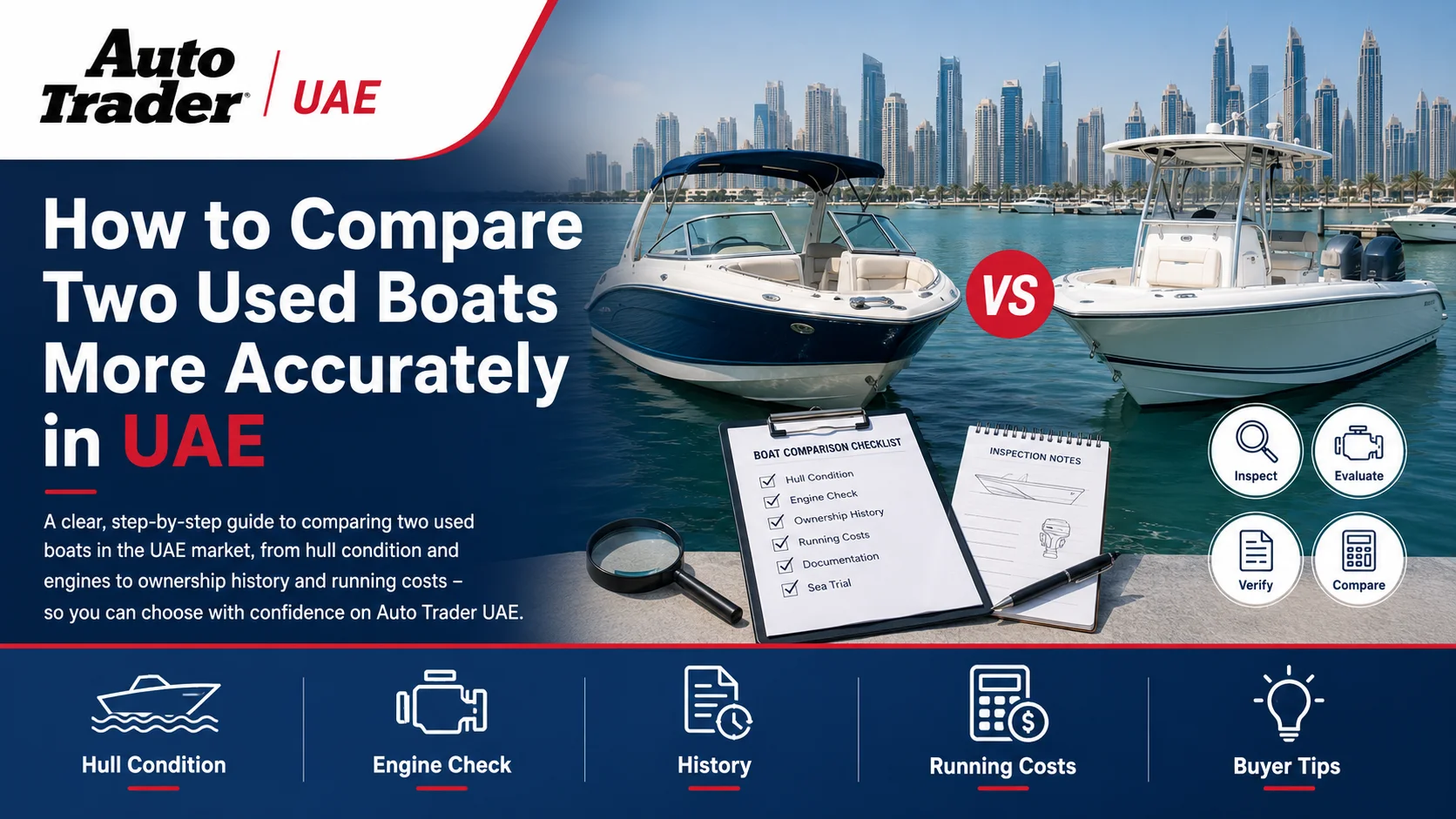
How to Compare Two Used Boats More Accurately in UAE
Shopping two used boats side by side can feel confusing, especially in the UAE where usage patterns, mooring conditions and maintenance standards vary a lot. This guide breaks down how to compare any two used boats accurately, so you can choose the better one for your lifestyle and budget – and avoid expensive surprises later.
1. Start With Like‑for‑Like Comparisons
Before you dive into details, make sure you’re comparing boats that make sense together.
Match the basics
- Type: Compare fishing boat with fishing boat, cruiser with cruiser, wake boat with wake boat, etc.
- Size: Keep the length and beam (width) roughly similar – for example 24 ft vs 26 ft is fair, 24 ft vs 36 ft is not.
- Engine setup: Outboard vs inboard vs sterndrive will affect performance and maintenance.
- Age range: Comparing a 3‑year‑old boat with a 15‑year‑old boat will naturally skew results unless the price reflects it.
Check the ownership and paperwork first
In the UAE, clean documentation can be as important as condition:
- Title / ownership documents: Make sure the seller can legally transfer ownership.
- Registration status: Check current registration status with the relevant local authority.
- Service records: A boat with partial but consistent service history can be better than a spotless but undocumented one.
When comparing two boats, score them simply: paperwork "complete", "partial" or "uncertain". Favour the boat with clearer history, even if the price is slightly higher.
2. Compare Hull and Structural Condition
The hull is the foundation of any boat. Structural issues can be very expensive in the UAE, especially for imported parts.
Things to check on both boats
- Visible damage: Look for cracks, blisters, repairs, and mismatched paint or gelcoat.
- Signs of grounding: Check the keel, bow and stern for impact marks or poorly done repairs.
- Osmosis / blistering: Small blisters in gelcoat on older fibreglass boats may be common, but widespread blistering can be a red flag.
- Deck and floor firmness: Walk everywhere. Soft or spongy areas suggest rot or delamination.
How to compare accurately
- If one boat has any questionable structural repair and the other does not, treat that as a major negative.
- A slightly older but solid, original hull is usually better than a newer boat with structural repairs you can’t fully verify.
- Always budget for a professional survey if the boat is a significant purchase; use the same surveyor for both boats where possible to get consistent evaluation.
3. Engines, Hours and Mechanical Health
Engine condition is often the biggest cost factor on a used boat in the UAE.
Key data points to compare
- Engine brand and model: Popular brands in the local market usually mean easier parts and service.
- Horsepower and configuration: Single vs twin engines, and total horsepower, will change fuel use, performance and insurance.
- Engine hours: Hours matter, but how they were used matters more.
- Service history: Look for documented oil changes, impeller replacements, and major services.
Outboard vs inboard in UAE waters
Because UAE boating often involves high temperatures and saltwater, cooling systems and corrosion protection are critical:
- Outboards: Easier to replace or upgrade, but check for corrosion under the cowling and around mounting bolts.
- Inboards/sterndrives: Usually smoother and quieter, but more complex and costly to repair.
How to compare two engines objectively
- Use engine hours divided by age to estimate average annual usage.
- Compare compression test results if available – consistent readings across cylinders are a good sign.
- Listen and feel on sea trial: starting behaviour, idle smoothness, smoke, vibration and top‑end performance.
When one boat has clearly better mechanical documentation, fewer issues on sea trial and a well‑known engine brand, it usually wins even if it has slightly higher hours.
4. Saltwater Exposure and Storage History in UAE
UAE boats face strong sun, heat and high salinity. How and where each boat was stored will significantly affect long‑term condition.
What to ask every seller
- Kept on trailer, dry stack, or in the water? Dry‑stored boats generally suffer less corrosion and fouling.
- Covered or uncovered? A shaded berth or proper cover helps preserve gelcoat and upholstery.
- Flushed after use? Regular fresh‑water flushing of engines is essential in saltwater use.
Comparing real‑world condition
- Inspect metal fittings (rails, cleats, hinges) for pitting and corrosion.
- Check electrical connections, batteries and wiring for salt creep and green corrosion.
- Look under seats and inside lockers for mould or water damage.
If one boat has clear signs of long‑term marina berthing without proper care while the other shows clean fittings and dry storage history, the better‑stored boat typically offers lower future maintenance costs.
5. Layout, Usability and Comfort
Two similar‑sized boats can feel completely different on the water. In UAE conditions, shade, seating and family comfort matter as much as speed.
Key layout points to compare
- Deck layout: Is there enough space for your main use (fishing, cruising, watersports, diving)?
- Shade: Bimini tops, T‑tops and cabin shade are critical under UAE sun.
- Seating: Number of comfortable seats, quality of cushions, and smart storage solutions.
- Cabin (if any): Ventilation, headroom and condition of interior fittings.
- Access: Boarding ladders, swim platforms and side decks for safe movement.
When comparing two boats, imagine your typical day on the water – who’s onboard, what you’re carrying, and how long you’ll be out. The boat that fits your real use case better is often the wiser choice, even if the other looks flashier.
6. Electronics and Safety Equipment
In UAE waters, navigation and safety gear add real value. But remember: electronics age quickly.
Electronics checklist
- GPS / chartplotter and the age of the unit
- Fishfinder / sonar
- VHF radio (and whether it’s fixed or handheld)
- Audio system and speakers
- Lighting (navigation, deck, cabin)
Safety gear to compare
- Lifejackets for all passengers
- Fire extinguishers with valid dates
- Flares and signalling devices (where applicable)
- First‑aid kit and basic tools
A boat with more modern, integrated electronics can justify a slightly higher price, but never over‑value outdated units that may soon need replacing. When comparing, list what you would actually need to add to each boat to meet your safety and comfort expectations.
7. True Running Costs in the UAE
Two boats with similar asking prices can have very different long‑term costs.
Fuel consumption
- Bigger engines or twin setups will usually burn more fuel.
- Heavier boats need more power to cruise at the same speed.
- Hull type (deep‑V vs flatter) also affects fuel burn in choppy conditions.
Maintenance and service
- Check typical service intervals for the engines on each boat.
- Ask local workshops for estimated annual service costs for that specific engine model.
- Consider antifouling costs if the boat stays in the water year‑round.
Mooring and storage
- Trailer‑kept: you’ll need suitable parking and towing capacity.
- Marina berth: monthly fees vary by location and size.
- Dry stack: often a good compromise for mid‑size boats.
When comparing two boats, sketch a simple 12‑month cost estimate for each (fuel, service, storage, insurance). The boat with lower total running cost may be the smarter buy even if the asking price is slightly higher.
8. Price, Market Value and Negotiation
In the UAE, used boat prices can vary widely for similar models, depending on how urgently the owner wants to sell and how well the boat has been maintained.
How to judge asking prices
- Search multiple similar listings on Auto Trader UAE to understand a realistic price range.
- Adjust your comparison for age, engine hours, storage method, and equipment level.
- Be cautious of prices that are far below market – they may hide serious issues.
Comparing value, not just price
To compare two boats fairly, ask:
- What would I need to spend immediately after buying? (service, safety gear, electronics, cosmetic fixes)
- How much life is left in the engines before major overhauls?
- Does the boat come with extras I actually want (trailer, fishing gear, covers, upgraded sound system)?
A slightly more expensive boat that’s fully serviced, well‑equipped and ready to launch can be the better deal compared with a cheaper boat that needs substantial work.
9. Sea Trial: The Final Comparison
Never skip the sea trial – and where possible, sea trial both boats in similar conditions.
What to test on each boat
- Start‑up: Cold start behaviour, smoke, alarms.
- Acceleration and handling: Does it get on the plane easily? Any unusual vibrations?
- Steering and trim: Smooth steering, functional trim / tilt.
- Noise and comfort: Engine noise, wind protection and general ride quality in local chop.
- Systems check: Bilge pumps, lights, electronics, gauges, freshwater systems.
Take notes during each trial. Immediately after, write down your impressions while they’re fresh so you can compare boats objectively later.
10. A Simple Side‑by‑Side Checklist
Create a basic table or checklist and score each boat from 1–5 in these areas:
- Paperwork and ownership clarity
- Hull and structure
- Engine and mechanicals
- Storage and corrosion
- Layout and comfort
- Electronics and safety gear
- Running costs (estimated)
- Price vs condition
- Sea trial performance
Add up the scores but also consider which categories matter most to you (for example, families may place extra weight on comfort and shade; anglers on deck space and stability).
Next Steps with Auto Trader UAE
When you’re ready to compare two used boats more accurately in the UAE:
- Shortlist similar boats using detailed filters and clear photos.
- Contact sellers with specific questions about storage, service history and sea trial availability.
- Use the checklist above to make an informed, side‑by‑side comparison.
Whether you’re buying your first small fishing boat or upgrading to a larger cruiser, following a structured comparison process will help you choose the right boat, negotiate confidently and enjoy safer, more reliable days on the water – all starting with the listings you’ll find on Auto Trader UAE.
Browse used boats in UAE on Auto Trader UAE to compare live listings, prices, and current market activity more clearly.
Related Links
Buyer Takeaway
When buying a used car in the UAE, focus on vehicle condition, service history, inspection quality, paperwork, and total running costs rather than price alone. Compare options carefully and choose the option that best matches your budget and real needs.
Seller Takeaway
If you are selling a used car in the UAE, present the service history clearly, price the vehicle realistically, and highlight condition, specification, and ownership strengths honestly. A well-prepared listing with accurate details usually attracts more serious buyers.
Conclusion
A careful used car purchase in the UAE starts with research, proper inspection, and clear paperwork before making the final decision.