
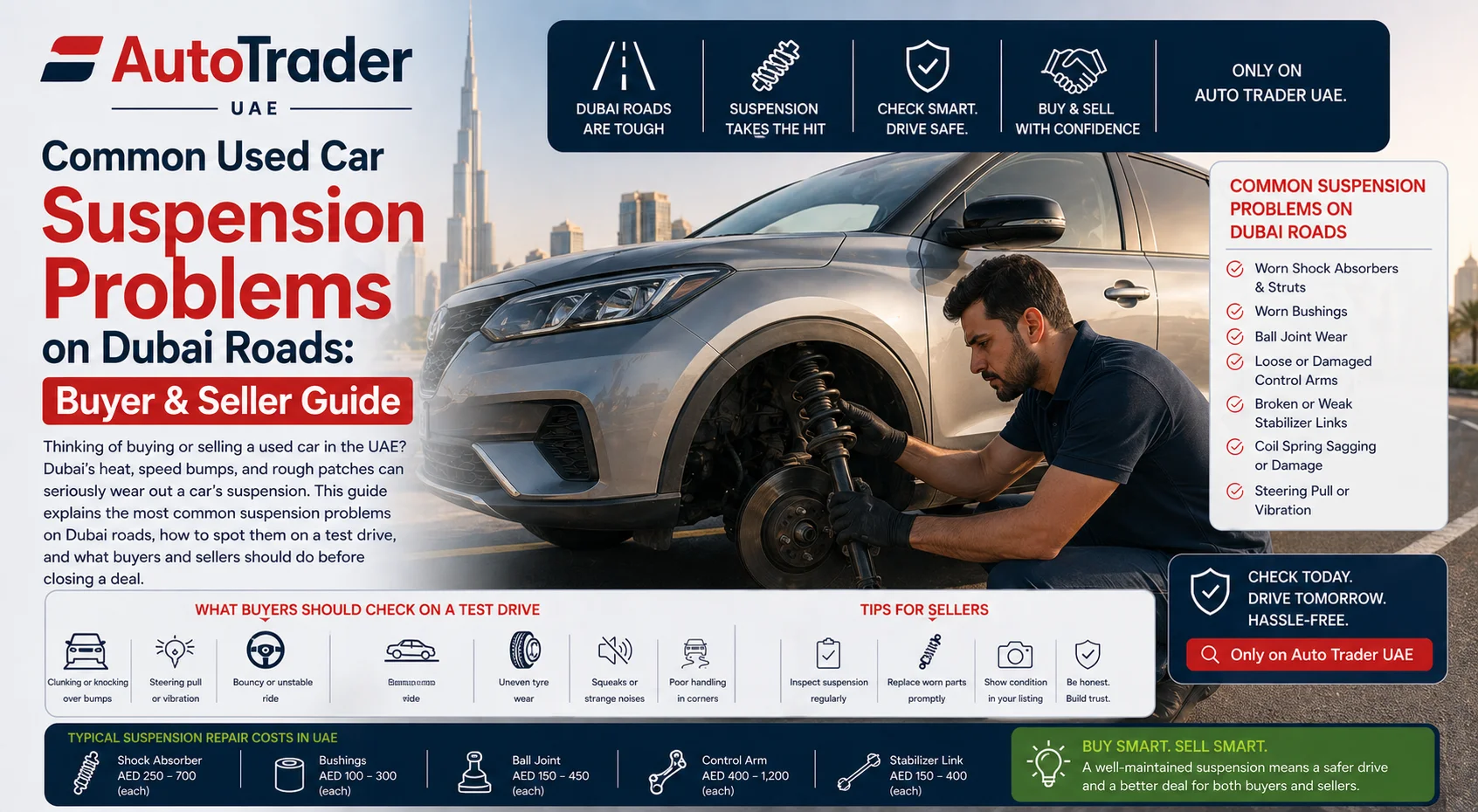
Common Used Car Suspension Problems on Dubai Roads: Buyer & Seller Guide
Dubai’s roads are generally good, but daily life here is tough on suspension. High speeds on Sheikh Zayed Road, steep ramps in parking buildings, aggressive speed breakers in some communities, sand, and hot weather all add up. If you’re buying or selling a used car in the UAE, suspension condition can easily make the difference between a smart deal and an expensive mistake.
This guide from Auto Trader UAE explains the most Common Used Car Suspension Problems on Dubai Roads, how to spot them, and what it means for price negotiations.
Why Suspension Suffers More in Dubai
Before looking at specific problems, it helps to understand why suspension wear is often accelerated in the UAE:
- Speed bumps and ramps: Many residential communities have tall speed breakers and sharp ramps that stress shocks, springs, and bushings.
- High-speed driving: Sustained highway speeds over minor road imperfections increase suspension fatigue.
- Heat and UV exposure: Rubber components (bushings, mounts, dust boots) dry, crack, and harden faster in the heat.
- Occasional off-road or shoulder driving: Sand tracks, gravel, and rough parking areas punish suspension, especially on SUVs.
- Heavier loads: Families, luggage, and cargo in SUVs and 7-seaters can sag springs and stress shock absorbers.
Because of this, a car that looks perfect on the outside can hide thousands of dirhams of needed suspension work underneath.
Most Common Suspension Problems on Dubai Roads
1. Worn Shock Absorbers and Struts
What happens: Shock absorbers (and struts on many front suspensions) control how the car bounces and keep your tyres in contact with the road. Over time, internal seals wear and fluid can leak, especially in hot climates and after repeated hits from speed bumps.
Typical signs:
- Excessive bouncing after going over a bump or speed breaker
- Car feels “floaty” or unstable at highway speeds
- Longer braking distances or nose-diving under hard braking
- Uneven tyre wear (often cupping or scalloping on the tread)
- Visible oil or dampness on the shock body
Buyer tip: During your test drive for a used car in Dubai, drive over a speed bump at low speed, then let the car settle. It should go up, come down, and stop. If it continues to bounce more than once or twice, the shocks are likely worn.
Seller tip: If your car feels bouncy or unstable, have a mechanic check the shocks before listing it. Replacing worn shocks can make the car drive like new and support a stronger asking price.
2. Cracked or Collapsed Bushings
What happens: Rubber or polyurethane bushings separate metal components, absorb vibration, and keep suspension arms aligned. Constant heat and UV exposure in Dubai, plus aggressive ramps, can crack and deform them prematurely.
Typical signs:
- Clunking or knocking over bumps or when turning at low speed
- Slight wandering or pulling on straight roads
- Vibration through the steering wheel
- Visible cracking or splitting when inspected on a lift
Buyer tip: Ask your mechanic to inspect lower control arm bushings, sway bar (stabiliser) bushings, and engine mounts during a pre-purchase inspection. These are common wear items in the UAE and not always obvious on a short test drive.
Seller tip: Replacing badly worn bushings before selling removes suspension noises that can scare away buyers or trigger heavy price drops during negotiation.
3. Noisy or Worn Ball Joints and Tie Rod Ends
What happens: Ball joints and tie rod ends connect steering and suspension components and allow movement. When they wear, steering precision suffers and knocking noises appear, especially on rough surfaces.
Typical signs:
- Clicking or knocking sounds when turning the steering wheel
- Loose, vague steering feel, especially at highway speeds
- Uneven or rapid tyre wear
- Steering that doesn’t self-center smoothly
Buyer tip: On a test drive, gently weave within your lane at 80–100 km/h. The car should respond immediately and predictably. Any delay, vibration, or knocking sounds could indicate worn steering joints.
Seller tip: If a buyer’s mechanic finds worn ball joints or tie rods, expect them to use it as leverage to reduce your price. Addressing them in advance can help maintain your car’s value.
4. Broken or Sagging Springs
What happens: Springs support the weight of the car and keep ride height even. Repeated overloading, high kerbs, and rough ramps can crack or weaken them.
Typical signs:
- Car sits lower on one corner or one side
- Bottoming out (suspension hitting the bump stops) over speed bumps
- Harsh, uncomfortable ride even at low speeds
- Visible broken coil or deformed spring when inspected
Buyer tip: Step back and look at the car from the front and side on level ground. Check if all four corners sit at a similar height. Any obvious lean or sag should be investigated.
Seller tip: If you notice your car scraping more often on speed bumps or sitting low, get springs checked before advertising it, especially for SUVs and 7‑seaters often driven fully loaded.
5. Misaligned Wheels and Uneven Tyre Wear
What happens: Hitting potholes, kerbs, or deep speed bumps can knock your wheel alignment out of spec. Misalignment doesn’t just affect handling; it kills tyres quickly, and tyre condition is one of the first things UAE buyers check.
Typical signs:
- Car pulls to one side when driving straight
- Steering wheel is off-centre when driving in a straight line
- Inner or outer edge of tyres worn much more than the rest
- Steering feels nervous or tramlines on grooves in the road
Buyer tip: On a safe, straight stretch, lightly hold the steering wheel and see if the car tracks straight. Check all four tyres for uneven wear patterns. Misalignment can also indicate older suspension damage.
Seller tip: A simple wheel alignment and rotating the tyres can significantly improve test-drive feel and tyre appearance, making your listing more attractive on Auto Trader UAE.
6. Failing Suspension Mounts and Top Mount Bearings
What happens: Many cars use strut mounts and top mount bearings that sit between the shock absorber and the body. Heat and age cause the rubber to crack and the bearings to wear, especially with constant turning in tight parking garages.
Typical signs:
- Groaning, creaking, or popping sounds when turning the steering wheel
- Metallic clunk over bumps from the top of the suspension
- Vibration or slight knock felt through the steering column
Buyer tip: Turn the steering wheel lock-to-lock while parked and moving slowly in a quiet area. Listen carefully near the front strut towers for any grinding or clunking noises.
Seller tip: If your car has these noises, don’t ignore them. Buyers in the UAE are increasingly aware of inspection reports and can easily walk away if a car sounds unhealthy.
7. Air Suspension Issues (Premium SUVs and Luxury Cars)
What happens: Many premium SUVs and luxury sedans on Dubai roads use air suspension. Over time, air bags can leak, compressors weaken, and valves stick, especially with heat and dust exposure.
Typical signs:
- One corner or one side of the car sits lower, especially after parking overnight
- “Suspension fault” or ride height warnings on the dashboard
- Compressor running for long periods or sounding loud
- Car stuck in one ride height mode
Buyer tip: For any used luxury SUV or high-end sedan, park it, switch it off, and check again after some time (if possible) to see if it sags. Factor potential air suspension repairs into your budget—they can be significantly more expensive than regular suspensions.
Seller tip: If your air suspension is showing issues, get a proper diagnosis before listing the car. Buyers will search for this specific problem, and transparency (with invoices or estimates) can help you maintain trust and realistic pricing.
How to Check Suspension on a Used Car in the UAE
Whether you browse used cars on Auto Trader UAE or view them in person, use this simple checklist during viewing and test driving.
1. Visual Checks While Parked
- Ride height: Check the car from all angles for any corner sitting low or leaning.
- Tyres: Look for uneven wear, bald edges, or cupping on the tread.
- Leaks: Look behind each wheel at the shock absorbers for oil or dampness.
- Bushings: With a torch, inspect visible rubber parts for cracking or separation.
2. Simple Bounce Test
- Press down firmly on each corner of the car and release.
- The body should rise and then settle immediately.
- Multiple bounces usually mean tired shocks/struts.
3. Test Drive Checks
- Low-speed bumps: Drive slowly over a speed bump and listen for clunks, bangs, or rattles.
- Straight-line stability: At 80–100 km/h on a safe road, the car should track straight without wandering.
- Braking behaviour: Under firm braking, the car should stay straight without excessive nose-dive or pulling.
- Cornering: Take a gentle curve at moderate speed; the car should feel stable, not floaty or unsettled.
4. Professional Inspection
For any serious purchase, especially higher-value SUVs and luxury cars, a pre-purchase inspection is strongly recommended. A workshop can:
- Raise the car on a lift and check joints and bushings properly
- Measure play in ball joints and tie rod ends
- Inspect shocks, springs, mounts, and subframes
- Scan for related warning lights and codes
What Suspension Issues Mean for Price and Negotiation
For Buyers
- Use issues as leverage: If an inspection reveals worn shocks, bushings, or ball joints, ask for a price reduction that fairly reflects repair costs.
- Prioritise safety items: Steering joints and major suspension problems should be fixed immediately, so don’t ignore them in your budget.
- Compare within the market: Use Auto Trader UAE to compare prices of similar cars with and without clear service history or recent suspension work.
For Sellers
- Invest smartly before listing: Fixing obvious knocks, clunks, or uneven tyre wear can pay back by making your car more desirable and easier to sell.
- Keep invoices: Prove any recent suspension work with invoices or workshop reports; buyers in the UAE value documented maintenance.
- Be transparent: If you choose not to repair minor wear, price the car accordingly and mention it honestly to avoid wasted viewings.
Which Cars in the UAE Are Most at Risk?
Any car can have suspension issues, but on Dubai roads some categories are more exposed:
- Family SUVs and crossovers: Often driven fully loaded, used on rough tracks to desert camps, and taken over high speed bumps.
- Lowered or modified cars: Reduced ground clearance means more scraping and impact on components.
- Luxury cars with air suspension: Comfort is excellent when new, but repairs can be costly when components age.
- High-mileage fleet or ride-hailing vehicles: Constant urban use over ramps and speed breakers wears components faster.
How to Reduce Suspension Wear in the UAE
Whether you’ve just bought a used car or you’re preparing one for sale, these habits help protect the suspension:
- Take speed bumps at very low speed and straight on, not at an angle.
- Avoid jumping off kerbs or driving over high parking stops.
- Don’t overload the vehicle beyond its rated capacity.
- Rotate tyres and do wheel alignment regularly as recommended.
- Wash underbody and suspension after off-road or beach use to remove sand and salt.
Buyer Takeaway: Making a Confident Used Car Choice
Understanding the Common Used Car Suspension Problems on Dubai Roads helps you choose better and negotiate smarter. A car with a clean suspension, fresh tyres, and a solid alignment will feel safer, more comfortable, and hold its value longer in the UAE market.
When you shortlist cars on Auto Trader UAE, look for:
- Clear service history and any mention of suspension or tyre work
- Accurate mileage and ownership history
- Honest descriptions of condition, including any known faults
Seller Takeaway: Presenting Your Car at Its Best
If you plan to sell your car on Auto Trader UAE, treating suspension as part of your preparation can help you:
- Avoid last-minute price drops after buyer inspections
- Make test drives smoother and more convincing
- Position your car as a well-maintained, honest example in a competitive market
Combine suspension checks with a full service, fluid top-ups, and a clean interior and exterior to maximise buyer interest and offers.
Next Steps with Auto Trader UAE
Ready to put this guide into practice?
- If you’re buying, start browsing used cars and compare options side by side on Auto Trader UAE. Pay attention to condition descriptions, ownership history, and any mention of new tyres or suspension work.
- If you’re selling, use this checklist to prepare your car before you create your listing. A well-maintained suspension and a clear, honest advert will attract more serious buyers.
For more practical advice on budgeting for repairs, financing, and running costs in the UAE, explore the money and advice guides available through the Auto Trader UAE website, and keep an eye on the Auto Trader UAE blog for more local used car tips and buying guides.
Browse used cars in UAE on Auto Trader UAE to compare live listings, prices, and current market activity more clearly.
Related Links
Conclusion
A careful used car purchase in the UAE starts with research, proper inspection, and clear paperwork before making the final decision.