
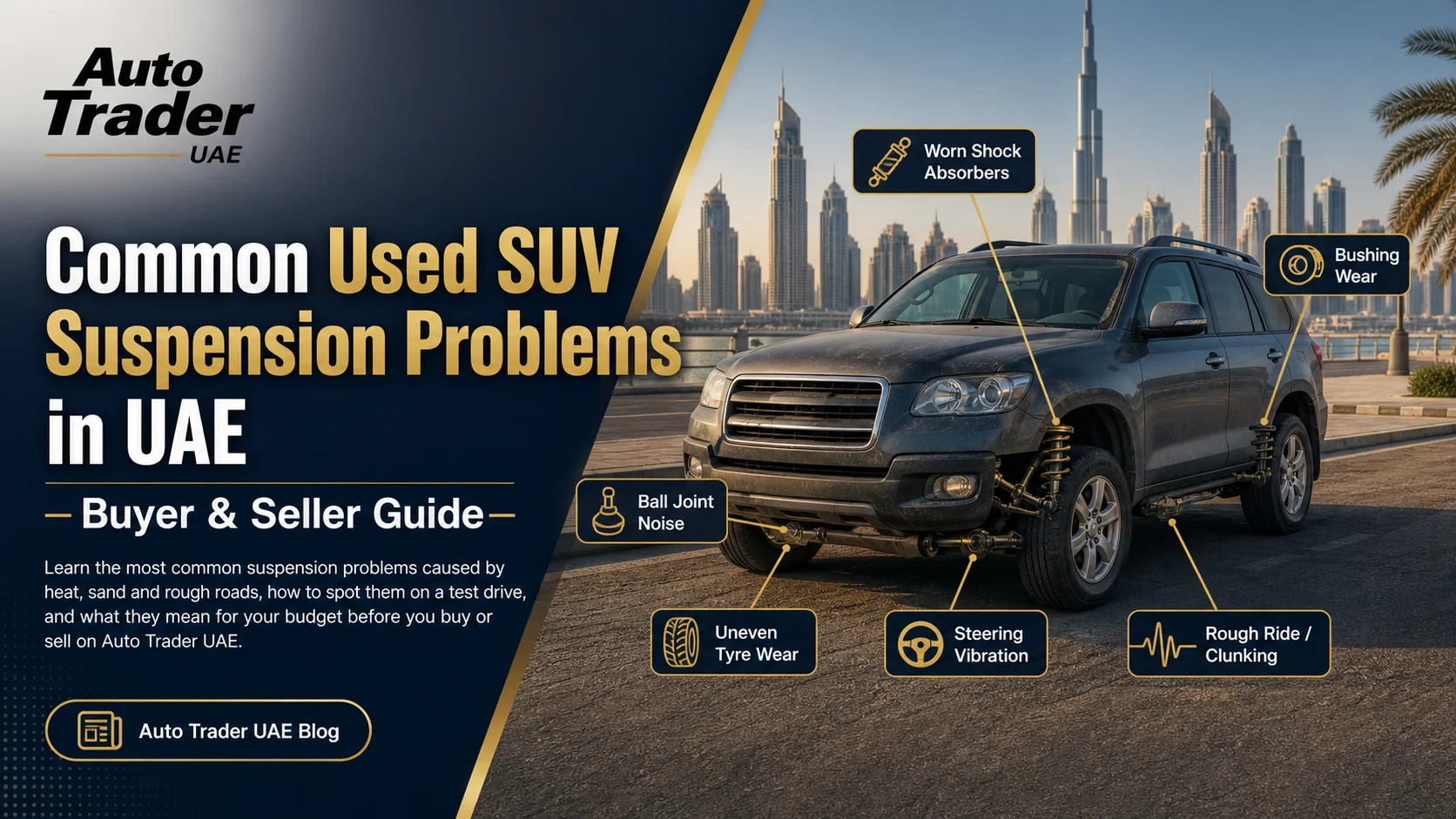
Common Used SUV Suspension Problems in UAE: Practical Guide for Buyers & Sellers
Used SUVs are hugely popular in the UAE for their space, comfort and ability to handle rough roads. But high heat, speed bumps, sand tracks and heavy loads are tough on suspension parts. If you’re shopping for a used SUV – or planning to sell yours on Auto Trader UAE – suspension condition can make the difference between a great deal and an expensive headache.
This guide explains the most common used SUV suspension problems in the UAE, how to spot them during viewing and test drives, and what repairs usually involve. Use it as a checklist before committing to any SUV.
Why Suspension Matters So Much in UAE Conditions
Suspension isn’t just about comfort. In the UAE it directly affects:
- Safety – Worn parts increase stopping distance and reduce stability at highway speeds.
- Tyre wear – Bad suspension can destroy a set of tyres in a few thousand kilometres.
- Off-road ability – For desert drives, healthy shocks and bushings are essential.
- Resale value – Buyers quickly walk away from SUVs with obvious suspension issues.
Because many UAE SUVs are used for family trips, towing, and occasional off-road use, their suspension can be more stressed than a typical city car in cooler countries.
1. Worn Shock Absorbers & Struts
Why it’s common in the UAE
High temperatures, repeated speed bumps, and long highway runs cause shocks to overheat and leak over time. Heavy SUVs and 7-seaters suffer particularly if driven fully loaded.
Symptoms to look for
- Excessive bouncing after going over a bump or speed hump.
- Nose-diving when braking or rear-end squatting when accelerating.
- Uneven tyre wear, especially cupping or scalloping on the tread.
- Oily residue or wet marks on the shock body (visible leak).
- Loose, floaty feeling at 100–140 km/h on Sheikh Zayed Road or E11.
How to check during a viewing
- Push down firmly on each corner of the SUV and let go. It should rise and settle quickly. Continuous bouncing suggests weak shocks.
- Look inside the wheel wells with a torch; check the shocks for oil leaks or dents.
- On the test drive, go over a small bump at low speed and feel how many times the body oscillates.
What repairs might cost (general guidance)
Replacing shocks and struts on an SUV is more expensive than on a small car, especially for 4x4 models with complex setups or adaptive/air systems. Genuine parts typically cost more but help resale value. Always get a workshop quote for the specific model.
2. Cracked or Perished Rubber Bushings
Why it’s common in the UAE
Rubber bushings in control arms, sway bars and other suspension links dry out and crack faster in extreme heat and sun. Dubai and Abu Dhabi stop-start traffic plus rougher roads in some areas increase stress further.
Symptoms to look for
- Clunking or knocking sounds when going over bumps or entering driveways.
- Vague or wandering steering at highway speeds.
- Uneven tyre wear or difficulty maintaining wheel alignment.
- Visible splits or gaps in the rubber when you look under the vehicle.
How to check during a viewing
- Use your phone torch to inspect visible suspension arms and mounts.
- Look for cracked, missing, or heavily squashed bushings.
- During a slow drive over a speed bump with windows down, listen for clunks.
Repair notes
On many SUVs, worn bushings mean replacing whole control arms or links. It’s usually not a safety emergency if wear is mild, but it affects comfort and tyre life. Factor this into your negotiation.
3. Ball Joint Wear
Why it’s common in the UAE
Heavier front ends, potholed internal roads in some communities and frequent kerb crossings stress ball joints. Once dust boots crack, sand and grit can accelerate wear.
Symptoms to look for
- Front-end clunking when turning into basement parking or over small bumps.
- Vibration or shimmy through the steering wheel.
- Loose or imprecise steering feel.
- In severe cases, uneven tyre wear on the front axle.
How to check during a viewing
- Turn the steering fully left and right while stationary and listen for clicking or knocking.
- During the test drive, make slow, tight turns in a quiet area and listen.
- A pre-purchase inspection can physically check for play in ball joints.
Risk level
Worn ball joints are more than just noise – if ignored, they can affect control and alignment. Treat them as a priority repair, especially on heavier 4x4 SUVs.
4. Broken or Sagging Coil Springs
Why it’s common in the UAE
Constantly driving loaded, towing, and regular trips over speed bumps can fatigue springs. Rust is less of an issue in the UAE, but repeated heavy use can still cause sagging or cracks, especially on older or abused vehicles.
Symptoms to look for
- One side of the SUV sitting lower than the other when parked on level ground.
- Rear end noticeably lower with light luggage or passengers.
- Thuds or metallic noises over bumps if coils are broken.
How to check during a viewing
- Stand a few metres away and visually check that all four corners sit at a similar height.
- Look inside the wheel wells for cracked or misaligned coils.
Repair notes
Springs are usually replaced in pairs on the same axle. If you see sagging, assume you’ll need at least two springs and a wheel alignment afterwards.
5. Air Suspension Leaks (on Premium SUVs)
Why it’s common in the UAE
Many luxury SUVs sold in the UAE have air suspension for extra comfort and height adjustment. Heat, age, and sand exposure can cause air bags and lines to crack or leak, and compressors to fail.
Symptoms to look for
- One corner or one axle sitting lower after the SUV is parked overnight.
- Warning lights or suspension error messages on the dashboard.
- Compressor running loudly and frequently.
- Slow or no response when changing suspension height modes.
How to check during a viewing
- Start the SUV and cycle through height modes (if available). It should raise and lower smoothly and evenly.
- Look for any tilt after the SUV is parked for 10–15 minutes.
- Listen near the wheel arches and under the car for air leaks (hissing).
Repair and ownership impact
Air suspension repairs can be costly compared with conventional systems. If a used SUV shows signs of leaks or compressor issues, negotiate hard and budget for specialist repair – or consider a version with standard suspension if long-term running costs are a concern.
6. Steering & Alignment Issues
Why it’s common in the UAE
High kerbs, parking hits, and occasional off-road or wadi driving often knock wheel alignment out of spec. Worn suspension parts then make it hard to keep the SUV tracking straight.
Symptoms to look for
- Steering wheel not centred when driving straight.
- Vehicle pulls to one side on a flat road.
- Uneven tyre wear on inner or outer edges.
- Steering feels heavy, or lighter than expected, or inconsistent.
How to check during a test drive
- On a straight, safe road at 80–100 km/h, gently loosen grip and see if the SUV drifts.
- Check if the steering wheel is centred when going straight.
- Inspect tyres for feathered edges or obvious uneven wear.
Repair notes
Sometimes a simple four-wheel alignment and tyre rotation solves the problem. If the alignment cannot be set correctly, it often points to worn or bent suspension components underneath.
7. Off-Road & Desert Use Damage
Why it’s common in the UAE
Many SUVs in the UAE spend time on sand dunes, gravel tracks or rocky wadis. Even if the owner says “light off-road only”, this can accelerate wear.
Potential issues from off-road use
- Sand intrusion into bushings, ball joints and shocks, increasing wear.
- Impact damage to lower arms, tie rods and underbody components.
- Strained shocks and springs from repeated dune jumps or heavy articulation.
Signs of heavy off-road use
- Deep scratches or dents on the underbody, control arms and diff housings.
- Aftermarket lift kits or suspension modifications with no supporting paperwork.
- Mixed brands of shocks and springs, suggesting previous failures or patch repairs.
How to approach a desert-used SUV
Many owners take good care of their desert toys, but you should:
- Request service records and bills from off-road workshops.
- Get a specialist inspection focused on suspension and drivetrain.
- Confirm that any lift or modification is properly declared and insured.
How to Inspect a Used SUV’s Suspension in the UAE
Step 1: Visual walkaround
- Check ride height at all four corners on level ground.
- Look for sagging, leaning, or obvious uneven gaps above wheels.
- Inspect tyres for strange wear patterns – a strong indicator of hidden suspension problems.
Step 2: Underbody and wheel well check
- Use a torch to check shocks, springs, arms and bushings for leaks, cracks or heavy corrosion.
- Look for fresh underbody paint or thick underseal that might hide repairs.
- Check rubber dust boots around ball joints and tie-rods for splits.
Step 3: Static tests
- Bounce each corner of the SUV to feel damping strength.
- Turn the steering lock-to-lock while parked; listen for clunks or grinding.
Step 4: Test drive checks
- Low speed: Drive over speed bumps and broken surfaces. Listen for rattles, squeaks or knocks.
- Medium speed: At 60–80 km/h, feel for vibrations or wandering.
- Highway: If safe, at 100–120 km/h the SUV should track straight and feel stable, not floaty.
Step 5: Professional inspection
Before you transfer ownership, a full chassis and suspension check by a trusted workshop or testing centre in the UAE is strongly recommended, especially for larger 4x4 SUVs and luxury models.
Red Flags vs Acceptable Wear
Red flags – consider walking away
- Severe body lean or obvious height difference between sides.
- Multiple warning lights for suspension or stability systems.
- Heavy clunking noises over small bumps from both front and rear.
- Poor alignment that can’t be corrected even after adjustment (as reported by a workshop).
Acceptable wear – negotiation points
- Mild bushing cracks with no big gaps.
- Small squeaks over bumps on an older SUV.
- Tyre wear that matches age and mileage, not extreme.
Use any issues as a negotiation tool on Auto Trader UAE and budget realistically for repairs after purchase.
Tips for Sellers: Preparing Your SUV’s Suspension for Sale
If you’re planning to list your SUV on Auto Trader UAE, a solid suspension can help you sell faster and closer to your asking price.
- Fix obvious problems first – Noisy shocks, severe lean, or dashboard warnings will scare off serious buyers.
- Do an alignment and tyre check – Provide proof of recent alignment and tyre replacement if done.
- Keep service records – Invoices for suspension work (bushings, shocks, arms) add trust.
- Describe honestly – Mention recent suspension work in your listing description for added value.
When you’re ready, create your listing and connect with buyers who are already searching for used SUVs in the UAE.
Best Practices for Buyers: Choosing a Used SUV with Healthy Suspension
- Shortlist smart – Filter by year, mileage and service history when browsing used cars in the UAE.
- Prioritise well-maintained examples – A higher mileage SUV with documented suspension work can be better than a low-mileage one with unknown history.
- Insist on inspection – Agree with the seller on a pre-purchase inspection at a neutral workshop.
- Factor in running costs – Luxury and air-suspension SUVs may offer great comfort but come with higher long-term costs.
Conclusion: Make Suspension Health Part of Your Decision
Common used SUV suspension problems in the UAE are largely caused by heat, load and road conditions – but they’re manageable if you know what to look for. A careful inspection, realistic budget for wear-and-tear items, and honest communication between buyer and seller will protect both sides.
Whether you’re buying your first family SUV or upgrading your current 4x4, start by exploring the wide range of used SUVs in the UAE on Auto Trader UAE. If you’re based in the emirate, you can also focus your search on used cars in Dubai to find options close to home.
Browse used cars in UAE on Auto Trader UAE to compare live listings, prices, and current market activity more clearly.
Related Links
Buyer Takeaway
When buying a used car in the UAE, focus on vehicle condition, service history, inspection quality, paperwork, and total running costs rather than price alone. Compare options carefully and choose the option that best matches your budget and real needs.
Seller Takeaway
If you are selling a used car in the UAE, present the service history clearly, price the vehicle realistically, and highlight condition, specification, and ownership strengths honestly. A well-prepared listing with accurate details usually attracts more serious buyers.