
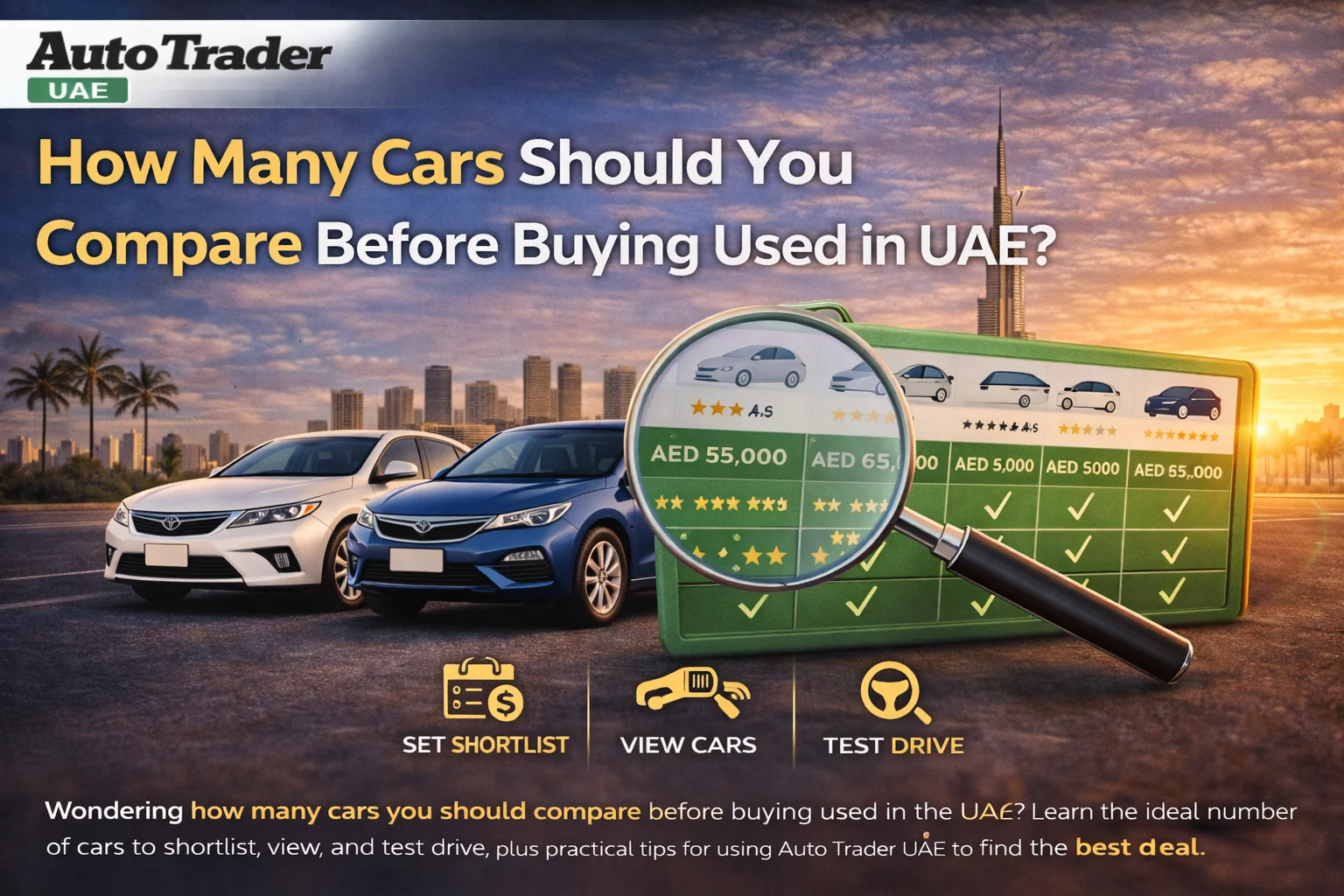
How Many Cars Should You Compare Before Buying Used in UAE?
If you’re buying a used car in the UAE, one of the first questions that comes up is: how many cars should you compare before you decide? Compare too few and you risk overpaying or missing issues. Compare too many and you waste time and end up confused.
This guide from Auto Trader UAE breaks down a practical comparison strategy for the UAE market, including how many cars to:
- Shortlist online
- Contact and inspect
- Test drive before you buy
What’s the Ideal Number of Cars to Compare?
There’s no single magic number, but for most buyers in the UAE, this framework works well:
- Online shortlist: 8–15 cars that match your budget and needs
- Serious inspection list: 3–5 cars to physically view and check
- Final test drives: 2–3 cars to test drive and compare directly
This gives you enough choice to understand the market, without getting overwhelmed. High-end or rare models may require a bit more flexibility, while very common models may allow you to be pickier.
Step 1: Build a Smart Online Shortlist
Start your search by building a strong shortlist on Auto Trader UAE. Use filters to narrow down:
- Budget range (set a realistic minimum and maximum)
- Preferred body type (SUV, sedan, hatchback, etc.)
- Model year range
- Mileage limit that you’re comfortable with
- Transmission and fuel type
- Location (Emirate/city that’s convenient for you)
A good target is to end up with 8–15 cars in your shortlist that genuinely match your needs. That’s enough to:
- See how prices vary for similar cars
- Spot unusually cheap or expensive listings
- Compare specs, trims, and features
From there, you’ll narrow down to the few worth seeing in person.
How to Compare Listings Efficiently
When looking at each car’s detail page, pay close attention to:
- Service history: documented dealership or specialist maintenance is a major plus.
- Accident or insurance history: any declared accidents, repairs, or repaint.
- Ownership details: single owner vs multiple owners.
- Usage type: private, company, or rental history where mentioned.
- Photos: look for clear images from all angles, including interior and engine bay.
Remove any listing that looks poorly maintained, incomplete, or suspicious. Your goal is to keep only cars you’d realistically be happy to buy if they check out in person.
Step 2: Shortlist 3–5 Cars to Inspect in Person
From your online shortlist of 8–15 cars, narrow down to 3–5 serious candidates to view. This number works well for most buyers in the UAE because it balances:
- Effort: visiting more than 5 cars usually adds confusion, not clarity.
- Market awareness: 3–5 gives you a real sense of typical condition and pricing.
- Negotiation power: you know there are other options if one seller won’t move on price.
Which Cars Make the Top 3–5?
Prioritise the cars that score best on:
- Price vs market: reasonably priced compared with similar listings on Auto Trader UAE.
- Mileage vs age: lower mileage for the model year is generally better, if service is proper.
- Ownership & history: full service history, fewer owners, clearly described condition.
- Location: easy to reach for viewing and inspection.
If you notice a listing that is far cheaper than the rest, don’t rush. It may be a bargain, or it may hide major issues. Always verify with inspection.
Step 3: Test Drive 2–3 Final Options
After inspecting 3–5 cars, you’ll usually feel that 2–3 of them are genuine contenders. These are the cars you should definitely test drive. Test driving fewer than 2 cars makes it hard to compare, while more than 3 often creates decision fatigue.
What to Compare on the Test Drive
When you test drive each car, compare:
- Engine performance: smooth acceleration, no strange noises, no warning lights.
- Gearbox behaviour: smooth shifts without jerks, hesitation, or slipping.
- Steering & suspension: car tracks straight, rides comfortably, no vibrations.
- Brakes: firm pedal, no pulling to one side, no grinding or squealing.
- Air conditioning: especially important in the UAE; must cool quickly and consistently.
- Interior comfort & tech: seats, infotainment, parking sensors, cameras, etc.
Take notes after each test drive. When you drive the next car, you’ll clearly feel differences in comfort, noise, performance, and build quality.
When Should You Compare More Cars?
The 8–15 shortlist, 3–5 viewed, and 2–3 driven rule fits most buyers. But you might want to compare more cars if:
- You’re buying a rare or specialist model: supply might be limited, so you monitor more listings over time.
- Your budget is tight: you may need to compare more cars to find a clean example at the right price.
- You have specific colour or trim requirements: more comparisons improve your chance of finding the exact spec.
On the other hand, you might compare fewer cars if:
- You’re buying a very common model (for example, a popular compact sedan or SUV) with plenty of supply.
- You’ve done strong research beforehand on reliability and known issues.
- You find an excellent car early with full history, clean inspection, and a fair price.
How to Use Price Comparisons Correctly
Comparing cars isn’t just about the number of cars; it’s about understanding price vs value. When you browse multiple listings on Auto Trader UAE, you’ll quickly see a typical price range for a given model and year.
Factors That Justify Higher or Lower Prices
- Service history: fully documented dealer or specialist history can justify a higher price.
- Accident-free reports: cars with no major accident history are usually worth more.
- Mileage: lower mileage typically commands a premium, but only with proper maintenance.
- Trim and options: higher trims, sunroof, leather seats, advanced safety tech all add value.
- Tyres and consumables: new tyres or recent major services reduce your immediate costs.
Comparing several listings helps you see whether a particular car is fairly priced, overpriced, or suspiciously cheap. That’s why it’s worth looking at more than just one or two cars.
Buyer Checklist: What to Compare Between Cars
When you move from online research to real-world comparison, use a simple table or checklist. For each shortlisted car, compare:
- Model year and mileage
- Service history (full, partial, missing)
- Accident/repair history (as claimed and later verified)
- Ownership history (individual, company, rental)
- Interior and exterior condition
- Tyres, brakes, and fluids condition
- Features and options
- Asking price vs average market price on Auto Trader UAE
- Estimated immediate costs (tyres, service, registration, insurance)
With 2–3 cars in a table like this, it becomes much easier to decide which one offers the best total value, not just the lowest sticker price.
Why Comparing Too Many Cars Can Backfire
Some buyers keep searching endlessly, comparing 20–30 cars or more. This often leads to:
- Analysis paralysis: constantly second-guessing every option.
- Missed deals: good cars are sold while you’re still “thinking”.
- Confusion about fair price: too much data with no clear pattern.
Setting a clear comparison limit–for example, 3–5 serious inspections and 2–3 test drives–helps you stay focused and make a confident decision.
How Sellers Benefit When Buyers Compare Multiple Cars
If you’re selling a used car in the UAE, you might think more buyer comparisons are a problem. In reality, informed buyers often make faster, more confident decisions when your car stands out positively among others.
To compete well when buyers are comparing multiple listings on Auto Trader UAE:
- Price your car realistically based on similar listings.
- Be transparent with service and accident history.
- Provide clear, high-quality photos inside and out.
- Fix small, cheap-to-repair issues before listing.
If a buyer has seen several weaker cars before yours, your well-presented, fairly priced car often becomes the obvious choice.
Using Auto Trader UAE to Compare Used Cars Efficiently
On Auto Trader UAE, you can streamline the whole process:
- Use filters to narrow down to the right make, model, price range, and Emirate.
- Create a shortlist of cars you want to monitor and contact.
- Compare price, mileage, year, and basic specs side by side.
- Explore related buying guides to understand ownership costs and reliability.
This helps you stay within the ideal comparison range without missing good opportunities.
Buyer Takeaway: A Simple Comparison Formula
To keep things simple in the UAE used car market, use this formula:
- 8–15 cars shortlisted online on Auto Trader UAE.
- 3–5 cars viewed and inspected in person.
- 2–3 cars test driven before deciding.
Within that structure, focus less on the raw number of cars and more on:
- Clear budget and needs
- Verified condition and history
- Total cost of ownership, not just price
Conclusion: Compare Enough Cars to Be Confident, Not Confused
The answer to “How Many Cars Should You Compare Before Buying Used in UAE?” is: compare enough to understand the market, but not so many that you get stuck.
For most buyers, that means:
- Do your homework on Auto Trader UAE.
- Shortlist wisely, inspect carefully, and test drive a small number of serious contenders.
- Make your final choice based on value, condition, and how the car fits your daily life in the UAE.
Ready to start comparing? Browse used cars for sale in the UAE on Auto Trader UAE today and build your shortlist with confidence.
If you are exploring used cars in Dubai or elsewhere in the UAE, Auto Trader UAE makes it easier to compare listings, prices, trims, mileage, and seller details in one place.
Related Links
Seller Takeaway
If you are selling a used car in the UAE, present the service history clearly, price the vehicle realistically, and highlight condition, specification, and ownership strengths honestly. A well-prepared listing with accurate details usually attracts more serious buyers.