
Overview
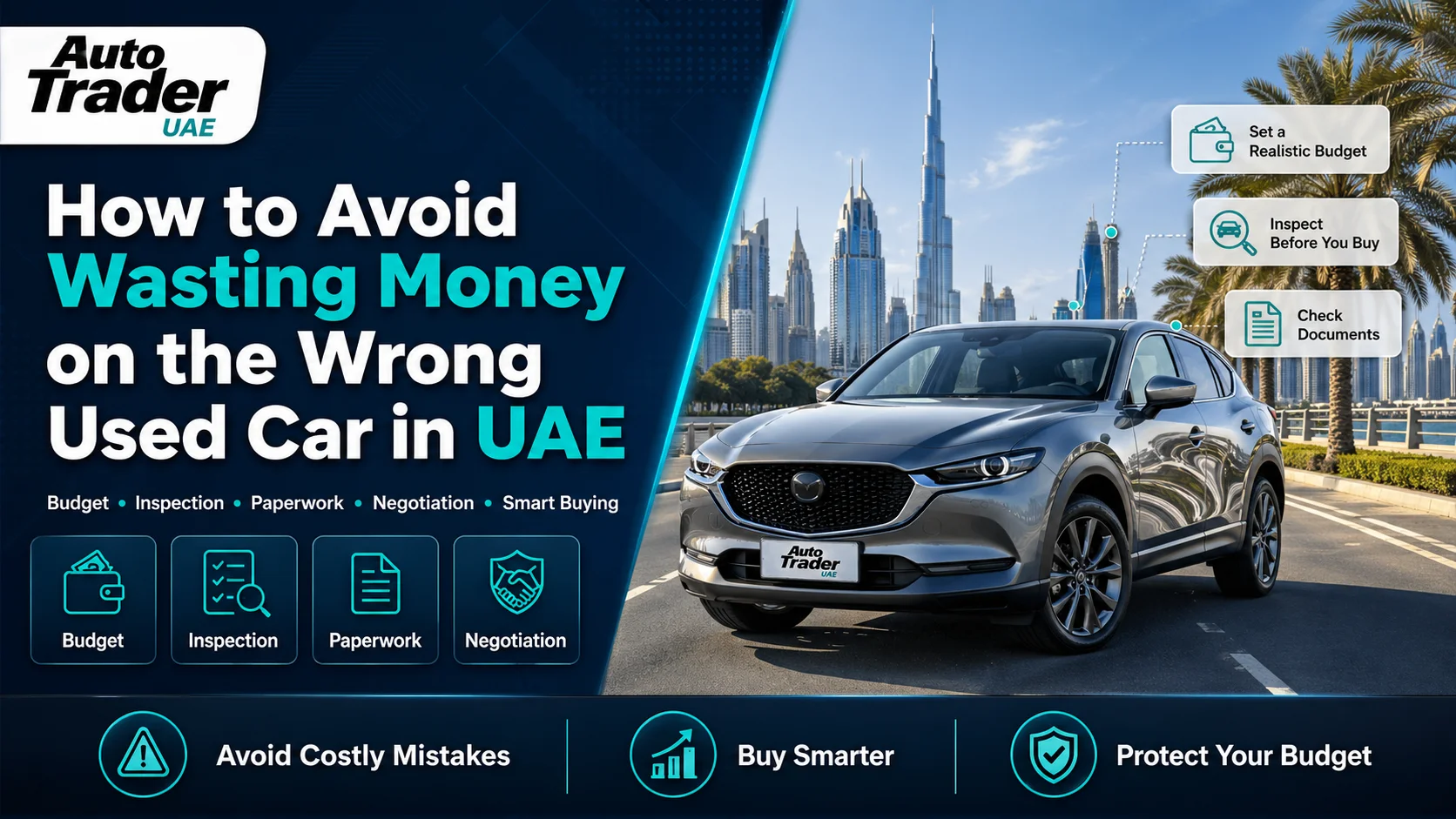
Buying a used car in the UAE can save you a lot of money – but only if you avoid expensive mistakes. With so many options, different ownership histories, and varying conditions, it’s easy to choose the wrong car and end up paying for repairs, depreciation, or hidden issues. This guide walks you through how to avoid wasting money on the wrong used car in the UAE, with practical steps you can follow before, during, and after the purchase.
1. Start with the Right Budget (Not Just the Price Tag)
Most buyers focus only on the purchase price. In the UAE, you should plan for total cost of ownership instead.
1.1 Calculate the full cost
When you set your budget, include:
- Purchase price – what you pay the seller.
- RTA registration and testing fees – mandatory for transfer of ownership.
- Insurance – varies a lot by age of car, value, and driver profile.
- Fuel costs – a V8 SUV will cost far more to run than a small hatchback.
- Maintenance and repairs – especially important for older or luxury cars.
1.2 Avoid stretching your budget for the wrong reasons
You can easily waste money by:
- Choosing a premium badge when parts and service are more than you can comfortably afford.
- Buying a much older car just because the price looks cheap, but then paying heavily for repairs.
- Underestimating insurance and registration costs for high-value or high-performance models.
Set a firm maximum budget, then aim to spend below it so you have a buffer for unexpected work.
2. Choose the Right Type of Car for UAE Roads and Your Lifestyle
The “wrong” car is often simply the wrong fit for your daily life in the UAE.
2.1 Think about where and how you drive
Ask yourself:
- Do you mostly drive in city traffic (Dubai, Abu Dhabi, Sharjah), or do you commute long distances?
- Do you really need 4x4 capability, or is it just a nice-to-have?
- Do you park in tight basement car parks where a large SUV will be difficult?
- Do you carry family, kids, or car seats regularly?
Then match your needs with broad categories:
- Small hatchbacks/sedans – ideal for city driving, easier to park, cheaper to run.
- Mid-size sedans – good for mixed city and highway use, comfortable and efficient.
- Crossovers/SUVs – better for families, occasional off-road, and taller seating position.
- 4x4s – suitable if you genuinely use the desert or tow regularly.
2.2 Consider UAE-specific conditions
To avoid costly regrets, factor in:
- Air conditioning performance – essential for UAE heat; weak A/C can mean expensive repairs.
- Cooling system health – overheating is common if the system isn’t maintained.
- Desert and dust usage – off-road driving can accelerate wear on suspension and underbody.
- GCC specs – GCC-spec cars are generally better suited to local climate than grey imports.
3. Research Reliability, Parts, and Resale Value
Not all used cars cost the same to keep on the road. Some models are cheap to buy but expensive to maintain or hard to resell.
3.1 Focus on models with strong reliability records
Before you shortlist cars:
- Look up known issues on owner forums and reputable automotive sites.
- Search for recall history and common faults for the specific make, model, and year.
- Ask local workshops which models are “trouble-free” and which ones they see with regular problems.
3.2 Check parts and service availability in the UAE
You can waste a lot of money (and time) if parts are rare or expensive. To protect yourself:
- Confirm that genuine parts are available locally or via well-known dealers.
- Check the cost of common wear items (brakes, suspension, filters, tyres).
- Find a trusted independent workshop that can service the car at a reasonable rate.
3.3 Think ahead about resale value
A car that depreciates quickly can be a costly mistake. In the UAE, models with strong resale demand often include:
- Popular Japanese brands with a proven track record.
- Well-known SUVs and crossovers that suit family life.
- Fleet-favourite sedans with established reliability.
Look at current listings for the same model with different mileages to see how values drop over time.
4. Understand Mileage and Age in UAE Context
Many buyers focus only on low mileage, but in the UAE, how a car has been used matters as much as the odometer reading.
4.1 Don’t fear higher mileage if maintenance is strong
Highway-driven cars with full service history can be safer than low-mileage cars that have mostly done short trips or sat unused. A well-maintained 5–7-year-old car with 120,000–150,000 km can be a better buy than a neglected 3-year-old car with lower mileage.
4.2 Watch for odometer tampering
Odometer rollback is less common than before, but it still exists. To protect yourself:
- Compare mileage with service records and RTA inspection history if available.
- Look at wear on steering wheel, pedals, and seats – does it match the stated km?
- Be cautious of cars that feel heavily worn but show surprisingly low mileage.
5. Inspect Before You Commit – Never Skip This Step
Skipping a proper inspection is one of the fastest ways to waste money on the wrong used car in the UAE.
5.1 Do your own basic checks first
When viewing a car:
- Inspect the body for uneven paint, misaligned panels, and rust spots.
- Check tyre condition and age; mismatched or very worn tyres may signal poor maintenance.
- Look under the car for oil leaks or signs of damage.
- Start the engine cold if possible; listen for rattles or rough idling.
- Turn on the A/C and ensure it cools quickly and consistently.
5.2 Always get a professional pre-purchase inspection
A paid inspection at a trusted workshop or independent inspector can save you thousands. Ask them to check:
- Engine compression and leaks.
- Gearbox performance (automatic and dual-clutch gearboxes need special attention).
- Suspension condition and bushings (often affected by speed bumps and rough roads).
- Accident or structural damage (chassis, frame, airbags).
- Electrical systems, especially in high-spec models with many features.
Use the inspection report to either walk away or negotiate a fairer price based on realistic repair costs.
6. Check the Car’s History and Paperwork Carefully
In the UAE, paperwork is just as important as the car itself. Ignoring it can lead to fines, delays, or legal issues.
6.1 Verify ownership and RTA status
Make sure:
- The seller’s Emirates ID matches the name on the Mulkiya (registration card).
- There are no outstanding fines, loans, or bans on the vehicle.
- The car passes RTA test if it’s due for registration renewal.
6.2 Look for accident and insurance history
Ask for:
- Service records from dealer or independent workshops.
- Any previous accident repair bills or reports.
- Evidence of major repairs, such as engine or gearbox replacements.
If the car has been in a serious accident, compare the asking price with similar non-accident cars and decide if the discount is truly worth it.
6.3 Confirm specs: GCC vs import
Non-GCC (grey import) cars may be cheaper but can be riskier in terms of parts, spec differences, and insurance. Check:
- Whether the car is clearly labelled as GCC spec.
- Any modifications done after import.
- If your insurer is happy to cover that specific car.
7. Test Drive Like a Pro
A quick spin around the block is not enough. Use the test drive to discover issues before you pay.
7.1 What to test on the road
During your drive, pay attention to:
- Engine response – smooth acceleration, no hesitation or jerking.
- Gearbox shifts – no harsh shifts, slipping, or delay.
- Steering and alignment – car should track straight without pulling.
- Brakes – firm, consistent feel; no vibration or squealing.
- Suspension – no clunks over bumps, stable at highway speeds.
- Noises and vibrations – listen with the radio off.
7.2 Test all features
Don’t forget to check:
- All windows, locks, mirrors, and seat adjustments.
- Infotainment system, Bluetooth, and navigation if fitted.
- Lights, indicators, wipers, and reverse camera or sensors.
Small electrical faults can add up to big bills, especially in premium models.
8. Don’t Rush the Deal or Skip Comparison Shopping
Impulse decisions are a common reason buyers end up with the wrong used car.
8.1 Compare similar cars side by side
Use platforms like Auto Trader UAE to:
- Compare prices for the same make, model, year, and mileage.
- See how different trim levels affect value.
- Understand what a “fair” asking price looks like in the current market.
If a car is significantly cheaper than the market average, assume there is a reason and investigate carefully.
8.2 Watch for pressure tactics
If a seller insists you transfer money immediately or claims “five other buyers are coming today”, step back. A good deal will withstand a day or two of proper checks and inspection.
9. Negotiate Smartly – and Be Ready to Walk Away
Negotiation is expected in the UAE used car market, but it should be based on facts, not guesswork.
9.1 Use evidence, not emotions
Bring:
- Printouts or screenshots of similar listings on Auto Trader UAE.
- Your inspection report with estimated repair costs.
- Any missing service history or cosmetic issues as leverage.
Make a reasonable offer and explain how you reached it. Unrealistic low offers may close the conversation quickly.
9.2 Walk away if the numbers don’t work
If the seller refuses a fair price, or if new issues appear during checks, be prepared to leave. Losing one car is better than losing money on a bad one.
10. Protect Yourself During Payment and Transfer
The final step is where scams and costly surprises can still happen.
10.1 Use safe payment methods
- Avoid paying the full amount in cash without any proof.
- Prefer bank transfers with clear reference details.
- Never pay a large deposit before you have seen the car and documents in person.
10.2 Complete the deal properly at RTA
At the RTA centre or approved service centre:
- Ensure the vehicle passes the technical test if required.
- Transfer ownership officially and get a new Mulkiya in your name.
- Confirm that there are no outstanding fines or loans.
Only hand over final payment once you are satisfied that the transfer is legitimate and complete.
Buyer Takeaway: A Checklist to Avoid the Wrong Used Car
To avoid wasting money on the wrong used car in the UAE, follow this simple order:
- Set a realistic total budget including insurance and maintenance.
- Choose the right type of car for your lifestyle and UAE conditions.
- Research reliability, parts, and resale value for your shortlist.
- Shortlist cars with clear histories and complete documents.
- Inspect carefully – first yourself, then with a professional.
- Test drive thoroughly, checking all mechanical and electrical systems.
- Compare prices on Auto Trader UAE and negotiate based on evidence.
- Complete payment and transfer only through official RTA channels.
Seller Takeaway: How to Attract Serious Buyers
If you’re selling a used car and want to avoid time-wasters while achieving a fair price:
- Gather all service records, invoices, and RTA documents before listing.
- Fix simple issues (bulbs, basic servicing, minor detailing) to present the car well.
- Be honest about any accidents or repairs – transparency builds trust.
- Set a realistic asking price using current listings on Auto Trader UAE as a benchmark.
Next Steps with Auto Trader UAE
When you’re ready to buy or sell, using a trusted marketplace helps you avoid many common pitfalls. On Auto Trader UAE, you can browse a wide range of used cars, compare real market prices, and shortlist models that match your budget and needs. For more advice on budgeting, finance, and getting the best value from your next car, explore our money and ownership tips in the Auto Trader UAE finance and advice section. You can also visit the Auto Trader UAE blog for up-to-date guides, checklists, and insights tailored to buyers and sellers across the UAE. By taking a structured, informed approach – and using the right tools and platforms – you dramatically reduce the risk of wasting money on the wrong used car and increase your chances of finding a vehicle that fits your life, your budget, and the UAE roads perfectly.
Browse used cars in UAE on Auto Trader UAE to compare live listings, prices, and current market activity more clearly.
Conclusion
A careful used car purchase in the UAE starts with research, proper inspection, and clear paperwork before making the final decision.