
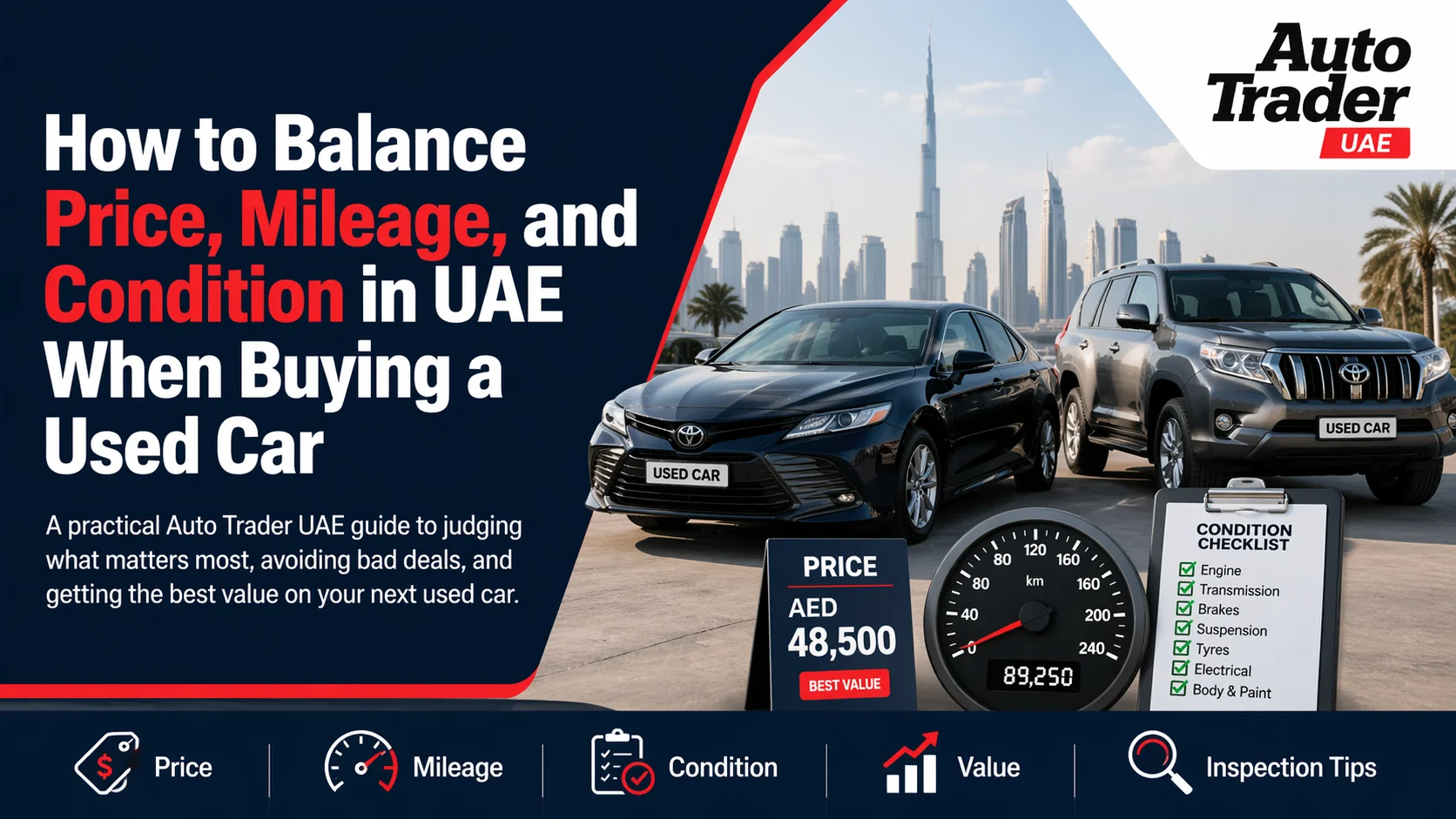
How to Balance Price, Mileage, and Condition in UAE
Shopping for a used car in the UAE often comes down to three things: price, mileage, and condition. The challenge is knowing when to prioritise each one so you don’t overpay – or buy a headache.
This guide from Auto Trader UAE explains how to balance these three factors in the UAE market, for both buyers and sellers. You’ll learn how to judge value, what to compromise on, and how to use online tools and inspections to protect your money.
Overview
In the UAE, you’ll find two cars with the same model year priced thousands of dirhams apart. Usually, it’s because of some mix of:
- Price – your budget and the car’s asking price
- Mileage – how far the car has been driven
- Condition – mechanical, cosmetic, and service history
Most buyers start by looking at price and mileage, but condition often matters more. A well-maintained, higher‑mileage car can be a safer buy than a low‑mileage car with poor service history or accident damage.
Because the UAE has a mix of hot climate, highway use, urban stop‑start traffic, and sand, understanding how these affect a car is key to making the right decision.
How Price, Mileage, and Condition Work Together
1. Price: What Is “Good Value” in the UAE?
A good price in the UAE isn’t just about being cheap; it’s about fair value for the car’s age, mileage, condition, and spec.
When comparing prices on Auto Trader UAE listings, always factor in:
- Model year and generation – newer shape or facelift models often justify higher prices.
- Spec and options – full‑option trims, panoramic roofs, ADAS safety systems, and leather interiors add value.
- Service history – full dealer or specialist history in the UAE is a major plus.
- Ownership type – private owner vs. fleet or rental can affect price and expected wear.
- Accident history – cars with major repairs should be priced lower.
Tip: Build a shortlist on Auto Trader UAE and compare at least 5–10 similar cars (same year, engine, and trim) to understand the realistic price range before you negotiate.
2. Mileage: What Is “High Mileage” in the UAE?
Mileage is important, but it’s often misunderstood. In the UAE, many cars do long, steady highway runs, which are easier on the engine than short, stop‑start city trips.
As a rough guide (varies by brand and usage):
- Low mileage: under 15,000 km per year
- Average mileage: 15,000–25,000 km per year
- High mileage: 25,000+ km per year
Example: a 5‑year‑old car with 120,000 km can be perfectly normal and reliable if it has a full service history and is in good condition.
More important than the number itself:
- Was it mainly highway or city driving?
- Was servicing done on time using proper parts and fluids?
- Have major wear items (tyres, brakes, suspension components) been replaced as needed?
3. Condition: The Factor That Can Outweigh Mileage
Condition is where good deals are made – or regretted. In the UAE, the harsh climate can expose weaknesses in a poorly maintained car very quickly.
Key aspects of condition to check:
- Mechanical health – engine, gearbox, air‑conditioning, cooling system.
- Service history – stamped books or digital records; regular oil changes; major services done.
- Accident and bodywork – uneven paint, panel gaps, overspray, frame damage.
- Interior wear – seats, steering wheel, buttons; heavy wear can indicate rough use even with low mileage.
- Electrical systems – sensors, infotainment, cameras, and safety systems.
A car that’s mechanically sound with a strong service history, even at higher mileage, is often a better long‑term bet than a lower‑mileage car with unclear history.
Common UAE Scenarios: What to Choose?
Scenario 1: Low Mileage, Average Condition, Higher Price
This is popular in adverts: "very low km" but with a noticeably worn interior, incomplete history, or minor bodywork issues.
When it can still be worth it:
- If you can confirm the mileage is genuine via service records and RTA history.
- If cosmetic issues are minor and cheap to fix (polish, small dents, basic interior cleaning).
- If you plan to keep the car for many years and use the remaining mileage potential.
Be cautious if:
- Service history is missing or irregular.
- The wear on the interior doesn’t match the stated mileage.
- The price premium over similar cars is too high.
Scenario 2: Higher Mileage, Excellent Condition, Fair Price
This is where value usually hides: a company executive car or family car with higher mileage but regular dealer service and very clean condition.
Why it can be a smart buy:
- Highway‑driven cars with smooth, long journeys typically have less wear and tear.
- Full service history shows consistent care.
- You pay less than for a low‑km example of the same car, with similar or better reliability.
What to check:
- Engine and gearbox behaviour on a test drive (no jerks, slipping, or warning lights).
- Cooling system performance – no overheating, AC is strong even in hot midday traffic.
- Any big upcoming maintenance (timing belt/chain, tyres, brakes) that you may soon pay for.
Scenario 3: Perfect Price, But Condition Is Questionable
Sometimes a deal looks too good compared to similar listings on Auto Trader UAE. This might be a genuine urgent sale – or it might hide issues.
Always investigate:
- Request full service history and any accident reports.
- Have the car inspected at a trusted independent workshop or RTA‑approved testing centre.
- Check for warning lights, misaligned panels, uneven tyre wear, and fluid leaks.
If an inspection reveals major accident repair, structural damage, or heavy rust/corrosion, even a very low price may not be worth the future repair costs and safety risks.
How to Evaluate Condition Properly in the UAE
1. Check Service History
In the UAE, a strong service history is often a better indicator of future reliability than the mileage alone.
- Look for recorded services every 10,000 km (or as per manufacturer schedule).
- Prefer cars with dealer or reputable specialist service history.
- Ask for invoices for major work: engine repairs, gearbox services, AC compressor, suspension parts, etc.
Many official dealers and large workshops in the UAE can provide digital service reports if you have the VIN.
2. Inspect for Heat and Sand Damage
The UAE climate is tough; look closely at:
- Paint and clear coat – fading or peeling, especially on roof and bonnet.
- Rubber seals and plastics – cracking around windows and doors.
- AC performance – cold air at idle and while driving; weak AC can mean costly repairs.
- Air filters and radiators – excessive sand or dust build‑up can indicate poor maintenance.
3. Get a Professional Inspection
Before paying a large amount for any used car, consider:
- An inspection at an independent workshop familiar with the brand.
- Checking RTA test reports if the car was recently tested.
- Scanning for diagnostic trouble codes (DTCs) using a professional scan tool.
The relatively small cost of an inspection can save you from major repair bills later.
How to Set a Realistic Budget in the UAE
When you browse used car listings on Auto Trader UAE, prepare your budget in two parts:
1. Purchase Budget
- Car price (after negotiation).
- RTA registration and testing fees.
- Insurance (third‑party vs. comprehensive).
- Any bank processing or evaluation fees if you use finance.
2. Immediate Running Costs
- Basic service after purchase (oil, filters, fluids).
- Tyres or brakes if near end of life.
- Any minor repairs found in the inspection.
Sometimes the cheaper car becomes more expensive once you include the repairs needed to bring it to a safe, reliable standard.
Buyer Takeaway: How to Balance the Three for the Best Deal
When buying through Auto Trader UAE, use this simple priority order:
- Condition & history first – walk away from cars with unclear or poor history, serious accident repair, or obvious neglect, regardless of price or mileage.
- Mileage second – prefer average or slightly above‑average mileage with a strong history over suspiciously low mileage with no proof.
- Price last – negotiate based on actual condition and upcoming maintenance, not just on what similar cars are advertised for.
Practical steps:
- Use filters on Auto Trader UAE to set your budget, preferred mileage range, and model years.
- Shortlist 5–8 cars with good photos and detailed descriptions.
- Call or message the seller to confirm service history and any accidents before you visit.
- Test drive and, if the car seems promising, arrange a pre‑purchase inspection.
Seller Takeaway: How to Price Your Car Correctly
If you’re selling your car on Auto Trader UAE, you can attract serious buyers faster by being realistic and transparent.
1. Know Where Your Car Sits in the Market
- Search Auto Trader UAE for similar cars (same model, year, engine, and trim).
- Note the average asking price, then adjust up or down based on:
- Lower mileage + excellent condition – price near the upper end.
- Higher mileage but full history and clean condition – price around the middle.
- Visible cosmetic issues or missing history – price at the lower end and mention issues honestly.
2. Highlight Condition and Maintenance
Serious buyers in the UAE care about how the car was treated. In your listing:
- Mention full service history and where it was serviced.
- List major recent work (new tyres, brakes, battery, AC servicing, etc.).
- Be honest about any minor defects to build trust and avoid wasted viewings.
3. Be Flexible, But Know Your Minimum
Decide your lowest acceptable price before meeting buyers. If your car has higher mileage but is in excellent condition with full history, use that to justify your price with buyers who are focused only on the odometer reading.
When to Walk Away
Whether you’re a buyer or seller, some situations are not worth forcing:
- The seller refuses an inspection or is vague about history.
- The car has a serious structural accident history.
- The price is far below market and the story doesn’t add up.
- There are legal or finance complications (unsettled loans, unpaid fines) that the seller won’t clearly explain.
With the volume of listings available on Auto Trader UAE, it’s usually better to move on and choose a car with clear documentation and condition.
Conclusion
Balancing price, mileage, and condition in the UAE comes down to one principle: pay for proven care, not just for a number on the odometer.
If you prioritise condition and service history first, accept reasonable mileage, and negotiate based on real inspection findings, you’re far more likely to end up with a reliable car that fits your budget.
Start your search or list your current car today on Auto Trader UAE, where you can compare prices, mileage, and condition across hundreds of models, and make a confident decision on your next car in the UAE.
If you are exploring used cars in Dubai or elsewhere in the UAE, Auto Trader UAE makes it easier to compare listings, prices, trims, mileage, and seller details in one place.