
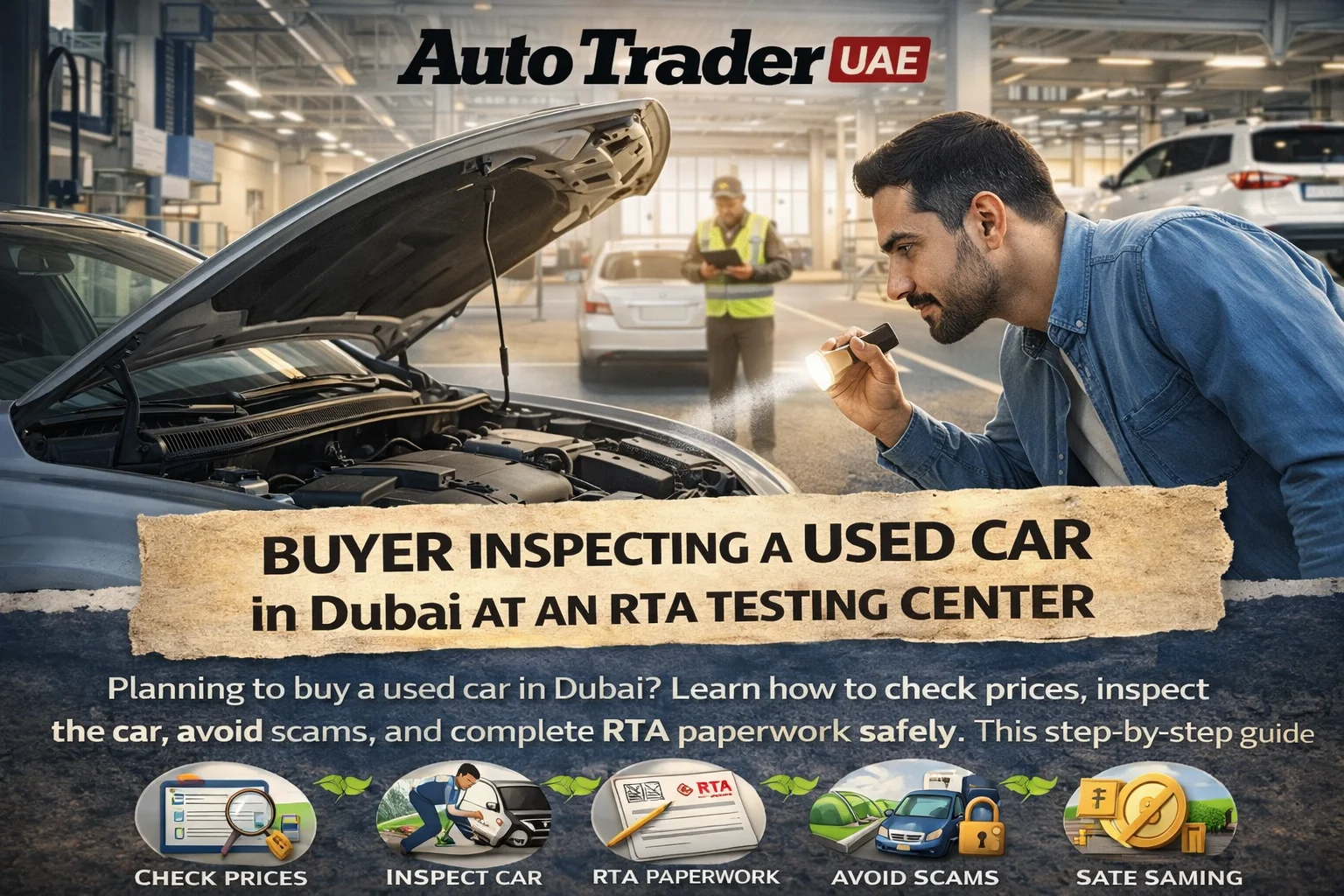
How to Buy a Used Car Safely in Dubai: A Step‑by‑Step Guide
Buying a used car in Dubai can save you a lot of money, but only if you do it safely and smartly. This guide walks you through every step – from shortlisting cars on Auto Trader UAE to transferring ownership at the RTA – so you protect your money and avoid costly mistakes.
1. Set a Realistic Budget for the UAE Market
Before browsing listings, decide exactly how much you can spend – and remember that in the UAE the car price is not your only cost.
Include all ownership costs
- Car price: what you pay the seller or dealer.
- Insurance: comprehensive is recommended for newer and higher‑value cars.
- RTA registration & testing: mandatory for transfer of ownership.
- Salik: if the car already has a Salik tag, you’ll need to update it.
- Fuel & maintenance: consider engine size, service costs and parts prices.
Decide how you’ll pay
- Cash: safest and simplest; use a bank branch or transfer where possible.
- Bank finance: get pre‑approval so you know your exact budget and required down payment.
- Personal loan: can be faster but usually has different rates and terms.
2. Choose the Right Type of Used Car for Dubai
Think about how and where you’ll use the car in the UAE.
- Daily city driving (Dubai, Sharjah, Abu Dhabi): small sedans and hatchbacks are cheaper to run and easier to park.
- Family use: crossovers and SUVs offer better space, comfort and safety features.
- Long‑distance commuting: look for fuel‑efficient engines and good service history.
- Off‑road & desert trips: serious dune driving needs a proper 4x4 with low‑range and solid maintenance history.
On Auto Trader UAE, you can filter used cars by body type, engine size, year, mileage, and more to quickly narrow your search.
3. Research Market Prices Before You Call Anyone
One of the easiest ways to stay safe is to know the fair market price for the car you want.
How to check if the price is fair
- Search the same make, model, year, trim and mileage on Auto Trader UAE.
- Compare with multiple listings – not just one – to see the price range.
- Be cautious of cars that are much cheaper than average; they may have hidden issues, accident damage or outstanding finance.
4. Shortlist Safe, Genuine Listings
When browsing used car listings, look for signs of a serious, transparent seller.
Signs of a good listing
- Clear photos of exterior, interior, dashboard, engine bay and odometer.
- Accurate details: year, mileage, spec, number of owners, GCC/import, service history.
- Honest condition description: mentions minor scratches, replaced parts, etc.
Red flags to avoid
- Only stock photos or very few blurry images.
- Unrealistically low price with no explanation.
- Seller refuses inspection or RTA testing.
- Insists on fast payment or deposit before viewing the car.
5. Contact the Seller Safely
Once you find a promising car on Auto Trader UAE, contact the seller directly via the provided details.
What to ask immediately
- “Are you the owner or a dealer?” – helps you know who you’re dealing with.
- “Is the car GCC spec or import?” – GCC spec is generally better suited to the region.
- “Any major accidents or repairs?” – listen for hesitation or vague answers.
- “Do you have full or partial service history?” – services at agency or reputable garages is a big plus.
- “Is there any outstanding bank finance?” – very important for safe transfer.
Never share copies of your Emirates ID, passport, or bank details at this stage. These are only needed later during official processes.
6. Inspect the Car in Daylight and in a Safe Location
Always view the car in person before committing to buy.
Where and when to meet
- Meet in a public, well‑lit place or at an RTA testing center.
- Avoid remote locations and never agree to meet late at night.
- Try to inspect the car in daylight so you can see paintwork clearly.
Basic checks you can do yourself
- Exterior: look for uneven paint, panel gaps, rust, dents or signs of accident repair.
- Tyres: check tread depth, even wear, and manufacturing date.
- Interior: check seat condition, odometer reading, dashboard lights, infotainment and AC.
- Engine bay: look for leaks, odd smells, loose wires or poorly fitted parts.
- Cold start: engine should start easily, without loud knocking or excessive smoke.
If you are not confident, consider taking a trusted friend or arranging a professional inspection.
7. Always Do a Professional or RTA Test
In Dubai, transferring ownership requires a passing RTA test. You can use this to your advantage.
RTA testing
- Book a test at an authorised RTA testing center (e.g. Tasjeel, Shamil, Wasel, etc.).
- The test checks chassis, brakes, suspension, lights, emissions and more.
- If the car fails, you’ll see the issues in the report; use this to decide whether to walk away or negotiate.
Independent inspection
For higher‑value cars or luxury models, a detailed inspection by a specialist garage can reveal hidden problems like:
- Flood or severe accident damage.
- Odometer tampering.
- Engine or gearbox issues that are not obvious on a short test drive.
If a seller refuses any form of test, consider it a major warning sign.
8. Check the Service History and Documents
Documentation tells you how the car has been treated.
What to look for
- Original registration card (Mulkiya): confirms the owner, plate number, and car details.
- Service book or invoices: regular stamps or receipts from agency or reputable garages.
- Warranty documents (if still valid): read what is covered and expiry date.
- Spare keys and manuals: a small sign of a well‑kept car.
GCC spec vs import
- GCC spec cars are built for local climate and usually easier to insure and service.
- US or European imports can be fine, but check accident history carefully and verify specifications.
9. Test Drive Safely and Pay Attention
Never buy without a proper test drive.
Before you start
- Ask the seller to drive first so you can observe.
- Ensure you are properly insured to drive the car during the test; some sellers have demo insurance, others may not.
During the drive
- Listen for unusual noises from engine, suspension or brakes.
- Check for vibrations at different speeds.
- Test steering – the car should track straight, without pulling.
- Test AC performance – crucial in UAE summers.
- Try parking, reversing and tight turns to check steering and gearbox smoothness.
10. Negotiate the Price Using Facts, Not Guesswork
Once you are satisfied with the car’s condition, it’s time to agree on a final price.
How to negotiate fairly
- Use your market research from Auto Trader UAE as a baseline.
- Show any RTA test report or inspection findings that require future repairs.
- Consider costs you will bear soon: tyres, service, minor bodywork.
- Make a reasonable offer close to market value; unrealistic offers often waste time.
If terms don’t feel right, be ready to walk away. There are plenty of used cars in the UAE market.
11. Complete Payment Safely
Safety during payment is critical.
Best practices
- Prefer bank transfer or cashier’s cheque over large cash payments.
- Complete payment on the same day as ownership transfer at the RTA center whenever possible.
- Never transfer the full amount before seeing the original Mulkiya and confirming the seller’s identity.
- For cars with bank finance, the seller should clear the loan and get a release letter before you pay in full.
12. Transfer Ownership at RTA (Dubai)
In Dubai, ownership transfer is straightforward when you have the right documents.
Documents typically required
- Buyer’s and seller’s Emirates ID and driving licence.
- Original Mulkiya (registration card).
- Valid RTA test certificate (for used vehicles).
- Insurance policy in the buyer’s name (can often be arranged online or at the RTA service center).
- Release letter from bank if car was under finance.
Steps at the RTA center
- Submit documents at the counter or kiosk.
- Pay the transfer and registration fees.
- Receive the new Mulkiya in your name and new plates if required.
Never hand over full payment or leave without confirming that the vehicle is now officially registered under your name.
13. Common Scams and How to Avoid Them in Dubai
Staying alert will protect you from most problems.
- Deposit scams: seller asks for a holding deposit before you see the car. Avoid sending money until you’ve inspected and agreed on the deal.
- Odometer tampering: mileage seems too low for the age. Cross‑check with service records and condition.
- Hidden accident damage: fresh paint or mismatched panels. Always do an RTA or professional test.
- Outstanding finance: car still mortgaged to a bank. Ensure a proper bank release before transfer.
- Fake sellers: no name on Mulkiya, refuses RTA transfer, or wants to keep the car under their name. Only deal with the legal owner.
14. Tips for Sellers: How to Sell Your Used Car Safely
This guide is also useful if you’re selling a car in Dubai.
- Advertise on trusted platforms like Auto Trader UAE to reach serious buyers.
- Be honest about the car’s condition, accidents and service history.
- Prepare documents: Mulkiya, service book, invoice copies, bank release if needed.
- Meet buyers safely: public locations or RTA centers; avoid letting strangers test drive alone.
- Only transfer keys after payment is cleared and RTA transfer is completed.
15. Buyer & Seller Takeaway
- Do your homework on prices before viewing any car.
- Never skip physical inspection, test drive and RTA testing.
- Check documents and service history carefully.
- Use secure payment methods and complete the sale at RTA.
- Whether buying or selling, use reputable platforms and avoid rushed decisions.
Conclusion: Use Auto Trader UAE to Buy a Used Car Safely in Dubai
Buying a used car safely in Dubai is all about preparation and process. When you:
- Set a clear budget and know the market price,
- Inspect and test the car properly,
- Check all documents and RTA reports, and
- Handle payment and transfer only through official channels,
…you greatly reduce the risk of problems and maximise the value you get for your money. On Auto Trader UAE, you can browse thousands of used cars across Dubai and the wider UAE, compare prices, filter by make, model, year and budget, and connect directly with serious buyers and sellers. Use this guide as your checklist, shortlist your next car on Auto Trader UAE, and head to the RTA with confidence for a safe, smooth purchase or sale.
If you are exploring used cars in Dubai or elsewhere in the UAE, Auto Trader UAE makes it easier to compare listings, prices, trims, mileage, and seller details in one place.
Related Links
Buyer Takeaway
When buying a used car in the UAE, focus on vehicle condition, service history, inspection quality, paperwork, and total running costs rather than price alone. Compare options carefully and choose the option that best matches your budget and real needs.
Auto Trader UAE connects you with thousands of used cars from trusted private sellers and dealers across Dubai and the UAE.