
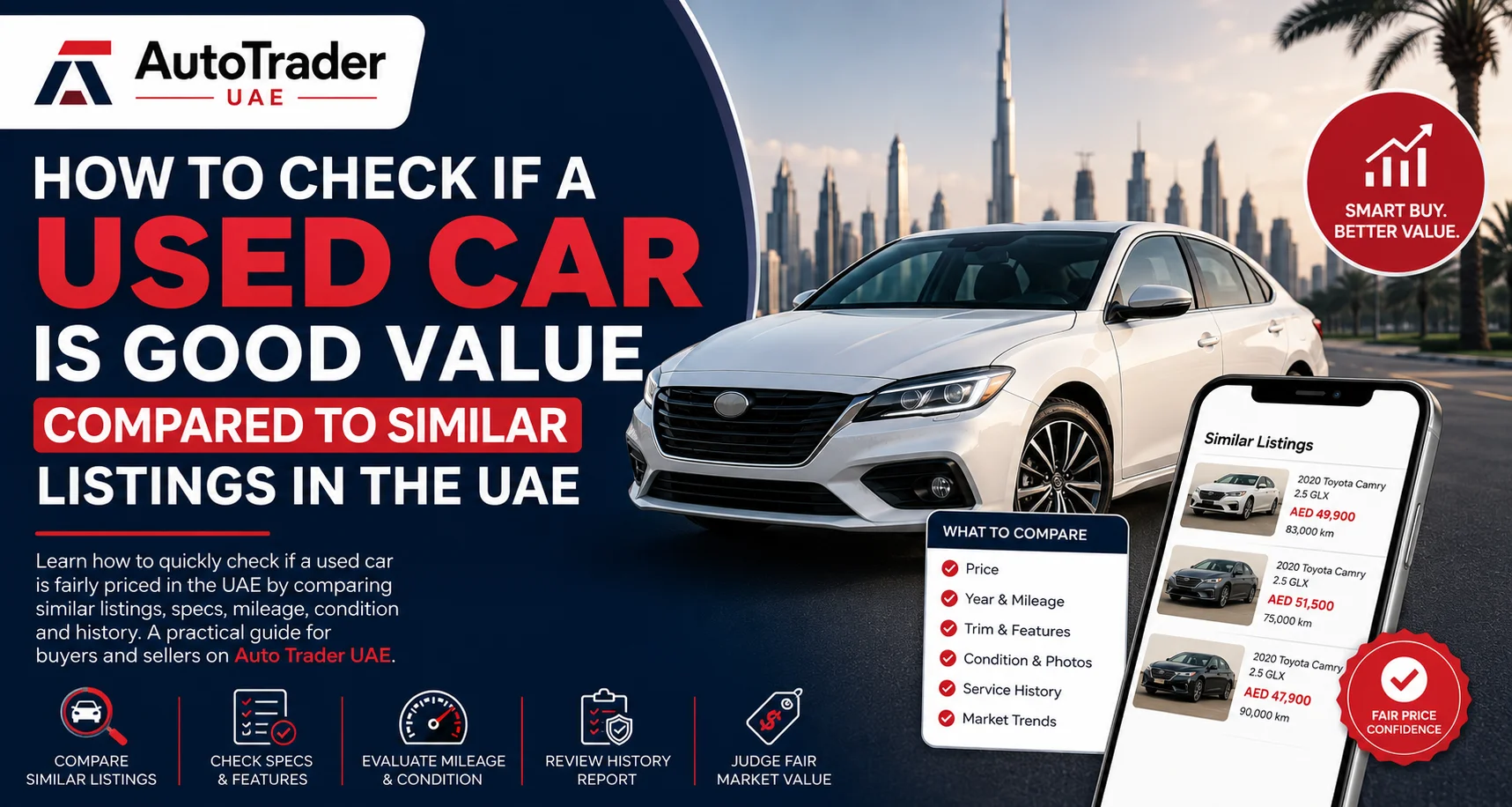
How to Check If a Used Car Is Good Value Compared to Similar Listings in the UAE
Buying a used car in the UAE can save you a lot of money – but only if you pay a fair price. With hundreds of listings live at any time on Auto Trader UAE, it’s not always obvious whether a car is a bargain, average, or overpriced. This guide explains exactly how to check if a used car is good value compared to similar listings, using simple steps and real‑world checks you can do in minutes.
1. Start With a Like‑for‑Like Comparison
The biggest mistake buyers make is comparing a car only by model name and year. To judge value accurately in the UAE, you should match as many details as possible.
Key specs to match
- Make and model (e.g. Toyota Camry, Nissan Patrol, Hyundai Tucson)
- Trim level (e.g. SE, GL, Sport, Platinum)
- Engine and drivetrain (e.g. 2.0L, V6, turbo, AWD)
- Model year and registration year
- Mileage (within a similar range)
- Body style (sedan, hatchback, SUV, pickup)
- Options and packages (sunroof, leather, advanced safety, infotainment)
On Auto Trader UAE used cars, use the filters to narrow down to the closest possible matches. The closer the match, the more accurate your value comparison will be.
2. Compare Prices Across Multiple Listings
Once you’ve filtered to similar cars, take note of:
- Lowest price for a similar car
- Highest price for a similar car
- Average asking price in the middle
A quick rule of thumb:
- If a car is far below the typical range, it might be a distressed sale, high mileage, or hiding issues.
- If it’s far above the range, it needs to be in exceptional condition or very well‑equipped to justify the price.
Look at at least 5–10 similar listings across the UAE to build a realistic view of the market.
3. Adjust for Mileage the Right Way
Mileage has a big impact on value in the UAE, especially for commuter cars and SUVs.
Typical yearly mileage in the UAE
Many cars in the UAE average around 15,000–25,000 km per year, but this varies by use. Treat anything far above this as high mileage for its age, and anything well below as low mileage.
How to factor in mileage
- Compare the mileage to the car’s age and similar listings.
- For everyday cars (e.g. Corolla, Civic), high mileage should usually mean a lower price.
- For some large SUVs and pickups used for long highway drives, slightly higher mileage may be normal – but still compare carefully.
If the price is high but the mileage is also high, the car is probably overpriced compared to the market.
4. Check Service History and Ownership
In the UAE, a clean and documented service history can justify a higher price compared to similar listings with no paperwork.
What to look for
- Full service history with dealer or reputable workshop stamps.
- Regular service intervals (typically every 10,000 km or as per manufacturer).
- Receipts for major work (timing belt, brakes, suspension, tyres).
- Number of previous owners – fewer long‑term owners is usually better.
If two similar cars are priced the same but only one has complete service records, that one is usually the better value.
5. Factor in Accident and Repair History
A car that looks cheap at first can turn out expensive if it has a bad accident history.
How to check:
- Ask the seller directly about any accidents or major repairs.
- Inspect panel gaps, paint differences, and overspray around doors and boot.
- Check for airbag warning lights on the dashboard.
- Use an independent inspection service if you are unsure.
A car with major accident repairs should usually be priced below clean, accident‑free examples. If it’s priced the same as clean cars, it’s poor value.
6. Evaluate Condition: Exterior, Interior, and Mechanical
Two cars with the same specs and mileage can be very different in real condition. When comparing value, look beyond the photos.
Exterior
- Check for dents, scratches, faded paint, and rust.
- Look closely at headlights and windscreen for cracks or clouding.
Interior
- Inspect seats for rips, stains, or sagging.
- Test all electronics: A/C (crucial in UAE), infotainment, windows, mirrors.
- Smell for dampness or strong odours that may indicate leaks or poor care.
Mechanical
- Test drive the car: listen for unusual noises from engine, gearbox, or suspension.
- Check if the car tracks straight and brakes smoothly.
- Look for warning lights on the dashboard.
A car in excellent overall condition compared to similar‑priced listings can be good value, even if it’s not the cheapest ad you see.
7. Consider Market Demand in the UAE
Some models hold value better in the UAE because of reliability, parts availability, and local preference. Examples:
- Reliable Japanese sedans and SUVs are often in high demand.
- Family SUVs and crossovers are very popular in Dubai, Abu Dhabi, and Sharjah.
- Fuel‑efficient compact cars and hybrids are gaining interest as fuel costs matter more to daily commuters.
For high‑demand models, expect prices to sit nearer the upper end of the range. For slow‑moving models, you should be able to negotiate closer to the lower end.
8. Don’t Ignore Running Costs
A cheap purchase price is not always good value if the car is expensive to own.
Key running costs to think about
- Fuel consumption – large engines and heavy SUVs use more fuel.
- Insurance – sports cars and luxury models usually cost more to insure.
- Tyres and brakes – larger wheels and performance tyres are more expensive.
- Service and parts – European luxury cars often cost more to maintain than mainstream Japanese or Korean models.
Two used cars at the same price can have very different ownership costs. The one with lower long‑term costs is usually better value for money.
9. Use a Simple Value Checklist Before You Commit
Before you call a seller, use this quick checklist to see if the car looks like good value compared to similar listings on Auto Trader UAE:
- Price is within the normal range for similar cars.
- Mileage is reasonable for the age and use.
- Service history is clear and complete (or fairly priced if not).
- Condition in photos matches the asking price.
- No obvious red flags about accident damage.
- Specs and options match what you need – you’re not overpaying for features you won’t use.
If a car scores well on most of these points, it is likely fair value or better.
10. Tips for Sellers: How to Price Your Used Car Competitively
If you’re selling on Auto Trader UAE, the same rules help you set a realistic asking price.
Steps to set the right price
- Search for similar listings in your city and across the UAE.
- Position your car’s price based on its mileage, history, and condition.
- Highlight extras (new tyres, recent major service, warranty) in your ad to justify your price.
- Be ready to negotiate slightly, as buyers expect some flexibility.
A well‑priced car with clear photos and a detailed description is more likely to attract serious buyers and sell faster.
11. When to Walk Away
Even if a car looks like good value on paper, you should walk away if:
- The seller refuses inspection or a test drive.
- Service history and mileage do not make sense.
- The car’s condition is much worse than the photos suggested.
- The price is far below market average with no clear reason.
In the UAE’s busy used car market, there are always more options. It’s better to miss one deal than buy a problem car.
Next Steps with Auto Trader UAE
To summarise, how to check if a used car is good value compared to similar listings comes down to:
- Comparing like‑for‑like specs and mileage
- Checking service and accident history
- Judging real condition, not just photos
- Considering running costs and local demand
Use these steps as you browse used cars in the UAE on Auto Trader UAE. Filter by brand, body type, price and mileage, then compare similar listings side by side to see which cars offer the best value. Whether you’re shopping for a compact city hatchback, a family SUV, or a premium saloon, you’ll find a wide choice of used cars in Dubai and across the Emirates. Take your time, compare carefully, and use this guide to make sure the price you pay truly matches the car’s real value.
Browse used cars in UAE on Auto Trader UAE to compare live listings, prices, and current market activity more clearly.
Related Links
Buyer Takeaway
When buying a used car in the UAE, focus on vehicle condition, service history, inspection quality, paperwork, and total running costs rather than price alone. Compare options carefully and choose the option that best matches your budget and real needs.
Seller Takeaway
If you are selling a used car in the UAE, present the service history clearly, price the vehicle realistically, and highlight condition, specification, and ownership strengths honestly. A well-prepared listing with accurate details usually attracts more serious buyers.
Conclusion
A careful used car purchase in the UAE starts with research, proper inspection, and clear paperwork before making the final decision.