
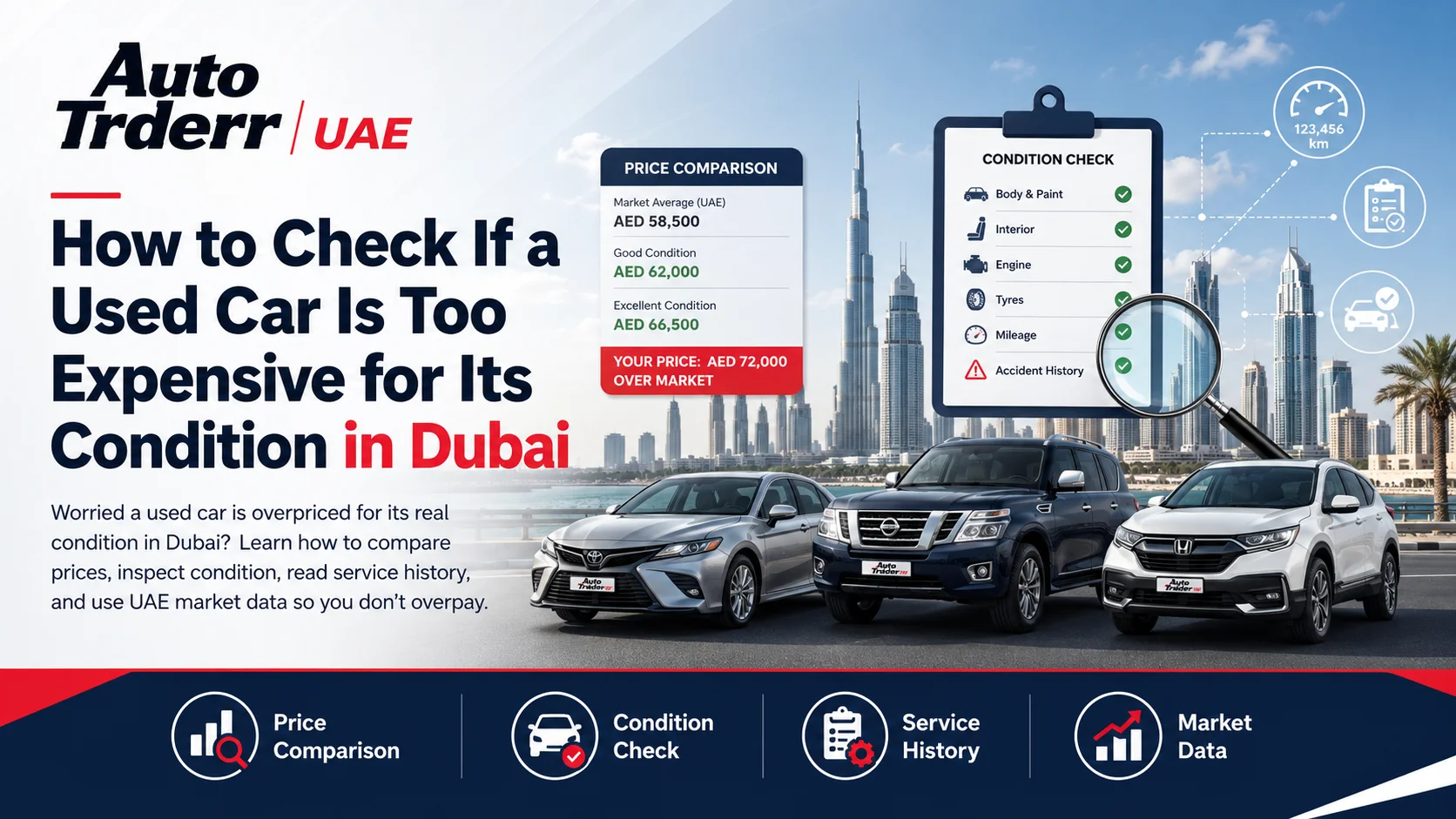
How to Check If a Used Car Is Too Expensive for Its Condition in Dubai
Buying a used car in Dubai can save you a lot of money – but only if the price matches the car’s real condition. With so many options across traders, showrooms, and online platforms like Auto Trader UAE, it’s easy to overpay if you don’t know what to look for. This guide explains how to check if a used car is too expensive for its condition in Dubai, step by step, so both buyers and sellers can price cars fairly and confidently.
1. Start With a Realistic Market Price Range
Before you even see the car, you need a rough idea of what similar cars are actually selling for in the UAE.
Use online listings as your baseline
Open multiple tabs and compare:
- Same make and model
- Same or very similar year
- Similar mileage (within 20,000–30,000 km)
- Similar trim level and engine size
- Similar fuel type (petrol, diesel, hybrid, EV)
A practical way to start is to browse:
Take note of asking prices for at least 10–15 similar vehicles. This gives you a realistic price band rather than relying on a single ad.
Watch for outliers
If one car is significantly more expensive than all the others, ask why. Possible reasons:
- Full agency service history from a main dealer
- Very low mileage for its age
- Top-spec trim with options like advanced safety, panoramic roof, or premium sound
- Still under manufacturer or extended warranty
If none of these apply, that higher price is likely not justified.
2. Understand How Condition Affects Value in Dubai
In the UAE, the same model can vary dramatically in price depending on how it has been used and maintained.
Key condition factors that change value
- Mileage: High mileage is common in Dubai, but it should be reflected in the price. A car with 180,000 km should be cheaper than a similar one with 70,000 km.
- Service history: Full, documented service history – ideally with authorised dealers – usually justifies a higher price.
- Accident history: Major accident repairs or chassis damage should reduce the price significantly.
- Exterior and paint: Sun damage, faded paint, and poor-quality resprays should pull the price down.
- Interior condition: Torn seats, sagging roof liner, broken buttons, and heavy wear lower value.
- Mechanical health: Engine, gearbox, suspension, and air conditioning are critical in UAE conditions.
If a car is priced at the top of the market but has average or below-average condition in any of these areas, it’s probably too expensive.
3. Check UAE-Specific Issues That Affect Value
Dubai’s climate and driving conditions create some unique wear points that should impact the price.
Heat and sun damage
Look for:
- Cracked or faded dashboard and plastics
- Peeling steering wheel or gear knob
- Faded paint, especially on roof, bonnet, and boot
- Headlights that are yellow or cloudy
All of these are signs of long-term outdoor parking and should lower the value versus a similar car kept mostly in covered parking.
Sand and dust exposure
Check:
- Air filter and cabin filter condition (if visible from maintenance records)
- Rubber seals on doors and windows
- Door hinges and electrical switches for stiffness or erratic behaviour
Excessive dust, especially inside the cabin, usually signals weaker care and maintenance – that should not command a premium price.
Stop–go city driving and short trips
Many Dubai cars do frequent short trips and heavy traffic driving:
- Check for worn brakes, warped discs, or vibrations.
- Listen for transmission judder in stop–go speeds.
- Ask about recent major maintenance: brakes, tyres, battery, and AC.
If the owner hasn’t kept up with these wear items, the buyer will have to – and the price should be adjusted down.
4. Compare Asking Price vs. Condition Step by Step
To judge if a used car is overpriced for its condition:
- Set the baseline price: From your research on Auto Trader UAE and other portals, find the typical asking price for similar cars in good condition.
- Score the car’s condition:
- Exterior/bodywork: Excellent / Good / Fair / Poor
- Interior: Excellent / Good / Fair / Poor
- Mechanical: Excellent / Good / Fair / Poor
- Tyres and brakes: Excellent / Good / Fair / Poor
- Service and history: Complete / Partial / Missing
- Adjust in your head:
- Excellent in most areas + full history can justify top of the range price.
- Good but not perfect condition should sit in the middle of the range.
- Fair or poor in any major area should push the price towards the lower end – or below it.
- Factor in upcoming costs: If tyres, brakes, or major services are due soon, mentally deduct those costs from the asking price.
If the seller wants top-of-market money for a car that clearly falls in the middle or bottom of this condition scale, it’s too expensive.
5. Use Reports and Inspections to Check for Hidden Problems
A car can look good on the surface but still be overpriced if it hides accident damage or mechanical issues.
Run a history check
In Dubai and across UAE, look for:
- RTA records and mileage readings on past tests
- Insurance or agency records (when accessible)
Ask the seller for any paperwork showing:
- Accident repairs, especially structural work
- Major replacements like engine, gearbox, or air conditioning compressor
A car with a serious accident history should be priced clearly below clean, accident-free examples.
Get a pre-purchase inspection
If you are spending a significant amount, consider a professional inspection from a reputable workshop or inspection centre. They can:
- Check chassis alignment and underbody
- Scan for electronic fault codes
- Test engine compression, transmission shifts, and suspension
If the inspection reveals issues that will cost money to fix, that’s a direct reason to negotiate the price down – or walk away.
6. Assess Wear-and-Tear vs. Age and Mileage
Not all wear is equal. You should judge whether the condition matches what you’d expect for the car’s age and mileage.
When condition doesn’t match the odometer
Be cautious if:
- The mileage is low, but the steering wheel, seats, and pedals are heavily worn.
- The mileage is high, but the owner claims “perfect condition” with almost no documented maintenance.
- There are gaps in the service book that don’t match the age and mileage.
Suspicious patterns don’t always mean tampering, but they should prevent you from paying top money.
Normal vs. excessive wear in Dubai
Examples of normal wear for a UAE car after 5–7 years:
- Some stone chips on the front
- Light interior marks
- Reasonable seat creasing
- One or two minor bumper repairs
Excessive wear that should lower the price:
- Multiple mismatched paint panels and overspray
- Deep scratches, dents, or cracked bumpers
- Badly sagging roof lining
- Strong smoking odour or heavy stains
7. Compare Features, Trim, and Options
Two cars can be the same model and year but have very different specs, which strongly affect value.
Features that usually justify higher prices
- Advanced safety features (adaptive cruise control, lane-keep assist, blind-spot monitoring)
- Leather seats and upgraded interior packages
- Panoramic roof or sunroof (if in good working condition)
- Premium sound systems
- Factory navigation and larger infotainment screens
- Alloy wheels and appearance packages
Always verify that these features are functioning properly. A panoramic roof that doesn’t open or an infotainment system with glitches reduces value instead of adding it.
Don’t overpay for modifications
Many Dubai cars have aftermarket mods, such as:
- Non-standard wheels and tyres
- Body kits or wraps
- Lowered suspension
- Performance upgrades
These rarely increase resale value and can sometimes decrease it, especially if not done by reputable installers. For most buyers, modifications are not a reason to accept a higher price.
8. Factor in Running Costs and Upcoming Maintenance
A car that is cheap to buy but expensive to maintain can still be the wrong choice.
Ask the seller about recent major work
Key questions:
- When were the tyres last changed?
- When were the brake pads and discs last replaced?
- Has the battery been changed recently?
- Has the AC system been serviced?
- Is any major service (like timing belt) due soon?
If several of these items are due in the next 6–12 months, you should pay less now to cover those expenses later.
Consider fuel type and efficiency
For city driving in Dubai:
- Smaller turbocharged petrol engines and hybrids can be more fuel-efficient.
- Larger engines and powerful SUVs cost more to run, even if the purchase price seems fair.
Compare similar options on Auto Trader UAE, such as:
If one car is priced high but will clearly cost more to run than similar alternatives, it may be poor value overall.
9. Use Negotiation to Test How Firm the Price Really Is
Once you have a clear idea of what the car is truly worth, it’s time to negotiate.
Prepare your negotiation points
Base your discussion on facts, not feelings:
- Comparable listings with lower prices for similar condition
- Visible issues: paintwork, interior wear, tyres, minor dents
- Service gaps or missing documentation
- Upcoming maintenance costs
If a seller is asking above-market money but won’t adjust the price even when presented with clear evidence, the car is likely overpriced – and you should be ready to walk away.
Know when to move on
Dubai’s used car market is large and varied. If the numbers don’t make sense, simply move on to other cars. Explore more options on:
A deal that feels forced or uncomfortable is rarely a good one.
10. Tips for Sellers: Pricing Your Car Fairly in Dubai
If you’re selling a used car, understanding how buyers judge price vs. condition can help you set a realistic and attractive price.
Be honest about condition
- Fix small issues that make a big visual impact: headlight polishing, minor detailing, basic interior cleaning.
- Photograph the car clearly from all angles in good light.
- Mention all important positives (full history, agency maintenance, low mileage) – but don’t hide negatives.
Support your price with documentation
- Keep service invoices and receipts organised.
- Highlight recent big-ticket items: new tyres, brakes, battery, or major service.
- Explain any accident repairs and show before/after photos if available.
A well-documented, transparently presented car can justify a stronger price and typically sells faster.
11. When a Used Car Is Definitely Too Expensive
You should strongly reconsider if any of these apply:
- The car is priced higher than similar listings with better condition and documentation.
- There are clear condition issues (paint, interior, mechanical) but the seller insists the car is “perfect”.
- The seller refuses inspections or history checks.
- The story about mileage, ownership, or accident history keeps changing.
- Upcoming maintenance costs will be high, but the price doesn’t reflect that.
In these situations, you are better off continuing your search.
Buyer Takeaway: Protect Your Budget, Not Just the Car
To avoid overpaying for a used car in Dubai:
- Research prices thoroughly for similar cars on Auto Trader UAE.
- Inspect condition carefully, with UAE-specific issues in mind.
- Use inspections and history checks to reveal hidden problems.
- Adjust the price in your head for wear, missing history, and upcoming costs.
- Be prepared to walk away if the price doesn’t match the real condition.
Seller Takeaway: Fair Pricing Attracts Serious Buyers
For sellers, a realistic price based on condition is the fastest way to a smooth sale:
- Research competing listings before setting your price.
- Present your car honestly with clear photos and full details.
- Use service records and recent maintenance to justify your asking price.
- Be open to reasonable negotiation based on factual feedback.
Conclusion: Use the Market to Your Advantage
Dubai’s used car market gives both buyers and sellers plenty of choice. The key is to connect price with real-world condition, not just model names and year numbers. If you’re ready to start comparing real cars and real prices, explore current listings on:
Use this guide as a checklist, and you’ll be far better equipped to spot when a used car is too expensive for its condition – and when you’ve found genuine value in the UAE market.
Browse used cars in UAE on Auto Trader UAE to compare live listings, prices, and current market activity more clearly.