
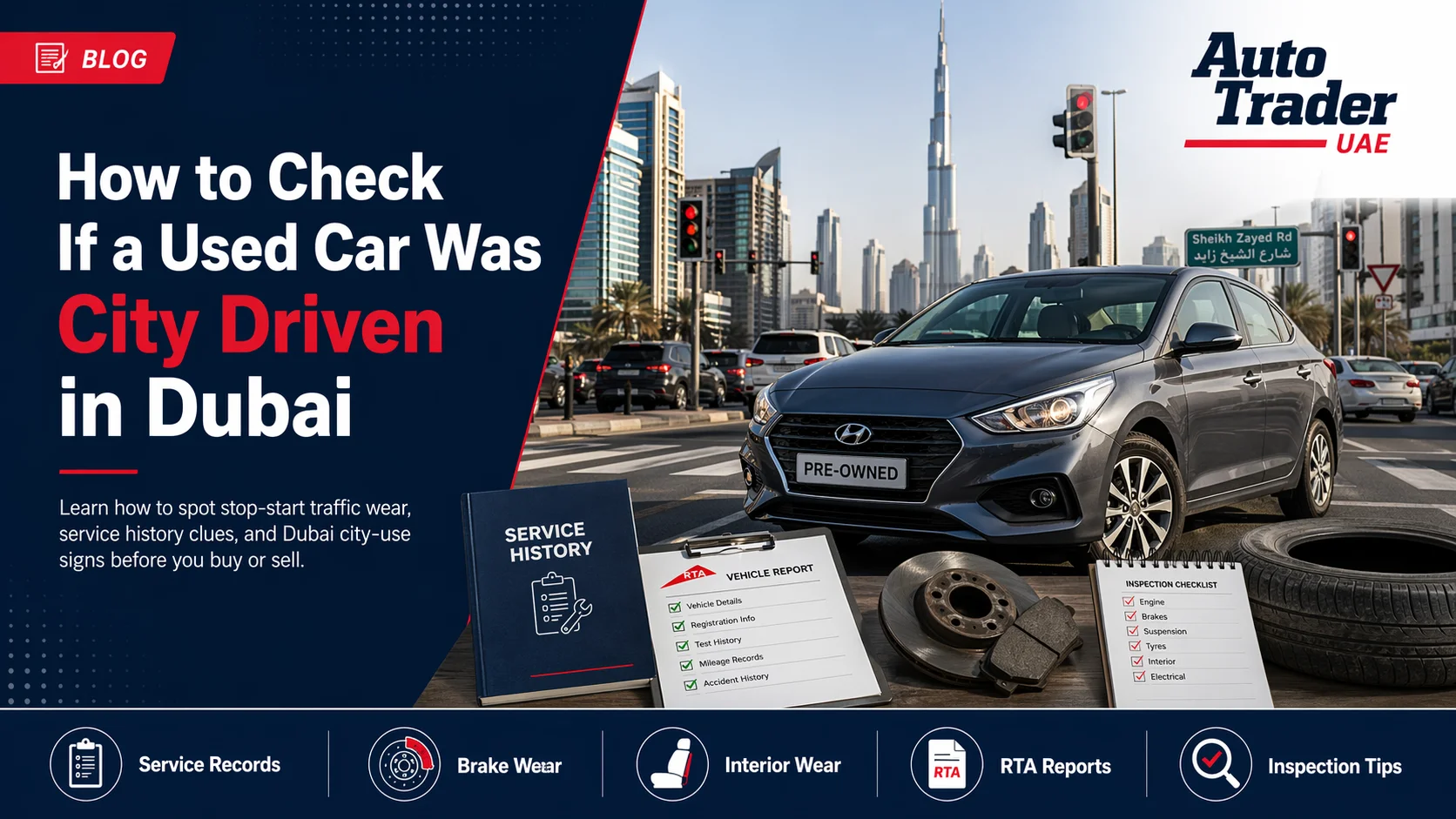
How to Check If a Used Car Was City Driven in Dubai
When you’re buying a used car in the UAE, one of the most important questions is how and where the car was driven. In Dubai, there’s a big difference between a car that has spent its life in stop‑start city traffic and one that has mainly done relaxed highway runs between emirates.
This guide explains how to check if a used car was city driven in Dubai, what that really means for wear and tear, and how buyers and sellers can use this information to price and negotiate more confidently on Auto Trader UAE.
Why It Matters if a Car Was City Driven in Dubai
City driving in Dubai usually means:
- Heavy traffic on Sheikh Zayed Road, Business Bay, Marina, Deira, and older districts
- Short trips with lots of cold starts
- Frequent stop‑start driving and hard braking
- Increased idling time with the AC running at full power in hot weather
This can accelerate wear on certain components, especially compared with smoother highway driving between Dubai, Abu Dhabi, Sharjah, and other emirates.
City‑driven cars are not necessarily bad – in fact, they can still be in excellent condition if properly serviced – but you should know what to look for and how to factor it into your decision and negotiation.
City Driving vs Highway Driving: What’s the Difference?
Typical City‑Driven Car in Dubai
- Lower yearly mileage, but more engine hours
- More wear on brakes, suspension bushings, and steering components
- Higher risk of cosmetic damage: parking dents, curb rash, minor scratches
- Engine and AC working harder in low‑speed, high‑heat conditions
Typical Highway‑Driven Car in the UAE
- Higher mileage, but mostly steady‑speed driving
- Smoother wear on engine and transmission
- Less stop‑start stress on brakes and gearbox
- Less parking damage, but potentially more stone chips from high‑speed roads
When checking a used car on Auto Trader UAE, the goal is to understand which pattern fits the car you’re viewing, then decide whether that’s right for your needs.
Step‑by‑Step: How to Tell if a Car Was City Driven in Dubai
1. Ask the Owner Specific, Location‑Based Questions
Many buyers simply ask, “Was it city driven or highway driven?” That often gets a rehearsed answer. Instead, ask detailed questions:
- “Where do you live and work?” – Daily commute between, for example, JLT and Business Bay suggests heavy city use.
- “Which roads did you use most?” – E11 (Sheikh Zayed Road) within Dubai, Al Khail, and SZR junctions often mean city rush‑hour use.
- “Any regular long trips?” – Regular drives Dubai–Abu Dhabi or Dubai–RAK point to more highway use.
- “Is this a daily car or a second car?” – Second cars used only for school runs or city errands are often short‑trip, city‑driven vehicles.
Note their answers and see whether they match what you find in the service history and inspection.
2. Check the Mileage Against the Car’s Age
In the UAE, a typical privately used car often does around 15,000–25,000 km per year. Use that only as a rough guide, then ask:
- Low mileage for its age (e.g., 5‑year‑old car with 40,000–60,000 km) – Very likely city driven or occasionally used only within Dubai.
- Average mileage (e.g., 5‑year‑old car with 80,000–130,000 km) – Mix of city and highway use.
- High mileage (e.g., 5‑year‑old car with 160,000+ km) – Often used for long highway journeys or commercial use (taxis, ride‑hailing, delivery).
Low mileage is attractive, but in Dubai’s climate, low mileage plus many short trips and long idling can actually be harder on the engine than moderate highway mileage with regular servicing.
3. Compare Wear on Pedals, Steering Wheel, and Seats
Interior wear can reveal how the car was used:
- Brake pedal – Heavy wear relative to the odometer may indicate extensive stop‑start city traffic.
- Steering wheel – Smooth, shiny patches suggest lots of low‑speed maneuvering (parking, tight streets).
- Driver’s seat bolsters – Excess wear can show frequent short trips with many entry/exit cycles.
If the car shows high interior wear but low mileage, it may have spent most of its life in congested areas of Dubai.
4. Inspect the Brakes and Wheels
City‑driven cars usually go through brake parts faster. Look for:
- Brake discs and pads – Check invoices or RTA test notes. Multiple early brake changes can indicate heavy city use.
- Feel during test drive – Pulsation, vibrations, or a soft pedal can suggest worn components from repeated hard braking.
- Wheel condition – Curb rash, scratched alloys, and damaged hubcaps are common with tight parking in Dubai malls and residential towers.
5. Look for Signs of Frequent Parking and Tight Maneuvering
City‑driven cars in Dubai often pick up cosmetic scars:
- Small dings on doors from mall or office car parks
- Scratches on bumpers at corner edges
- Scuffs on side mirrors from narrow streets or parking ramps
One or two marks are normal, but many small impacts can hint at a life spent in densely packed city parking.
6. Review Service History and RTA Test Reports
In Dubai and the wider UAE, maintenance records are powerful evidence of how a car was used. Ask for:
- Dealer or specialist service history – Regular oil changes every 10,000–15,000 km or at least once a year are crucial for city‑driven cars.
- RTA test reports – Annual test results may note mileage and remarks on brakes, suspension, steering, and emissions.
- Brake and suspension work – Frequent or early replacement of pads, discs, bushings, or shocks can indicate harsh city conditions.
When a seller on Auto Trader UAE lists full service history with clear mileage progression, it helps you verify that the usage story (city vs highway) is genuine.
7. Pay Attention to Engine Condition and Idling Signs
City‑driven cars in Dubai spend a lot of time idling with the AC on, which can age the engine faster than the odometer shows.
Check for:
- Rough idle – At traffic lights during the test drive, the engine should feel smooth with minimal vibration.
- Unusual engine noise – Ticking, knocking, or whining may indicate wear or lack of oil changes.
- Exhaust smoke – Blue or heavy white smoke is a serious red flag, especially on a supposedly low‑mileage, city‑used car.
- Engine bay heat damage – Brittle hoses, discolored plastics, or leaking gaskets can be worsened by long idle times in high heat.
8. Check Tyre Wear Patterns
Tyres can also tell a story:
- Uneven tyre wear – More common with frequent turning, U‑turns, and speed bumps found in city use.
- Frequent tyre changes in records – If tyres were changed often at relatively low mileage, the car may have seen a lot of aggressive stop‑start and cornering in urban traffic.
Confirm tyre age from the DOT code on the sidewall. Old tyres on a low‑mileage, city‑driven car may suggest long stationary periods in open parking under the sun.
9. Use OBD Scans and Engine Hour Readings When Possible
Some modern cars keep a record of total engine hours in the onboard computer (accessible via OBD scanner).
- High engine hours with low mileage – Suggests lots of idling and short‑distance city trips.
- Lower engine hours with high mileage – Points to steady highway driving where the engine runs efficiently.
If you’re not sure how to check this, you can ask a trusted workshop in Dubai or Sharjah to scan the car during a pre‑purchase inspection.
10. Consider Professional Pre‑Purchase Inspection
For higher‑value cars, or when buying a used vehicle you plan to keep for years, a professional inspection is worth the cost. A good workshop in Dubai can:
- Check suspension, steering, and brakes in detail
- Scan for stored fault codes in the ECU
- Inspect underbody for damage from speed bumps, curbs, or rough parking ramps
- Confirm if wear patterns match the claimed usage (city vs highway)
Many buyers on Auto Trader UAE use a third‑party inspection report to negotiate with confidence and avoid surprises later.
How City Driving in Dubai Affects Different Parts of the Car
Engine and Cooling System
- More heat from idling with AC
- Greater dependence on regular oil and coolant changes
- Possible carbon buildup from frequent short trips
Transmission
- Automatic gearboxes shift more often in traffic
- More heat build‑up in transmission fluid
- Stop‑start systems (if equipped) working constantly
Brakes and Suspension
- Faster brake pad and disc wear in stop‑start conditions
- Suspension bushings and shocks stressed by speed bumps and rough inner‑city roads
- Steering components under more strain from tight parking
Bodywork and Interior
- Higher chance of small parking dents and scratches
- More sun exposure if parked outdoors during office hours
- Frequent in‑and‑out usage leading to interior wear on seat bolsters, door handles, and switchgear
How Sellers in Dubai Can Use This to Their Advantage
If you’re selling your car on Auto Trader UAE and it’s mostly city driven:
- Be transparent – Clearly describe your typical usage (e.g., daily commute JVC to Business Bay, weekend city errands).
- Highlight maintenance – Show receipts for brake work, suspension checks, oil changes, and AC services.
- Fix easy cosmetic issues – Removing small dents and repairing curb rash can make a city‑driven car feel much more desirable.
- Mention parking conditions – Covered parking at home or office is a plus in Dubai’s heat.
Honesty builds buyer trust, helps justify your asking price, and can lead to a faster sale.
Buyer Takeaway: Practical Checklist Before You Decide
When you inspect a used car in Dubai and want to know if it was city driven, run through this quick checklist:
- Does age vs mileage suggest mainly city, mixed, or highway use?
- Do interior wear and pedal condition match the displayed mileage?
- Are there many small parking dents, scratches, or curb marks?
- Do service records show frequent brake or suspension work?
- Does the engine idle smoothly with the AC on?
- Have tyres worn evenly, and are they appropriate for the mileage and age?
- Do the owner’s answers about commute and typical routes make sense?
If most signs point to city use, factor in possible extra wear on brakes, suspension, and engine, and negotiate accordingly.
How Auto Trader UAE Helps Buyers and Sellers
Whether a car was city driven or highway driven, the key to a safe purchase is clear information and proper inspection. On Auto Trader UAE you can:
- Browse thousands of used cars for sale in the UAE with detailed descriptions and photos
- Filter by brand, model, year, mileage, and price to match your budget and usage
- Check other guides on buying used cars in Dubai and the UAE to learn what to inspect
- Compare popular models on dedicated make and model pages for reliability and running costs
Conclusion
Understanding how to check if a used car was city driven in Dubai helps you read between the lines of any online listing, ask smarter questions, and inspect more effectively.
Don’t judge only by mileage or a simple “city vs highway” label. Instead, combine service history, visual inspection, test drive impressions, and the owner’s story to get a complete picture.
When you’re ready to start your search, visit Auto Trader UAE to find well‑maintained used cars across Dubai and the wider UAE, and use what you’ve learned here to choose the right car for your daily drives.
If you are exploring used cars in Dubai or elsewhere in the UAE, Auto Trader UAE makes it easier to compare listings, prices, trims, mileage, and seller details in one place.
Related Links
Seller Takeaway
If you are selling a used car in the UAE, present the service history clearly, price the vehicle realistically, and highlight condition, specification, and ownership strengths honestly. A well-prepared listing with accurate details usually attracts more serious buyers.