
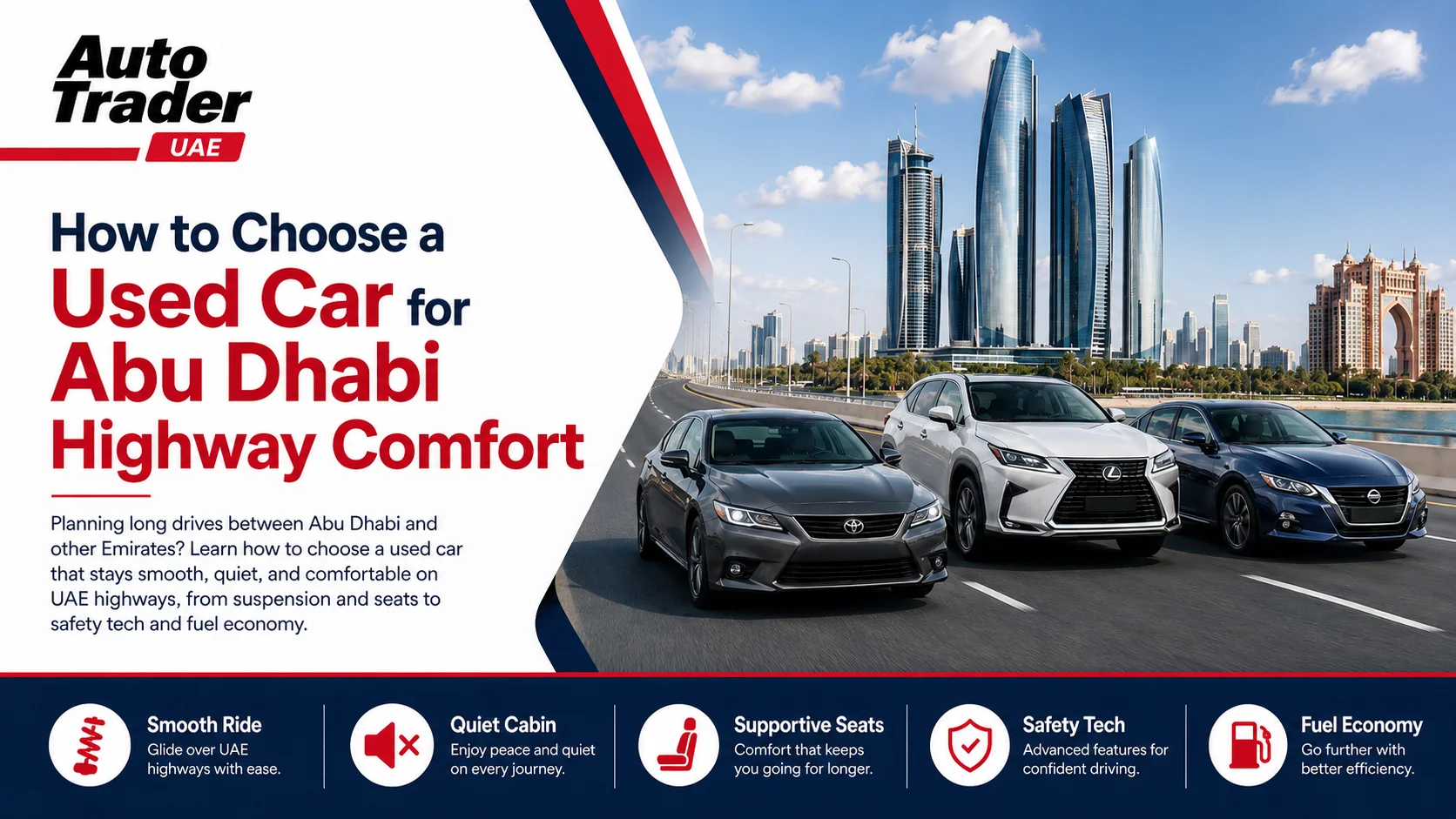
How to Choose a Used Car for Abu Dhabi Highway Comfort
If you spend a lot of time on the E11 or driving between Abu Dhabi, Dubai, and Al Ain, highway comfort matters as much as price and looks. Long, straight roads, high speeds, and summer heat all put extra demands on your car. This guide from Auto Trader UAE explains how to choose a used car that feels stable, quiet, and relaxing on Abu Dhabi highways – and what to check before you buy.
1. Decide What “Highway Comfort” Means for You
Before you search used cars in the UAE, be clear on your priorities. For Abu Dhabi highways, comfort usually means:
- Ride quality: The car absorbs bumps, expansion joints, and rough patches without shaking the cabin.
- Low cabin noise: Wind and tyre noise stay low even at 120–140 km/h.
- Supportive seats: You can drive for 1–2 hours without back or neck pain.
- High-speed stability: The car feels planted in crosswinds and when overtaking heavy trucks.
- Effective climate control: AC keeps the cabin cool at midday in August.
Think about your typical use:
- Daily commuting Abu Dhabi–Dubai: Comfort, fuel economy, driver-assist tech.
- Weekend family trips: Rear-seat comfort, boot space, safety.
- Business travel: Quiet cabin, premium feel, good infotainment.
Once you know what matters most, you can filter listings more effectively on Auto Trader UAE.
2. Best Used Body Types for Abu Dhabi Highways
Different body styles offer different types of comfort. Here’s how they compare for long UAE highway drives.
2.1 Sedans
Sedans are a very strong choice for Abu Dhabi highway comfort:
- Low centre of gravity – usually stable and planted at speed.
- Often better fuel economy than SUVs.
- Quieter cabins due to more aerodynamic shapes.
They’re ideal if you mostly drive on paved roads and don’t need high ground clearance.
2.2 Crossovers and Small SUVs
Crossovers and compact SUVs are popular in the UAE because they offer:
- Slightly higher driving position for better visibility.
- More boot space for luggage and family gear.
- Good comfort if suspension is well-tuned.
Focus on models known for refined ride rather than off-road toughness. Some SUVs with very stiff suspensions can feel bouncy on the highway.
2.3 Large SUVs
Full-size SUVs can deliver a very smooth ride over rough surfaces and speed bumps, with lots of space. However:
- They may use more fuel on long commutes.
- Higher body means more sensitivity to crosswinds.
They’re best if you regularly carry many passengers or tow, and still want highway comfort.
2.4 Hatchbacks and Compact Cars
Small cars can be comfortable for shorter Abu Dhabi city trips, but for long highway runs:
- They may feel a bit light at higher speeds.
- Tyre and wind noise can be more noticeable.
If your budget is limited, look for higher-trim versions with better sound insulation and upgraded seats.
3. Key Comfort Features to Look For
When you’re browsing used cars on Auto Trader UAE, pay close attention to the features that genuinely improve long-distance comfort.
3.1 Seats and Driving Position
Seats make or break highway comfort. Check for:
- Adjustable lumbar support: Reduces lower back strain on long drives.
- Height adjustment and tilt steering: Helps you find a natural driving posture.
- Cushion length and side support: Thigh support and side bolstering keep you comfortable and secure.
- Ventilated seats (if available): Very useful in UAE heat on leather seats.
When test driving, spend at least 15–20 minutes behind the wheel. If you feel any pressure points or discomfort early, it will be worse on the Abu Dhabi–Dubai stretch.
3.2 Suspension and Ride Quality
A good highway car should absorb small imperfections quietly. During your test drive:
- Drive over expansion joints, patched tarmac, and minor bumps.
- Notice if the car settles quickly after a bump or keeps bouncing.
- Listen for clunks or rattles that may signal worn suspension parts.
If possible, test at both city speeds and 100–120 km/h on a smooth highway section.
3.3 Noise Insulation
At UAE highway speeds, cabin noise makes a big difference to fatigue levels. Look for:
- Thicker door seals and double door rubbers.
- Carpets and soft-touch materials on doors and dashboard.
- Acoustic windscreen (often mentioned in spec sheets on higher trims).
On the test drive, turn off the audio and AC fan for a while and listen to:
- Wind noise around mirrors and A-pillars.
- Tyre noise depending on road surface.
- Engine noise when accelerating to 120–140 km/h.
3.4 Climate Control Performance
Abu Dhabi heat quickly exposes weak AC systems. In a used car, check:
- How quickly the cabin cools from hot start.
- If rear passengers get enough airflow (rear vents are a big plus).
- If the AC maintains performance at highway speeds under direct sun.
Dual-zone or tri-zone climate control can significantly improve comfort for family trips.
3.5 Highway-Friendly Technology
Modern driver aids can make long drives smoother and safer:
- Adaptive cruise control: Maintains distance from the car ahead, very useful in varying E11 traffic.
- Lane keeping assist: Helps reduce fatigue on long, straight stretches.
- Blind-spot monitoring: Helpful for multi-lane highway lane changes.
- Apple CarPlay/Android Auto: For easy navigation and calls without distraction.
Not all used cars have these, but if you drive long distances regularly, they’re worth paying extra for.
4. Safety Essentials for High-Speed Travel
Comfort and safety go together, especially at 120–140 km/h.
- ESC (Electronic Stability Control): Helps keep the car stable in sudden avoidance manoeuvres.
- Multiple airbags: At least front and side airbags, ideally curtain airbags for rear passengers.
- Strong braking system: On the test drive, perform a firm stop from ~80 km/h to feel stability and stopping power.
- Tyre condition and size: Quality tyres in the correct size and load rating make a huge difference to grip and comfort.
Before buying any used car for Abu Dhabi highways, budget for a fresh set of good-brand tyres if the current ones are old or mismatched.
5. Engine, Gearbox, and Fuel Economy
Highway comfort is also about how relaxed the car feels at speed.
5.1 Engine Size and Power
You don’t need a large engine, but you do want enough power to:
- Overtake safely without the engine screaming.
- Maintain 120–140 km/h with low RPM.
Turbocharged 4-cylinder engines and smooth 6-cylinder units can both work well. Focus on how the car feels at 100–140 km/h, not just from standstill.
5.2 Transmission Type
- Automatic transmissions: Preferable for stop–go traffic and relaxed cruising.
- Traditional torque-converter automatics: Usually smooth and proven for UAE conditions.
- CVT gearboxes: Can be very smooth and efficient but vary by brand; check maintenance history.
At highway speed, the gearbox should keep revs low and shifts barely noticeable.
5.3 Fuel Economy at Highway Speed
If you commute daily between Emirates, fuel costs add up. When comparing used cars, look at:
- Realistic highway fuel consumption (from owner reviews where available).
- Tank size – larger tanks reduce fuel stops on long trips.
Balance comfort features with running costs that fit your monthly budget.
6. What to Inspect on a Used Car in the UAE
Abu Dhabi’s climate is harsh, so pay attention to wear from heat, sun, and past highway use.
6.1 Service History and Mileage
- Look for full or mostly complete service records, ideally with authorised dealers or reputable workshops.
- Highway mileage isn’t necessarily bad; steady cruising can be easier on a car than short city trips. Focus on maintenance quality, not only odometer numbers.
6.2 Suspension and Steering
For a comfortable highway car, mechanical condition is crucial:
- Check for uneven tyre wear and vibrations.
- On test drive, see if the car pulls to one side.
- Listen for knocking sounds over bumps.
If you like a car, consider a pre-purchase inspection at a trusted workshop to assess shocks, bushings, and alignment.
6.3 Interior Condition
A clean, well-kept cabin often signals careful ownership:
- Check seat bolsters and stitching for wear.
- Test all seat adjustments, especially electric motors.
- Inspect dashboard and trim for sun damage or warping.
6.4 Air Conditioning Health
Ask the seller about any AC work done (compressor, condenser, gas refills). A weak AC will directly affect comfort and can be costly to repair.
7. How to Test Drive for Highway Comfort
A quick spin around the block is not enough. To evaluate Abu Dhabi highway comfort, try to:
- Start in the city: Evaluate ride over speed bumps and rougher patches.
- Join a main road: Accelerate up to 100–120 km/h and feel how the car builds speed.
- Check stability: On a safe, straight stretch, lightly change lanes and notice if the car feels composed.
- Assess noise: At cruising speed, note wind, tyre, and engine noise.
- Simulate a commute: Drive for at least 20–30 minutes continuously if possible.
Go back-to-back if you are comparing two cars; differences in comfort become clearer when drives are close together.
8. Budgeting: Comfort vs. Features vs. Age
When shopping used, you’ll often choose between:
- Newer car with basic trim – better safety tech, newer platform, simpler interior.
- Older car with high trim – more features like leather, sunroof, premium audio, but possibly more wear.
For long Abu Dhabi highway driving, prioritise:
- Mechanical condition and safety (tyres, brakes, suspension, ESC).
- Seat comfort and AC performance.
- Noise insulation and ride quality.
- Optional technology features.
Sometimes, a well-maintained mid-trim car will be more comfortable and reliable than a top-trim car with neglected maintenance.
9. Matching the Car to Your Route
Consider where you actually drive most of the time:
- Abu Dhabi–Dubai daily: Look for a refined sedan or comfortable crossover with good fuel economy, supportive seats, and adaptive cruise control if possible.
- Abu Dhabi–Al Ain or Western Region: Prioritise strong AC, robust suspension, good lighting for night driving, and a large fuel tank.
- Mainly within Abu Dhabi city with occasional highway trips: A compact sedan or hatchback with decent sound insulation may be enough.
10. Using Auto Trader UAE to Find the Right Used Car
On Auto Trader UAE, you can narrow your search for highway-comfortable cars by:
- Filtering by body type (sedan, SUV, crossover) and price.
- Using keywords like “full option”, “leather seats”, “cruise control”, “sunroof”, or “GCC spec” in the search bar.
- Sorting by newest listings to spot fresh, well-kept cars quickly.
When you see an attractive listing:
- Read the description carefully for mentions of service history, new tyres, and highway use.
- Check photos for seat condition, steering wheel wear, and any visible modifications.
- Contact the seller with specific questions about comfort features and recent maintenance.
11. Buyer and Seller Tips for Highway-Focused Cars
For Buyers
- Shortlist a few models known for comfort rather than chasing every deal.
- Always do a proper highway-style test drive before committing.
- Set aside a small budget after purchase for new tyres, wheel alignment, and AC service – these upgrades can transform highway comfort.
For Sellers
If your car is particularly good on highways, highlight this in your Auto Trader UAE listing:
- Mention commuting routes (e.g. regular Abu Dhabi–Dubai use) if the car has proven stable and reliable.
- List comfort features clearly: cruise control, seat type, sound system, AC work.
- Service the AC, check tyre condition, and fix any suspension noises before advertising – buyers focused on comfort will notice these immediately.
Conclusion: Build Your Own Definition of Comfort
Choosing a used car for Abu Dhabi highway comfort is not about chasing the most expensive model; it’s about finding the right combination of seating, ride quality, noise control, AC, and safety for your budget and route. Define what matters most to you, test drive with highway use in mind, and prioritise condition over extras. With a structured approach and the right filters on Auto Trader UAE, you can find a used car that keeps you and your passengers relaxed on every trip across the Emirates. When you’re ready to start, explore a wide selection of used cars in UAE, and if you travel frequently between Emirates, you can also compare options among used cars in Dubai to secure the most comfortable highway companion for your needs.
Browse used cars in UAE on Auto Trader UAE to compare live listings, prices, and current market activity more clearly.
Related Links
Buyer Takeaway
When buying a used car in the UAE, focus on vehicle condition, service history, inspection quality, paperwork, and total running costs rather than price alone. Compare options carefully and choose the option that best matches your budget and real needs.
Seller Takeaway
If you are selling a used car in the UAE, present the service history clearly, price the vehicle realistically, and highlight condition, specification, and ownership strengths honestly. A well-prepared listing with accurate details usually attracts more serious buyers.