
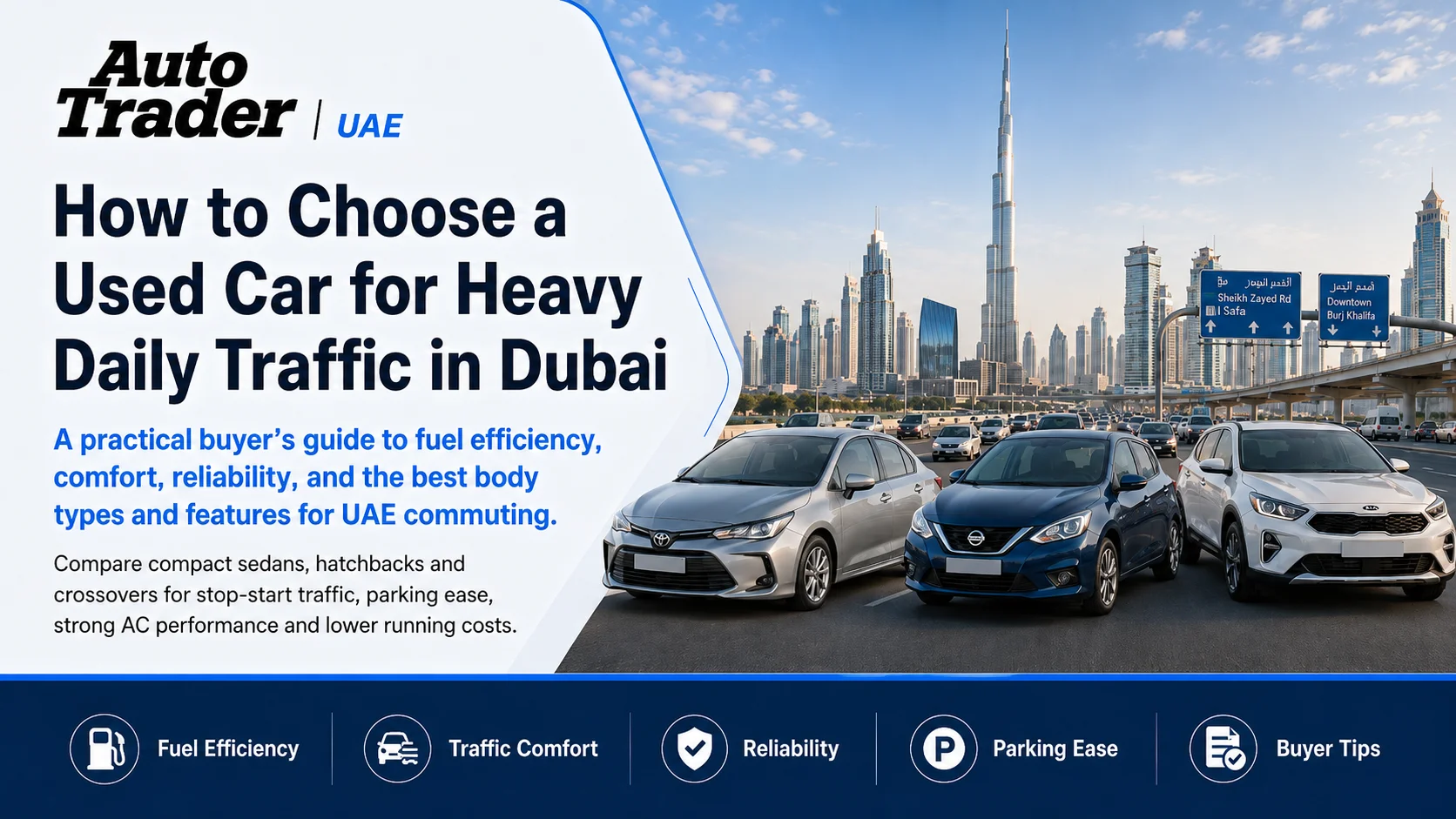
How to Choose a Used Car for Heavy Daily Traffic in Dubai
Daily commuting in Dubai can mean long stretches on Sheikh Zayed Road, slow-moving congestion around Business Bay, and frequent stop‑start traffic near popular business districts. Choosing the right used car for this type of driving is less about top speed and more about comfort, efficiency, and reliability.
This guide from Auto Trader UAE walks you through how to choose a used car that can handle heavy daily traffic in Dubai, plus the types of models and features that make commuting less stressful.
1. Start with Your Daily Commute Profile
Before you even look at specific cars, be clear about how and where you drive most days:
- Distance: How many kilometres do you cover daily?
- Route type: Mostly highways, inner-city roads, or mixed?
- Traffic pattern: Peak hours only, shift work, or flexible timings?
- Parking: Basement parking, parallel street parking, or open lots?
If you spend 60–90 minutes daily in heavy traffic, comfort and fuel economy should be your top priorities. If your commute includes tight parking in older areas, compact size and visibility become more important.
2. Best Body Types for Heavy Dubai Traffic
Different body styles suit different types of commuting. For Dubai traffic, these are the most practical choices on the used market:
2.1 Hatchbacks
Best for: Solo drivers or couples, tight parking, Deira/Bur Dubai inner-city driving.
Why: Easy to park, good visibility, usually very fuel-efficient, and cheaper to maintain. Popular examples include compact Japanese and Korean hatchbacks that are common across Dubai.
2.2 Compact Sedans
Best for: Daily commuting from Sharjah or Ajman to Dubai, budget-conscious buyers.
Why: Balance of cabin space, boot capacity, and fuel economy. Many taxi and fleet sedans in the UAE are chosen for exactly these reasons, which proves their suitability for long traffic-heavy drives.
2.3 Crossovers and Small SUVs
Best for: Drivers who want a higher seating position, families, mixed city/highway driving.
Why: Higher driving position improves visibility in crowded lanes, making it easier to anticipate braking and lane changes. Modern crossovers often have good fuel efficiency, especially smaller engine options.
Unless you regularly go off‑road or carry heavy loads, a large SUV with a big engine is often unnecessary for daily traffic and can mean higher fuel and maintenance costs.
3. Engine Size, Fuel Type, and Gearbox: What Works Best?
3.1 Engine Size
- 1.4L–2.0L petrol engines usually offer the best balance of power and fuel economy for Dubai commuting.
- Very small engines can feel underpowered when merging on highways if the car is fully loaded.
- Large engines (3.0L+) offer strong performance but may be excessive for daily stop‑start traffic, with noticeably higher fuel costs.
3.2 Petrol vs Hybrid vs Diesel
- Petrol: Most common and easy to service in the UAE. Good all‑round choice for heavy city traffic.
- Hybrid: Can offer excellent fuel economy in stop‑go traffic, where the electric motor assists at low speeds. Make sure you understand battery warranty, age, and replacement costs.
- Diesel: Less common for private cars in Dubai. More relevant for large SUVs and commercial use than daily commuting in heavy traffic.
3.3 Automatic vs Manual Gearbox
In heavy Dubai traffic, an automatic gearbox is usually the most practical choice:
- Automatic: Much less tiring in stop‑start driving, easier for new drivers, and widely available on most used cars in the UAE.
- CVT (Continuously Variable Transmission): Common in many modern Japanese and some Korean models. Offers smooth acceleration and good fuel economy but should be test-driven carefully for any hesitation or unusual noises.
- Dual-clutch (DCT/DSG): Can shift quickly and efficiently but may feel jerky in very slow traffic if not tuned well or if not maintained properly.
4. Comfort and Features That Matter in Dubai Traffic
When you’re inching along Sheikh Zayed Road in August, the right comfort features make a big difference.
4.1 Must-Have Comfort Features
- Strong air conditioning: Check that the A/C cools the cabin quickly, even after the car has been parked in the sun.
- Comfortable seats: Look for good back support, height adjustment, and, if possible, adjustable lumbar support.
- Quiet cabin: Excessive road or wind noise can become exhausting in long traffic jams.
- Rear A/C vents (for family use): Helpful if you often carry passengers or children.
4.2 Technology and Convenience
- Cruise control: Useful for longer highway stretches, even if traffic is medium.
- Apple CarPlay / Android Auto: Easier navigation and calls without handling your phone.
- Reverse camera and parking sensors: Essential for tight mall and office parking in busy areas.
- Keyless entry and start: Convenient when you’re in and out of the car multiple times a day.
5. Safety Priorities for Heavy City Driving
In dense Dubai traffic, safety features help reduce accidents and make sudden stops and lane changes less risky.
5.1 Core Safety Features to Look For
- ABS (Anti-lock Braking System) and stability control as a minimum.
- Multiple airbags – front, side, and curtain where possible.
- Traction control – useful during sudden acceleration or on slippery surfaces.
5.2 Advanced Driver Assistance (If in Budget)
- Adaptive cruise control – maintains distance to the car ahead in slow‑moving traffic.
- Forward collision warning and automatic emergency braking – helps avoid low‑speed nose‑to-tail accidents in congestion.
- Blind-spot monitoring – useful on multi-lane highways where lane changes are frequent.
- Rear cross-traffic alert – helps when reversing out of crowded parking spaces.
6. Reliability and Maintenance in UAE Conditions
Heavy daily traffic, high temperatures, and dust mean that some cars handle Dubai conditions better than others. When choosing a used car, focus on:
6.1 Proven Reliability
- Look for brands and models with a strong reputation in the UAE for lasting well beyond 150,000 km with regular servicing.
- Check that maintenance records are available: dealership stamps, service invoices, and major parts replacements.
6.2 Cooling and Air-Conditioning Systems
- Ensure there are no signs of overheating, such as temperature gauge fluctuations during a test drive.
- Test the A/C at idle and while driving; it should remain consistently cold.
6.3 Cost and Availability of Parts
- Popular models in Dubai usually have more accessible spare parts and multiple service options.
- Ask about typical costs of routine parts such as brake pads, suspension components, and A/C servicing.
7. Fuel Economy vs Performance in Stop-Start Traffic
In heavy traffic, you’re often idling or accelerating gently. A car that is too powerful for its weight can consume more fuel than necessary in such conditions.
When comparing used cars:
- Check real-world fuel consumption, not only brochure figures.
- Smaller, modern engines (with or without mild hybrid tech) often perform very efficiently in city driving.
- Tyre choice and correct tyre pressures also have a noticeable impact on fuel consumption and comfort.
8. Size, Manoeuvrability, and Parking in Dubai
Dubai’s main roads are wide, but office towers, older neighbourhoods, and crowded malls can be challenging for large vehicles.
- Shorter wheelbase and compact length make daily parking, U‑turns, and lane changes easier.
- Good visibility – slim pillars and large mirrors help in dense traffic.
- Light steering is more comfortable in city driving than very heavy steering setups.
9. Essential Checks When Inspecting a Used Car for Daily Traffic Use
When buying a used car for heavy daily commuting, go beyond the basic visual checks.
9.1 Service History and Mileage
- Prefer cars with consistent service history, especially for cars that were used as daily commuters.
- A higher mileage car with full, regular maintenance can be a better choice than a low‑mileage car with no records.
9.2 Test Drive in Real Conditions
Try to test drive the car in a way that replicates your daily commute:
- Drive during a busier time of day if possible.
- Include both highway and inner-city driving.
- Pay attention to gearbox behaviour in slow traffic – any jerks, delays, or shuddering.
- Check for vibrations through the steering wheel or seat at idle.
9.3 Mechanical and Structural Checks
- Look for uneven tyre wear – often a sign of suspension or alignment issues.
- Listen for knocking sounds over bumps, which may indicate worn suspension components.
- Inspect the interior for excessively worn pedals and steering wheel, which can suggest harder usage than the mileage shows.
- Whenever possible, have a trusted independent workshop or inspection service check the car before you commit.
10. Budgeting for a Daily Dubai Commute Car
When you set your budget for a used car in Dubai, include more than just the purchase price.
- Insurance: Premiums vary based on vehicle value, age, and your driving history.
- Fuel: Estimate monthly fuel based on your daily route and the car’s realistic fuel consumption.
- Service and tyres: Regular services, brake pads, and tyres will be needed more frequently if you cover high mileage each year.
- Depreciation: Popular, reliable models usually hold value better, which is important if you plan to sell in a few years.
11. Matching Car Type to Dubai Commuter Profiles
Here are simple profiles to help narrow down your search on Auto Trader UAE:
- Solo professional, mostly city driving: Compact hatchback or small sedan with automatic transmission, strong A/C, and parking sensors.
- Family commuter, Dubai – Sharjah or Dubai – Ajman: Reliable compact sedan or crossover with good rear space, rear A/C vents, and a focus on comfort and fuel economy.
- Business owner making multiple short trips in the city: Easy-to-park hatchback or compact crossover with good visibility, strong A/C, and low running costs.
12. Next Steps: Finding the Right Used Car in the UAE
Once you know the body type, engine size range, and features that suit your daily Dubai traffic, the next step is to browse real cars and compare options.
On Auto Trader UAE, you can filter used cars by year, mileage, body type, transmission, fuel type, and price to match your commuting needs. Take your shortlist, arrange test drives in realistic traffic conditions, and always review service history and inspection reports carefully before making a decision.
Whether you’re upgrading your daily commuter or selling your current car to move into something more efficient, the right choice will make heavy Dubai traffic more manageable, safer, and less tiring every day.
Ready to start?
- Browse the latest used cars in UAE.
- If you commute mainly within the city, explore used cars in Dubai to find options close to you.
With a clear checklist and the right search filters, you can find a used car that is perfectly suited to heavy daily traffic in Dubai.
Browse used cars in UAE on Auto Trader UAE to compare live listings, prices, and current market activity more clearly.
Related Links
Buyer Takeaway
When buying a used car in the UAE, focus on vehicle condition, service history, inspection quality, paperwork, and total running costs rather than price alone. Compare options carefully and choose the option that best matches your budget and real needs.
Seller Takeaway
If you are selling a used car in the UAE, present the service history clearly, price the vehicle realistically, and highlight condition, specification, and ownership strengths honestly. A well-prepared listing with accurate details usually attracts more serious buyers.
Conclusion
A careful used car purchase in the UAE starts with research, proper inspection, and clear paperwork before making the final decision.