
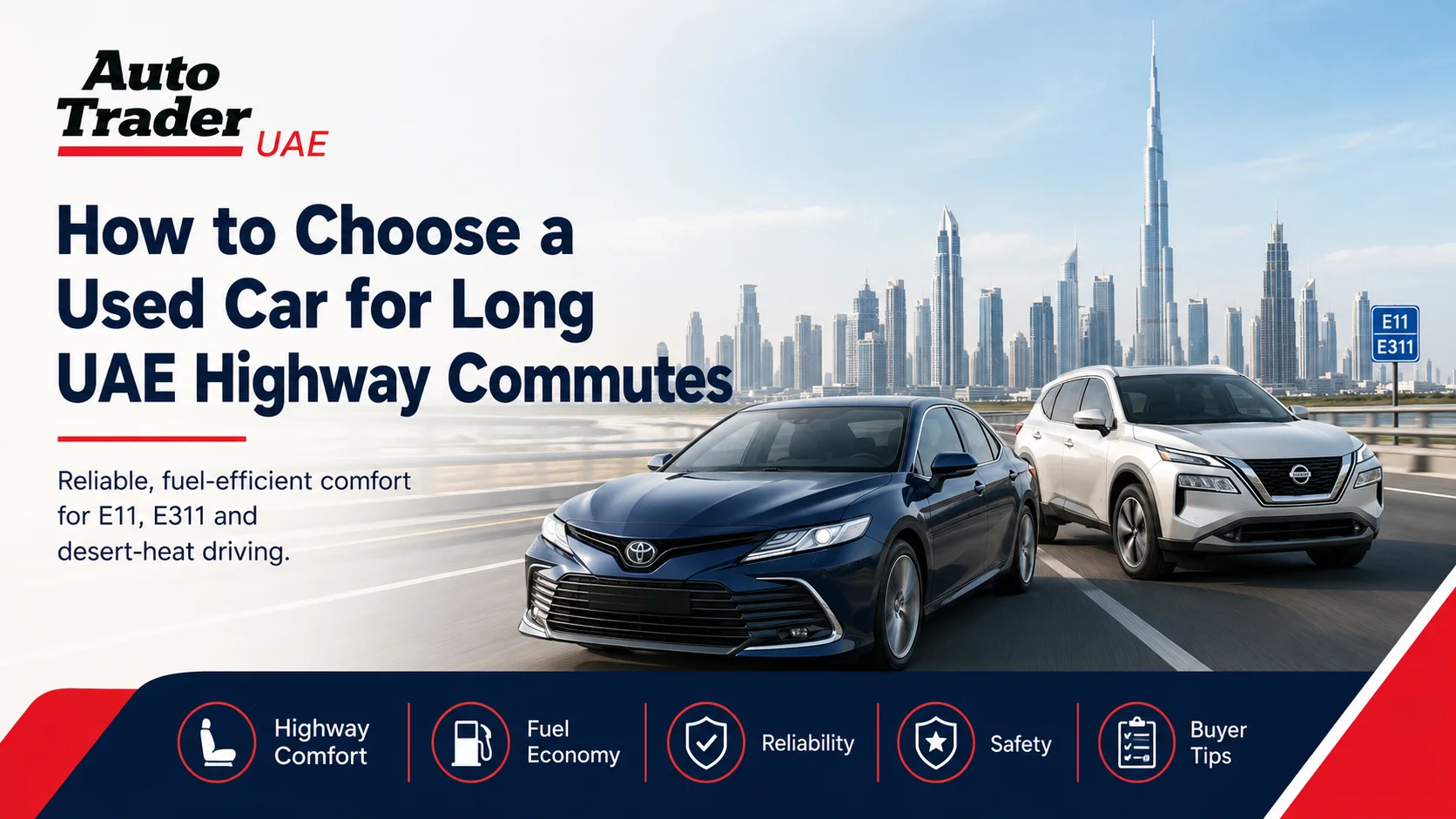
How to Choose a Used Car for Long UAE Highway Commutes
Daily drives between emirates on Sheikh Zayed Road (E11), E311, or E611 demand more from a car than short city trips. High speeds, hot weather, and strong crosswinds mean your used car choice really matters. This guide explains how to choose a used car that can handle long UAE highway commutes comfortably, safely, and efficiently.
1. Start with the Right Body Type for Highway Use
Before looking at brands or features, think about the kind of driving you’ll actually do every day.
Sedan: best balance for most commuters
- Pros: Stable at high speeds, usually more fuel-efficient, quieter cabins than many small SUVs, and often cheaper to buy.
- Ideal for: Solo commuters or couples driving between Dubai–Abu Dhabi, Sharjah–Dubai, or Al Ain–Dubai.
Crossover / small SUV: comfort and visibility
- Pros: Higher driving position, easier to see around traffic, more space for family and luggage.
- Consider: Aerodynamics and weight – some crossovers use more fuel at 120–140 km/h than sedans.
- Ideal for: Families commuting between emirates, or drivers who mix highway and occasional trips to desert tracks or farms.
Large SUV: only if you really need it
- Pros: Very comfortable, big fuel tanks, strong presence on the road.
- Cons: Higher fuel bills, more tyre wear, possible body roll in sudden lane changes.
- Best for: Long-distance drivers who regularly carry 4–7 passengers or tow trailers.
For most UAE highway commuters, a well-kept used sedan or compact crossover is the smart, economical choice.
2. Prioritise Comfort for Long Distances
On a 150–300 km daily round trip, comfort affects your safety, alertness, and health.
Seats and driving position
- Look for height-adjustable driver’s seat and lumbar support (manual or electric).
- Check seat cushioning: sit for at least 10–15 minutes in the driver’s seat during the viewing.
- Make sure you can reach pedals and steering wheel comfortably without stretching.
Cabin noise and ride quality
- On a test drive, take the car up to typical highway speeds (where legal) and listen for wind, tyre, and engine noise.
- Watch how the car handles expansion joints, bridges, and rough patches – excessive bouncing will be tiring over time.
- Check the condition and brand of tyres; cheap, hard tyres can make long drives noisy and harsh.
Climate control for UAE heat
- Strong AC performance is essential: the cabin should become noticeably cooler within a few minutes, even in the afternoon.
- Prefer automatic climate control and, if possible, rear AC vents for family commuters.
- Check for signs of AC neglect: weak airflow, bad smells, or unusual noises when AC is on.
3. Choose the Right Engine and Fuel Economy
At steady highway speeds, the engine works differently than in the city. You want a balance of power, refinement, and efficiency.
Engine size and type
- 1.6–2.0L petrol sedans and crossovers usually offer the best compromise for solo commuters.
- 2.0–2.5L petrol suits heavier cars, regular overtaking, and fully loaded family trips.
- Turbo engines give strong performance, but check service history carefully – they need timely oil changes.
Fuel economy in real UAE conditions
- Official fuel-consumption numbers are useful, but also search for owner feedback in GCC conditions.
- Highway commuting at steady legal speeds is usually more efficient than stop–go city driving.
- Consider total monthly cost: fuel, Salik, and maintenance – not just litres per 100 km on paper.
Petrol vs diesel for UAE commuters
- Petrol is simpler, quieter, and easier to service almost everywhere in UAE.
- Diesel may be economical for very high mileage drivers with the right car, but diesel passenger cars are less common and resale may be slower.
4. Safety Features for Fast UAE Highways
Long commutes on multi-lane highways mean you share the road with heavy trucks, fast vehicles, and sometimes low visibility from dust or fog. Safety tech is worth paying for.
Essential active safety
- ABS (anti-lock braking system)
- ESC/ESP (electronic stability control) – helps keep the car stable in emergency manoeuvres.
- Traction control – useful on wet or sandy patches.
- Cruise control – reduces fatigue and helps you maintain a steady, legal speed.
Useful advanced driver assistance
If your budget allows, look for:
- Adaptive cruise control (keeps distance to car ahead)
- Lane-keep assist (gentle steering help to stay in the lane)
- Blind-spot monitoring (warning when a car is in your blind spot)
- Forward collision warning or autonomous emergency braking
Passive safety and structure
- Prefer cars with at least four airbags (front and side).
- Check international safety ratings (Euro NCAP, ANCAP, etc.) for the model and year where available.
- Inspect the car for signs of accident repairs: misaligned panels, overspray, paint mismatch.
5. Highway Stability, Steering, and Braking
On long UAE commutes, you may face crosswinds, sudden lane changes, and quick braking. How the car behaves at speed is critical.
High-speed stability
- During a test drive, check if the car tracks straight at 100–120 km/h without constant steering correction.
- Pay attention to body roll when changing lanes quickly.
- If the car feels nervous or "floating", budget for suspension and alignment checks – or consider another vehicle.
Steering feel
- Steering should be light at low speeds but firmer at highway speeds.
- Excessive play or vibration through the steering wheel can indicate worn components or unbalanced wheels.
Brakes
- From highway speed, perform a firm but safe brake test when the road is clear.
- The car should slow in a straight line without pulling or vibrations.
- Grinding noises or long pedal travel suggest upcoming brake work.
6. Transmission Choice for UAE Commutes
Your gearbox has a big impact on comfort, fuel use, and long-term reliability.
Automatic transmissions
- Traditional torque-converter automatics are usually smooth and proven for long-distance driving.
- CVTs (continuously variable transmissions) can be very smooth and efficient but need regular fluid changes and careful test drives for any shuddering or whining.
- DCTs (dual-clutch transmissions) shift quickly and efficiently, but some older designs can feel jerky at low speed; a long test drive is essential.
Manual transmissions
- Less common in UAE and not ideal for heavy traffic near city centres.
- Can be reliable and economical if you are comfortable driving manual and mainly do open-highway kilometres.
7. Ownership Costs for High-Mileage Drivers
Long UAE highway commutes quickly add kilometres. Choose a used car that can handle high mileage without destroying your budget.
Service history
- Look for a full service history (agency or reputable workshop).
- Check that major services (timing belt/chain, transmission fluid, coolant, spark plugs) were done on time.
- A car with slightly higher mileage but excellent maintenance is often better than a low-mileage car with poor or unknown servicing.
Parts availability and workshop support
- Stick to popular brands and models in UAE so parts are easier and cheaper to source.
- Ask local garages about known issues with the model you’re considering.
- Check insurance quotes before buying – some models cost more to insure due to parts cost or repair complexity.
Resale value
- High motorway mileage is normal in UAE; buyers will still consider your car if it has clear history and regular maintenance.
- Well-known commuter sedans and crossovers generally hold value better than niche or imported models with limited support.
8. What to Inspect on a Used Car for Highway Commutes
When viewing used cars, focus on items that affect safety, comfort, and long-distance durability.
Exterior and tyres
- Check tyre brand, age, and tread; old or budget tyres may need immediate replacement for safe high-speed driving.
- Look for even tyre wear – uneven wear can indicate alignment or suspension problems.
- Inspect headlights for clarity; foggy lenses reduce night visibility.
Interior and electronics
- Test AC on full load and different fan speeds.
- Check infotainment, Bluetooth, and steering-wheel controls – long commutes are easier with hands-free calling and navigation.
- Ensure all windows, mirrors, and seat adjusters operate smoothly.
Mechanical checks
- Listen for engine knocking, rattling, or excessive ticking on start-up and when warm.
- Check for fluid leaks under the car after a test drive.
- Have an independent inspection done for engine compression, suspension components, and brakes if possible.
9. Smart Test-Drive Route for UAE Highway Buyers
A quick spin around the block isn’t enough for a commuter car. Plan a test drive that copies your real use.
- Start in the city to feel low-speed comfort, visibility, and gearbox smoothness.
- Join a nearby highway (E11, E311, E611, or similar) to test stability, noise, AC performance under load, and cruise control.
- Drive for at least 20–30 minutes so issues appear when the car is fully warm.
- Try an emergency-style brake test when safe and legal.
10. Matching the Car to Your Commute Pattern
Different UAE commutes need different strengths. Consider:
Dubai–Abu Dhabi or Abu Dhabi–Al Ain
- Long, high-speed runs with limited stops.
- Prioritise comfort, quietness, and fuel economy over extreme performance.
Sharjah–Dubai or Ajman–Dubai
- Mix of heavy traffic and open highway.
- Look for good AC, automatic gearbox, and strong safety features for dense traffic plus highway stability.
Northern Emirates to Dubai/Abu Dhabi
- Longer distances and sometimes stronger crosswinds.
- Choose a car with confident lane-change behaviour and solid high-speed stability.
11. Using Auto Trader UAE to Find the Right Used Commuter Car
Once you know what you need, you can use Auto Trader UAE search filters to narrow down the best options for your daily highway drive. Filter by body type, price, mileage, fuel type, and more to match your commute and budget.
Browse live listings for used cars in UAE, refine by emirate if needed, and compare multiple options that fit your daily route and distance.
12. Buyer and Seller Tips for Long-Commute Cars
For buyers
- Be honest about your daily kilometres and choose a model known for reliable high-mileage use.
- Factor in future maintenance costs before committing – especially tyres, brakes, and major services.
- Always request service records and avoid cars with unclear history, especially if they will be your main commuter.
For sellers
- Highlight maintenance history, long-distance use, and any recent work (tyres, brakes, AC).
- Be transparent about highway mileage – many UAE buyers accept higher km if service history is strong.
- In your Auto Trader UAE listing, mention features important for commuters: cruise control, fuel economy, AC strength, safety tech.
Conclusion: Choose Smart, Drive Far
Choosing a used car for long UAE highway commutes is about more than looks or badge. Focus on comfort, safety, fuel efficiency, and solid maintenance history, and you’ll enjoy safer, less stressful drives between emirates.
When you’re ready to find your next commuter, explore used cars in UAE on Auto Trader UAE, compare options from trusted sellers, and shortlist the models that best fit your daily route and lifestyle. If you’re based in or commuting to Dubai, you can also focus your search on used cars in Dubai to find a well-maintained highway-ready car near you.
Browse used cars in UAE on Auto Trader UAE to compare live listings, prices, and current market activity more clearly.
Related Links
Buyer Takeaway
When buying a used car in the UAE, focus on vehicle condition, service history, inspection quality, paperwork, and total running costs rather than price alone. Compare options carefully and choose the option that best matches your budget and real needs.
Seller Takeaway
If you are selling a used car in the UAE, present the service history clearly, price the vehicle realistically, and highlight condition, specification, and ownership strengths honestly. A well-prepared listing with accurate details usually attracts more serious buyers.