
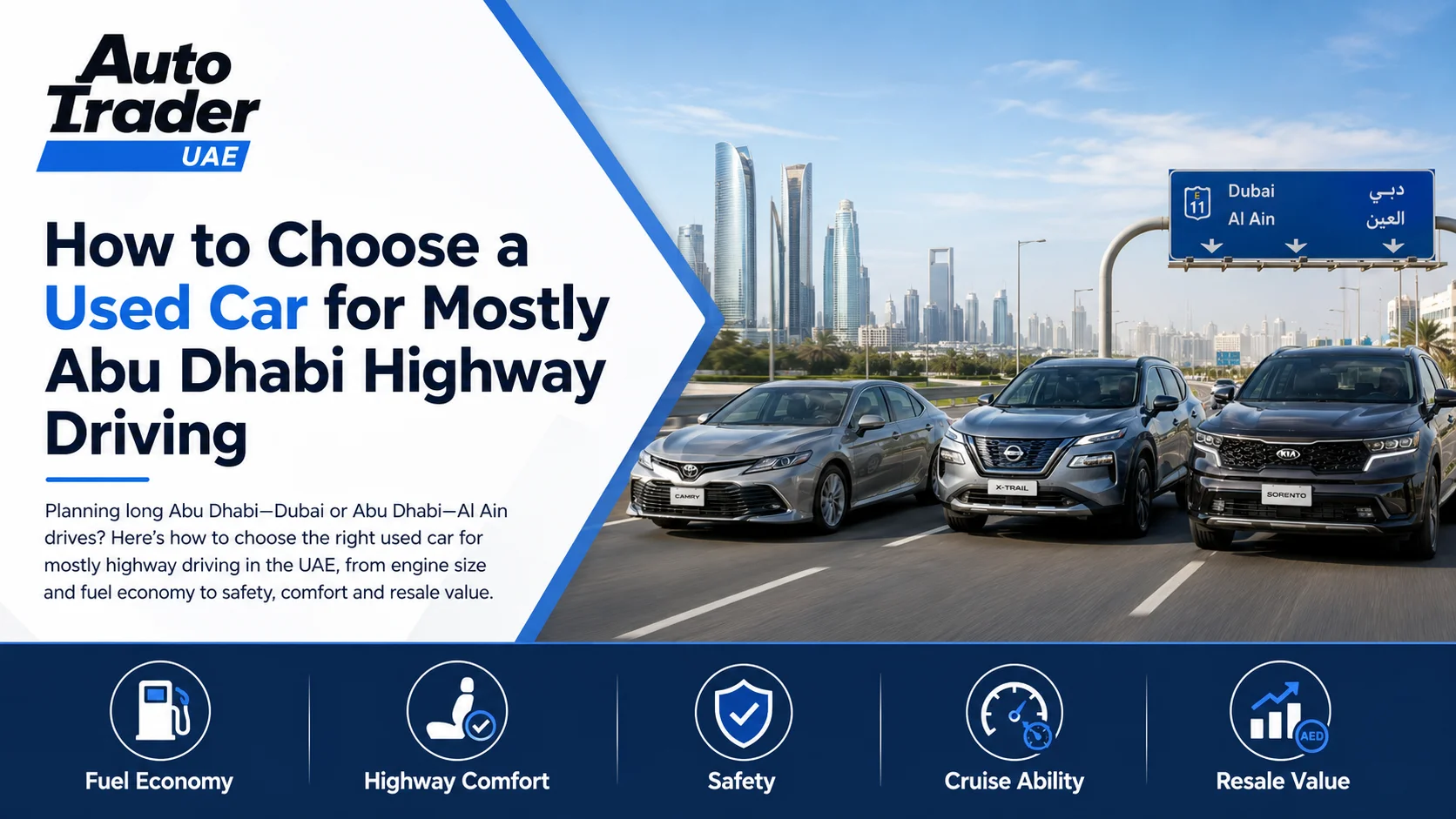
How to Choose a Used Car for Mostly Abu Dhabi Highway Driving
Regular Abu Dhabi highway driving is very different from short city commutes. Long, straight roads, high average speeds, strong crosswinds, desert heat and night driving all put specific demands on your car – and on your budget.
This guide from Auto Trader UAE explains how to choose a used car that feels stable at 140 km/h, stays cool at 50°C, and remains cheap to run and own in the long term.
1. Clarify Your Real Highway Use
Before shortlisting cars, be clear about how you actually use the highways around Abu Dhabi:
- Daily commute Abu Dhabi–Dubai, Khalifa City, Mussafah, KIZAD, Al Ain?
- Weekend trips to Dubai, Ras Al Khaimah, Fujairah, Liwa?
- Mostly solo driving or regular family trips with luggage?
- Annual mileage – under 20,000 km, or 30,000–50,000 km per year?
If most of your kilometres are on E11, E12, or E22 at 120–140 km/h, prioritise:
- High-speed stability
- Reliable cooling (engine and cabin)
- Driver‑assist safety tech
- Comfortable seats and low cabin noise
- Good fuel economy at highway speeds
2. Body Style: Sedan, SUV or Crossover for Highway Use?
For mostly highway driving around Abu Dhabi, three body types stand out:
2.1 Sedans
Best for: Solo drivers or small families who want comfort and fuel efficiency.
- Lower and more aerodynamic – usually more stable at speed and more efficient than tall SUVs.
- Often have better ride comfort and less wind noise on long trips.
- Boot is secure and separate from the cabin, keeping luggage cooler.
Browse a wide range of used sedans for sale in the UAE.
2.2 Crossovers
Best for: Drivers who want some SUV practicality but still value comfort and economy.
- Higher driving position with better highway visibility.
- Softer suspension than full-size SUVs; usually more comfortable and efficient.
- Fine for occasional light off‑road or sand parking, but not built for heavy desert use.
Explore used crossovers in the UAE.
2.3 SUVs
Best for: Families who carry a lot of passengers or luggage, or mix highway with desert camping and off‑road drives.
- More space for people and bags.
- Better for towing and rough roads, but often less fuel‑efficient at 140 km/h.
- Taller body can feel more affected by crosswinds on open Abu Dhabi highways.
If you need space and flexibility, check used SUVs for sale in the UAE.
3. Engine Size, Power and Fuel Economy
3.1 How Much Power Do You Really Need?
On UAE highways, you need enough power to safely join fast traffic, overtake confidently, and stay relaxed at 120–140 km/h without the engine constantly straining.
- 1.6–2.0L petrol – suitable for light sedans and compact crossovers if you usually drive alone or with one passenger. Good balance of performance and economy.
- 2.0–2.5L petrol – ideal for most Abu Dhabi highway drivers, especially if you carry passengers or luggage. Stronger mid‑range for overtakes.
- 3.0L+ petrol or V6/V8 – powerful and smooth, common in larger SUVs and luxury sedans. Great for comfort and towing, but higher fuel bills.
- Turbocharged engines – good power from smaller capacity, but make sure they have a solid maintenance history and use quality oil.
3.2 Fuel Economy at Highway Speeds
Many cars show attractive official economy figures, but real‑world UAE highway use can be different. For mostly steady 120–140 km/h driving:
- Look for owner reviews mentioning fuel economy at constant speed, not just city use.
- Check that the engine is comfortable at low RPM in top gear; an engine that revs too high at cruise will drink more fuel.
- Balance power vs cost if you do 30,000+ km per year – a slightly less powerful but efficient engine can save thousands of dirhams over a few years.
4. Transmission: Automatic, CVT or Dual‑Clutch?
For long Abu Dhabi highway drives, smoothness and reliability matter more than ultimate performance.
- Conventional automatic gearboxes (torque converter) are generally robust and well‑suited to UAE conditions. Good choice for most buyers.
- CVT gearboxes can be very smooth and efficient at constant speeds, but feel different to drive. Ensure regular fluid changes and test for any shuddering or whining noises.
- Dual‑clutch transmissions (DCT) can shift quickly and improve performance and economy. For heavy traffic plus heat, look for models with a reputation for reliability and a clear service history.
On the test drive, focus on:
- How the car shifts between 80–120 km/h.
- Any jerkiness, delayed response, or slipping sensations.
- Smooth kickdown when you accelerate to overtake.
5. Highway Safety Features to Prioritise
High‑speed safety is critical in Abu Dhabi, especially during sandstorms, night driving, and heavy traffic. On a used car, look for:
- Electronic Stability Control (ESC) – essential at highway speeds, especially during sudden avoidance manoeuvres.
- Multiple airbags – front, side, and curtain airbags provide better protection for all occupants.
- Anti‑lock Braking System (ABS) with brake assist – help maintain control under hard braking.
- Tyre Pressure Monitoring System (TPMS) – important for early warning of punctures or slow leaks on hot tarmac.
- Adaptive Cruise Control (ACC) – automatically adjusts your speed to keep a safe distance from the car ahead; very helpful on busy sections of E11.
- Lane Keep Assist / Lane Departure Warning – helps reduce fatigue‑related drifting on long, straight stretches.
- Blind‑spot monitoring – useful when changing lanes around large SUVs, buses, and trucks.
- Automatic emergency braking – becoming more common even in mainstream used models; an extra layer of safety.
Many recent used cars in the UAE now offer these features. When shortlisting on Auto Trader UAE, review the safety and options list in each advert carefully.
6. Comfort and Convenience for Long Trips
Highway driving can look easy, but fatigue builds up. A comfortable cabin is a major safety factor on Abu Dhabi–Dubai and Abu Dhabi–Al Ain routes.
6.1 Seats and Driving Position
- Supportive front seats with good lumbar support reduce back pain.
- Adjustable steering wheel (reach and rake) helps you find a relaxed position.
- Height‑adjustable seat for the driver is a big plus if more than one person uses the car.
6.2 Cabin Noise and Ride Quality
On your test drive, take the car:
- Up to highway speed (100–140 km/h) on a smooth road.
- Over some expansion joints or rougher surfaces.
Listen for:
- Wind noise around mirrors and doors.
- Tyre roar from worn or cheap tyres.
- Suspension knocks over bumps, which could suggest wear.
6.3 Climate Control and Heat Management
Abu Dhabi heat is one of the toughest tests for any car. Prioritise:
- Strong AC performance – car should cool quickly even after being parked in the sun.
- Rear AC vents if you regularly carry passengers.
- Good tint (legal standard) to reduce glare and keep the cabin cooler.
- Sunshades or privacy glass, especially for families.
7. Stability, Brakes and Tyres for UAE Highways
7.1 Suspension and High‑Speed Stability
At 120–140 km/h, a secure, planted feel is non‑negotiable. During your test drive, notice:
- Does the car feel stable in crosswinds or when overtaken by trucks?
- Is the steering precise, or is there play around the centre?
- Does the car bounce or float after bumps at speed?
A well‑maintained suspension is more important than sporty handling. If the car feels vague or nervous, budget for potential suspension work or choose a different example.
7.2 Brakes
- Check for vibration through the steering wheel when braking from highway speeds – this can indicate warped discs.
- Listen for squealing or grinding noises.
- Inspect the service history for recent brake pad and disc changes.
7.3 Tyres: Your Only Contact With the Road
Tyres are especially critical in UAE heat. For highway‑focused cars:
- Check brand and quality – premium or mid‑range brands are worth the extra cost at 140 km/h.
- Inspect the manufacture date (DOT code); in the UAE, tyres over 5 years old are not permitted for registration.
- Look for even tread wear; uneven wear may suggest alignment or suspension issues.
- Ensure all four tyres are the same size and type, and that there is a usable spare.
8. Reliability and Service History in UAE Conditions
A used car might seem fine on a short test drive but struggle with months of high‑speed, high‑heat use. Protect yourself by checking:
- Full service history – stamps or invoices from main dealer or reputable independent garages in the UAE.
- Regular oil changes – ideally earlier than the maximum interval, using the correct specification.
- Cooling system maintenance – radiator, coolant, water pump, and hoses are vital in desert heat.
- Transmission servicing – especially for automatics, CVTs, and DCTs; fluid changes are key to longevity.
- AC system work – compressor replacements or gas refills can signal previous weaknesses; make sure it now performs well.
Where possible, have a pre‑purchase inspection carried out by a trusted workshop in Abu Dhabi or Dubai. For late‑model cars still under warranty, verify remaining coverage with the dealer.
9. Technology and Features That Help on Highways
Modern features can make long trips safer and more relaxing:
- Apple CarPlay / Android Auto – for live navigation, traffic updates, and hands‑free calls.
- Built‑in navigation – useful backup if your phone loses signal, but ensure the maps can be updated.
- Adaptive headlights – improve visibility when driving at night or in poorly lit areas between cities.
- Auto‑dimming mirror – reduces glare from cars behind you.
- Front and rear parking sensors / camera – useful for parking in tight city spaces after highway journeys.
10. Budgeting: Purchase Price vs Running Costs
For mostly Abu Dhabi highway use, your total cost of ownership matters more than initial price alone.
10.1 Upfront Price vs Depreciation
- Popular, reliable models often retain value better, which is important if you plan to sell in a few years.
- A slightly higher purchase price for a well‑maintained car can be cheaper long‑term than a cheaper car that needs major repairs.
10.2 Fuel, Maintenance and Insurance
- Fuel – estimate your annual km and fuel consumption; small differences can add up.
- Maintenance – research typical service costs and parts prices in the UAE for your shortlisted models.
- Insurance – larger engines and luxury brands can mean significantly higher premiums.
Use listings on Auto Trader UAE to compare similar used models and see how asking prices vary with mileage, year, trim, and condition.
11. Test‑Driving a Used Car for Highway Use
When viewing a used car, don’t just drive around the block. Ask the seller for a proper test drive that includes highway time. Focus on:
- Acceleration – smooth and strong from 80–120 km/h.
- Steering feel – stable in a straight line, no pulling to one side.
- Vibration – minimal through steering wheel and seat at high speed.
- Noise levels – acceptable wind and road noise for your comfort.
- AC performance – stays cold at speed and in traffic.
Take notes after each test drive and compare a few different models and examples before deciding.
12. Registration, RTA Tests and Paperwork
When buying a used car in the UAE, make sure the paperwork is clean and up to date:
- Check the Mulkiya (registration card) matches the chassis and engine numbers.
- Ensure any bank loan on the car has been settled before transfer.
- Verify the car has passed the required RTA or ADNOC inspection for renewal where applicable.
- Check for outstanding fines or Salik issues before completing the deal.
Using a reputable dealer or showroom listed on Auto Trader UAE can simplify this process and reduce risk.
13. Where to Find the Right Used Car for Abu Dhabi Highways
To start your search, filter by body style, price, mileage, and location across the UAE:
- All used cars for sale in the UAE
- Used cars in Abu Dhabi
- Used cars in Dubai
- Used hatchbacks in the UAE
- Used luxury cars in the UAE
14. Buyer Takeaways: Building Your Shortlist
When you’re choosing a used car for mostly Abu Dhabi highway driving, use this quick checklist:
- Choose a stable body style – sedan or crossover for efficiency and comfort, SUV if you need space and versatility.
- Pick an engine and gearbox that cruise easily at 120–140 km/h without strain.
- Prioritise safety features – ESC, multiple airbags, TPMS, and, if possible, modern driver‑assist tech.
- Test the AC, brakes, tyres and suspension carefully at highway speeds.
- Insist on a solid service history suitable for UAE conditions, and consider a pre‑purchase inspection.
- Balance purchase price with fuel, maintenance, insurance and resale value.
15. Selling Your Current Car in the UAE
If you’re upgrading to a more highway‑friendly car, presenting your current car properly will help you achieve a stronger selling price:
- Gather all service records and receipts.
- Highlight any recent tyre, brake, or AC work – buyers value this in the UAE.
- Clean the car thoroughly inside and out, including engine bay and boot.
- Be honest about condition to avoid time‑wasting viewings.
Listing through a trusted marketplace such as Auto Trader UAE connects you directly with buyers searching for used cars across Abu Dhabi, Dubai and the wider UAE.
Conclusion: Choose with Your Highways in Mind
Choosing a used car for mostly Abu Dhabi highway driving means thinking beyond looks and initial price. Focus on stability at speed, strong AC, safety tech, and a proven service history in UAE conditions. Take your time to test a few options, compare total running costs, and then use Auto Trader UAE to find the right car – or buyer – anywhere in the country.
When you’re ready, start browsing used cars in the UAE or narrow your search to used cars in Dubai and other emirates, and find a car that makes every Abu Dhabi highway drive smoother, safer and more enjoyable.
Browse used cars in UAE on Auto Trader UAE to compare live listings, prices, and current market activity more clearly.
Related Links
Seller Takeaway
If you are selling a used car in the UAE, present the service history clearly, price the vehicle realistically, and highlight condition, specification, and ownership strengths honestly. A well-prepared listing with accurate details usually attracts more serious buyers.