
Overview
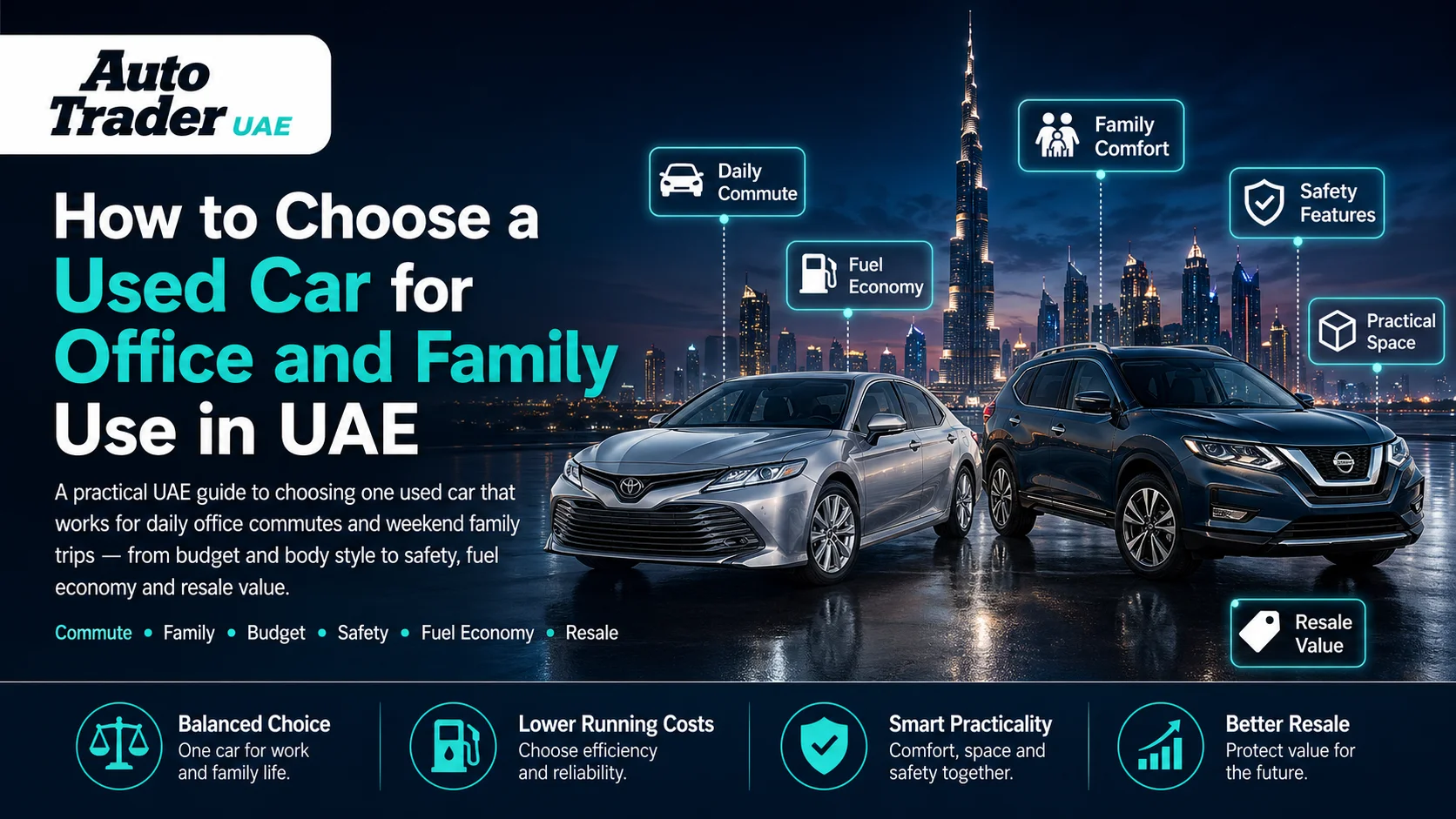
Choosing one car that fits both your office commute and your family’s daily needs is a smart way to save money in the UAE. But it also means you have to balance comfort, running costs, space, and safety in a single used car. This guide from Auto Trader UAE walks you step-by-step through how to choose a used car for office and family use in the UAE, with practical tips for buyers and useful insights for sellers too.
1. Start With Your Real-World Needs
Before looking at brands and models, be clear about how you’ll actually use the car in the UAE.
Key questions to ask yourself
- Daily commute: How many kilometres per day? Mostly city traffic, highway (E11, E311), or mixed?
- Family size: How many regular passengers (kids, adults, nanny)? Do you need a third row?
- Cargo: Do you need to carry strollers, sports gear, groceries, laptops, or tools?
- Parking: Do you have tight basement parking or easy villa parking?
- Driving pattern: Office only, or frequent weekend trips to other emirates (Fujairah, Ras Al Khaimah, Abu Dhabi)?
- Budget: How much can you afford to pay upfront or per month, including insurance and fuel?
Having this clear will help you avoid over-buying (big SUV you don’t use) or under-buying (small sedan that can’t fit your family properly).
2. Set a Realistic Total Budget (Not Just Purchase Price)
In the UAE, it’s easy to focus only on the sticker price of a used car. For a car that will serve both office and family duties, calculate the total cost of ownership:
- Purchase price: The price of the car itself.
- Insurance: Comprehensive is usually recommended for family and daily use; premiums depend on age of car, driver’s profile, and claim history.
- Fuel: Your daily commute plus weekend trips can add up quickly.
- Service and maintenance: Regular servicing, tyres, brake pads, AC service (very important in UAE heat).
- Registration and testing: Annual RTA or relevant emirate testing and registration fees.
- Unexpected repairs: Keep a buffer for wear-and-tear issues common on used cars.
Tip: For a shared work–family car, aim to keep your total automotive spending (including fuel and insurance) in line with what you can comfortably handle for at least the next three years.
3. Choose the Right Body Style for Office and Family Use
Different body styles suit different lifestyles. For mixed office and family use in the UAE, these are the most practical categories:
Compact Sedan
- Best for: Solo commuters or couples with one child who want low running costs.
- Pros: Easy to park, fuel-efficient, usually cheaper to insure and maintain.
- Cons: Limited rear legroom and boot space, especially with child seats and strollers.
Mid-Size Sedan
- Best for: Families of 3–4 needing more comfort for daily use and longer drives.
- Pros: Comfortable ride, good fuel economy, bigger boot, more rear space.
- Cons: Not as versatile as SUVs for tall passengers or bulky cargo.
Compact SUV / Crossover
- Best for: Urban families who want higher seating, extra space, and easy access for kids.
- Pros: Higher driving position, more headroom, flexible seating, often better ground clearance for speed bumps and rougher roads.
- Cons: Slightly higher fuel consumption compared to similar sedans.
Mid-Size / 7-Seater SUV
- Best for: Larger families, frequent airport runs, or weekend trips with relatives.
- Pros: Three-row seating, strong AC, large boot (with third row folded), good for long-distance comfort.
- Cons: Higher running costs, more expensive tyres, can be harder to park in tight office parking.
If you’re using the car every day for office and family, compact crossovers and mid-size sedans are often the sweet spot for UAE buyers.
4. Prioritise Safety for Daily Commutes and Family Trips
For a dual-purpose office and family car, safety should be non-negotiable. In the UAE’s mixed driving conditions, look for:
- Airbags: At least front and side airbags for driver and passenger; curtain airbags are a plus.
- ABS and stability control: Helps maintain control during sudden braking or lane changes.
- ISOFIX child-seat anchors: Essential if you have young children.
- Rear parking sensors / camera: Very helpful in tight building parking and malls.
- Tyre condition: Good tyres with proper tread are critical in hot weather and at highway speeds.
- Brakes: Test for vibration, noise, or pulling to one side during your test drive.
When inspecting a used car, ask specifically if it has ever been involved in a major accident and check any available service or accident history reports.
5. Focus on Comfort and Convenience Features That Matter in the UAE
Because you’ll be using the car for both work and family, comfort and convenience features make a real difference.
Must-haves for UAE daily use
- Strong AC: The system should cool the cabin quickly, including rear seats.
- Rear AC vents: Important for kids and rear passengers in summer.
- Comfortable seats: Enough support for long commutes and weekend trips.
- Bluetooth and USB: For hands-free calls and charging multiple devices.
- Cruise control: Very useful on highways between emirates.
Nice-to-have features
- Apple CarPlay / Android Auto: Easier navigation and media control.
- Keyless entry and start: Convenient for quick office and school drop-offs.
- Automatic headlights and wipers: Helpful but not essential.
Think about your daily routine: school run, office commute, grocery stops, weekend mall visits—then choose features that make those tasks smoother.
6. Engine, Fuel Economy, and Performance
In the UAE, long distances and AC usage affect fuel consumption. For a car that will do both office commutes and family duties:
- Engine size: A 1.5L–2.5L petrol engine usually offers a good balance of power and economy for sedans and crossovers.
- Fuel type: Most buyers stick with petrol for simplicity and smoother driving.
- Gearbox: Automatic is preferred for traffic; check for smooth shifting with no jerks or delays.
- Fuel economy: If you drive a lot, prioritise models known to be economical and reliable in hot climates.
During test drives, drive in both city and highway conditions to feel how the car performs with the AC on and with family on board.
7. Space, Practicality, and Family-Friendly Details
A car can look big outside but still feel cramped inside. Check:
- Rear legroom and headroom: Sit in the back with the front seats adjusted for your height.
- Boot space: Bring a stroller or child seat to test how it fits, along with grocery bags or luggage.
- Seat flexibility: Folding rear seats, split-fold options (60:40), and easy access for child seats.
- Storage spaces: Cupholders, door pockets, centre console space for daily items.
If your car doubles as your mobile office, check you have safe, secure places for a laptop bag, documents, and work equipment.
8. Reliability, Service History, and Resale Value
Since your car is important for both your job and your family, downtime can be costly and stressful. Look for:
- Reliable brands and models: Choose cars known in the UAE for durability and easy parts availability.
- Service history: Prefer cars with documented regular servicing at an agency or reputable workshop.
- Number of previous owners: Fewer owners usually means easier to track how the car has been treated.
- Resale value: Popular models in the UAE tend to sell faster and hold value better when you upgrade later.
Ask to see service invoices, stamps, and any major repair records. Well-documented history is a strong positive sign for a used car.
9. Essential Checks When Inspecting a Used Car in the UAE
Whether you are buying from a private seller or a dealer, always:
Exterior and body
- Look for mismatched paint, panel gaps, or overspray – signs of past repairs.
- Check for rust or corrosion (especially underneath) if the car spent time near coastal areas.
- Inspect tyres for even wear and cracking due to heat and age.
Interior
- Check all seat belts, child locks, windows, and mirrors.
- Test the AC thoroughly, including different fan speeds and temperatures.
- Check infotainment, reverse camera, sensors, and all lights.
Mechanical
- Listen for unusual engine sounds (ticking, knocking) when cold and warm.
- Check for fluid leaks under the car after it has been parked.
- Test the brakes for smooth, straight stopping.
Test drive
- Drive at low and highway speeds where possible.
- Check steering for vibration or pulling.
- Notice any warning lights on the dashboard.
Whenever possible, get a pre-purchase inspection from a trusted independent workshop. The small cost can save you from buying a car with hidden problems.
10. Legal and Paperwork Essentials in the UAE
Make sure everything is in order before you transfer ownership:
- Mulkiya (registration card): Check that the chassis number, engine number, and plate match the car.
- Outstanding finance: Confirm there are no pending loans on the vehicle.
- RTA test (or emirate equivalent): The car must pass the required inspection for transfer and renewal.
- Service and warranty: If any agency warranty or service contract remains, ensure it is transferable.
Always complete ownership transfer at official RTA or authorised centres and avoid paying the full amount until you are satisfied with both the car and documents.
11. Tips for Sellers: Positioning Your Used Car for Office and Family Buyers
If you are selling a car that suits both office and family use, highlight what matters most to these buyers:
- Emphasise fuel economy, comfort, and safety features.
- Show a complete service history and any recent maintenance (tyres, brakes, major services).
- Present the car clean, with AC working strongly and interior odour-free.
- Mention family-friendly points like ISOFIX, rear AC vents, boot size, and parking sensors.
Being transparent about condition builds trust and can help you achieve a faster, smoother sale.
12. Using Auto Trader UAE to Find the Right Used Car
Auto Trader UAE makes it easier to match your budget and lifestyle with the right used car:
- Search filters: Narrow down by price, body style, mileage, model year, and location.
- Feature filters: Pick safety and comfort features that matter to your office and family use.
- Multiple options: Compare several cars side by side before test driving.
You can also explore our latest money and car-buying tips to plan your budget, understand running costs, and decide whether to pay cash or finance. For more in-depth buying guides and ownership advice, visit the Auto Trader UAE blog.
Buyer Takeaway
To choose a used car for office and family use in the UAE, focus on total cost of ownership, safety, space, and comfort in real-world conditions. A well-maintained mid-size sedan or compact SUV with strong AC, solid safety equipment, and a clean service history often delivers the best balance for daily commuting and family life.
Seller Takeaway
If your car already fits this dual role, present it clearly as a reliable, economical, and family-friendly option. Complete documentation, visible maintenance, and honest descriptions help attract serious buyers who depend on their car for both work and home. By using Auto Trader UAE’s listings and resources, both buyers and sellers can make more confident, informed decisions in the used car market across the Emirates.
Browse used cars in UAE on Auto Trader UAE to compare live listings, prices, and current market activity more clearly.
Conclusion
A careful used car purchase in the UAE starts with research, proper inspection, and clear paperwork before making the final decision.