
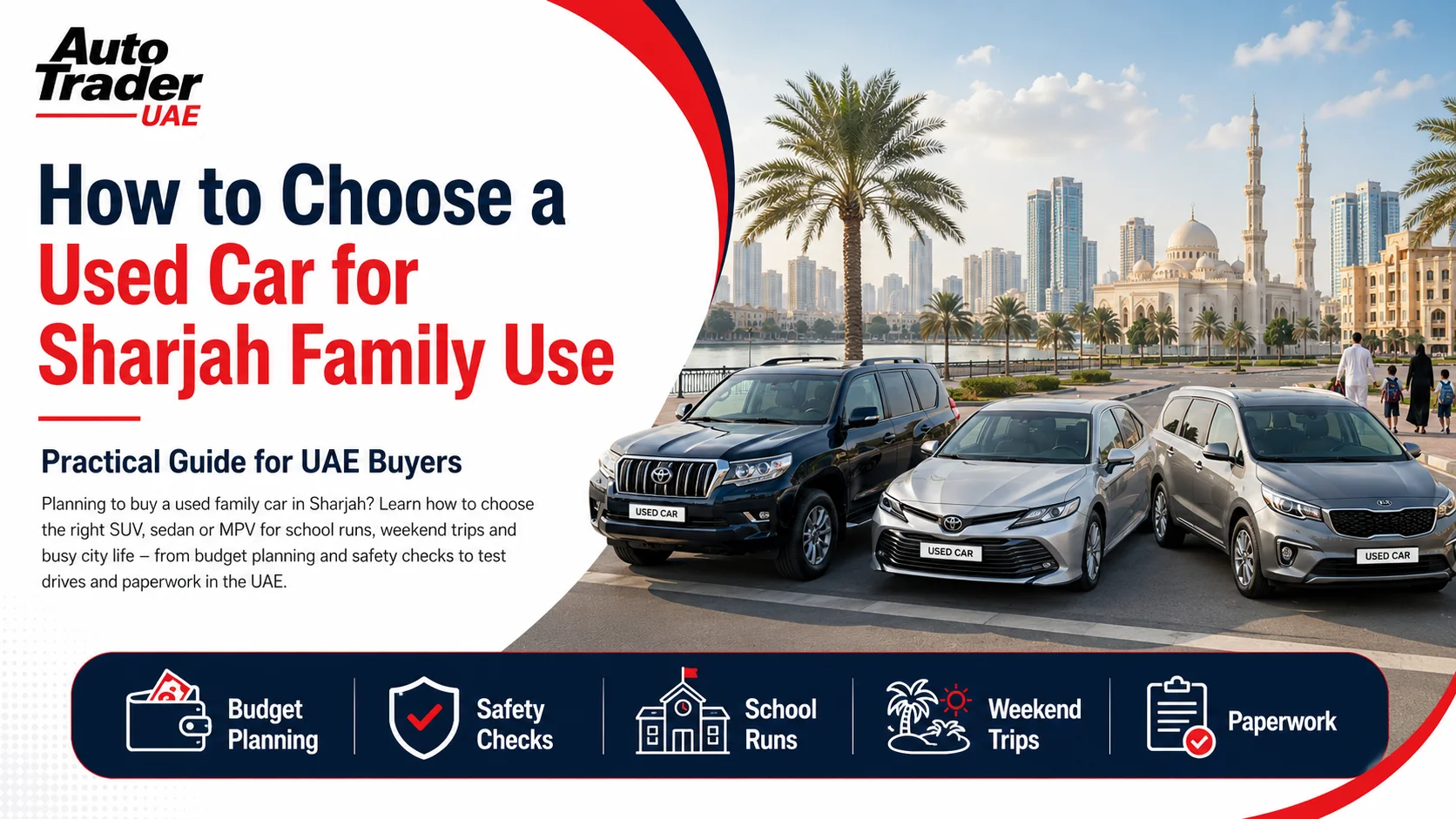
How to Choose a Used Car for Sharjah Family Use
Looking for a used family car in Sharjah means balancing comfort, safety, space and budget – while also thinking about hot weather, school runs, weekend trips to Dubai, and traffic around popular areas like Al Nahda, Al Khan and University City.
This guide from Auto Trader UAE walks you through how to choose a used car for Sharjah family use step by step, with practical advice for parents and family drivers across the UAE.
1. Start with your real family needs
List how you actually use the car
- Daily school runs – Is it just one child, or three with friends and car seats?
- Commuting – Do you drive to Dubai or stay mostly inside Sharjah?
- Weekend trips – Beach runs, desert camping, or visiting family in other emirates?
- Parking – Tight apartment parking in Al Majaz or easier villa parking in Al Tai?
Match body type to your lifestyle
- Compact hatchback: Good for small families, easy to park, lower fuel use. Best for city driving and short trips.
- Compact / midsize sedan: Comfortable for 4–5 people, good boot space, stable at highway speeds between Sharjah and Dubai.
- Compact SUV / crossover: Higher driving position, better ground clearance for speed bumps and rougher roads, flexible seating for kids and luggage.
- Full-size SUV / 7-seater: Ideal for bigger families, school runs with multiple kids, and long trips. More fuel use, usually higher running costs.
- MPV / people carrier: Sliding doors, easy third-row access, very practical for families with small children.
On Auto Trader UAE used cars, use filters to select body type, seating capacity and price to quickly shortlist family-friendly models.
2. Set a realistic total budget
Think beyond the purchase price
When choosing a used car for Sharjah family use, calculate your total cost, not just the price on the ad:
- Purchase price – What you pay the seller or dealer.
- Registration and insurance – Higher for bigger engines and newer models.
- Fuel costs – Sharjah–Dubai commuting can add up quickly.
- Service and maintenance – Regular service, tyres, brakes, A/C repairs.
- Salik (if you cross to Dubai) – For daily commuters.
Choose age and mileage wisely
- 0–3 years old: Higher price, but more features, better safety tech, and often still under warranty.
- 3–6 years old: Good balance of price and reliability if service history is strong.
- 6–10 years old: Lower purchase price, but budget extra for maintenance and possible wear items.
To stay within budget, compare options across the UAE using used cars in UAE listings and then filter to Sharjah or nearby emirates.
3. Prioritise family safety and reliability
Key safety features for Sharjah family driving
- Airbags – Front, side and curtain airbags give better protection for all passengers.
- ABS and ESC – Anti-lock brakes and stability control help in sudden stops and sharp swerves.
- ISOFIX child-seat anchors – Essential if you use child seats.
- Rear parking sensors / camera – Very useful in crowded parking buildings and tight street parking.
- Tyre pressure monitoring system (TPMS) – Helpful in hot UAE weather where tyre issues are more common.
Check reliability and common issues
Before choosing a used car for Sharjah family use, research:
- Known issues with the model (gearbox, A/C performance, electronics).
- Average service and spare parts costs in the UAE.
- Availability of service centres in Sharjah and nearby emirates.
Use online owner forums and UAE-based reviews, and compare similar models on used SUV listings or used sedan listings to see which models appear most frequently in family budgets.
4. Choose the right engine, fuel economy and A/C performance
Engine size and power
- Smaller engines (1.5L–2.0L): Better fuel economy; fine for city use and light loads.
- Mid-size engines (2.0L–2.5L): Good balance for families who drive between emirates.
- Larger engines (V6 and above): More power for fully loaded SUVs, but higher fuel usage and sometimes higher insurance.
Fuel economy in daily Sharjah use
Stop–go traffic, school runs and A/C running all day increase fuel consumption. Look for official fuel figures, but also:
- Ask the seller about real-world fuel use for mixed Sharjah–Dubai driving.
- Check online owner reviews from UAE or GCC, not just global markets.
A/C strength is critical in the UAE
- Test the A/C at idle and while driving.
- Check rear vents in second and third rows – important for children.
- Make sure fan speeds, temperature controls and modes all work.
5. Ensure enough space and practicality for your family
Seating and comfort
- Seats – Check legroom and headroom for all rows, especially if you use child seats.
- Third row use – In 7-seaters, test access and comfort; some third rows are only suitable for children.
- Seat flexibility – Split-folding seats, sliding second row, and quick-fold third row make daily life easier.
Boot space and storage
- Bring a stroller or baby gear when viewing the car and test how it fits in the boot.
- Check under-floor storage, door pockets and cupholders.
- Consider rear seats up vs folded – you may need space for both passengers and luggage.
To compare different layouts, browse used 7-seater cars and used MPVs in UAE on Auto Trader UAE.
6. Think about Sharjah roads, parking and driving style
Ground clearance and suspension
- Higher ground clearance helps with speed bumps, curbs and some unpaved areas.
- Softer suspension is more comfortable for family but may feel less sporty.
Parking in busy areas
- If you live in a building with tight parking, measure your space before committing to a large SUV.
- Look for parking sensors, camera and good visibility from the driver’s seat.
Highway stability
If you regularly travel on Sheikh Mohammed Bin Zayed Road or E11 between Sharjah and Dubai:
- Choose a car that feels stable at 100–120 km/h.
- Prefer models with cruise control and good noise insulation for family comfort.
7. Inspecting a used family car in the UAE
Check service history and records
- Ask for stamped service book or digital records.
- Prefer cars with regular servicing at agency or reputable workshops.
- Look for major repairs – accident repair, gearbox, engine work – and ask what happened.
Exterior and body inspection
- Look for uneven panel gaps, different paint shades or overspray (possible accident repairs).
- Check tyres for even wear and sufficient tread; mismatched tyres may show cost-cutting.
- Inspect lights and glass for cracks or heavy scratches.
Interior and family-friendly features
- Check all seat adjustments, seatbelts, ISOFIX mounts and headrests.
- Test all electrical items – windows, mirrors, locks, infotainment, USB ports.
- Look for signs of water damage, heavy wear or strong smells.
Mechanical inspection and test drive
Whenever possible, use a trusted independent workshop or inspection centre in Sharjah or Dubai.
- Cold start: Listen for unusual noises, check for warning lights.
- Engine: Smooth idle, no excessive vibration.
- Gearbox: Smooth shifts, no jerks or slipping.
- Brakes: No pulling to one side, no strong vibrations.
- Steering and suspension: Stable, no knocking noises on bumps.
Use the test drive route that includes slow city traffic, speed bumps and a short highway stretch to simulate real Sharjah family driving.
8. Paperwork, RTA tests and legal checks
For Sharjah and the wider UAE, pay attention to documentation when buying a used family car:
- Mulkiya (registration card) – Ensure the seller’s name matches their Emirates ID.
- Vehicle inspection certificate – Required for ownership transfer; check validity.
- Outstanding finance – Confirm no bank loan is pending; ask for clearance letter if needed.
- Chassis number – Match VIN on the car with the registration and inspection report.
For cross-emirate purchases, confirm the process for transferring ownership and inspection in Sharjah vs other emirates.
9. Negotiating the deal wisely
Use market prices to your advantage
- Compare similar cars on used cars in Sharjah listings to understand fair price ranges.
- Check differences in mileage, options, condition and service history when comparing.
Negotiate based on facts
- Use inspection report findings (tyres, brakes, upcoming major service) as negotiation points.
- Be realistic – a well-maintained, accident-free car with full history will usually justify a higher price.
- Factor in immediate costs like new tyres, minor repairs and registration.
10. Best used car types for Sharjah family use
While the “best” car depends on your budget and family size, these categories are popular for family life in Sharjah and the UAE:
Compact family sedans
Ideal for small families who mainly drive inside Sharjah city with occasional trips to Dubai or other emirates.
- Comfortable, efficient and usually lower running costs.
- Easier to park and insure than larger SUVs.
Browse a wide range of options on used sedans in UAE.
Compact and midsize SUVs
Very popular for Sharjah families due to space, higher seating and practicality.
- Good for school runs, weekend trips and mixed city–highway driving.
- Better boot space for strollers, luggage and sports gear.
Explore options on used SUVs in UAE and refine by price, year and mileage.
7-seaters and MPVs
Best for larger families, shared school runs or those who often travel with relatives and friends.
- Flexible seating for 6–7 passengers.
- Some offer sliding doors and extra storage.
Compare spacious people movers on used 7-seater cars and used MPVs in UAE.
11. When buying from a dealer vs private seller
Buying from a dealer
- May offer limited warranty or service package.
- More experience with paperwork and finance options.
- Prices can be slightly higher than private sellers.
Buying from a private seller
- Potentially better price if you negotiate well.
- More direct knowledge of how the car was used (ask about family use, commuting patterns, accidents).
- Requires more attention to inspection and paperwork.
Auto Trader UAE lists both dealer and private cars, so you can compare offers from different sellers and choose what suits your family.
12. Final checklist before you decide
Before choosing a used car for Sharjah family use, make sure you can honestly tick these boxes:
- The car fits your family size and daily routine.
- Safety features and reliability are acceptable for transporting children.
- You have a clear picture of total costs (fuel, insurance, maintenance).
- The car’s service history and inspection report are satisfactory.
- You’ve done a proper test drive in realistic conditions.
- Paperwork and ownership transfer steps are fully understood.
Next steps with Auto Trader UAE
To move from research to action:
- Set your budget and pick your preferred body type (sedan, SUV, 7-seater, MPV).
- Browse used cars in Sharjah to find models that match your family needs.
- Compare similar cars across used cars in UAE to understand value.
- Shortlist 3–5 cars, arrange viewings and professional inspections.
- Negotiate based on condition and history, then complete the transfer at the authorised centre.
When you’re ready to upgrade or change cars in the future, you can also list your current family car on Auto Trader UAE to reach serious buyers looking for used cars in Dubai, Sharjah and across the country.
Browse used cars in UAE on Auto Trader UAE to compare live listings, prices, and current market activity more clearly.
Related Links
Buyer Takeaway
When buying a used car in the UAE, focus on vehicle condition, service history, inspection quality, paperwork, and total running costs rather than price alone. Compare options carefully and choose the option that best matches your budget and real needs.
Seller Takeaway
If you are selling a used car in the UAE, present the service history clearly, price the vehicle realistically, and highlight condition, specification, and ownership strengths honestly. A well-prepared listing with accurate details usually attracts more serious buyers.
Conclusion
A careful used car purchase in the UAE starts with research, proper inspection, and clear paperwork before making the final decision.