
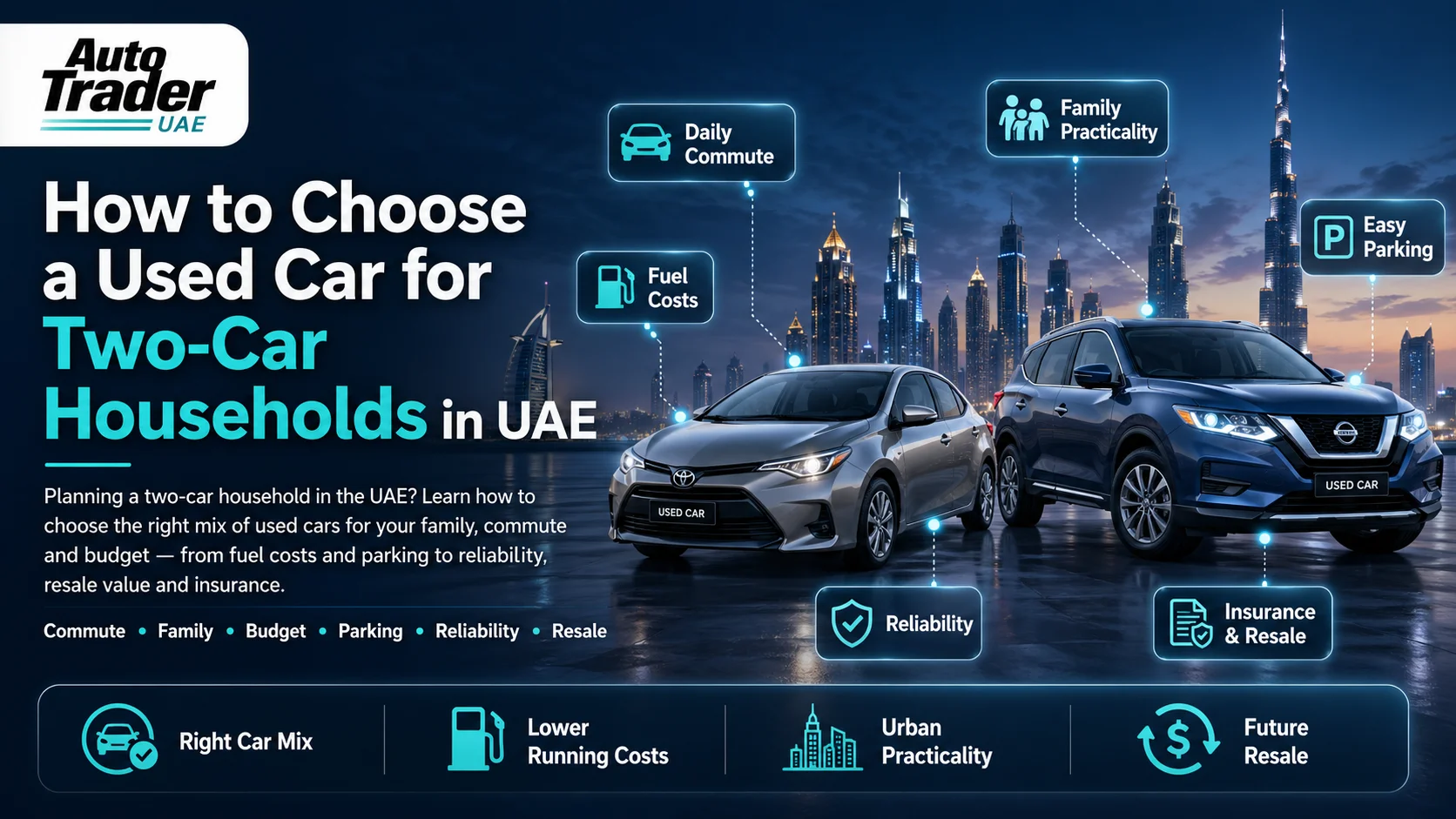
How to Choose a Used Car for Two-Car Households in UAE
Two-car households are now common in the UAE. Different work locations, school runs, and weekend trips mean many families need more than one vehicle. The challenge is choosing the right combination of used cars that fits your lifestyle and budget – without overbuying. This guide explains how to choose a used car for two-car households in the UAE, step by step, with practical advice for both buyers and sellers on Auto Trader UAE.
1. Start with Your Household’s Real Needs
Before looking at brands and models, be clear about how each car will be used. In two-car homes, it’s rarely “two of the same thing.” Usually you need two different roles:
- Daily commuter – for work, city driving and errands
- Family / weekend car – for kids, long trips, luggage and comfort
Ask these questions:
1.1 Who will drive each car?
- Is one driver mainly in city traffic (Dubai, Abu Dhabi, Sharjah)?
- Does someone commute long distances between emirates?
- Is a new or less experienced driver using one of the cars?
1.2 What are your weekly routines?
- School run, nursery, activities
- Office commute and peak-hour traffic
- Grocery and mall trips
- Weekend desert, camping or beach trips
1.3 What do you actually transport?
- How many passengers most of the time (not just once a year)?
- Do you need space for strollers, sports gear, tools, or pets?
- Do you tow a trailer, jet ski, or boat?
Write down what each car must do, then what would be “nice to have.” This helps you separate emotion from real needs.
2. Decide Each Car’s Main Role
For two-car households in the UAE, the smartest strategy is to give each car a clear role instead of buying two large, expensive vehicles.
2.1 Car 1: The City Commuter
Ideal for:
- Daily office commute
- Solo or couple driving
- Easy parking in tight basement or street spaces
What to prioritise:
- Fuel efficiency – especially with frequent city traffic
- Compact size – easier to park at work and home
- Reliability – minimal workshop time
- Low running costs – tyres, minor service, brake pads
Examples of good commuter types:
- Small hatchbacks
- Compact sedans
- Small crossovers (for higher seating and comfort)
2.2 Car 2: The Family / Weekend Car
Ideal for:
- Family trips within and outside the city
- Road trips to Ras Al Khaimah, Fujairah, or Oman (where allowed)
- Carrying kids, luggage and sometimes guests
What to prioritise:
- Interior space – legroom, headroom, boot capacity
- Comfort – suspension, seats, noise levels
- Safety features – airbags, ESC, child-seat support (ISOFIX)
- AC performance – strong rear AC for summer
Common choices for the second car:
- Mid-size or full-size SUVs
- 7-seater crossovers
- Spacious sedans
3. Match Your Two-Car Setup to UAE Conditions
Driving in the UAE has its own realities: hot climate, busy highways, speed limits, and multi-storey parking. Your two-car combination should work well in this environment.
3.1 Heat and AC performance
- Check how quickly the AC cools the cabin.
- Make sure rear AC vents are available for family cars.
- Test cars in the daytime, not only at night, if possible.
3.2 City traffic and parking
- One car should be easy to park in crowded areas and tight parking.
- Consider parking space at home – can two big SUVs really fit?
- Check turning radius and visibility for city driving.
3.3 Long-distance and highway comfort
- Choose a stable, comfortable cruiser for the family car.
- Look for cruise control, good seats, and decent sound insulation.
- Check that the engine has enough power for safe overtaking when fully loaded.
3.4 Light off-road and desert use
If your weekends include desert, wadis, or farms:
- Make sure at least one car has higher ground clearance.
- Consider 4WD or AWD if you regularly go off-road.
- Check for underbody protection and recovery points if you go dune-bashing.
4. Plan the Total Budget for Two Cars, Not One
Two used cars mean double the fixed costs. Focus on total monthly cost, not just purchase price.
4.1 Purchase price and financing
- Set a combined budget for both cars based on your income.
- Decide how much you will pay in cash vs. finance.
- For financed cars, keep the monthly instalment plus insurance within a safe percentage of your income.
4.2 Insurance cost
Insurance can be very different between a small sedan and a big SUV, even with the same driver.
- Get insurance quotes for both cars before finalising.
- Check the effect of driver age, claims history, and car value.
- Decide which car needs comprehensive cover and which can manage with third-party depending on age and value.
4.3 Fuel and maintenance
Two large, thirsty SUVs can become very expensive to run. To keep costs under control:
- Choose at least one fuel-efficient car for daily use.
- Review typical service intervals and average service bills for the models you’re considering.
- Factor in tyres – big SUVs often use more expensive tyres.
4.4 Depreciation and resale value
In the UAE, some brands and body types hold value better:
- Widely known brands with good parts availability tend to have stronger resale.
- Popular SUVs and practical sedans usually find buyers faster than niche models.
- For the commuting car, you might accept more kilometres and age to save money, as long as it’s well-maintained.
5. How to Divide the Budget Between the Two Cars
For two-car households, there are three common budget strategies. The best one depends on your priorities.
5.1 Strategy A: Spend more on the family car
You invest more in the main family/weekend vehicle and keep the commuter simple and affordable. Best if:
- You drive long distances as a family.
- Comfort and safety with kids is the top priority.
- The commuter car mostly carries one person.
5.2 Strategy B: Balance both cars equally
You buy two mid-range used cars instead of one premium and one basic. Best if:
- Both drivers spend serious time on the road.
- You switch cars often depending on the day.
- Both cars must be reliable and comfortable, but not luxurious.
5.3 Strategy C: One newer, one older
You choose one newer, lower-mileage car for family and long trips, and one older but dependable car for short commutes. Best if:
- You want at least one car under manufacturer or extended warranty.
- You’re comfortable with a higher-mileage second car that you maintain properly.
6. Key Factors to Check When Buying Any Used Car in a Two-Car Household
Whether it will be the commuter or family car, these points are essential for used cars in the UAE.
6.1 Service history
- Look for stamped service book or digital records.
- Check if services were done at agency or a reputable independent garage.
- Long gaps in service history can be a warning sign.
6.2 Accident and repair history
- Inspect body panels for unequal gaps, mismatched paint or overspray.
- Ask directly about any major accidents or chassis damage.
- Review previous insurance reports if available.
6.3 Kilometres vs. age
- The UAE average is often higher than some other markets due to highway use.
- Highway kilometres are usually less damaging than short city trips, if serviced on time.
- Compare kilometres with service history, not in isolation.
6.4 Mechanical and electrical condition
- Always go for a professional pre-purchase inspection.
- Test all electronics: windows, mirrors, AC, infotainment, lights.
- Check for warning lights on the dashboard during a test drive.
6.5 Tyres and consumables
- Check tyre date codes; very old tyres are unsafe even with good tread.
- Look at brake pads, discs and suspension condition during inspection.
- Factor these items into your negotiation and budget.
7. Suggested Two-Car Combinations for UAE Households
Below are example combinations of body types (not specific brands) that work well in the UAE. Match them to your lifestyle and budget.
7.1 Budget-conscious couple or small family
- Car 1 (commuter): Used compact hatchback or small sedan
- Car 2 (family): Used compact crossover or mid-size sedan
Why it works:
- Low fuel and maintenance costs overall.
- Enough space for weekend trips without overspending.
7.2 Growing family with kids
- Car 1 (commuter): Compact sedan or crossover
- Car 2 (family): 3-row SUV or 7-seater crossover
Why it works:
- Flexible seating and boot space for strollers and school bags.
- One city-friendly car and one fully practical family car.
7.3 Active lifestyle, travel and light off-road
- Car 1 (commuter): Efficient sedan or compact crossover
- Car 2 (weekend): 4WD SUV with higher ground clearance
Why it works:
- You keep commuting costs down with Car 1.
- You still have serious weekend capability with Car 2.
7.4 Mixed drivers (new + experienced)
- Car 1 (for new driver): Small, easy-to-park used hatchback or sedan with basic power and strong safety
- Car 2 (for experienced driver): Larger sedan or SUV
Why it works:
- The new driver gains confidence in a smaller, more forgiving car.
- The experienced driver handles the more powerful or bigger vehicle.
8. Practical Tips for Test Driving as a Two-Car Household
When you’re choosing two cars, test driving becomes even more important.
- Test both cars on the same day if possible, so you can compare comfort, noise and AC directly.
- Bring the main passengers (especially kids) to test the family car’s space and access.
- Simulate your real use: try parking, tight turns, highway speeds and speed bumps.
- Check child-seat installation in any car that will carry children often.
- Swap drivers during the test drive – each main driver should test both cars.
9. Selling or Upgrading One Car in a Two-Car Household
Two-car setups change over time. New job, new baby, kids going to university – all of these can make one car unnecessary or unsuitable.
- Review your needs every couple of years and decide if your combination still works.
- If one car is rarely used, consider selling it and upgrading the main car instead.
- Time your sale outside peak summer if possible, when more buyers are active.
- Keep service records organised to support a higher resale price when listing on Auto Trader UAE.
10. Next Steps with Auto Trader UAE
To choose a used car for your two-car household in the UAE, focus on roles, budget and total running costs instead of only brand or looks. A smart combination – one efficient commuter and one comfortable family car – usually gives better value than owning two large, expensive vehicles. On Auto Trader UAE, you can:
- Filter used cars by body type, price, year, mileage and features to build your ideal two-car setup.
- Compare different options side by side to balance budget, comfort and fuel economy.
- List your current car for sale if you’re reshaping your household fleet.
For more help with budgeting and ownership costs, explore the money and finance advice on Auto Trader UAE, and visit the Auto Trader UAE blog for additional buying guides, ownership tips and market insights tailored to drivers in the UAE.
Browse used cars in UAE on Auto Trader UAE to compare live listings, prices, and current market activity more clearly.
Related Links
Buyer Takeaway
When buying a used car in the UAE, focus on vehicle condition, service history, inspection quality, paperwork, and total running costs rather than price alone. Compare options carefully and choose the option that best matches your budget and real needs.
Seller Takeaway
If you are selling a used car in the UAE, present the service history clearly, price the vehicle realistically, and highlight condition, specification, and ownership strengths honestly. A well-prepared listing with accurate details usually attracts more serious buyers.
Conclusion
A careful used car purchase in the UAE starts with research, proper inspection, and clear paperwork before making the final decision.