
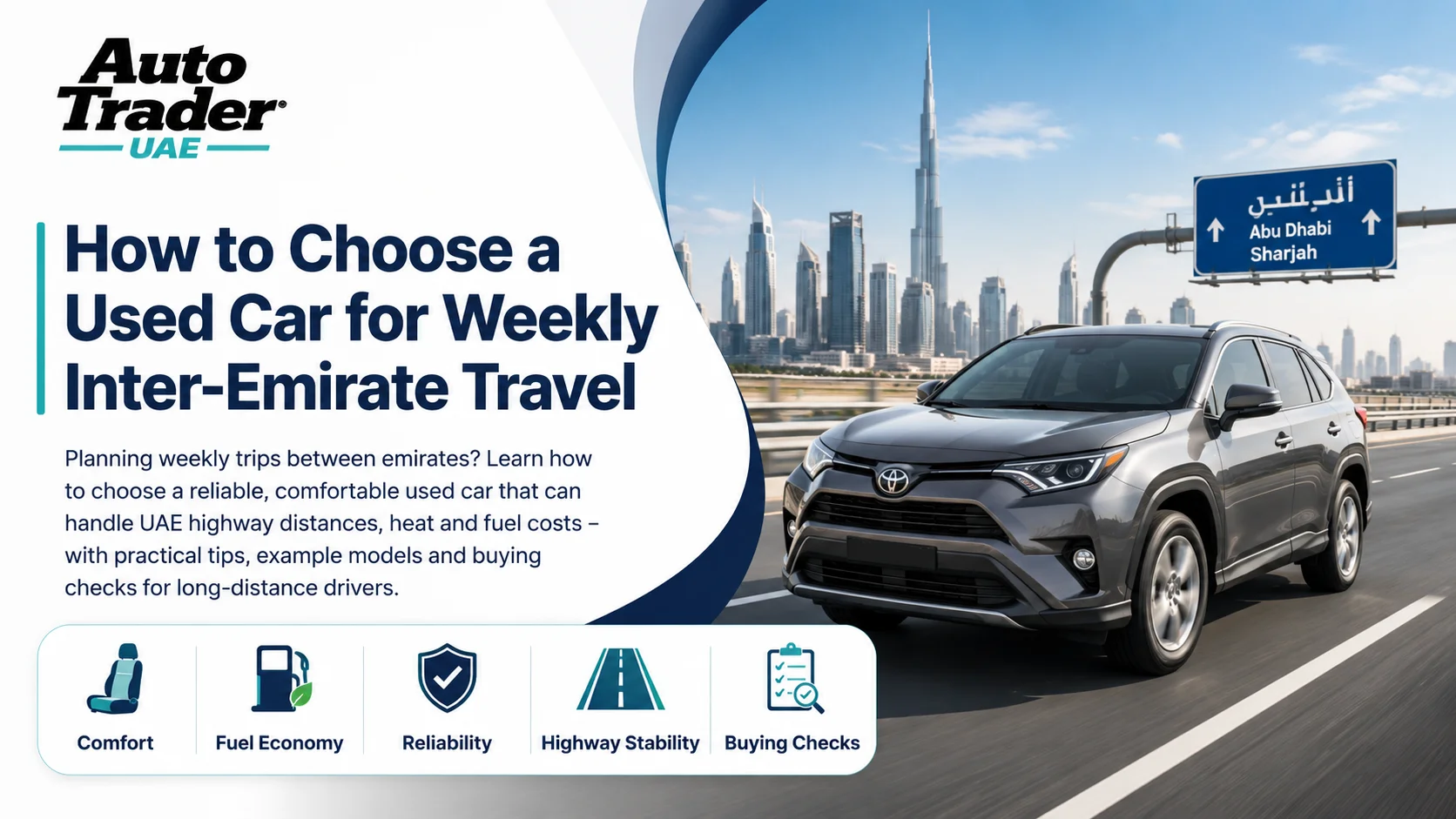
How to Choose a Used Car for Weekly Inter-Emirate Travel
Regular trips between Dubai, Abu Dhabi, Sharjah, Ras Al Khaimah and the other emirates demand more from a car than the average school run. High cruising speeds, long distances, heavy traffic and year‑round heat all put serious stress on any vehicle – and the wrong choice can quickly become tiring or expensive.
This guide explains how to choose a used car that’s comfortable, safe and economical for weekly inter‑emirate travel in the UAE, with practical tips for both buyers and sellers on Auto Trader UAE.
1. Define Your Inter-Emirate Driving Pattern
Before looking at specific cars, be clear about how and where you’ll drive. It will shape almost every decision.
Key questions to ask yourself
- Typical route: Dubai–Abu Dhabi? Sharjah–Abu Dhabi? Dubai–RAK? Each has different traffic and road conditions.
- Weekly distance: 300–400 km is very different from 1,000+ km per week in terms of wear, fuel and service needs.
- Passengers: Mostly solo, or regular family/colleague trips? This affects size, comfort and luggage space.
- Driving times: Peak‑hour commuting vs off‑peak weekend travel will influence comfort and safety priorities.
- Parking and city use: Will you use the same car daily inside the city, or only for long trips?
Once you understand your pattern, you can balance comfort, fuel economy, size and budget more intelligently.
2. Choose the Right Body Type for Long Distances
Different body types suit different travel styles across the UAE. Consider these common options for weekly inter‑emirate runs:
Saloon / Sedan
- Best for: Solo drivers or small families who mainly use highways.
- Pros: Stable at speed, usually more fuel‑efficient than SUVs, comfortable ride, quieter cabins.
- Cons: Lower ground clearance than SUVs, boot access not as flexible as hatchbacks.
Compact Crossover / Small SUV
- Best for: Drivers who want a higher driving position and extra practicality without heavy fuel bills.
- Pros: Good visibility, flexible boot, easier access for kids and older passengers.
- Cons: Slightly higher fuel use than equivalent sedans; ride comfort varies a lot between models.
Full-Size SUV
- Best for: Large families, carpooling, or those who often carry luggage or equipment.
- Pros: Space, comfort, strong air‑conditioning, confident highway presence.
- Cons: Higher fuel consumption, larger tyres and brakes to replace, more difficult to park in dense areas.
Hatchback
- Best for: Budget‑focused drivers who do mixed city and inter‑emirate commuting.
- Pros: Easy to park, usually very efficient, flexible boot space.
- Cons: Shorter wheelbase often means slightly less highway comfort and more cabin noise.
On Auto Trader UAE you can browse all used cars in the UAE and filter by body style to match your use case.
3. Prioritise Highway Comfort and Safety
For regular Dubai–Abu Dhabi or Dubai–Al Ain runs, comfort and safety are more important than flashy features.
Comfort factors to focus on
- Seat comfort: Look for supportive seats with adjustable lumbar support and height. On a 150–200 km run, poor seats will cause back and neck pain.
- Cabin noise: Test the car at typical highway speeds (120–140 km/h) and pay attention to wind and tyre noise.
- Ride quality: Rough, bouncy suspensions become tiring over long distances. Search for models known for comfortable suspension rather than very stiff “sporty” setups.
- Climate control: Strong, fast A/C is essential in UAE summers. Dual‑zone or rear vents are a plus for passengers.
Safety features worth having
- Multiple airbags: At minimum, front and side airbags for driver and front passenger.
- Electronic Stability Control (ESC): Helps keep the car stable during sudden manoeuvres at highway speeds.
- ABS and brake assist: Standard on most modern cars, but always check.
- Cruise control: Reduces fatigue and helps maintain a steady legal speed.
- Lane assist / blind‑spot monitoring: Helpful on multi‑lane highways if your budget allows newer models.
- Tyre‑pressure monitoring system (TPMS): Very useful in hot conditions where under‑inflated tyres can be dangerous.
4. Balance Engine Size, Performance and Fuel Economy
For weekly inter‑emirate drives, your engine needs to be strong enough for confident overtaking and fully‑loaded driving, but not so large that fuel costs become painful.
Engine size and type
- 1.6–2.0L petrol: Suitable for light to medium‑sized sedans and crossovers used mainly by 1–3 people.
- 2.0–2.5L petrol: A good balance for mid‑size SUVs or sedans regularly carrying family and luggage.
- V6 engines: Offer strong performance for big SUVs or luxury sedans, but expect higher fuel and service costs.
- Turbocharged engines: Give good power from smaller capacity, but prioritise models with a strong reliability reputation and check service history carefully.
Transmission choices
- Traditional automatic: Smooth and familiar, widely available in UAE, easy to service.
- CVT (Continuously Variable Transmission): Often more fuel‑efficient in city and highway use, but some drivers dislike the feel and older designs can be more sensitive to poor maintenance.
- Dual‑clutch / DCT: Quick shifting and efficient but can feel jerky in traffic and may be more costly to repair if abused.
If your weekly kilometres are high, small differences in fuel consumption can add up. When browsing used Toyota cars in the UAE or used Honda cars, compare engine and transmission options to find the right blend of power and economy.
5. Reliability and Maintenance: What Matters for Weekly Travel
High‑mileage, high‑temperature use means reliability is critical. A breakdown between emirates is inconvenient at best and dangerous at worst.
Look for these reliability indicators
- Full service history: Ideally with stamped dealer or reputable workshop records, especially for engine, gearbox and major services.
- Recent major services: Timing belt/chain checks, transmission oil changes, brake overhauls and cooling system work reduce your risk.
- Mileage vs age: High mileage is not automatically bad, but it must be supported by strong maintenance history.
- Model reputation: Some brands and models are well known locally for surviving long high‑way runs and heat with fewer issues.
Important mechanical checks for UAE conditions
- Cooling system: Radiator, hoses, water pump and coolant condition – vital in UAE summers.
- Air‑conditioning: Confirm it cools quickly and stays stable on longer test drives.
- Tyres: Age (check manufacture date), tread depth and even wear. Look for desert or high‑temperature‑rated tyres when possible.
- Brakes: No vibrations under hard braking at speed; discs and pads should have life left.
- Suspension: Listen for knocks over bumps and test stability on the highway.
Whenever possible, invest in an independent pre‑purchase inspection before committing, especially for inter‑emirate duty cars.
6. Tech, Connectivity and Driver Comfort Features
Long drives are easier when your car’s technology supports you rather than distracts you.
- Apple CarPlay / Android Auto: Safer navigation and calls without touching your phone.
- Adaptive cruise control: Helps in variable traffic between emirates by automatically managing your distance from the car ahead (available on newer models).
- Quality audio system: Makes long night drives or desert stretches more pleasant.
- Multiple charging ports: For passengers and navigation devices.
- LED headlights: Better night visibility and lower fatigue than older halogen lamps.
7. Budgeting: Purchase Price, Fuel, Salik and Service Costs
When you travel between emirates every week, the true cost of ownership matters as much as the price you pay today.
Key cost areas to consider
- Purchase price: Set a realistic budget that leaves space for insurance, registration and an initial maintenance refresh.
- Fuel economy: Compare real‑world consumption, not only brochure figures. Heavier SUVs with big engines will cost more to run.
- Service and parts: Mainstream Japanese and Korean models generally have competitive parts pricing and many workshop options across the UAE.
- Tyres: Larger wheel sizes (19–21 inches) are more expensive to replace and can wear faster if you drive aggressively.
- Salik and tolls: If your route is heavy on toll gates, efficient route planning can make a noticeable difference over the year.
Remember that a slightly more expensive, reliable car with good fuel economy can be cheaper in the long run than a cheaper car with high running costs or recurring repairs.
8. Practical Model Examples for Inter-Emirate Travel
Every driver’s needs and budget are different, but some types of cars tend to work especially well for weekly highway runs in the UAE. Use these as starting points while browsing Auto Trader UAE.
Efficient, comfortable sedans
- Mid‑size Japanese and Korean sedans known for reliability, comfort and service network coverage.
- Typically offer good fuel economy, strong A/C, and enough space for small families.
Explore options on:
Compact crossovers for mixed family and work use
- Offer higher driving position and practicality without the full running costs of a large SUV.
- Good choice if you combine weekday commuting with weekend trips across emirates.
Browse examples on:
Full-size SUVs for maximum space and comfort
- Best if you regularly carry 5–7 passengers or heavy luggage on long trips.
- Prioritise models with a strong durability record in hot climates.
Start your search with:
9. Essential Inspection Checklist for Highway-Ready Used Cars
When you visit a car you’re considering for weekly inter‑emirate use, inspect it with long‑distance reliability in mind.
Paperwork and history
- Compare the mileage on the odometer with service records.
- Check for any major accident repairs in the history.
- Confirm chassis and engine numbers match the registration documents.
On-the-spot checks
- Cold start: The engine should start easily, with no loud knocking, rattling or excessive smoke.
- Fluids: Engine oil, coolant, brake and transmission fluid levels and condition.
- Tyres and spare: Check all tyres, including the spare, for age and condition.
- Lights: Test headlights (low and high beam), indicators, brake lights and fog lights.
Test drive at realistic speeds
- Drive on a road where you can safely reach highway speed.
- Check for vibrations through the steering wheel or seat.
- Test cruise control, if fitted.
- Check that the gearbox shifts smoothly, without delays or jerks.
- Listen for wind noise from doors and windows.
If anything feels wrong at 120 km/h on a short drive, it will feel much worse when you do that drive every week.
10. Tips for Sellers Targeting Inter-Emirate Buyers
If you’re selling a car that’s suitable for weekly inter‑emirate travel, highlighting the right features in your Auto Trader UAE listing can attract serious buyers.
- Show full history: Upload clear photos of service records, especially major service items related to long‑distance use.
- Mention highway use honestly: Many buyers accept higher mileage if it’s mostly highway and well maintained.
- Highlight comfort and safety: Mention cruise control, A/C performance, seat comfort, new tyres and brake work.
- Be transparent about recent work: New tyres, battery, or suspension parts are strong selling points for inter‑emirate drivers.
11. Using Auto Trader UAE to Find the Right Car
Auto Trader UAE makes it straightforward to filter and compare used cars that fit weekly inter‑emirate use:
- Filter by price, mileage and year to match your budget and reliability expectations.
- Select body style (sedan, SUV, crossover, hatchback) based on your passenger and luggage needs.
- Use brand filters to explore reliable long‑distance options such as:
- Save favourites and compare specs to see which cars offer the best blend of comfort, fuel economy and safety for your route.
Conclusion: Choose with the Highway in Mind
For weekly inter‑emirate travel in the UAE, the best used car is not always the flashiest; it’s the one that keeps you safe, comfortable and confident at 120–140 km/h week after week, without draining your wallet.
Define your routes, passengers and budget, then focus on highway comfort, safety features, proven reliability and realistic running costs. Use a thorough inspection and a proper test drive at highway speeds before you buy.
When you’re ready to find your next long‑distance companion, explore the wide choice of used cars in the UAE on Auto Trader UAE. If you’re based in the emirates’ busiest market, you can also narrow your search to used cars in Dubai and uncover deals that fit your weekly inter‑emirate lifestyle.
Browse used cars in UAE on Auto Trader UAE to compare live listings, prices, and current market activity more clearly.
Related Links
Buyer Takeaway
When buying a used car in the UAE, focus on vehicle condition, service history, inspection quality, paperwork, and total running costs rather than price alone. Compare options carefully and choose the option that best matches your budget and real needs.
Seller Takeaway
If you are selling a used car in the UAE, present the service history clearly, price the vehicle realistically, and highlight condition, specification, and ownership strengths honestly. A well-prepared listing with accurate details usually attracts more serious buyers.