
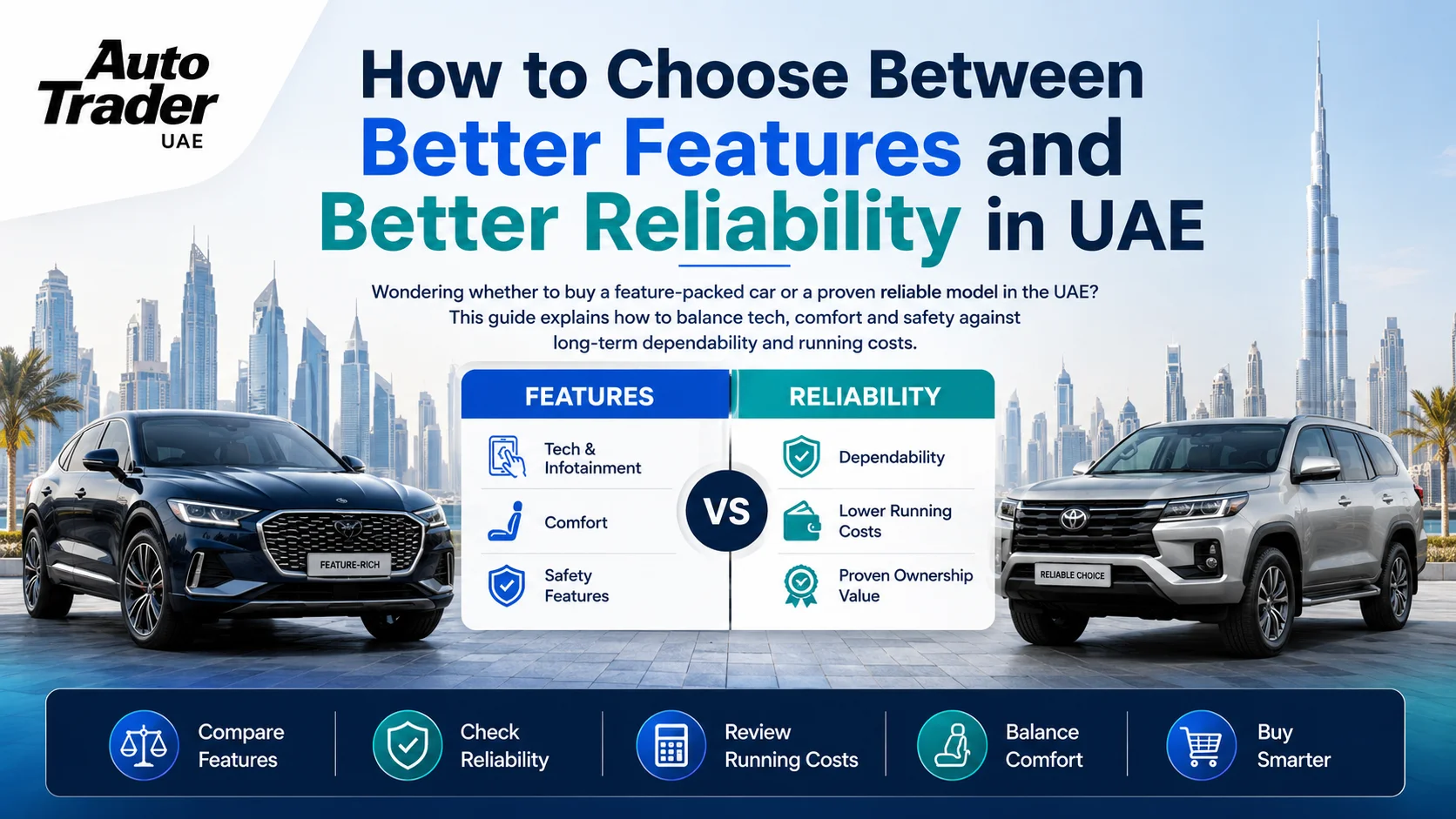
How to Choose Between Better Features and Better Reliability in UAE
Car buyers in the UAE often face one big dilemma: choose the car with more features, or the one with better reliability. With so many tech‑loaded models on the market – from touchscreens and ADAS safety systems to massaging seats – it’s easy to get distracted from the basics: how long the car will actually last, and what it will cost you to keep it on the road.
This Auto Trader UAE guide walks you through how to balance features versus reliability for UAE conditions, so you can buy confidently and protect your budget – whether you’re shopping new or used.
What “Features” vs “Reliability” Really Mean
What counts as “better features”?
Features are the comfort, convenience, tech and styling extras that make a car feel modern and premium. In the UAE, buyers often look for:
- Comfort & convenience: dual- or tri-zone climate control (essential in UAE heat), ventilated seats, electric seats with memory, panoramic roof, power tailgate
- Infotainment & connectivity: large touchscreen, Apple CarPlay/Android Auto, premium sound system, wireless charging, digital driver display
- ADAS & safety tech: adaptive cruise control, lane keeping assist, blind spot monitor, 360° camera, automatic emergency braking, rear cross-traffic alert
- Style & performance: LED or matrix headlights, alloy wheel upgrades, body kits, drive modes, paddle shifters
More features usually mean a higher original price and more complex electronics – which can affect long‑term reliability and repair costs, especially once the warranty ends.
What counts as “better reliability”?
Reliability is about how consistently a car performs without faults and how expensive it is to repair when something does go wrong. Practically, in the UAE this includes:
- Engine and gearbox durability in hot, dusty conditions
- Cooling system strength for summer traffic and long highway runs
- Affordable, available spare parts locally
- Simple, proven technology rather than untested or overly complex systems
- Resilience of electronics to heat, humidity and frequent AC use
A reliable car is not just about avoiding breakdowns; it also tends to hold its value better in the UAE resale market and is easier to sell on Auto Trader UAE when you’re ready to upgrade.
Key UAE Factors That Change the Equation
1. Extreme heat and dust
Cars in the UAE live a tougher life than in many other markets. High temperatures, intense sun, and dusty environments stress engines, plastics, rubber components and electronics. This makes reliability – especially of the cooling system and electrical features – more important than in mild climates.
When you’re choosing between a feature-heavy car and a simpler, proven model, always ask: how will all this tech survive a few years of UAE summers?
2. AC performance is non‑negotiable
Whatever you buy, strong air conditioning is essential. In practice, a car with rock‑solid AC and fewer gadgets is often more livable than a fully loaded model with weak or troublesome climate control. On test drives, always:
- Check how fast the cabin cools from hot start-up
- Test AC at idle and at highway speeds
- Try rear vents (and third row if it’s a 7‑seater)
3. Resale value in the UAE market
UAE buyers pay a premium for reliability and service history. Cars known for long‑term dependability generally:
- Lose value more slowly over 3–5 years
- Sell faster as used cars on Auto Trader UAE
- Are easier to finance and insure at competitive rates
On the other hand, some feature-rich models with weaker reliability reputations can look attractive when new but depreciate faster, especially once the warranty expires.
4. Availability and price of parts & service
In the UAE, brands with strong dealer networks and common parts usually mean:
- Shorter waiting times for repairs
- Lower prices for consumables (brake pads, filters, belts, etc.)
- More independent workshops familiar with the model
A car can have some reliability concerns yet still be manageable if parts and expert service are widely available. Always factor this into your decision.
How to Decide: Features vs Reliability – Step‑by‑Step
Step 1: Define your real daily needs
Before comparing spec sheets, get clear on how you use your car in the UAE:
- Main usage: city commuting, school run, long-distance between emirates, occasional off‑road, ride‑hailing, or business use?
- Passengers: usually solo, couple, young family, or big family needing 7 seats?
- Parking and driving style: street parking in the sun, underground parking, frequent short trips or long highway drives?
Your actual usage should drive your priorities. For instance, a family doing frequent highway trips Abu Dhabi–Dubai might value reliability, fuel economy and ADAS more than a panoramic roof or ambient lighting.
Step 2: Set a total ownership budget, not just purchase price
Many buyers only compare sticker prices. To choose wisely between features and reliability, consider total cost of ownership over 3–5 years:
- Purchase price (and down payment/EMI if financing)
- Fuel consumption in mixed UAE driving
- Insurance premiums for your age and profile
- Dealer service package costs or independent maintenance
- Expected repairs after warranty (especially for complex features)
- Projected resale value in the UAE
Sometimes paying a bit more upfront for a car with a strong reliability record saves you significantly in maintenance, downtime and resale.
Step 3: Decide which features are truly “must‑have”
Make three lists before you start browsing Auto Trader UAE:
- Must‑have features: e.g. strong AC, rear camera, parking sensors, Bluetooth/CarPlay, at least 6 airbags, cruise control
- Nice‑to‑have features: e.g. sunroof, leather seats, power tailgate, large wheels, adaptive cruise
- Can‑live‑without features: e.g. massaging seats, gesture controls, very large touchscreen, fancy ambient lighting
This helps you walk away from cars that compromise long‑term reliability just to give you non‑essential tech.
Step 4: Research reliability for UAE conditions
Global reliability reports are useful, but UAE usage is unique. When you shortlist cars, check:
- Local owner forums and groups for issues specific to hot climates
- Feedback from UAE workshops and service advisors about common faults
- Frequency and cost of typical repairs once the car is 4–7 years old
- Whether the model has known AC, gearbox or electronics problems
On Auto Trader UAE, compare listings of the same model with higher mileage (150,000 km+). If many high‑km cars are still running with full history, that’s a positive sign.
Step 5: Compare two cars side by side
When torn between a feature‑packed model and a more reliable one, create a quick comparison:
- Car A: More features, lower reliability reputation
- Car B: Fewer features, stronger reliability reputation
Then compare these points:
- Price difference (purchase and likely resale)
- Warranty length and coverage (especially for electronics/ADAS)
- Real‑world fuel economy in UAE traffic
- Service intervals and cost per service
- Common issues in hot climates
- Insurance quotes for both cars
Often, you’ll find that one model offers a more balanced package: adequate features, strong reliability, and realistic running costs.
When to Prioritise Reliability Over Features
In several common UAE situations, reliability should clearly come first:
- High annual mileage: If you commute daily between emirates or do delivery/ride‑hailing work, your car will rack up kilometres quickly. Mechanical strength and cheap, fast repairs matter more than a long options list.
- Long‑term ownership: If you plan to keep the car 7–10 years, avoid overly complex, unproven tech. Simple, durable engines and gearboxes usually win.
- Limited budget for unexpected repairs: If a single big repair bill would be a serious problem, lean strongly towards brands and models known for low failure rates.
- Remote or desert driving: If you regularly drive outside major cities or off‑road, mechanical toughness and easily available parts are more important than luxury features.
When Extra Features May Be Worth It
On the other hand, paying more for features can make sense if:
- You mainly drive in the city: Features like 360° cameras, parking assist, and adaptive cruise can genuinely reduce stress and minor accidents.
- You often carry family or VIP passengers: Extra comfort, better sound insulation and premium interiors improve the overall experience.
- You change cars frequently (3–4 years): While reliability still matters, you may sell the car while it’s under warranty, before complex systems age.
- Safety tech is the difference: If choosing the better‑equipped trim adds advanced safety systems without compromising brand reliability, that’s often a smart upgrade.
How This Plays Out in Different Car Segments
1. Small hatchbacks and compact sedans
In the entry‑level segments, the trade‑off is usually between:
- A basic, very reliable car with fewer gadgets
- A more stylish, tech‑heavy option with a shorter reliability track record
For many first‑time buyers in the UAE – students, young professionals, ride‑hailing drivers – low running costs and reliability typically matter more than features like sunroofs or big wheels.
2. Family SUVs and crossovers
Family cars need a balance of both. Parents often want:
- Strong AC for all rows
- Good safety rating and ADAS
- Rear camera and parking sensors
- A comfortable ride and decent space
Here, choose a reliable base or mid‑spec trim of a solid model over a full‑option version of a car with a weaker durability reputation. The right middle ground often delivers enough tech without sacrificing long‑term dependability.
3. Luxury sedans and premium SUVs
In higher segments, features are part of the appeal – but complexity rises significantly. When you’re looking at a luxury car on the used market in the UAE, be very cautious of:
- Old high‑tech infotainment systems that are expensive to repair
- Air suspension and complex electronics out of warranty
- Imported (non‑GCC spec) vehicles without proper service history
In many cases, a slightly less optioned, well‑maintained GCC‑spec car with full dealer history is a smarter buy than a full‑option model with gaps in its records.
Feature vs Reliability: New Car vs Used Car in UAE
Buying new
With a new car, you usually have a manufacturer warranty covering major defects for several years. This can make it feel safer to go for more features. Still:
- Check what the warranty actually covers – especially electronics, sunroofs and ADAS
- Ask about extended warranty options and their cost
- Confirm service package prices – heavily optioned models sometimes have higher labour time for certain jobs
Buying used
On the used market, features can make a car look like a bargain – but out‑of‑warranty tech can be expensive to fix. To choose wisely:
- Prioritise a clean, verifiable service history over extras like panoramic roof or upgraded wheels
- Get a pre‑purchase inspection focusing on electronics, AC, suspension and any air or hydraulic systems
- Budget for at least one major service or catch‑up maintenance after purchase
- Be careful with heavily modified cars; aftermarket electronics can impact reliability
You can explore a wide range of used cars in UAE on Auto Trader UAE, comparing specs, mileage, and condition to find the right balance between equipment and long‑term dependability.
Checklist: Questions to Ask Before You Decide
- Is this car known to handle UAE heat and dust well?
- How strong is its reliability record once the car passes 100,000 km?
- Are the extra features I’m paying for genuinely useful to me every week?
- How expensive is it to repair these features if they fail out of warranty?
- Does this car hold its value well in the UAE used market?
- Are parts and qualified workshops easily available where I live?
- Can I comfortably afford fuel, insurance and maintenance for the next 3–5 years?
Buyer Tips for Balancing Features and Reliability in UAE
- Choose the right trim level: A mid‑spec trim often offers the best mix of key features and fair price, without over‑complicating the car.
- Don’t sacrifice safety for style: If the choice is between a sunroof or more airbags/ADAS within your budget, safety should win.
- Focus on climate essentials: Strong AC, rear vents, heat‑resistant interior materials and a good cooling system are non‑negotiable in the UAE.
- Check GCC spec: For used imports, confirm whether the car is GCC‑spec and suitable for UAE conditions.
- Test every electronic feature during inspection: From seat controls to cameras and sensors, fixing them later can be costly.
What This Means for Sellers in the UAE
If you’re selling your car on Auto Trader UAE, understanding the features vs reliability balance helps you price and present it better:
- Highlight reliability points: Full service history, dealer maintenance, low number of owners, GCC‑spec, and any remaining warranty are strong selling points.
- Mention key features clearly: Buyers scan listings; highlight AC performance, safety tech, cameras, parking aids and connectivity first.
- Be transparent about known issues: Honest disclosure about any minor faults builds trust and helps close a fair deal faster.
- Use good photos: Show the interior condition, infotainment screen, seat controls and service book to prove care and equipment level.
Next Steps with Auto Trader UAE
Choosing between better features and better reliability in the UAE comes down to your usage, budget and risk tolerance. In most cases, the smartest move is a balanced car: solid reliability record, full service history, and the features you’ll actually use every day in the local climate.
On Auto Trader UAE you can:
- Compare specs and trim levels across hundreds of used cars in UAE
- Focus your search on popular, reliable body types like used SUVs in UAE
- Browse city‑focused options in key markets such as used cars in Dubai
Start shortlisting now, use your features‑vs‑reliability checklist, and book inspections or test drives with sellers through Auto Trader UAE before you decide.
Browse used cars in UAE on Auto Trader UAE to compare live listings, prices, and current market activity more clearly.
Related Links
Buyer Takeaway
When buying a used car in the UAE, focus on vehicle condition, service history, inspection quality, paperwork, and total running costs rather than price alone. Compare options carefully and choose the option that best matches your budget and real needs.
Seller Takeaway
If you are selling a used car in the UAE, present the service history clearly, price the vehicle realistically, and highlight condition, specification, and ownership strengths honestly. A well-prepared listing with accurate details usually attracts more serious buyers.
Conclusion
A careful used car purchase in the UAE starts with research, proper inspection, and clear paperwork before making the final decision.