
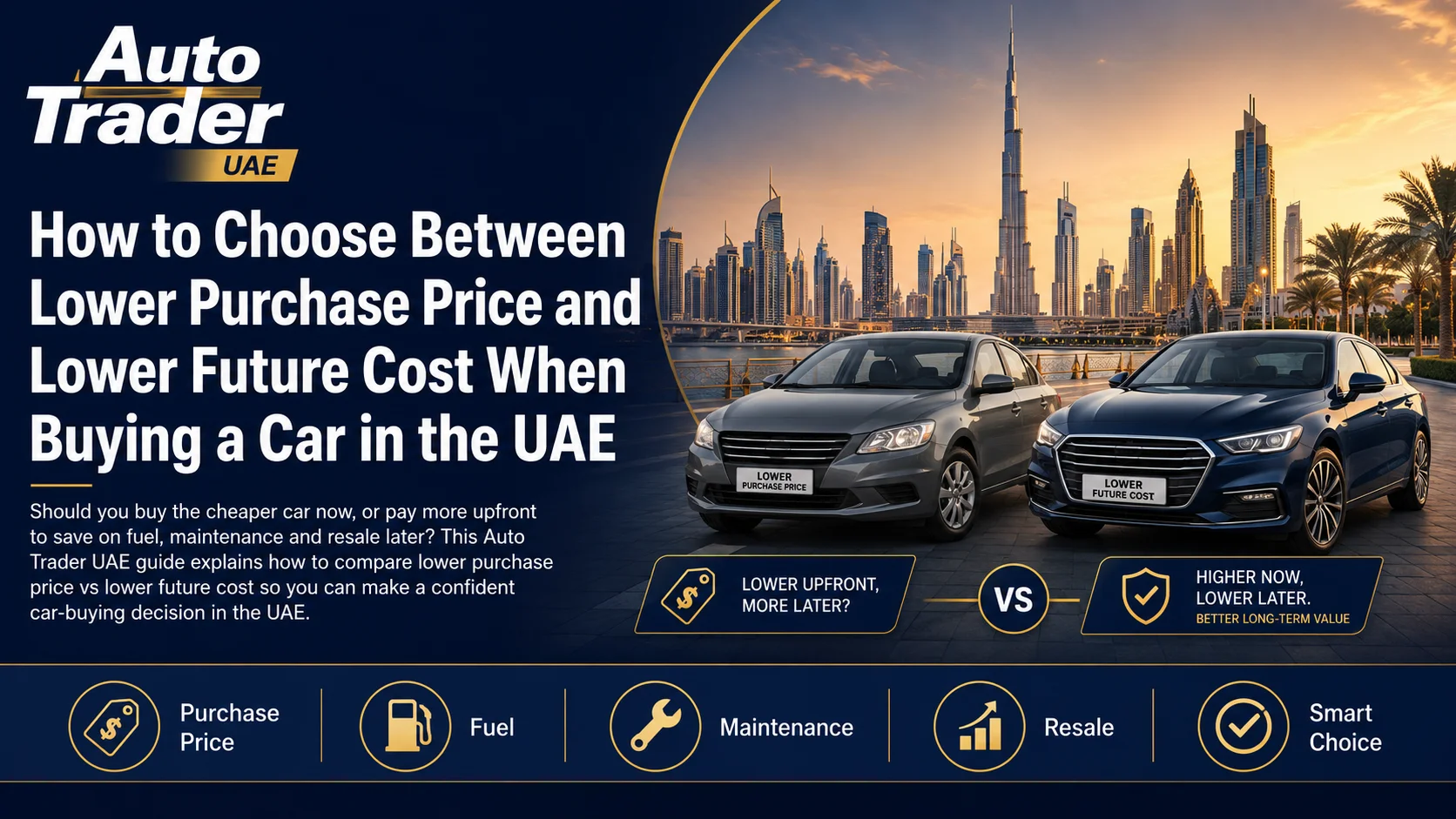
How to Choose Between Lower Purchase Price and Lower Future Cost in the UAE
Every car buyer in the UAE eventually hits the same question: is it smarter to pick the car with the lowest price today, or the one that will be cheaper to run, service and sell in the future?
This guide from Auto Trader UAE walks you through how to compare both options in a clear, practical way, so you can decide what really fits your budget, your lifestyle and your long-term plans.
What “Lower Purchase Price” vs “Lower Future Cost” Really Means
Lower purchase price
A car with a lower purchase price:
- Costs less to buy today (down payment or full cash)
- May have higher running costs (fuel, maintenance, insurance)
- May depreciate faster, so you get less back when you sell
Lower future cost
A car with lower future cost usually:
- Costs more upfront
- Gives better fuel economy
- Has lower maintenance and repair bills over time
- Holds its value better when you resell
The right choice depends on how long you plan to keep the car, how much you drive in the UAE, and how tight your monthly budget is.
Step 1: Be Honest About Your Budget in the UAE
Upfront budget vs monthly cash flow
Start with two clear numbers:
- Maximum upfront budget: down payment or full cash amount you can afford without stress.
- Maximum monthly budget: total you can comfortably spend on instalments, fuel, Salik, parking, and routine service.
If your upfront budget is tight, a lower purchase price may be necessary. If your monthly budget is tight but you can manage a bigger down payment, a car with lower future costs can be smarter.
Step 2: Estimate Your Annual Mileage in the UAE
How many kilometres you drive in the UAE changes everything. Someone who only drives in their neighbourhood will not benefit from fuel savings as much as a daily Dubai–Abu Dhabi commuter.
Rough guide:
- Low mileage: under 10,000 km/year
- Average: 10,000–20,000 km/year
- High mileage: 20,000–30,000+ km/year
If you’re high mileage, choosing the car with lower fuel consumption and better reliability matters more than saving a few thousand dirhams on the purchase price.
Step 3: Compare Total Cost of Ownership (TCO)
To choose between lower purchase price and lower future cost, look at total cost of ownership over the period you plan to keep the car.
Total cost of ownership typically includes:
- Purchase price (minus resale value)
- Fuel costs
- Routine servicing and minor repairs
- Insurance and registration
- Tyres and wear-and-tear items
Simple way to compare two cars
Imagine two used cars you’ve found on Auto Trader UAE:
- Car A – cheaper upfront: AED 45,000
- Car B – more efficient and reliable: AED 55,000
Assume:
- You keep the car 4 years
- You drive 20,000 km per year
Check:
- Fuel: Use the cars’ average fuel consumption and local petrol prices to estimate annual fuel cost for each.
- Service: Ask garages or check manufacturer schedules for typical service prices in the UAE.
- Insurance: Get online quotes for both models; more expensive cars can sometimes have lower premiums if they’re safer and cheaper to repair.
- Resale: Look at similar 4-year-old listings on Auto Trader UAE to estimate future value.
When you add all of this, you may find that Car B, even with a higher purchase price, ends up cheaper per year to own than Car A.
Step 4: Factor in Fuel Economy for UAE Driving
Fuel is a major cost in the UAE, especially if you commute across emirates or drive mostly in traffic with the AC always on.
How to compare fuel costs
- Find the car’s fuel consumption (L/100 km or km/L) from the manufacturer or reliable reviews.
- Estimate your annual kilometres.
- Multiply fuel consumption by km/year and fuel price.
A car that saves even 2–3 litres per 100 km can save thousands of dirhams over several years in the UAE.
Step 5: Consider Maintenance, Parts and Reliability
A cheap car today can become expensive if it spends time in the workshop or needs hard-to-find parts.
Things to check
- Service intervals: how often the car needs servicing and typical costs in UAE workshops.
- Parts availability: popular models usually have cheaper, readily available parts.
- Known issues: search owner forums and reviews for common problems for that model and year.
- Warranty: is the car still under agency or extended warranty?
For used cars, consider models that have a strong reputation in the UAE for long-term reliability and easy maintenance.
Step 6: Think About Depreciation and Resale in the UAE
Depreciation is the loss in your car’s value over time. Some models hold their value in the UAE market better than others.
To estimate depreciation:
- Search Auto Trader UAE for 3–5 year old versions of the same model.
- Compare their asking prices against original new prices or your intended purchase price.
- Models with strong resale may cost more now but return more when you sell.
If you plan to sell within 2–3 years, strong resale value often matters more than the lowest purchase price.
Step 7: Match the Car to Your UAE Lifestyle
Your usage pattern can change which option is better:
- City driver (Dubai, Abu Dhabi, Sharjah): stop-start traffic, parking costs, and Salik. Compact, fuel-efficient cars with lower running costs can be better than cheap, thirsty models.
- Long-distance commuter: look for comfort, fuel economy and reliability over a low purchase price.
- Family driver: safety features and reliability are worth paying more for, even if the purchase price is higher.
- Occasional user: if you drive very little, you can lean more towards a lower purchase price, as fuel savings will be smaller.
When a Lower Purchase Price Makes Sense
Choosing the cheaper car now may be the right decision if:
- You need a car urgently and your cash is limited.
- You plan to keep the car for a short time only (1–2 years).
- You drive very low mileage in the UAE.
- You accept slightly higher running costs in exchange for a smaller loan or no loan.
When to Choose Lower Future Cost Instead
Paying more upfront is usually smarter if:
- You drive long distances every week.
- You plan to keep the car 3–7 years.
- You want predictable servicing costs and strong reliability.
- You care about resale value in the UAE market.
How Finance and Interest Change the Equation
If you’re financing your car, the interest you pay on the loan changes the real cost of both options.
- Cheaper car, shorter loan: can mean less total interest but possibly higher monthly fuel and maintenance costs.
- More expensive car, longer loan: lower monthly instalments are possible, but calculate total interest and total ownership cost over the full term.
Always compare the total amount payable under each finance offer, not just the instalment.
Practical Checklist Before You Decide
Before choosing between a lower purchase price and lower future cost, go through this checklist:
- Confirm your maximum upfront and monthly budgets.
- Estimate your realistic annual mileage in the UAE.
- Compare fuel economy between your shortlisted cars.
- Get indicative insurance quotes for each model.
- Research service costs and parts availability.
- Check typical resale values for 3–5 year old examples on Auto Trader UAE.
- Decide how long you intend to keep the car.
Using Auto Trader UAE to Compare Real Options
To apply these ideas, use live listings on Auto Trader UAE:
- Shortlist two or three cars: one with a lower purchase price, and one that is newer, more efficient or from a brand known for high resale.
- Note their prices, mileage, service history and any remaining warranty.
- Run through the total cost of ownership points above for your actual options.
You can browse a wide range of used cars in the UAE to find combinations of price, age and running costs that suit your priorities. If you’re based in Dubai, focus your search on used cars in Dubai to compare similar models more easily.
Conclusion: Balance Today’s Price with Tomorrow’s Costs
There is no single “right” answer to how to choose between a lower purchase price and lower future cost. The best choice is the one that fits your cash today, your monthly comfort zone, and the way you actually drive in the UAE.
Use Auto Trader UAE to compare real cars, check how well similar models hold their value, and find a used car that offers the best balance between what you pay now and what you’ll spend later. With a clear view of total cost of ownership, you can buy with confidence—whether you’re prioritising the lowest sticker price or the smartest long-term investment.
Browse used cars in UAE on Auto Trader UAE to compare live listings, prices, and current market activity more clearly.
Related Links
Buyer Takeaway
When buying a used car in the UAE, focus on vehicle condition, service history, inspection quality, paperwork, and total running costs rather than price alone. Compare options carefully and choose the option that best matches your budget and real needs.
Seller Takeaway
If you are selling a used car in the UAE, present the service history clearly, price the vehicle realistically, and highlight condition, specification, and ownership strengths honestly. A well-prepared listing with accurate details usually attracts more serious buyers.