
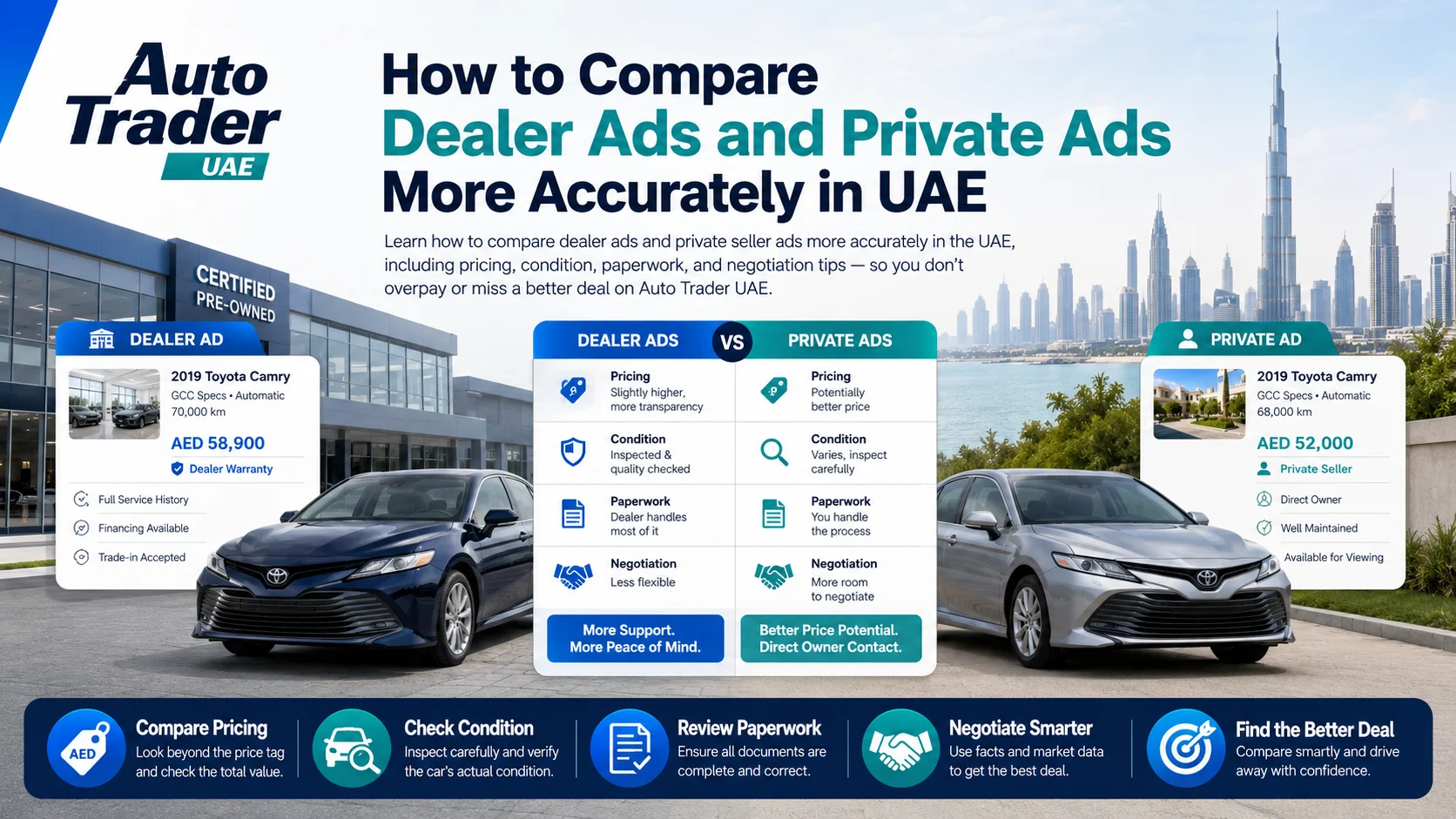
How to Compare Dealer Ads and Private Ads More Accurately in UAE
When you search for a used car in the UAE, you’ll usually see two main types of listings: cars from dealers and cars from private sellers. Both can offer good value, but they are not directly comparable at first glance. If you simply line up prices, you can easily misjudge which car is actually the better deal.
This guide explains how to compare dealer ads and private ads more accurately in the UAE, so you can make a confident choice when browsing used cars on Auto Trader UAE.
1. Start with the total cost, not just the price tag
Dealer cars almost always look more expensive on the surface. But some of that difference comes from services and protections that private sellers usually don’t offer. To compare fairly, build a total cost picture for each car.
What to include in a dealer total cost
- Advertised price (often slightly negotiable, especially for cash buyers)
- Dealer admin or processing fees (sometimes added on top)
- RTA transfer fees (sometimes handled by the dealer, sometimes paid by you)
- Warranty or service package included in price
- Fresh passing / inspection (if dealer arranges it)
- Registration assistance (some dealers include or charge a small fee)
What to include in a private seller total cost
- Advertised price (usually more negotiable than dealers)
- RTA test and passing (if registration is expiring soon)
- RTA transfer fee (normally paid at the RTA centre or service provider)
- Any immediate repairs or maintenance the car needs
- Optional extended warranty if you decide to buy one through a third party
Once you add everything up, the price gap between dealer and private ads often gets smaller. A cheaper private car that needs tyres, brakes and a major service can quickly cost more than a slightly higher-priced dealer car that has been reconditioned.
2. Compare condition with a checklist, not impressions
Condition is one of the biggest differences between dealer and private ads. Many dealers in the UAE invest in detailing, minor paintwork and mechanical checks. A private seller may not. To compare fairly, use the same checklist for both.
Condition checklist for any used car
- Exterior: paint overspray, mismatched panels, visible rust, dents or poorly aligned bumpers
- Interior: seat wear, steering wheel shine, odours (smoke, pets, damp), cracked trim
- Tyres: brand, tread depth and age (check DOT date code)
- Service history: stamped service book or digital records, especially for agency-maintained UAE cars
- Engine bay: leaks, burnt smells, messy wiring or obvious modifications
- Test drive: cold start, gearbox smoothness, steering alignment, braking feel, warning lights
Score each car (dealer or private) on the same points. A well-kept private car with full history can easily outrank an average dealer car – or vice versa. Condition should have a strong influence on what you’re willing to pay.
3. Understand what dealer extras are really worth
Dealer ads in the UAE often feature benefits that private sellers cannot provide. They have a real value, but that value depends on your plans and how long you’ll keep the car.
Common dealer extras in the UAE
- Limited warranty: often 3–12 months on engine and gearbox, sometimes extendable for a fee.
- Service contract: pre-paid minor/major services for a specific mileage or period.
- Reconditioning: new tyres, brakes, battery or fluids done before sale.
- Financing support: assistance with bank loan, valuation, and insurance.
- Trade-in option: ability to part-exchange your current car instead of selling privately.
Think about how each extra benefits you:
- If you’re new to the UAE or not mechanically confident, a dealer warranty can be worth a clear premium.
- If you expect to resell quickly, fresh service and reconditioning can help with your future resale value.
- If you are a cash buyer planning to keep the car long-term, you might prefer a cheaper private car and do the maintenance yourself.
4. Factor in financing and payment flexibility
Most private sellers in the UAE want cash or a single bank transfer. Dealers can usually support:
- Bank financing for residents
- Salary transfer letters and valuation documents
- Coordination with insurance and registration
If you need a bank loan, dealer ads often become more attractive because the process is smoother and sometimes faster. That convenience has a value, even if the sticker price is higher than a private ad.
5. Compare paperwork and history with the same standards
Paperwork quality is not guaranteed on either side. Some dealers offer very clean history cars; others import accident-repaired or high-mileage vehicles. Some private sellers are the first owner with full agency history; others may have incomplete documents.
Documents to compare
- Original registration card (Mulkiya) – check chassis number, engine number and expiry date.
- Service history – dealership stamps, invoices, or agency digital history where available.
- Accident history reports – from official sources where possible.
- Import status – GCC spec vs imported; ask directly and verify where you can.
- Loan / mortgage status – ensure the car is clear of any finance before paying.
Apply the same scrutiny to both dealer cars and private cars. Don’t assume a dealer car automatically has perfect history, and don’t assume a private car is always more risky. The details matter.
6. Adjust for negotiation power
Dealer and private pricing behave differently at negotiation time in the UAE.
Typical negotiation patterns
- Dealers: usually have less room to move on price, but may include extras (new tyres, full tank, minor repairs, fresh passing) instead of big discounts.
- Private sellers: often have more flexibility, especially if they are leaving the country or have already bought a new car.
When comparing two cars, estimate a realistic final price. If you know dealers on a certain model typically discount 1–3%, and private sellers may accept 5–8% off, factor that into your comparison rather than just looking at list prices on Auto Trader UAE.
7. Consider legal protection and recourse
In practice, you have more potential recourse with a registered business than with an individual. This doesn’t mean every dealer is perfect, but the structure matters.
Dealer vs private protection basics
- Dealer: You’re buying from a commercial entity. Contracts, invoices and warranties can give you more leverage if major undisclosed issues appear soon after purchase.
- Private seller: Sales are usually “as-is”. Once the RTA transfer is complete and money is paid, it’s difficult to claim anything back unless there has been clear fraud.
When a dealer car and a private car are similar in price and condition, this extra layer of protection can be a deciding factor in favour of the dealer.
8. Match the ad type to your buyer profile
Some buyers are better suited to dealer purchases; others are more comfortable with private deals. Understanding your own needs helps you compare more honestly.
Who is better off with dealer ads?
- First-time buyers in the UAE
- Busy professionals who value time-saving and paperwork handling
- Drivers who prefer warranty and structured aftersales support
- Buyers using bank finance tied to a registered showroom
Who is better off with private seller ads?
- Experienced car buyers who know how to inspect and value cars
- Cash buyers targeting the lowest entry price
- Enthusiasts looking for specific specs or well-kept single-owner cars
- Buyers comfortable arranging RTA processes and inspections themselves
9. Use filters and saved searches on Auto Trader UAE
On Auto Trader UAE, you can actively use filters to compare dealer and private listings side by side. This helps you see real market differences on the same model, year and mileage.
Practical steps on the site
- Filter by make, model, year and mileage, then toggle between dealer and private listings.
- Sort by price low–high to see how dealer and private prices overlap.
- Save your favourite listings from both dealers and private sellers for direct comparison.
- Use consistent notes: warranty, service history, condition summary and total estimated cost.
This kind of structured comparison will quickly show you whether a dealer premium on a specific model is justified – or whether a clean private car is the smarter choice.
10. Red flags to watch for in both dealer and private ads
While most buyers and sellers in the UAE market are genuine, you should still watch for warning signs on both sides.
Red flags in dealer ads
- Prices far below the market average with no clear reason
- Reluctance to show full service history or inspection report
- Pressure to pay a large deposit before a proper test drive or inspection
- Very vague warranty terms or verbal promises not written into the contract
Red flags in private ads
- Seller refusing a professional inspection or RTA pre-purchase check
- Inconsistent information about ownership, mileage or history
- Requests for money transfers before viewing the car
- Unwillingness to meet at an RTA centre or official test facility for transfer
11. How to decide between a specific dealer car and a private car
When you’ve narrowed things down to two or three serious options – maybe one dealer car and one private car – use a simple comparison sheet to get clarity.
Build a simple comparison table
Create a table (on paper or in a spreadsheet) with these columns:
- Price (advertised)
- Estimated final price after negotiation and fees
- Condition score (your own rating 1–10)
- Service history quality
- Warranty / extras
- Immediate repairs needed
- Seller type (dealer vs private)
- Risk / confidence level (your own feeling)
Seeing the numbers and notes next to each other makes it easier to ignore marketing language and focus on real value.
12. Next steps on Auto Trader UAE
To put this guide into action, start by browsing live listings and practising your comparison skills on real cars:
- Explore a wide range of used cars in UAE from both dealers and private sellers.
- If you’re Dubai-based, focus your search on used cars in Dubai to compare local dealer and private prices.
- Shortlist a mix of dealer and private ads on the same model to see how extras and condition affect real value.
By looking beyond the headline price and using a clear structure to compare dealer ads and private ads more accurately in the UAE, you’ll put yourself in a stronger position to negotiate – and to choose the car that genuinely suits your budget, risk level and long‑term plans.
Browse used cars in UAE on Auto Trader UAE to compare live listings, prices, and current market activity more clearly.
Related Links
Buyer Takeaway
When buying a used car in the UAE, focus on vehicle condition, service history, inspection quality, paperwork, and total running costs rather than price alone. Compare options carefully and choose the option that best matches your budget and real needs.
Seller Takeaway
If you are selling a used car in the UAE, present the service history clearly, price the vehicle realistically, and highlight condition, specification, and ownership strengths honestly. A well-prepared listing with accurate details usually attracts more serious buyers.
Conclusion
A careful used car purchase in the UAE starts with research, proper inspection, and clear paperwork before making the final decision.