
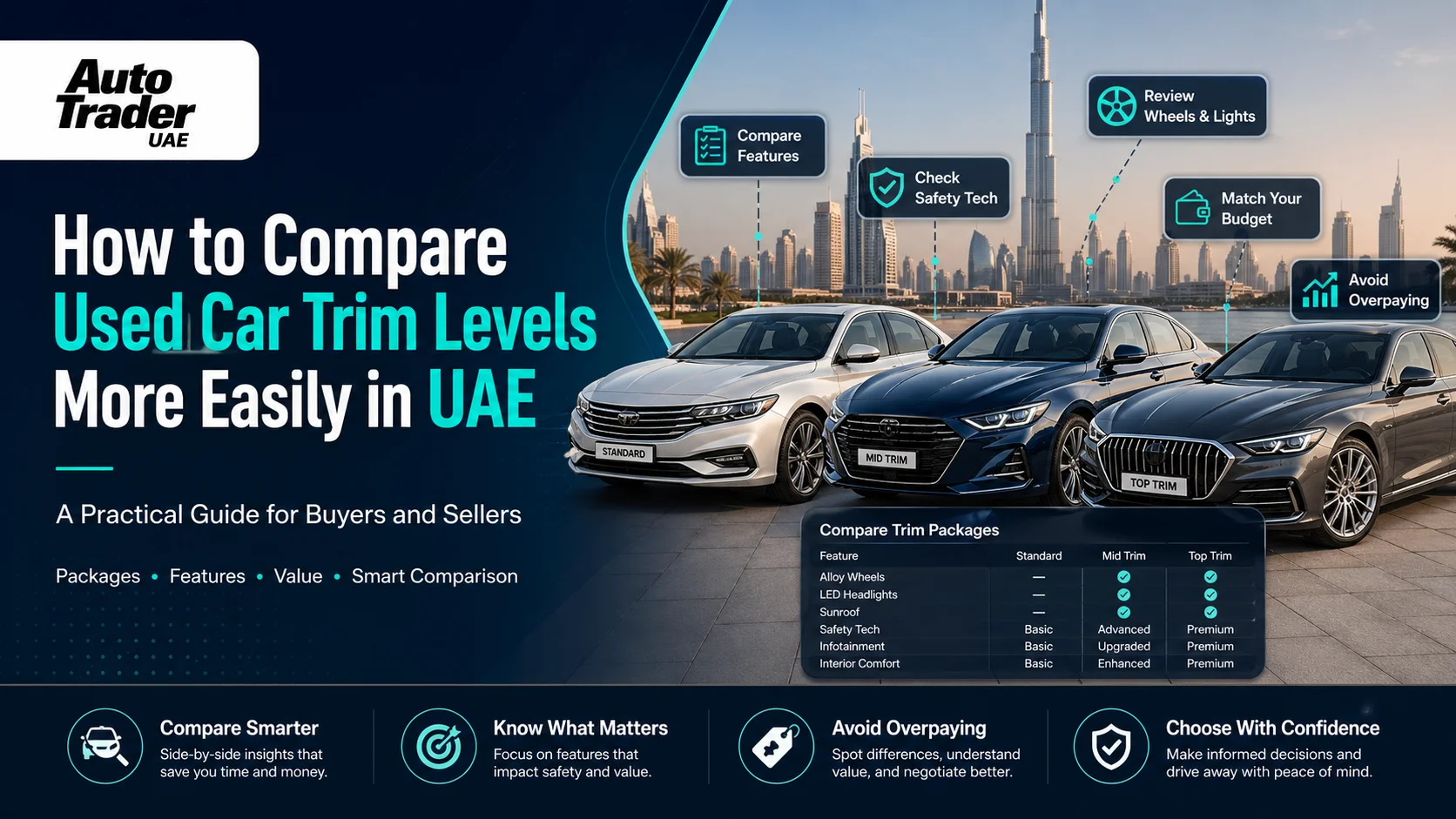
How to Compare Used Car Trim Levels More Easily in UAE
Looking at used car ads in the UAE and seeing Standard, Mid, Full, SE, Sport, Prestige, Platinum – but not really sure what you’re paying for? You’re not alone. Trim levels can dramatically change the price, equipment, and even resale value of a used car.
This guide explains how to compare used car trim levels more easily in UAE, so you can quickly see which car is better value and which upgrades are worth paying for.
What Is a Trim Level – and Why It Matters in UAE
A trim level is a version of a car with a specific combination of features, options and sometimes engine. For example, a model might have:
- Base / Standard
- Mid / Comfort / SE
- Full / Sport / Luxury / Platinum
In the UAE used market, trim level affects:
- Price: Higher trims cost more, but can offer better value if you want those features.
- Resale value: Popular trims are easier to sell later and hold value better.
- Running costs: Bigger engines, expensive tyres, complex electronics can be pricier to maintain.
- Comfort & safety: Trim is often the difference between basic and well-equipped.
Step 1: Decide What You Actually Need
Before you compare trims, be clear on your real-world needs. This stops you paying extra for features you’ll never use.
Key questions to ask yourself
- Daily use: Mostly city commuting, long-distance Abu Dhabi–Dubai drives, school runs, or off-roading?
- Passengers: Do you regularly carry family, kids in child seats, or colleagues?
- Parking: Do you often park in tight basement parking or street parking?
- Comfort vs budget: Are features like leather seats and sunroof essential, or is reliability and low cost more important?
Make a short checklist of must-haves and nice-to-haves. You’ll use this when comparing trim levels.
Step 2: Understand Typical Trim Names Used in UAE
Different brands use different trim names, but in the UAE market dealers and sellers also use common terms like GCC, Mid, Full Option. These are not fully standardised, so treat them as a starting point, not a guarantee.
Common trim descriptions you’ll see
- Base / Standard: Basic equipment, often cloth seats, steel or small alloy wheels, manual seat adjustment, simple audio system.
- Mid / Mid-Option / SE / Comfort: Adds some convenience features – alloy wheels, better infotainment, parking sensors, maybe partial leather or automatic AC.
- Full / Full Option / Platinum / Sport / Prestige: Usually top trim – leather, sunroof or panoramic roof, advanced safety tech, bigger wheels, upgraded sound system.
- GCC spec: Configuration officially sold for the Gulf region – generally preferred in the UAE for better cooling and easier servicing.
- Imported / US spec / European spec: Can offer more features for the money but check specs carefully and verify accident history.
Always confirm what is actually on the car – never assume “full option” means identical features across brands or even across model years.
Step 3: Compare Engine, Gearbox and Performance First
Trim levels can also include different engines and transmissions. These affect fuel economy, performance and long-term costs more than cosmetic features.
Engine size & type
- Smaller engines (e.g. 1.4L–2.0L) are usually more fuel-efficient and cheaper to insure, but may feel underpowered in a fully loaded SUV.
- Larger engines (e.g. V6, V8) offer stronger performance, better for high-speed highway use and towing, but higher fuel and maintenance costs.
- Turbo vs non-turbo: Turbos give more power from smaller engines but can be more complex to maintain if not serviced properly.
Gearbox type
- Automatic: Most common in UAE and easier to sell later.
- CVT: Smooth and efficient, but some buyers prefer traditional automatics for durability.
- Dual-clutch (DCT): Sporty and quick, but may need more careful maintenance, especially in hot stop-go traffic.
- Manual: Rare in UAE passenger cars; cheaper initially but harder to resell.
When comparing used cars, list the exact engine and gearbox for each trim you’re considering. Sometimes a slightly lower trim with a better engine is a smarter buy than a high trim with a basic engine.
Step 4: Prioritise Safety Features
Safety is one of the biggest differences between trim levels, especially on older used cars. In the UAE, some lower trims may miss critical safety tech that higher trims include.
Safety features worth paying attention to
- Airbags: How many? Front, side, curtain?
- ABS & stability control (ESP/VSC): Essential for emergency braking and stability.
- Rear camera & parking sensors: Very useful in tight parking and for taller SUVs.
- Blind-spot monitoring: Helpful on highways and multi-lane roads.
- Adaptive cruise control & lane assist: Common on newer models and higher trims; excellent for regular highway driving.
When choosing between trims, never downgrade safety to save a small amount. A mid trim with extra airbags and stability control is usually better value than a base trim with only cosmetic extras.
Step 5: Compare Comfort and Convenience Features
Once you’ve checked engine and safety, move to comfort and convenience differences. These are often the features that make daily driving in UAE heat more pleasant.
Features that matter in UAE conditions
- Automatic climate control / dual-zone AC: Keeps the cabin cool more effectively.
- Rear AC vents: Important if you carry passengers or kids in the back.
- Ventilated or cooled seats: Very useful in the summer, typically on higher trims.
- Remote start: Lets you cool the car before getting in (check if it’s officially installed).
- Keyless entry & push-button start: Convenience upgrade over traditional keys.
Comfort & interior extras
- Leather or leatherette seats vs cloth
- Power seats with lumbar support
- Sunroof or panoramic roof (nice but can add heat; check for leaks on older cars)
- Ambient lighting, upgraded materials and sound insulation
Ask yourself: Will this feature genuinely improve my daily use? For example, cooled seats might be a must in Dubai traffic, but a panoramic roof might not be essential if you park outdoors in direct sun.
Step 6: Check Infotainment and Technology
Infotainment is one area where older base trims can feel very dated compared with higher trims.
Important tech differences between trims
- Screen size and quality: Higher trims usually offer larger touchscreens.
- Apple CarPlay / Android Auto: A big plus for navigation, calls and music.
- Bluetooth streaming & USB ports: Almost essential for modern use.
- Navigation: Factory navigation can be helpful, though many drivers just use smartphone maps.
- Sound system: Branded or premium audio vs basic speakers.
If a lower trim is missing some tech, check if the features can be easily retrofitted by a trusted installer in the UAE. Sometimes an upgraded head unit is cheaper than paying a big premium for a higher trim.
Step 7: Look at Wheels, Suspension and Off-Road Gear
In SUVs and pickups, trim levels often change how capable and comfortable the vehicle is.
Wheels and tyres
- Wheel size: Larger wheels look better but can mean more expensive tyres and firmer ride.
- Tyre type: Highway, all-terrain or off-road tyres affect comfort and grip.
Off-road equipment (for UAE desert use)
- Four-wheel drive (4WD) or all-wheel drive (AWD)
- Low-range gearbox
- Locking differentials
- Off-road drive modes or terrain response systems
If you’re buying mainly for city use, you may not need full off-road kit. But if you go desert camping or off-roading, the right trim with proper 4WD hardware is worth the extra cost.
Step 8: Check Running Costs for Each Trim
Higher trims don’t just cost more to buy – they can cost more to run in the UAE.
Factors that change with trim
- Fuel consumption: Bigger engines and heavier trims use more fuel.
- Tyre size and type: 19–21 inch tyres are much more expensive than 16–17 inch.
- Service and parts: Advanced electronics, air suspension, adaptive dampers and complex safety systems can be costlier to repair out of warranty.
- Insurance: Some insurers price based on vehicle value and equipment level.
When comparing trims, ask for real-world fuel economy feedback and check typical service costs from owners’ forums or service centres in the UAE.
Step 9: Compare Resale Value and Market Demand
In the UAE, some trims are much easier to sell later than others. This can make them better value even if they cost more upfront.
Trims that usually hold value better
- GCC spec: Usually preferred over imports.
- Mid to high trims with must-have features: Rear camera, alloy wheels, proper AC and at least basic safety tech.
- Popular fleet or family specs: Trims commonly used by families or companies often have stable demand.
Browse listings for the same model on Auto Trader UAE and note which trims have more ads and higher asking prices – that’s a quick real-world indicator of demand.
Step 10: Use a Simple Trim Comparison Checklist
To make comparison easy, create a small table (even on paper or your phone) whenever you view or shortlist cars:
| Item | Car A (Trim) | Car B (Trim) | Car C (Trim) |
|---|---|---|---|
| Engine & gearbox | |||
| GCC / import | |||
| Airbags & safety tech | |||
| AC & comfort features | |||
| Infotainment & connectivity | |||
| Off-road / 4WD equipment | |||
| Tyre size & type | |||
| Service / maintenance condition | |||
| Price vs your budget |
Fill this in while you talk to sellers or dealers. It will quickly show which trim offers the best mix of features for the price.
Step 11: Inspect the Car – Not Just the Trim Badge
On used cars, badges and descriptions can be misleading. Some owners add aftermarket options or even change badges.
Always verify:
- VIN and spec sheet: Ask the seller or dealer for the original spec sheet or decode the VIN through the official distributor where possible.
- Service history: Higher trims often have more complex systems – full service history is important.
- Condition of features: Test sunroof, cameras, parking sensors, seat controls, AC modes and all buttons.
- Aftermarket modifications: Custom body kits, large aftermarket wheels or lowering can affect comfort, insurance and resale.
If you’re unsure, consider a pre-purchase inspection from a trusted workshop in the UAE, especially for higher trims with expensive electronics.
When a Higher Trim Is Worth It – and When It Isn’t
Worth paying for a higher trim if:
- You drive daily and will use comfort features like better AC, parking aids and tech.
- The higher trim has significant safety upgrades (more airbags, stability control, driver aids).
- You plan to resell in a few years and the higher trim is clearly more in demand.
- You need proper 4WD and off-road hardware for desert or camping trips.
You can skip the highest trim if:
- Upgrades are mostly cosmetic (slightly larger wheels, minor interior details).
- You can easily retrofit key tech (head unit, camera) at lower cost.
- Your priority is low running cost over luxury features.
Using Auto Trader UAE to Compare Trim Levels Faster
On Auto Trader UAE, you can quickly:
- Shortlist multiple cars of the same model but different trims.
- Compare asking prices for GCC vs imported specs.
- See which trims have more ads and how fast they sell, giving you a sense of market demand.
As you compare, keep your checklist open and focus on the trims that match your needs, budget and resale expectations.
Next Steps for Buyers and Sellers in UAE
If you’re buying
- Set a realistic budget including insurance, registration and initial service.
- Decide your must-have features and safety requirements.
- Use Auto Trader UAE to filter, shortlist and compare different trim levels of the same model.
- Arrange test drives and inspections to confirm the real spec and condition.
If you’re selling
- Clearly list your car’s exact trim level and major features in your advert.
- Mention whether the car is GCC spec and highlight key comfort and safety options.
- Upload clear photos of the interior, infotainment screen, wheels and any special options.
- Price your car in line with similar trims on Auto Trader UAE to attract serious buyers.
For more tips on budgeting, finance and getting the best value from your next car, explore the money and ownership advice in the Auto Trader UAE money section. You can also stay informed about the latest trends and guides by visiting the Auto Trader UAE blog.
By taking a structured approach to trim levels, you’ll be able to spot the cars that truly offer the best combination of price, features and resale value in the UAE – and avoid paying more for badges that don’t bring real benefits.
Browse used cars in UAE on Auto Trader UAE to compare live listings, prices, and current market activity more clearly.
Related Links
Buyer Takeaway
When buying a used car in the UAE, focus on vehicle condition, service history, inspection quality, paperwork, and total running costs rather than price alone. Compare options carefully and choose the option that best matches your budget and real needs.
Seller Takeaway
If you are selling a used car in the UAE, present the service history clearly, price the vehicle realistically, and highlight condition, specification, and ownership strengths honestly. A well-prepared listing with accurate details usually attracts more serious buyers.
Conclusion
A careful used car purchase in the UAE starts with research, proper inspection, and clear paperwork before making the final decision.