
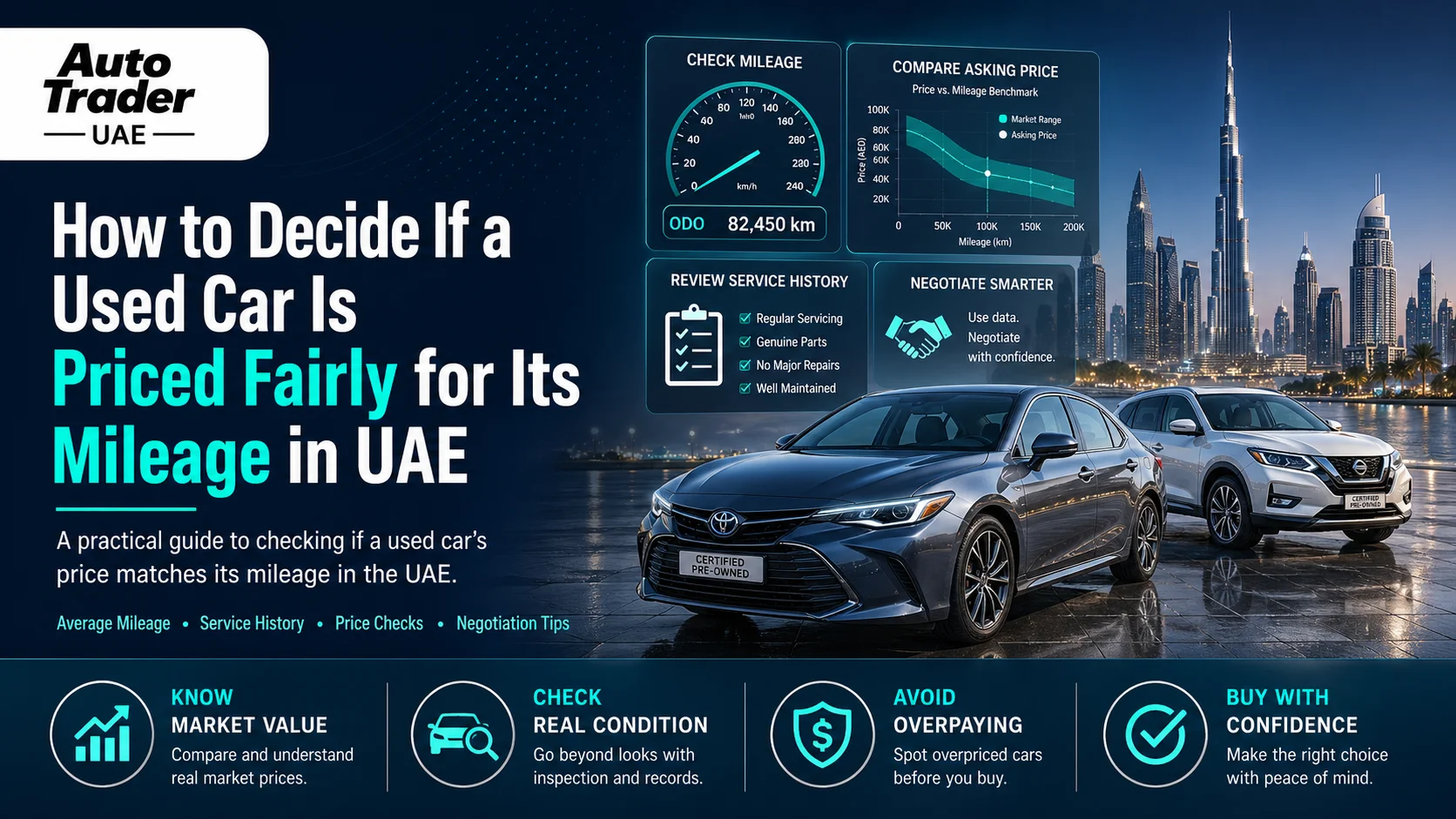
How to Decide If a Used Car Is Priced Fairly for Its Mileage in UAE
Buying or selling a used car in the UAE always comes back to one question: is the price fair for the mileage? Mileage is one of the first things UAE buyers look at, especially in hot climates where wear and tear can be higher. But a low odometer reading doesn’t automatically mean a good deal – and a higher one doesn’t always mean the car is overpriced. This guide explains how to judge whether a used car in the UAE is fairly priced for its mileage, and how both buyers and sellers can use mileage to negotiate with confidence.
1. Why Mileage Matters So Much in the UAE
Mileage affects value everywhere, but in the UAE it has some extra importance because of:
- Heat and stop–start traffic: High temperatures, air‑conditioning use and city driving can accelerate wear even at average mileage.
- Long highway commutes: Many residents commute between emirates, adding kilometres quickly – often gentler on the car than short school-run style trips.
- Resale-focused market: Buyers in Dubai, Abu Dhabi, Sharjah and beyond pay close attention to mileage because they’re already thinking about future resale.
Mileage is one of several major value drivers alongside age, condition, service history and brand. Your goal is to see whether the price reflects all of these – not mileage alone.
2. What Is “Normal” Mileage in the UAE?
There’s no official number, but most everyday UAE cars fall into some typical ranges. These are rough guides, not hard rules:
- Low mileage (for UAE): around < 15,000 km per year
- Average mileage: roughly 15,000–25,000 km per year
- High mileage: typically > 25,000 km per year
To estimate if a car’s mileage is reasonable:
- Check the year of manufacture (or first registration).
- Calculate age in years (current year − model year).
- Multiply age by 15,000–25,000 km to get a normal range.
- Compare the actual odometer reading to this range.
Example: A 2019 car in 2024 is roughly 5 years old.
- Typical range ≈ 75,000–125,000 km
- If it shows 45,000 km, that’s unusually low for the UAE.
- If it shows 180,000 km, that’s high for its age.
A car outside the normal range isn’t automatically a good or bad deal – it just means you should investigate why, and whether the price reflects it.
3. How Mileage Should Affect Price – in Simple Terms
Think of mileage as a sliding scale rather than a fixed penalty:
- Low mileage should generally mean a higher price than similar cars with average mileage.
- Average mileage should be priced around the market median for that model, year and condition.
- High mileage should usually come with a discount vs. similar cars with average mileage.
How much difference can mileage make? It varies widely by brand and segment, but in many practical cases in the UAE:
- The difference between a low-mileage and high-mileage example of the same year/model can easily be several thousand dirhams.
- Premium and European brands often have a bigger price gap for higher mileage because maintenance can be more expensive.
- Popular Japanese and Korean models sometimes hold value better even with moderate mileage, because they’re considered robust and cheap to run.
You don’t need exact numbers to make a good decision. What you need is to see whether the asking price makes sense compared to other cars of the same model year with similar mileage.
4. Step-by-Step: Check If the Price Is Fair for the Mileage
Use this simple process before you make an offer or set your asking price.
Step 1: Compare Like-for-Like Listings
On Auto Trader UAE and other major platforms, filter for:
- Same make and model
- Same or similar model year
- Similar trim level (engine size, options)
- Similar condition (clean title, no major accidents)
- Similar mileage bracket (e.g. 40–60k km, 80–100k km)
Then:
- Note the range of prices for similar mileage cars.
- See where your target car sits – low, middle or high of that range.
If a car has higher mileage than other listings but is priced at the top of the range, the price is probably unrealistic unless there’s something special (e.g. full dealer history, unique spec).
Step 2: Check Service History Against Mileage
Mileage is only valuable if you know the car has been maintained appropriately. Ask for:
- Service book or digital history from the dealer or respected garages.
- Invoices for major work (timing belt, brakes, suspension, tyres).
- Stamp dates and km readings that line up with the odometer.
Look for warning signs:
- Big gaps in service dates vs. mileage.
- Long periods with no documented service despite high km.
- Service stamps that don’t match the car’s age or odometer logically.
A higher‑mileage car that’s been serviced on time at good workshops is often a safer bet than a low‑mileage car with patchy or missing history.
Step 3: Inspect Wear vs. Odometer Reading
Physical condition should broadly match the mileage:
- Steering wheel, gear knob and pedals: Heavy wear on a claimed 40,000 km car is suspicious.
- Driver’s seat bolsters and seat base: Deep creasing and sagging usually appear after higher mileage.
- Buttons and switches: Faded icons from frequent use can hint at more km than shown.
- Exterior: Stone chips, faded paint or worn headlamps can also suggest long highway use.
If the visible wear looks like 150,000 km but the odometer says 60,000 km, you should question the accuracy of the mileage and adjust your willingness to pay.
Step 4: Consider UAE Driving Pattern
How the kilometres were done matters:
- Mostly highway km: Often gentler on the car – good if serviced regularly.
- Short city trips: Harder on engines, brakes and transmissions despite lower km.
- Used for deliveries or ride‑hailing: High daily use; check suspension, brakes and interior carefully.
A car with higher, mostly highway mileage may still be priced fairly if it’s clean, original and well maintained.
Step 5: Factor in Brand, Segment and Age
Different cars age differently with mileage:
- Luxury and performance cars: High mileage usually hits value harder, as parts and repairs are expensive.
- Popular Japanese/Korean saloons and SUVs: Often tolerated with higher mileage if known to be reliable.
- Older cars (8–10+ years): Mileage still matters, but overall condition and maintenance often matter more for value.
If you’re buying a premium model with 150,000+ km in the UAE, the price should reflect the likely cost of upcoming maintenance.
Step 6: Adjust for Upcoming Maintenance at This Mileage
Certain services tend to fall around common mileage points (exact km depends on brand):
- Around 60,000–80,000 km: Brake pads/discs, tyres, some fluids.
- Around 100,000–120,000 km: Major service, spark plugs, possibly suspension items.
- Above 150,000 km: More frequent component replacement – shocks, bushings, engine mounts, AC components.
Ask directly:
- What major services were completed recently?
- What big items might be due soon at this mileage?
If several expensive jobs are coming up, you can justify negotiating the price down, even if the mileage itself seems average.
5. Red Flags: When Mileage and Price Don’t Match
Watch out for situations where the price doesn’t align with the mileage story.
Red Flag 1: Very Low Mileage, But No Proof
A 10‑year‑old car with 30,000 km can be real, especially if owned by an occasional driver. But be cautious if:
- There is no consistent service history supporting the low mileage.
- The interior and exterior look older than the odometer suggests.
- The seller cannot logically explain why it was driven so little.
A dealer or independent inspection can help you confirm if the car’s condition matches the claimed kilometres.
Red Flag 2: High Mileage, Premium Price
If a car shows clearly high mileage for its age but is priced as if it’s low or average, the price is unlikely to be fair. To justify a strong price with high km, the car would need:
- Exceptional maintenance (with proof)
- Desirable spec (top trim, rare options)
- Very clean body and interior
Even then, there should still be some discount compared to similar low‑mileage examples.
Red Flag 3: Many Owners in a Short Time
A car that changed hands multiple times within a few years at various mileages deserves extra checking:
- Confirm the odometer readings at each transfer, if possible.
- Look for repeated sale adverts online with different mileages.
- Check for accident history that could impact proper valuation.
Frequent owners don’t automatically mean a bad car, but they can signal unresolved issues or aggressive usage.
6. How Buyers Can Use Mileage to Negotiate
Use these points to argue for a fair price:
- Show comparable ads: Find 3–5 similar cars on Auto Trader UAE and highlight how their mileage and prices compare.
- Point out upcoming maintenance: If the car is near a big service interval, estimate costs and use that as justification for a lower offer.
- Highlight any mismatch: If mileage is high for the year and the price is at the top of the market, clearly explain why you think it should be closer to the average or lower.
- Be realistic: Small differences in mileage (for example, 95,000 km vs. 105,000 km) shouldn’t result in massive price cuts; focus on big jumps and condition.
Make a written offer backed by data from listings and inspection reports, not just a random low number.
7. How Sellers Should Price Fairly for Mileage
If you’re selling your car in the UAE, pricing it honestly for its mileage will attract serious buyers faster.
- Benchmark properly: Check current listings on Auto Trader UAE for your exact model year, trim and similar mileage.
- Price within the right band: If your mileage is lower than most, you can position your price slightly higher – but still close enough to attract enquiries.
- Be transparent: Mention full service history, type of driving (mainly highway, family use, etc.) and recent major work in your ad.
- Prepare documents: Service book, invoices and inspection reports help justify your asking price.
Overpricing a high‑mileage car usually results in it sitting unsold for weeks, which can ultimately force a bigger discount later.
8. When a Higher-Mileage Car Can Still Be the Better Buy
Don’t automatically reject cars with higher km. In many UAE cases, a higher‑mileage example is the smarter buy when it has:
- Extensive service history from main dealers or known specialists.
- Highway‑heavy usage with one or two long‑term owners.
- Major wear items already replaced (suspension components, tyres, brakes, radiator, AC parts).
- Strong current condition with no warning lights, leaks or obvious faults.
The key is whether the total ownership cost over the next few years (purchase price + maintenance) makes sense compared to a lower‑km car that may still need expensive work soon.
9. Quick Checklist: Is This Used Car Fairly Priced for Its Mileage?
Use this checklist before you commit:
- Is the mileage reasonable for the age of the car?
- Does the price sit within the normal range for similar year/model/mileage on Auto Trader UAE?
- Is there a clear service history that supports the mileage?
- Does the physical condition match the odometer reading?
- Have you accounted for upcoming maintenance at this mileage?
- Have you compared at least 3–5 similar listings before deciding?
If most of these answer “yes”, the car is likely to be fairly priced for its mileage in the UAE market.
10. Next Steps with Auto Trader UAE
To make a confident decision on mileage and price:
- Browse similar cars on Auto Trader UAE and compare their mileage, prices and specs.
- Use detailed filters to narrow down by year, km, body type and budget so your comparisons are accurate.
- Read more buying and pricing advice on the Auto Trader UAE blog to understand ownership costs, financing and negotiation strategies.
By combining real‑world listings data with a careful look at mileage, service history and condition, you’ll be able to tell quickly whether a used car in the UAE is priced fairly – and make better decisions whether you’re buying or selling.
Browse used cars in UAE on Auto Trader UAE to compare live listings, prices, and current market activity more clearly.
Related Links
Buyer Takeaway
When buying a used car in the UAE, focus on vehicle condition, service history, inspection quality, paperwork, and total running costs rather than price alone. Compare options carefully and choose the option that best matches your budget and real needs.
Seller Takeaway
If you are selling a used car in the UAE, present the service history clearly, price the vehicle realistically, and highlight condition, specification, and ownership strengths honestly. A well-prepared listing with accurate details usually attracts more serious buyers.
Conclusion
A careful used car purchase in the UAE starts with research, proper inspection, and clear paperwork before making the final decision.