
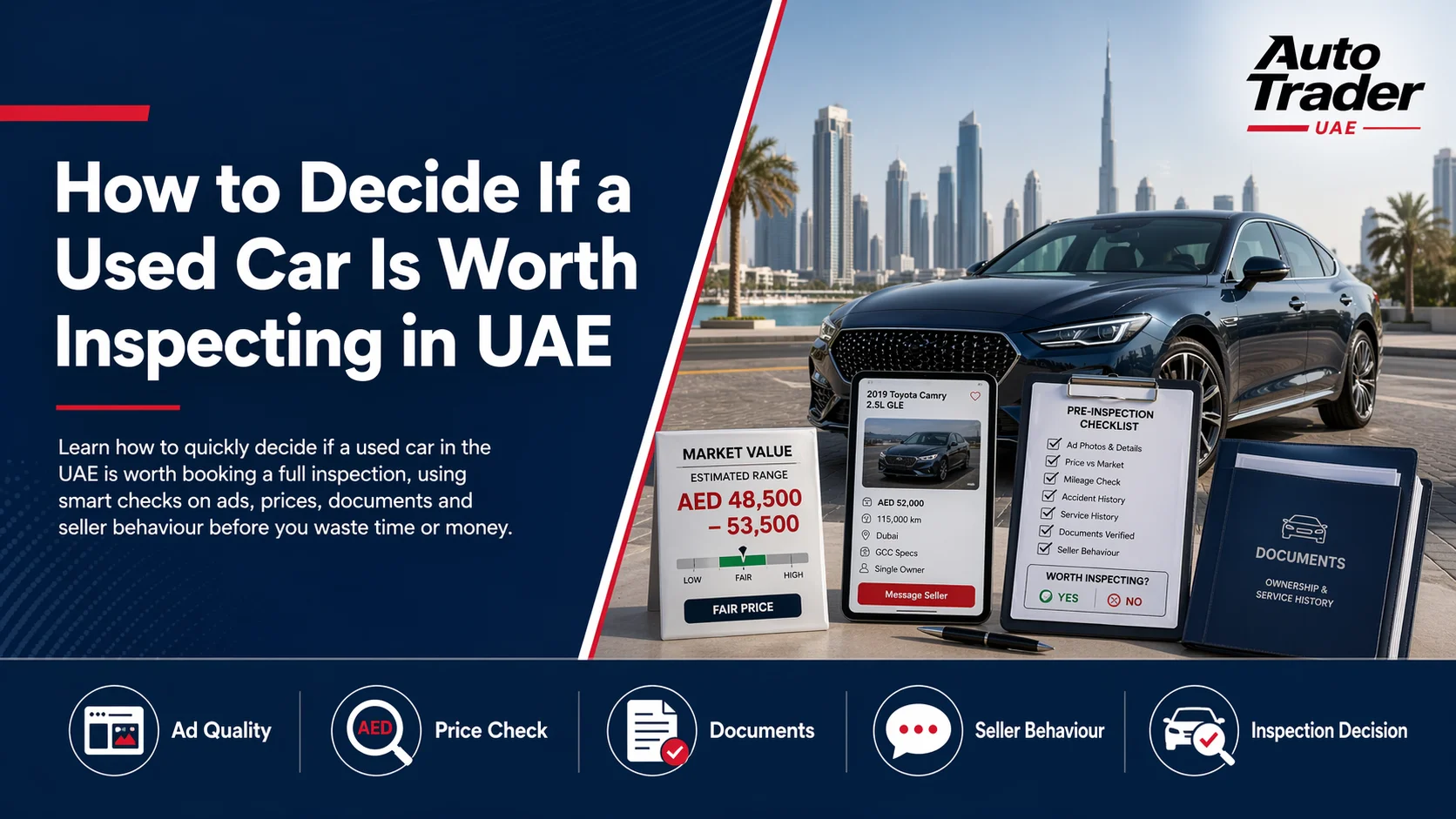
How to Decide If a Used Car Is Worth Inspecting in UAE
Buying used in the UAE can save a lot of money compared to a new car, but not every listing deserves your time or the cost of a professional inspection. The smart move is to filter hard before you drive across town or pay an inspector. This guide from Auto Trader UAE shows you how to decide, step by step, if a used car is even worth inspecting.
1. Start With the Listing: Red‑Flag or Shortlist?
Before you call the seller, use the advert itself to decide if the car belongs on your shortlist.
1.1 Check the basics in the ad
At minimum, a serious listing in the UAE should clearly show:
- Make, model, trim and year (e.g. 2019 Toyota Camry SE)
- Odometer reading (km)
- Engine size and fuel type (e.g. 2.0L petrol, 3.0L V6, hybrid)
- Transmission (automatic / manual / CVT / DCT)
- Accident / damage history (declared clearly)
- Number of previous owners (if known)
- Service history (full, partial, none, agency / independent)
- Location (emirate and area)
- Reason for sale (even a short, honest line)
If most of this information is missing, you’ll probably waste time chasing details later.
1.2 Compare the asking price to the UAE market
Use Auto Trader UAE to search the same model, similar year, trim and mileage. Ask yourself:
- Is the price wildly below market? This can signal major issues: accident repair, mechanical problems, pending loan, or urgent distress sale. It might still be a bargain, but only if everything checks out later.
- Is it far above market? The seller may be unrealistic or hiding that the car needs work. Unless the car has very low mileage or rare options, you may skip it.
- Is it aligned with similar listings? This is usually a good sign, especially if the ad is detailed and honest about minor flaws.
If the price is too good to be true and the ad is vague, it usually isn’t worth inspection.
1.3 Study the photos carefully
Photos tell you a lot before you ever visit. Good signs:
- Clear, daylight photos from all angles: front, rear, sides, interior, engine bay, wheels, odometer
- Close‑ups of any scratches or dents (honest seller behaviour)
- Clean interior and reasonably clean engine bay (not freshly steam‑cleaned to hide leaks)
Warning signs:
- Only a few photos or old screenshots from previous ads
- Blurry images or photos taken at night / underground parking (could hide paint defects)
- Panels that look a different shade under light (possible repaint / accident)
- Uneven panel gaps around doors, bonnet or boot (may indicate structural repair)
- Dashboard photos that avoid the instrument cluster (could hide warning lights)
If the seller can’t be bothered to upload decent photos, they may also not be honest or organised in other ways. Often, that’s your sign to move on.
2. Quick Pre‑Screen Call: Questions That Save You a Trip
Before you commit to an inspection, speak to the seller by phone or messaging. Your goal is to verify details, test their honesty, and see how they react to basic questions.
2.1 Essential questions to ask
Use these questions with both private sellers and dealerships:
- “Is the car still under warranty or service contract?” Ask for details: agency or third‑party, expiry date, km limit.
- “Do you have full service history? Agency or independent?” Full agency history and clear invoices are strong positives.
- “Has the car been in any accidents?” Then follow up: minor / major, which panels were replaced or painted?
- “Are there any current issues or warning lights?” Note how direct the answer is.
- “Any remaining bank finance on the car?” Cars under finance can be bought, but the process is more complex.
- “How long have you owned it and why are you selling?” Quick flip after a few months can be a red flag.
2.2 Behaviour that helps you decide
Positive signs:
- Seller answers calmly and consistently with what’s in the advert
- Willing to send extra photos (VIN plate, service booklet, tyre tread)
- Open to independent inspection at an RTA‑approved or trusted workshop
- Ready to meet at a public place or testing centre (e.g. ADNOC, Tasjeel, Shamil, RTA testing station)
Negative signs:
- Refuses inspection or only allows their “own” garage
- Unclear or changing story about accidents or ownership
- Pressure tactics: “Many buyers coming today, you must transfer deposit now”
- Won’t share chassis (VIN) number or plate number before meeting
If the seller fails this phone test, don’t waste time with a physical inspection.
3. Evaluate Documents Before You Inspect
In the UAE, paperwork can reveal as much as a mechanic. Try to see scans or photos of key documents early.
3.1 Registration (Mulkiya)
Ask the seller to share a clear photo of the mulkiya (vehicle registration card):
- Check chassis number, engine size, year and colour match the listing.
- Verify the name on the mulkiya matches the seller’s ID (for private sellers).
- Confirm registration is valid and not expired for a long period.
3.2 Service history and invoices
A car with complete, traceable maintenance is more likely worth inspecting. Look for:
- Stamped service book or digital history from the main dealer
- Invoices from reputable garages in the UAE
- Recent major services (e.g. timing belt, transmission service, brake overhaul) especially for higher‑km cars
Gaps of several years in service history, or no paperwork at all, increase risk – especially on European and luxury models.
3.3 Accident and insurance history
Ask if the seller has:
- Police report copies for accidents
- Insurance repair invoices or workshop reports
Some accidents are acceptable (e.g. minor bumper damage). Major structural repairs, airbag deployment or flood damage are usually reasons to skip inspection unless you are a specialist buyer.
4. Use the 3‑Minute Visual Check at First Viewing
If the car passes the advert and phone filters, your first in‑person visit is still a screening step, not yet a full inspection. In 3–5 minutes you can decide whether to proceed.
4.1 Exterior quick checks
Walk around the car:
- Look for colour differences between panels under sunlight.
- Check panel gaps around doors, bonnet and boot – they should be even.
- Inspect tyres: even tread wear and same brand on each axle are good signs.
- Check windows and lights for cracks, fogging or cheap non‑OEM replacements.
If you see heavy overspray, misaligned panels or uneven gaps, serious accident repairs are likely – this may not be worth a paid inspection.
4.2 Interior quick checks
Inside the cabin:
- Check seat wear vs. mileage (a “low‑km” car with heavily worn seat bolsters is suspicious).
- Turn on ignition and confirm all warning lights appear, then disappear after start.
- Test basic functions: windows, AC, infotainment, central locking, mirrors.
- Smell for moisture or mould – can indicate flood damage or leaks.
AC problems in the UAE are serious; repair can be expensive. If the AC is weak or noisy, factor that into your decision.
4.3 Short test drive feel
Even a brief drive around the block tells you a lot:
- Listen for knocks over bumps or while turning (suspension or steering issues).
- Note any vibration under acceleration or braking (engine mounts, tyres, discs).
- Check that the gearbox shifts smoothly without jerk or delay.
- Watch the temperature gauge and look for smoke from exhaust.
If the car drives badly or shows clear warning signs, don’t move to the paid inspection stage.
5. When Is a Used Car Worth Paying to Inspect?
A professional inspection in the UAE costs money and time. It’s worth it when certain conditions are met.
5.1 Cases where inspection is almost always worth it
You should strongly consider a full inspection if:
- The car has full or strong service history.
- The seller is cooperative and transparent.
- The price is fair compared to similar listings, or slightly below for clear reasons.
- The test drive felt normal, with no obvious serious issues.
- The car is a high‑value, luxury or performance model where hidden problems are costly.
In these cases, inspection can confirm you are getting a solid car or give you leverage to negotiate.
5.2 When you can skip inspection (or walk away)
You may skip a professional inspection or abort the deal if:
- The seller refuses independent inspection or RTA‑approved testing.
- There is no meaningful service history and obvious signs of neglect.
- You see evidence of serious crash damage, flood damage or odometer tampering.
- The asking price is unrealistically low and the story doesn’t add up.
In these cases, even a cheap car can become very expensive. It’s better to keep searching on Auto Trader UAE.
6. Where to Get a Used Car Inspected in UAE
If the car passes your personal checks, the next step is a formal inspection.
6.1 Official testing centres
Across the UAE, you’ll find facilities such as:
- RTA‑approved testing centres in Dubai
- Tasjeel, Shamil, ADNOC, Tamam and similar in other emirates
These centres can provide a structured multi‑point inspection and a printed report, which helps when negotiating or reselling later.
6.2 Independent workshops and specialists
For certain brands (e.g. German luxury, high‑performance, hybrids), a specialist workshop may be better. Look for:
- Good reputation and reviews in your emirate
- Experience with your specific make and model
- Clear, itemised inspection checklist and cost
Always keep the inspection report – it supports your confidence and resale value on Auto Trader UAE.
7. Buyer Takeaway: A Simple Decision Checklist
Use this quick checklist to decide if a used car is worth inspecting:
- Ad quality: Detailed info + clear photos? If no, skip.
- Price vs. market: Within normal range on Auto Trader UAE? If wildly off, be cautious.
- Seller behaviour: Honest, responsive, open to questions and inspection? If not, walk away.
- Documents: Mulkiya + service history + accident transparency? If missing or suspicious, think twice.
- Quick visual + drive: No obvious damage, issues or warning lights? If yes, proceed to inspection.
If a car ticks most of these boxes, it’s usually worth booking a proper inspection before agreeing on final price and starting transfer.
8. Seller Takeaway: Make Your Car Worth Inspecting
If you’re selling your car on Auto Trader UAE, your goal is to make buyers feel confident enough to book an inspection quickly. Here’s how:
- Write a complete, honest advert – include full specs, exact mileage, real photos, and all known issues.
- Upload clear, high‑quality photos – exterior, interior, engine bay, odometer, service book.
- Prepare your documents – mulkiya, service history, invoices, warranty papers.
- Be transparent about accidents – buyers prefer honest minor damage over hidden major repairs.
- Be open to independent inspection – it signals you have nothing to hide.
The more confidence you create, the faster serious buyers will move from browsing to inspecting and closing a deal.
Conclusion: Use Screening to Save Time and Money
In the UAE’s busy used‑car market, your time is valuable. The best strategy is to use adverts, pricing, documents and a quick first visit to filter hard. Only then should you spend money on a professional inspection. When a car looks right on paper, is fairly priced against similar listings on Auto Trader UAE, and passes your basic checks, that’s when an inspection becomes a smart investment – protecting you from expensive surprises and helping you negotiate with confidence. Start your search or list your car today on Auto Trader UAE, and use this guide as your step‑by‑step filter to decide which used cars are truly worth inspecting.
If you are exploring used cars in Dubai or elsewhere in the UAE, Auto Trader UAE makes it easier to compare listings, prices, trims, mileage, and seller details in one place.