
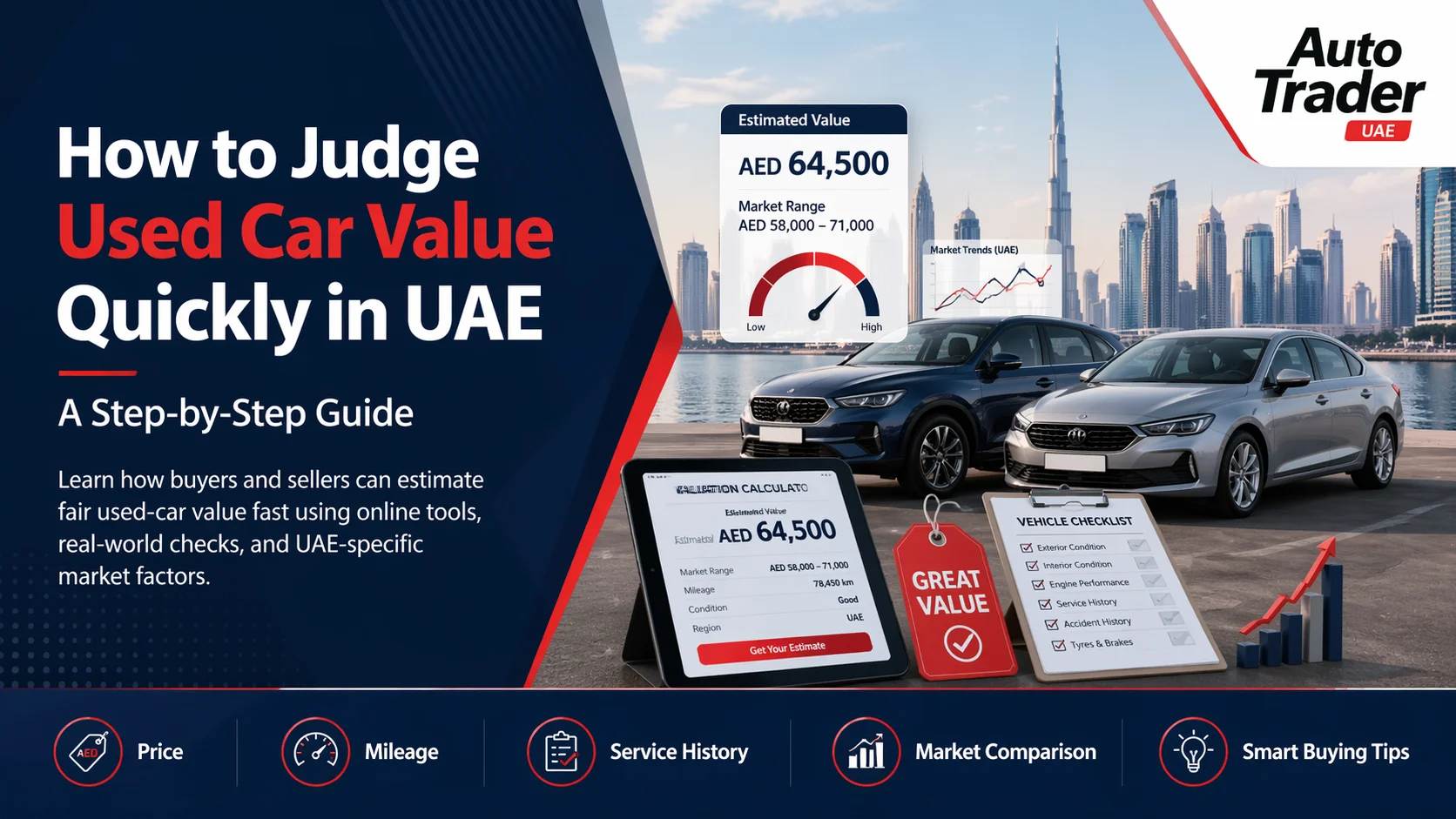
How to Judge Used Car Value Quickly in UAE
Whether you’re buying or selling, knowing a car’s real value in the UAE can save you thousands of dirhams. The goal isn’t to become a professional valuer – it’s to get a fast, realistic price range you can use to negotiate with confidence.
This guide from Auto Trader UAE explains how to judge used car value quickly in the UAE market, using simple checks and free tools you can access in minutes.
Overview
Used car prices in the UAE move quickly. Seasonal demand, fuel prices, new model launches and expat inflow/outflow all affect what a car is worth today – not what it was worth six months ago.
To judge used car value fast, focus on four things:
- Current market prices for the same car in the UAE
- The car’s exact spec: year, trim, engine, mileage and options
- Condition, service history and accident record
- UAE‑specific factors: GCC spec, warranty, and demand in your emirate
If you can get a clear answer on these points, you can usually estimate a fair price band within 10–15 minutes.
Step 1: Collect the Basic Car Details
Before you search prices, make sure you have the full details of the vehicle:
- Make and model (e.g. Toyota Corolla, Nissan Patrol, Mercedes‑Benz C‑Class)
- Model year (not just registration year)
- Trim level (e.g. SE, Sport, S, LE, Platinum)
- Engine size and fuel type (1.6L/2.0L, petrol/diesel/hybrid/EV)
- Gearbox (automatic, manual, CVT, dual‑clutch)
- Mileage (in kilometres)
- GCC spec or import
- Number of previous owners
- Service history (agency, specialist, or mixed)
The more precise you are, the more accurate your value estimate will be. The same model in a higher trim or with a bigger engine can easily differ by tens of thousands of dirhams.
Step 2: Check Real‑Time Market Prices in UAE
The fastest way to judge used car value in the UAE is to look at what similar cars are currently advertised for.
Use online listings as your baseline
Go to Auto Trader UAE and search for the same make, model and year. Then refine your search:
- Match the trim level as closely as possible
- Filter by similar mileage bands (e.g. 50–80k km, 80–120k km)
- Select same fuel type and engine size
- Prefer GCC spec if that’s what you are valuing
Open at least 5–10 similar listings and note:
- Lowest asking price – usually cars with higher mileage or weaker history
- Average asking price – where most well‑kept cars sit
- Highest asking price – often low‑mileage, full‑option, dealer or under warranty
From this, you’ll get a quick price band for that vehicle in today’s market.
Adjust for dealers vs private sellers
- Dealer cars usually list higher; they may offer warranty, finance and reconditioning.
- Private cars tend to be cheaper for the same spec and mileage.
If you’re selling privately, aim slightly under comparable dealer prices. If you’re buying, expect to negotiate most strongly with private sellers.
Step 3: Adjust for Mileage, Condition and History
Two identical cars on paper can have very different values based on how they’ve been used and maintained.
Mileage
- In the UAE, typical mileage is around 15,000–25,000 km per year.
- Well below average mileage usually justifies a higher price.
- Well above average mileage should pull the price down.
When you compare to online listings, choose cars with similar mileage; if your car is different, move your expected value up or down the band.
Service history
- Full service history (especially agency for the first years) adds value and buyer confidence.
- Incomplete or missing history should reduce the value, even if the car seems fine.
- Stamped service book or invoices are important in UAE – take them seriously.
Accident and repair history
Accidents have a direct impact on used car value:
- Minor cosmetic repairs (bumper respray, small dents) usually have limited impact if repaired properly.
- Major accidents (chassis damage, airbag deployment) can significantly reduce value.
Ask for:
- Police accident reports where possible
- Workshop invoices and parts lists
- Independent inspection if you’re unsure
Step 4: Consider UAE‑Specific Value Factors
The UAE market has its own preferences that affect price. When judging value quickly, don’t ignore these local details.
GCC spec vs imports
- GCC spec cars are typically preferred and often valued higher because they are built for regional climate and conditions.
- US or European imports can be cheaper but may have unknown histories or different specs.
If you are comparing prices, always compare GCC spec with GCC spec, and imported with imported.
Warranty and dealer support
- Cars still under manufacturer warranty usually command a premium.
- Extended warranties from reputable dealers also add value.
A car with 1–2 years’ warranty remaining is often worth paying more for, especially for premium brands where repair costs are higher.
Body style and fuel type
- SUVs and crossovers are in strong demand in the UAE and often hold value better.
- Economical compact cars are popular with daily commuters and ride‑hailing drivers.
- Hybrids and EVs are growing but can vary more in resale value; check plenty of similar listings.
Location and timing
- Demand can vary slightly between emirates (Dubai, Abu Dhabi, Sharjah, etc.).
- Prices may shift before Ramadan, back‑to‑school, or year‑end when promotions and new models appear.
If you see a lot of similar cars sitting unsold for weeks, the real market value may be lower than the asking prices suggest.
Step 5: Do a Quick Physical and Mechanical Check
Even if you’re only doing a quick valuation, a short inspection can affect the price you’re willing to pay or accept.
Exterior and interior
- Look for colour mismatch between panels (sign of repainting).
- Check for uneven panel gaps around doors, bonnet and boot.
- Inspect tyres – brand, tread depth and even wear.
- Check interior wear: steering wheel, seat bolsters, buttons and trim.
COSmetic condition affects value – buyers in the UAE do pay more for clean, well‑presented cars.
Mechanical and electrical
- Start the engine from cold and listen for unusual noises.
- Look for warning lights on the dashboard.
- Test air‑conditioning thoroughly – crucial in UAE and expensive to fix.
- Drive at different speeds; check brakes, gearbox shifts and steering.
Any obvious issues (AC not cold, gearbox jerks, brake vibration) should pull the value down, or be used as negotiation points.
Step 6: Set a Fair Price Band
Once you’ve gathered the above information, translate it into a realistic price band.
For buyers
- Use Auto Trader UAE listings to find the average price for similar cars.
- Move your target price down if mileage is higher, history is weak, or it’s an import.
- Be willing to pay closer to the upper side of the band for low mileage, GCC spec, full history and warranty.
For sellers
- Price your car slightly above the amount you realistically want to achieve to allow negotiation.
- Highlight value‑adding features in your ad: GCC spec, low mileage, full service history, warranty, single owner.
- If you get no calls or views in the first week, the market is telling you the price is too high – adjust accordingly.
Step 7: Use Professional Help When Needed
For higher‑value cars or when you’re unsure, spending a little on professional help can protect you from a bad deal.
- Pre‑purchase inspection: Many workshops and inspection centres in the UAE will inspect a car and provide a written report.
- Dealer appraisal: Getting a trade‑in quote from a dealer can give you a reference point, even if you sell privately.
You can then compare these opinions with the online market prices you’ve already checked on Auto Trader UAE.
Buyer Takeaway
- Never rely on a single listing to judge value – check several comparable cars on Auto Trader UAE.
- Focus on GCC spec, mileage, service history, and accident record; these drive real value in the UAE.
- Use issues you find (tyres, AC, cosmetic damage) to negotiate a fair discount, or walk away if the price doesn’t match the condition.
- Remember that the cheapest car is not always the best value if it comes with unknown history or high repair risk.
Seller Takeaway
- Research similar cars on Auto Trader UAE and price within the real market band if you want a quick sale.
- Invest a little in detailing, minor repairs and professional photos – presentation directly affects perceived value.
- Be transparent about history and service records; honest, well‑documented cars are easier to sell and justify stronger prices.
- Update your price if you’re getting views but no enquiries – the market feedback is valuable.
Conclusion
Judging used car value quickly in the UAE is about combining live market data with a few focused checks. In 10–15 minutes, you can:
- Match the car’s exact spec to current listings on Auto Trader UAE
- Adjust for mileage, history, condition and GCC spec
- Set a realistic price band to buy or sell with confidence
When you’re ready to move forward, head to Auto Trader UAE to:
- Browse thousands of used cars for sale in the UAE
- Compare prices for your short‑listed models
- Create a detailed listing for your own car with photos and full specs
- Explore more buying guides and selling tips to maximise your next deal
Use these steps every time you buy or sell, and you’ll quickly build a strong instinct for real‑world used car values in the UAE.
If you are exploring used cars in Dubai or elsewhere in the UAE, Auto Trader UAE makes it easier to compare listings, prices, trims, mileage, and seller details in one place.