
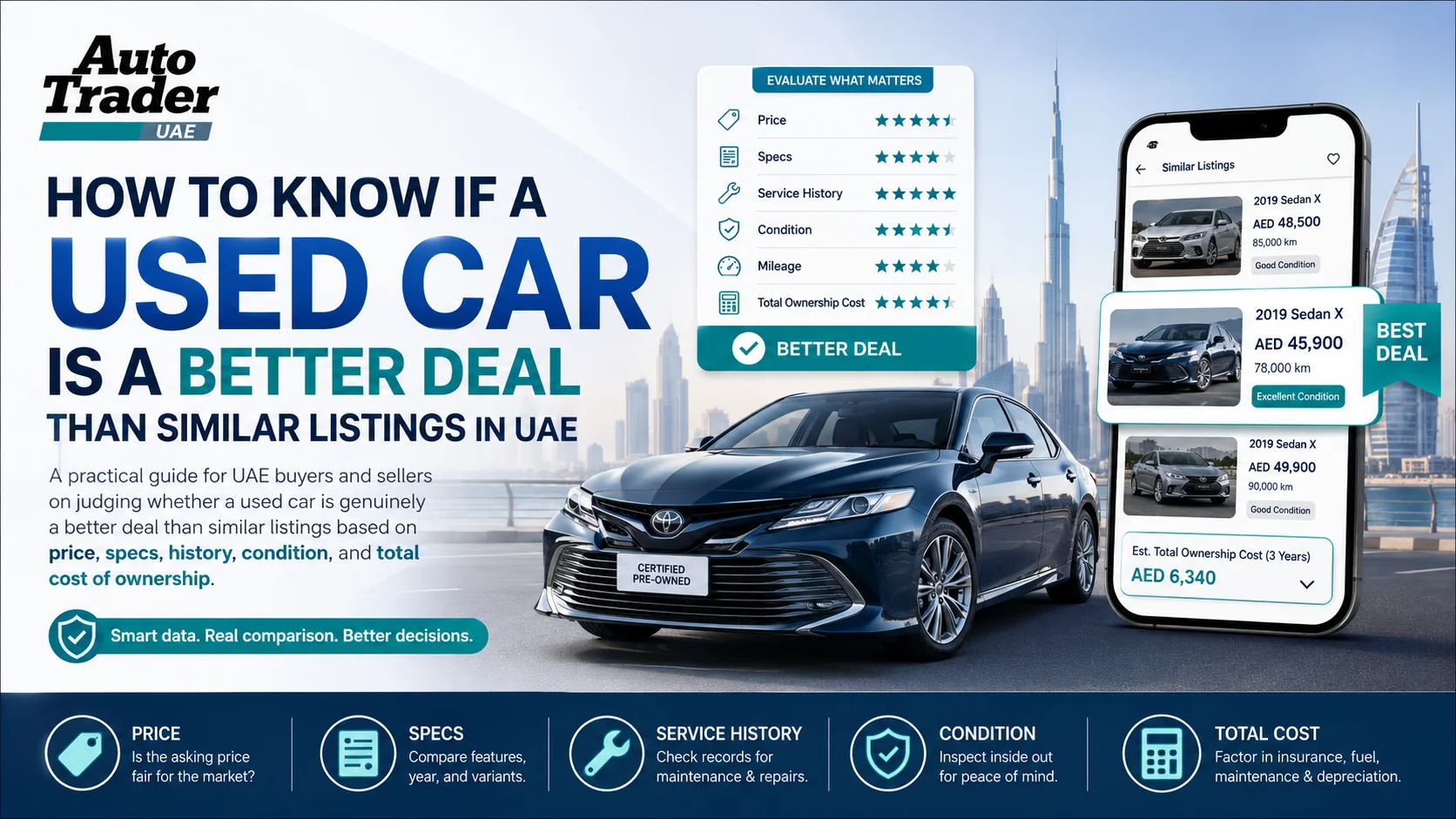
How to Know If a Used Car Is a Better Deal Than Similar Listings in UAE
Scrolling through pages of used cars in the UAE can be confusing. Two cars can look almost identical on paper but be very different in value. This guide will help you quickly judge whether a used car listing is a genuinely better deal than similar ads – and how to price your own car competitively on Auto Trader UAE.
1. Start With a Like‑for‑Like Comparison
Before deciding if a car is a “better deal”, make sure you’re comparing similar vehicles. Small differences in spec or condition can easily justify a higher or lower price.
Match the key basics
- Make and model: Compare within the exact model and generation – e.g. 2018 Toyota Camry vs 2018 Camry, not Camry vs Accord.
- Trim level: SE, Sport, Platinum, “GCC spec”, sunroof packages, and safety packs can all change value.
- Engine and drivetrain: 2.0 vs 3.5, turbo vs non‑turbo, FWD vs AWD – these affect performance, economy, and demand.
- Model year vs registration year: In the UAE, a 2019 model registered in 2020 may be priced differently to a 2020 model registered the same year.
On Auto Trader UAE, use filters to narrow down to the same model year, trim, fuel type, and body style so you can see true like‑for‑like rivals.
2. Use Market Price Ranges, Not Just a Single Number
A good deal isn’t always the cheapest car on the page; it’s the one that offers the best value for its condition and history within the market range.
How to sense‑check the price
- Browse several pages of similar cars on Auto Trader UAE to see the common price band.
- Ignore clear outliers – extremely cheap listings may signal hidden issues, accidents, or unpaid finance; very expensive ones might be unrealistic.
- Note KM and year when judging price; a slightly older or higher‑KM car should usually be further down the price range.
Once you know the typical range, a fair deal will usually sit slightly below the mid‑point for its age and KM if condition is average, or closer to the upper end if it’s exceptionally clean with full history and options.
3. Dig Into Mileage and How the Car Was Used
Mileage is one of the quickest ways to compare value between similar used cars in the UAE – but it has to be interpreted correctly.
What “better mileage” really means
- Lower KM at the same price is a strong sign of better value, provided the service history matches.
- Highway vs city use: Long‑distance commute on highways in the UAE can be gentler on a car than constant short city trips.
- Balanced annual mileage: Around 15,000–25,000 km per year is typical. Far lower or higher may need extra investigation.
Red flags and checks
- Ask for service history that shows KM at each visit.
- Check that odometer readings are consistent and never go backwards.
- For higher‑KM cars, look for evidence of major maintenance (timing belt, suspension, tyres, brakes) already done.
A car with slightly higher KM but with major components recently replaced can be a smarter purchase than a lower‑KM car that will soon need expensive work.
4. Compare Service History and Maintenance Quality
In the UAE climate, heat and dust put extra stress on mechanical parts. This makes documented maintenance a major factor when judging a deal.
What indicates a higher‑value car
- Full service history with dealer or known specialist workshops.
- Stamped service book or invoices matching KM and dates.
- Evidence of timely oil changes, filters, coolant, transmission service.
- Recent replacement of wear items: brake pads/discs, tyres, battery, belts.
Between two similar listings, the car with clear, well‑documented maintenance is almost always the better deal, even if the asking price is slightly higher.
5. Judge Condition Honestly: Exterior, Interior, and Mechanical
Condition is where a “cheap” car can quickly stop being a bargain. Photos and inspection are crucial.
Exterior and bodywork
- Look for colour mismatches, uneven panel gaps, and overspray – signs of accident repairs.
- Small scratches and chips are normal; structural damage or badly repaired panels are not.
- Check headlights for yellowing or cracks and windshield for major chips.
Interior and features
- Seat wear, torn leather, loose trim, and worn buttons can indicate hard use.
- Test basic amenities: AC performance (vital in UAE), infotainment, power windows, sunroof, reverse camera, sensors.
- Confirm that all airbags warning lights go off correctly after start‑up.
Mechanical health
- Engine should idle smoothly without knocking or excessive vibration.
- Gearbox should shift cleanly, without jerks or slipping.
- No strong burning smell, no major oil or coolant leaks under the car.
A car in clearly better cosmetic and mechanical condition than similar listings can justify a higher price – and may still be the better deal long term.
6. Check Accident, RTA, and Ownership History
Accident and ownership history can immediately separate a strong listing from a risky one.
What to ask and check
- Number of previous owners: Fewer owners usually means easier to trace how the car was looked after.
- Accident history: Ask directly if the car has been in major accidents and request repair bills where possible.
- RTA reports: For UAE‑registered cars, you can request history from the relevant authority to confirm registration data and check for major incidents.
- Import vs GCC spec: GCC‑spec cars are often preferred because they are configured for regional climate and fuel; this can affect value.
A slightly higher price for a GCC‑spec car with clean history can be a better deal than a cheaper import with unclear repairs.
7. Factor in Specification, Options, and Warranty
Two cars that look similar in photos might have very different equipment lists – and this strongly affects market value in the UAE.
High‑value options to look for
- Safety: Additional airbags, blind‑spot monitoring, adaptive cruise, lane assist.
- Comfort: Leather seats, electric adjustment, sunroof or panoramic roof, dual‑zone climate control.
- Technology: Larger infotainment screens, Apple CarPlay/Android Auto, better sound systems, 360‑degree camera.
- Appearance packages: Alloy wheel upgrades, body kits, sport packages.
Warranty and service contracts
- Remaining manufacturer warranty is a major plus and justifies a higher price.
- Transferable service or maintenance contracts add real value and reduce your running costs.
When you find a car that includes key options, ongoing warranty, and service plans at a similar price to basic‑spec rivals, that’s almost always a better deal.
8. Calculate Total Cost of Ownership, Not Just Purchase Price
In the UAE, some cars are cheaper to buy but more expensive to own. To decide if a listing is truly a better deal, look beyond the sticker price.
Costs to estimate and compare
- Fuel consumption: Larger engines and older SUVs typically use more fuel. Check the claimed or typical L/100 km and consider your daily commute.
- Insurance: Sporty models and luxury brands often have higher premiums. Get a quick quote based on the chassis number if possible.
- Tyres and consumables: Bigger wheels and performance tyres cost more to replace.
- Expected maintenance: Some brands and models have higher parts and labour costs in the UAE.
A car that is slightly more expensive to buy but noticeably cheaper to run over 3–5 years can be the smarter deal.
9. Use a Professional Inspection to Confirm Value
If you’re torn between similar listings, an independent inspection can highlight which car offers better value.
What an inspection can reveal
- Hidden accident damage or poor repairs.
- Upcoming major expenses (tyres, brakes, suspension, engine leaks).
- Fault codes in the ECU that aren’t yet visible as warning lights.
If one car needs AED 5,000 in immediate work and another needs almost nothing, the “cheaper” listing may end up costing more overall.
10. Warning Signs a “Bargain” Isn’t Really a Better Deal
Be cautious when you see:
- Price far below market average without a clear reason.
- No service history or lost service book.
- Sellers unwilling to allow inspection or RTA checks.
- Repainted panels on multiple sides of the car.
- Dashboard warning lights on during test drive (engine, ABS, airbag).
In these cases, a more expensive but transparent and well‑maintained car is usually the better deal.
11. How Sellers Can Make Their Car the “Better Deal”
If you’re selling on Auto Trader UAE, you can position your car as the best‑value choice even if your price is not the lowest.
Steps to stand out
- Price realistically: Check similar listings on Auto Trader UAE and aim for a fair, mid‑range price – then highlight your car’s advantages.
- Complete documentation: Upload clear photos of service history, warranty, and any major recent work.
- Honest description: Be transparent about small flaws and explain what has been recently replaced.
- Quality photos: Clean the car properly and show all angles, interior, tyres, and engine bay.
Buyers are prepared to pay slightly more for a car that feels trustworthy, well‑maintained, and easy to understand.
12. Using Auto Trader UAE to Find Better‑Value Used Cars
Auto Trader UAE makes it easier to compare similar listings side by side so you can judge true value.
Practical tips when searching
- Use filters for year, KM, price range, fuel type, body style, and GCC spec to create a tight comparison set.
- Shortlist 3–5 cars, then compare options, history, and condition in detail.
- Contact sellers directly to request service records, chassis number, and inspection options.
When you apply all the checks in this guide, you’ll quickly see which listing is the genuinely better deal among similar used cars in the UAE market.
Conclusion: The Better Deal Is the Better Car Overall
A better deal is rarely just the lowest price on the screen. For used cars in the UAE, it’s the vehicle that offers the best combination of:
- Fair price within the current market range.
- Verified mileage and strong service history.
- Clean condition and transparent accident record.
- Desirable specifications, options, and warranty.
- Reasonable total cost of ownership over the next few years.
Use Auto Trader UAE to compare like‑for‑like listings, ask the right questions, and arrange inspections where needed. Whether you’re buying or selling, focusing on overall value – not just the asking price – is the smartest way to know when a used car is truly a better deal than similar listings in the UAE.
Ready to put this into practice? Start comparing used cars in UAE on Auto Trader UAE today, and if you’re shopping in the emirate, narrow your search to used cars in Dubai to find the right car at the right value.
Browse used cars in UAE on Auto Trader UAE to compare live listings, prices, and current market activity more clearly.
Related Links
Buyer Takeaway
When buying a used car in the UAE, focus on vehicle condition, service history, inspection quality, paperwork, and total running costs rather than price alone. Compare options carefully and choose the option that best matches your budget and real needs.
Seller Takeaway
If you are selling a used car in the UAE, present the service history clearly, price the vehicle realistically, and highlight condition, specification, and ownership strengths honestly. A well-prepared listing with accurate details usually attracts more serious buyers.