
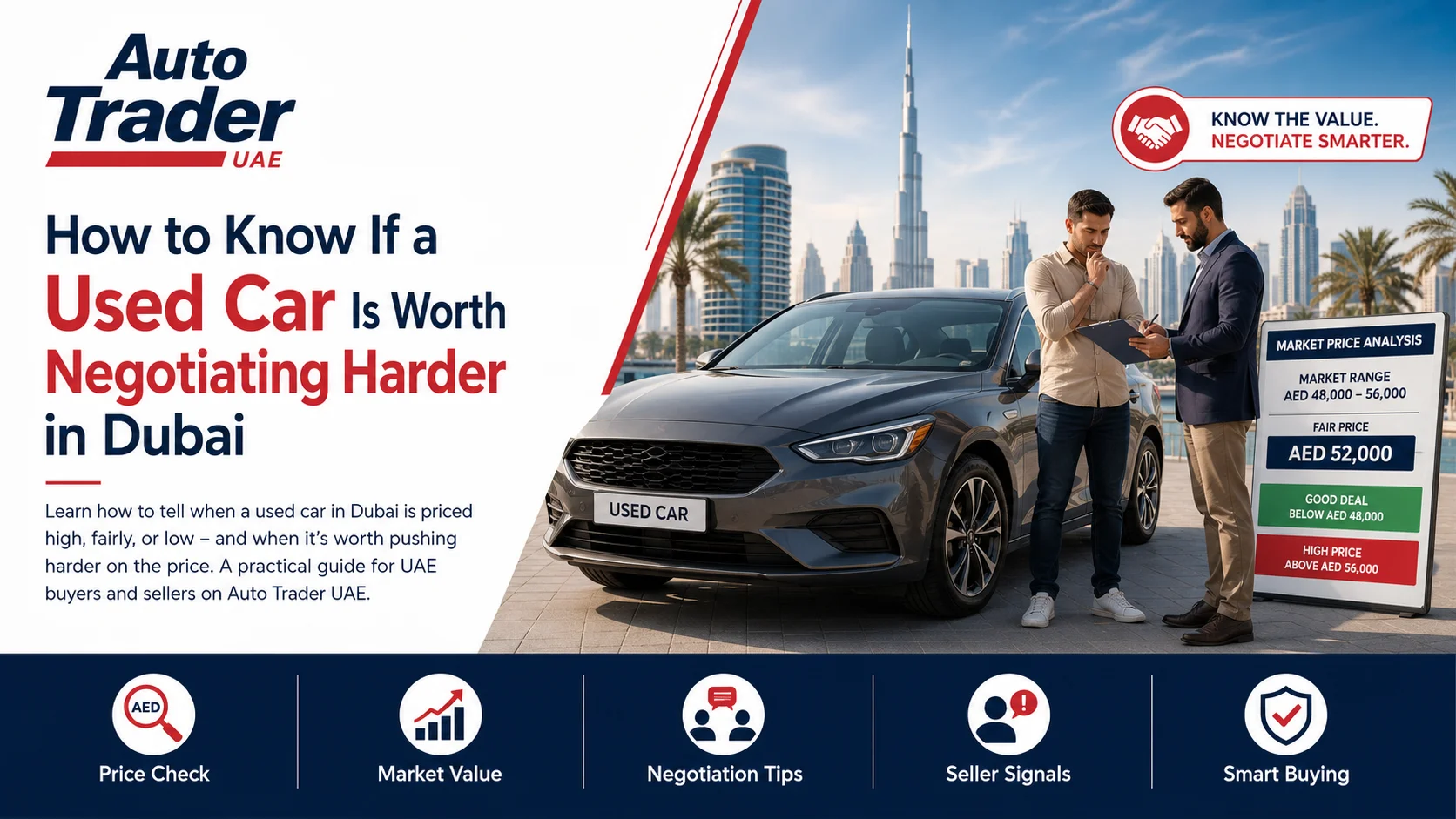
How to Know If a Used Car Is Worth Negotiating Harder in Dubai
Buying a used car in Dubai always involves some negotiation. But how do you know when it’s worth pushing harder on the price – and when you’re already getting a fair deal? This guide explains the key signs a used car is overpriced, fairly priced, or underpriced in the UAE market, so you can negotiate confidently on Auto Trader UAE or with any seller.
1. Start With a Realistic Market Check
Before you decide how hard to negotiate, you need to know the car’s true market value in the UAE.
Use live listings as your benchmark
Open multiple tabs with similar cars:
- Same make, model, and trim
- Similar year and mileage
- Same fuel type (petrol, diesel, hybrid, EV)
- Similar condition (accident‑free vs repaired, dealer vs private)
Compare with real inventory, for example:
- All used cars in UAE
- Used cars in Dubai
- Used Toyota cars
- Used Nissan cars
- Used Mitsubishi cars
- Used Mercedes-Benz cars
- Used BMW cars
- Used SUVs in UAE
Price band rule of thumb
Once you’ve checked 5–10 similar listings, you can judge where your target car sits:
- 0–5% above average: Usually fair if condition, service history, and spec are strong. Negotiation will be modest.
- 5–10% above average: There should be clear reasons (top spec, very low km, full agency service). If not, this is where you can negotiate harder.
- 10%+ above average: Almost always overpriced unless it’s rare, nearly new, or heavily upgraded. These are the cars worth pushing on – or walking away from.
If the car is already below the average price for similar listings, your negotiation power is weaker. Instead of pushing hard, focus on verifying that there’s no hidden issue.
2. Check How Long the Car Has Been Listed
Time on the market is a major signal of how flexible the price might be in Dubai.
Short time listed (under 1–2 weeks)
- If the car is popular (for example, a used Toyota, Nissan, or a compact SUV), the seller may hold firm on price.
- You can still negotiate, but don’t expect huge discounts unless there’s a clear fault.
Medium time listed (2–6 weeks)
- This is the most negotiable window. Interested buyers have seen it, but it hasn’t sold.
- Ask politely: “How long have you had this car listed?” or “Have you had many offers?”
- Less interest usually means more room for negotiation.
Long time listed (over 6–8 weeks)
- Often means the price is too high, or there’s something putting buyers off.
- If the inspection checks out, this is a strong candidate for harder negotiation.
- You can justify your offer with clear comparisons to other similar cars on Auto Trader UAE.
3. Evaluate Mileage and Usage Versus Price
Mileage in the UAE can vary a lot depending on whether the car was used for commuting, family trips, or business.
Typical annual mileage ranges in Dubai
- Low: Below 10,000 km per year – priced higher is normal.
- Average: 15,000–20,000 km per year – should reflect market average.
- High: Over 25,000 km per year – you have more grounds to negotiate.
When is it worth negotiating harder?
- The car has higher than average mileage but is priced like a low‑mileage example.
- The car has done lots of city driving (Dubai/Sharjah traffic) with many starts and stops.
- The tyres, brakes, and suspension show wear consistent with heavy use.
Ask the seller where the car was mainly driven – city, highway, or mixed. Long highway runs Abu Dhabi–Dubai are usually easier on the car than tight urban use.
4. Factor In GCC Specs, Service History, and Ownership
In the UAE, car origin and service history significantly affect fair value.
GCC spec vs import
Generally, GCC‑spec cars are better suited to local climate and are easier to resell. You can negotiate harder if:
- The car is a US or European import priced similar to or above GCC‑spec cars.
- The import has a salvage or accident history in its original country.
Service history
Full, documented service records add real value. Lack of records gives you negotiation leverage. You can push the price down if:
- There’s no service book and no invoices.
- Gaps appear in the mileage timeline (for example, nothing recorded for 40,000 km).
- Major services (timing belt, transmission oil, spark plugs) are overdue.
Number of owners
In Dubai, multiple owners are common but still affect perception.
- 1 owner, full dealer history: Expect a stronger price; negotiation room is smaller but still possible.
- 3+ owners, mixed history: Use this to justify a lower offer, especially for premium brands like BMW, Mercedes, and Audi.
5. Inspect the Car: Cosmetic vs Serious Issues
Your inspection findings are your strongest tool for real‑world negotiation.
Minor cosmetic issues (small leverage)
- Light scratches and stone chips
- Small alloy wheel scuffs
- Minor interior wear (seat bolster marks, light stains)
These can justify a moderate discount, but don’t expect a huge cut if everything else is perfect.
Moderate issues (good leverage)
- Tyres close to end of life
- Brake pads or discs near replacement
- AC not cooling strongly
- Non‑critical electrical issues (parking sensors, window switches, infotainment glitches)
For each of these, get a rough quote from a workshop and use that as a basis:
“I’ve checked with a garage – tyres and front brakes will cost around AED X. If we adjust the price by that amount, I’m ready to buy today.”
Serious issues (maximum leverage or walk away)
- Engine oil leaks or burning oil
- Gearbox slipping, jerking, or delayed shifting
- Major accident repairs, chassis or structural damage
- Warning lights on the dashboard (engine, ABS, airbag)
Here you either negotiate very hard or consider walking away. A “cheap” car with hidden major problems usually costs more in the long run.
6. Spot Red Flags in the Advertisement
How the advert is written often tells you how much flexibility you have.
Phrases that suggest limited negotiation
- “Price slightly negotiable” – small room only.
- “Final price” or “fixed price” – negotiation may be possible but minimal.
- “Urgent sale but no silly offers” – seller is motivated but sensitive about low bids.
Phrases that suggest more room to negotiate
- “Urgent sale” without a strong justification for the price.
- “Need cash” or “Leaving country.”
- “Negotiable for serious buyers.”
Also watch for incomplete descriptions, missing mileage information, or vague service history – all are signals to investigate more and potentially negotiate harder.
7. Consider Colour, Trim, and Options in the UAE Market
Not every spec is equally desirable in Dubai. Some cars are easier to sell, some are harder – and that affects how much you should push.
Stronger resale specs
- Neutral colours (white, silver, grey) – especially for SUVs and family cars.
- Mid to high trim levels with sunroof, alloy wheels, leather, parking sensors, and a good infotainment system.
- Popular body styles like used SUVs in UAE and crossovers.
These often justify slightly higher prices and leave less room for aggressive negotiation if demand is strong.
Harder‑to‑sell specs
- Unusual colours that don’t suit local taste.
- Base models with very few options.
- Manual transmission in segments where most buyers want automatic.
If the car you’re viewing has a harder‑to‑sell spec but is priced like a top‑spec model, that’s a clear sign you can negotiate more strongly.
8. Judge the Seller’s Situation and Behaviour
How the seller communicates can tell you a lot about your negotiation space.
Signs the seller may be flexible
- Responds quickly, willing to answer detailed questions.
- Mentioning relocation, job change, or needing cash.
- Open to meeting at your preferred time and location.
Signs the seller is less flexible
- Very slow or brief replies.
- Refusing inspection by a third‑party mechanic.
- Emotional attachment to the car and talking about how much they spent on extras.
Sometimes a respectful, straightforward approach can improve your chances more than the number itself. Make it clear you’re a serious buyer, not just “checking prices.”
9. Use a Pre‑Purchase Inspection as a Negotiation Tool
In the UAE, a professional inspection is almost always worth the cost, especially for higher‑value cars.
Why inspection strengthens your position
- Gives you a written report with specific items to reference.
- Helps separate normal wear from future expensive repairs.
- Shows the seller you are serious and informed.
How to use it in negotiation:
“The report shows the AC compressor and suspension bushes need attention soon. That will cost around AED X. If we adjust the price accordingly, I can transfer today.”
If the seller refuses any inspection at all, treat that as a major warning and be ready to walk away.
10. When to Push Hard – And When Not To
Push harder when:
- The asking price is clearly above similar cars on Auto Trader UAE.
- The car has been listed for over a month with no sale.
- There’s incomplete service history or non‑GCC spec at GCC‑level pricing.
- Inspection reveals upcoming costs (tyres, brakes, fluids, AC, suspension).
- The seller is relocating soon or urgently needs to sell.
Negotiate gently or accept the price when:
- The car is fairly priced vs the market and in excellent condition.
- It’s a high‑demand model with many buyers chasing it.
- You’ve seen several weaker cars at similar prices.
- The seller has full dealer history, one owner, and no accident record.
Sometimes the best deal is not the cheapest car, but the best‑kept car at a fair price.
11. Practical Negotiation Tips for Dubai Buyers
Go prepared
- Know the average market price before you arrive.
- Decide your maximum budget in advance.
- Bring funds ready (cashier’s cheque or bank approval) to close quickly if the deal is right.
Make a realistic first offer
- If the car is fairly priced, start 5–8% below asking.
- If it’s overpriced or has issues, you can start 10–15% below, with clear justification.
- Always explain your offer using market comparisons and inspection points, not emotion.
Stay respectful and calm
Being polite, patient, and clear often gets better results than being aggressive. Let the seller save face; you’re looking for a win‑win outcome.
12. Tips for Sellers: When to Stand Firm and When to Deal
This guide also helps you as a seller in Dubai understand when buyers are being reasonable.
When you can hold your price
- Your car is priced in line with similar listings on Auto Trader UAE.
- It has full service history, preferably at a dealer or reputable workshop.
- It’s a popular model or SUV with strong demand in the UAE.
When you should consider negotiating more
- Your listing has been live for several weeks with few calls.
- There are many similar cars listed cheaper.
- The buyer has a valid inspection report showing upcoming costs.
Presenting full records, high‑quality photos, and a transparent description helps you defend your price and attract serious buyers faster.
13. Next Steps: Find and Compare Used Cars in the UAE
Knowing how to know if a used car is worth negotiating harder in Dubai is only one part of getting a good deal. The other part is searching in the right place, with enough choice to compare properly. On Auto Trader UAE you can:
- Browse thousands of used cars for sale in UAE.
- Narrow down to used cars in Dubai that fit your budget and needs.
- Compare SUVs, sedans, hatchbacks, and more from trusted dealers and private sellers.
Use the tips in this guide to:
- Identify when a price is fair.
- Spot when you can negotiate harder.
- Walk away confidently when a deal doesn’t make sense.
Start your search today on Auto Trader UAE and use live market listings to back every offer you make, so you pay a fair price for your next used car in Dubai or anywhere in the UAE.
Browse used cars in UAE on Auto Trader UAE to compare live listings, prices, and current market activity more clearly.
Related Links
Buyer Takeaway
When buying a used car in the UAE, focus on vehicle condition, service history, inspection quality, paperwork, and total running costs rather than price alone. Compare options carefully and choose the option that best matches your budget and real needs.
Seller Takeaway
If you are selling a used car in the UAE, present the service history clearly, price the vehicle realistically, and highlight condition, specification, and ownership strengths honestly. A well-prepared listing with accurate details usually attracts more serious buyers.
Conclusion
A careful used car purchase in the UAE starts with research, proper inspection, and clear paperwork before making the final decision.