
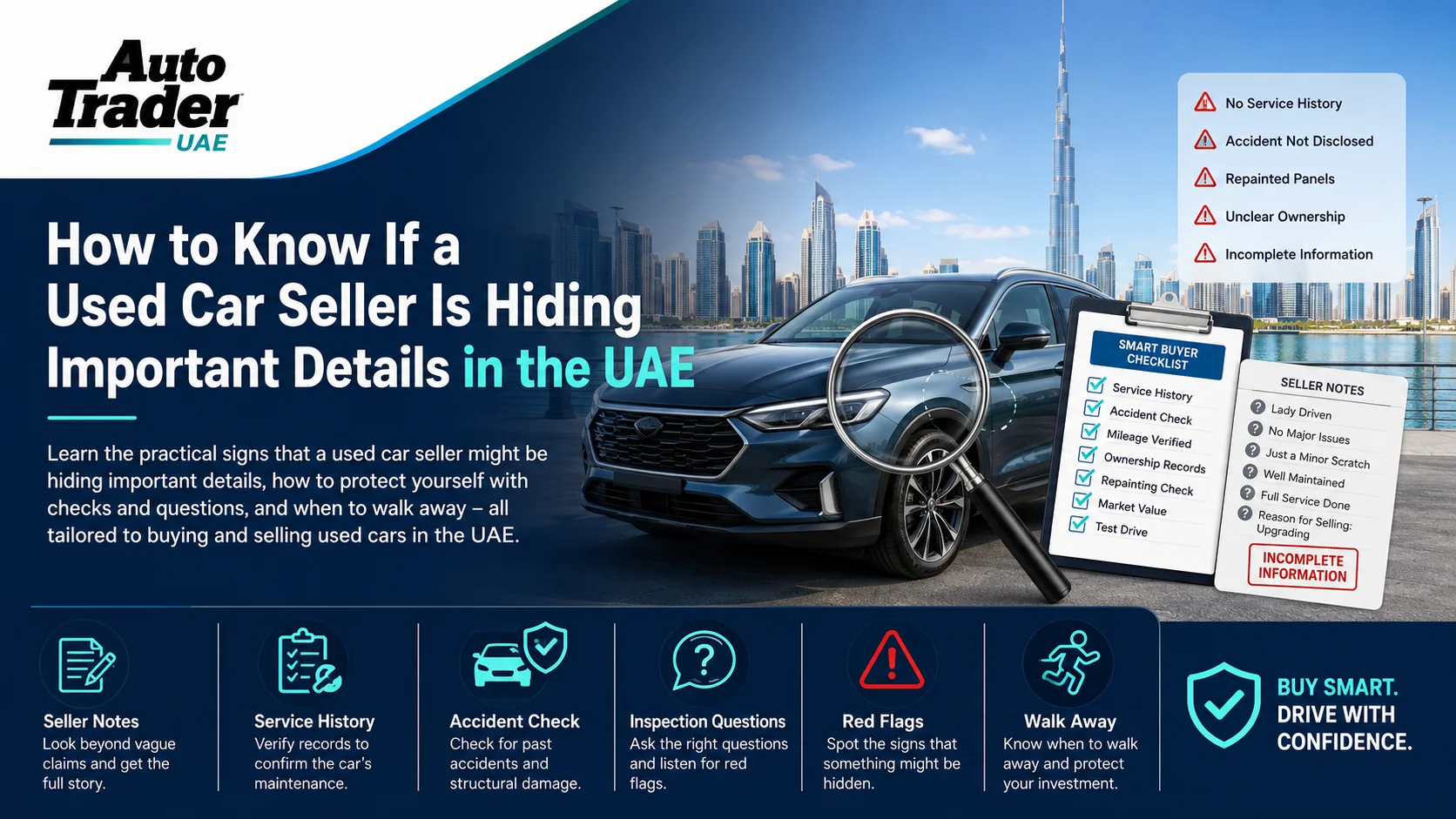
How to Know If a Used Car Seller Is Hiding Important Details in the UAE
Buying a used car in the UAE can save you a lot of money, but only if you avoid hidden problems. Some sellers are fully honest and transparent. Others may hide accident history, mechanical issues, mileage tampering, or unpaid finance.
This guide explains how to know if a used car seller is hiding important details, using realistic UAE scenarios and clear steps. Whether you’re buying privately, from a dealer, or through an online marketplace like Auto Trader UAE, these tips will help you stay in control.
1. Common Things Sellers Try to Hide
Not every seller is dishonest, but when details are hidden, it’s usually in one of these areas:
- Accident history – previous collisions, chassis damage, or poor repairs.
- Major mechanical issues – engine, gearbox, cooling system, or electrical faults.
- Flood or desert damage – water ingress from floods, or severe sand/dust damage.
- Odometer tampering – mileage rolled back to look lower.
- Service neglect – missed services, cheap parts, or non-specialist repairs.
- Outstanding finance or police cases – unpaid loans, fines, or legal blocks.
- Multiple owners or heavy use – ex-rental, ex-company, or rideshare history.
Your job as a buyer is to make it difficult for any of this to stay hidden.
2. Early Warning Signs in the Advertisement
Clues often appear before you even see the car. Look closely at the online ad or listing.
2.1 Vague or incomplete descriptions
- Only says “perfect condition” or “lady driven” with no real details.
- Missing basic information like mileage, year, trim level, or service history.
- Heavily edited or blurred photos, or only a few low-quality images.
A serious seller will usually mention mileage, service record, recent maintenance, and provide clear photos from multiple angles.
2.2 Price that is “too good to be true”
If the car is much cheaper than similar models on used cars in UAE listings, ask why. A cheap price can be:
- A genuine quick sale.
- Hidden problems (accident, engine issues, legal issues).
- A tactic to attract many buyers and pressure someone into a fast decision.
2.3 Reluctance to share the plate number or VIN
In the UAE, you can use the car’s plate number or VIN to check basic records. If a seller refuses to share this before meeting, they may be hiding something.
3. Red Flags When You Contact the Seller
How the seller communicates tells you a lot about their honesty.
3.1 Inconsistent stories
- First says “full agency service,” later says “some services outside.”
- Claims “single owner,” but registration card shows multiple previous owners.
- Changes the reason for selling when you ask again.
Ask the same question in different ways at different times. Serious inconsistencies are a warning sign.
3.2 Avoiding direct questions
Watch for answers like:
- “Don’t worry about that, the car is perfect.”
- “Just come and see it, I’m too busy to explain over the phone.”
- “Small accident only, nothing major” – but no details or proof.
Honest sellers usually answer directly and send any available documents or photos when asked.
3.3 High-pressure tactics
- “I have three buyers coming today, you must decide now.”
- “No time for inspection, take it or leave it.”
- “Pay a deposit before viewing to reserve.”
Walk away from any deal where you are not allowed a proper inspection or time to think.
4. Spotting Hiding Tactics During the Viewing
When you see the car in person, you can learn much more. Take your time and do not feel rushed.
4.1 Check the location and timing
- Insist on viewing in daylight, not at night in a poorly lit area.
- View the car when the engine is cold if possible – this exposes cold-start issues.
- Be cautious if the seller refuses to show the car at their home or workplace and insists on a random parking lot.
4.2 Physical signs of hidden accidents
Look for:
- Uneven gaps between body panels (doors, bonnet, boot).
- Different paint shades on adjacent panels, or overspray on rubbers and plastics.
- New headlights/taillights on one side only.
- Misaligned bumpers or slightly twisted number plates.
Check under the bonnet and in the boot for signs of welding, bent metal, or non-original seams – these can indicate previous accident repairs.
4.3 Interior clues
- Heavy wear on the steering wheel, pedals, and driver’s seat despite “low mileage”.
- Strong air freshener smell that could be masking smoke, mould, or flood damage.
- Wet carpets, rust on seat rails, or white powdery residue on metal parts (possible water damage).
4.4 Engine bay and underbody checks
You don’t need to be a mechanic to spot obvious issues:
- Fresh oil leaks or wet areas around the engine and gearbox.
- Unusual noises on start-up – knocking, ticking, or loud rattling.
- Excessive smoke from the exhaust (blue, white, or black).
- Visible rust or poorly repaired parts on the underbody.
If the seller refuses to let you open the bonnet or look underneath, consider that a strong red flag.
5. Paperwork: Where Hidden Truths Often Appear
In the UAE, checking documents is essential. Many hidden details show up on paper before they show up on the road.
5.1 Registration card and ownership history
Ask to see the Mulkiya (registration card):
- Confirm the chassis (VIN) matches the car’s VIN plate and windshield stamp.
- Check the year and model match the advertisement.
- Look for any note about “salvage,” “rebuilt,” or similar (if applicable).
If the seller’s name does not match the Mulkiya, ask why. They may be a middleman or trying to flip the car quickly.
5.2 Service history and invoices
Ask for a full service book and any invoices:
- Look for regular service intervals (e.g., every 10,000 km).
- Check where the car was maintained – main dealer or specialist garage.
- Compare recorded mileage on stamps/invoices with the odometer reading.
Gaps of several years with no records, or mileage that goes backwards, are major warning signs.
5.3 Outstanding finance and fines
Never rely only on the seller’s word about finance. Before transferring ownership, verify through the relevant emirate’s authority that there are no:
- Outstanding bank loans on the car.
- Unpaid traffic fines.
- Police or court blocks on sale or transfer.
Do this at the official registration centre during transfer, not after paying.
6. Use UAE Tools to Double-Check the Car’s History
In the UAE you have access to various online and official tools that help uncover hidden details. While systems differ per emirate, you can typically:
- Use the plate or chassis number to check for basic accident history and insurance claims.
- Review traffic fines and blocks associated with the vehicle.
- Confirm that the car is cleared for sale and transfer before paying.
If the seller discourages you from using official channels or insists on “quick transfer without checking,” that’s a major red flag.
7. The Test Drive: How Sellers Try to Hide Problems
Some sellers try to control the test drive so you don’t notice issues. Protect yourself with these steps:
7.1 Insist on a proper route
- Drive long enough to let the engine reach normal operating temperature.
- Include highway speeds, speed bumps, and some tight turns.
- Turn off the audio system so you can listen for noises.
7.2 Pay attention to how the car behaves
Watch for:
- Vibrations at certain speeds (wheels, tyres, or suspension issues).
- Steering pulling to one side (alignment or accident damage).
- Harsh gear changes or slipping (gearbox problems).
- Warning lights that come on after a few minutes of driving.
If the seller insists on a very short drive or refuses to let you drive at all, ask why. That can be a sign they’re hiding driveability issues.
8. Odometer Tampering: How to Spot It
Mileage manipulation still happens in some parts of the market. In the UAE, where many cars cover long distances on highways, unrealistically low mileage should be questioned.
Warning signs include:
- Seat, steering wheel, and pedals look older than the stated mileage.
- Service records showing higher mileage in previous years.
- Electronics or digital screens showing wear or fading inconsistent with “low km”.
Compare the mileage with the car’s age and expected use. For instance, a five-year-old SUV used in daily Dubai-Sharjah traffic with only 20,000 km may not be realistic.
9. When a Seller Refuses an Independent Inspection
One of the strongest protections you have is a pre-purchase inspection by an independent workshop or inspection centre.
If a seller refuses any of the following, consider walking away:
- Taking the car to a trusted garage for inspection.
- Allowing a brand specialist to check the vehicle (for luxury or performance models).
- Giving you a day or two to complete checks before paying the full amount.
An honest seller may set reasonable conditions (for example, you pay the inspection cost), but they should not block it completely.
10. How to Protect Yourself Step-by-Step
Use this simple process to reduce the chance of buying a car with hidden problems in the UAE:
- Research market prices – Compare similar cars on Auto Trader UAE used cars to know a fair range.
- Filter for transparent listings – Prefer ads with clear photos, full details, and honest descriptions.
- Ask detailed questions upfront – Accident history, ownership, service records, and reason for selling.
- Check documents – Mulkiya, service history, and any warranty or major repair invoices.
- Use official checks – Verify fines, finance, and basic accident history through official channels where possible.
- Visit in daylight – Inspect bodywork, interior, engine bay, and underbody carefully.
- Test drive properly – Drive at mixed speeds, listen for noises, check all functions.
- Get an independent inspection – Especially for higher-value or luxury cars.
- Never rush payment – Complete all checks and transfer processes at official centres.
11. Tips for Honest Sellers: How to Build Trust
If you’re selling your car and want buyers to feel confident, the same rules work in your favour:
- Prepare all documents (Mulkiya, service book, invoices) before listing.
- Be honest about any accidents or repairs – buyers often accept issues if they are clearly disclosed and priced fairly.
- Use clear, high-quality photos from all angles, and include interior and engine bay shots.
- Mention key points in your ad: agency service, major replaced parts, last service date, and current mileage.
- Allow reasonable test drives and inspections, within your comfort and safety limits.
Transparent sellers usually sell faster and with less negotiation.
12. Where to Find Reliable Used Cars in the UAE
Starting your search on a trusted platform can reduce the risk of dealing with dishonest sellers. On Auto Trader UAE you can browse:
- Used cars for sale across the UAE with detailed listings and photos.
- Popular segments like family SUVs, compact hatchbacks, and luxury sedans.
- Cars from both private owners and dealers, giving you more choice and flexibility.
Once you shortlist a few cars on Auto Trader UAE, apply the checks in this guide to each one. If any seller refuses reasonable questions, inspection, or official checks, simply move on – there are always more cars available.
Conclusion: Trust Your Instincts and the Evidence
Knowing how to tell if a used car seller is hiding important details is about combining facts with common sense. In the UAE, with strong official systems and a wide choice of vehicles, you never have to accept a suspicious deal.
If something feels wrong – the story doesn’t match the documents, the seller is rushing you, or they block inspections – walk away. Use platforms like Auto Trader UAE used cars to find alternatives until you’re confident in both the car and the seller.
When you’re ready to start or restart your search, explore the latest used cars in UAE and, if you’re based in the emirate, narrow down to used cars in Dubai to find options that match your budget, lifestyle, and peace-of-mind expectations.
Browse used cars in UAE on Auto Trader UAE to compare live listings, prices, and current market activity more clearly.
Related Links
Buyer Takeaway
When buying a used car in the UAE, focus on vehicle condition, service history, inspection quality, paperwork, and total running costs rather than price alone. Compare options carefully and choose the option that best matches your budget and real needs.
Seller Takeaway
If you are selling a used car in the UAE, present the service history clearly, price the vehicle realistically, and highlight condition, specification, and ownership strengths honestly. A well-prepared listing with accurate details usually attracts more serious buyers.