
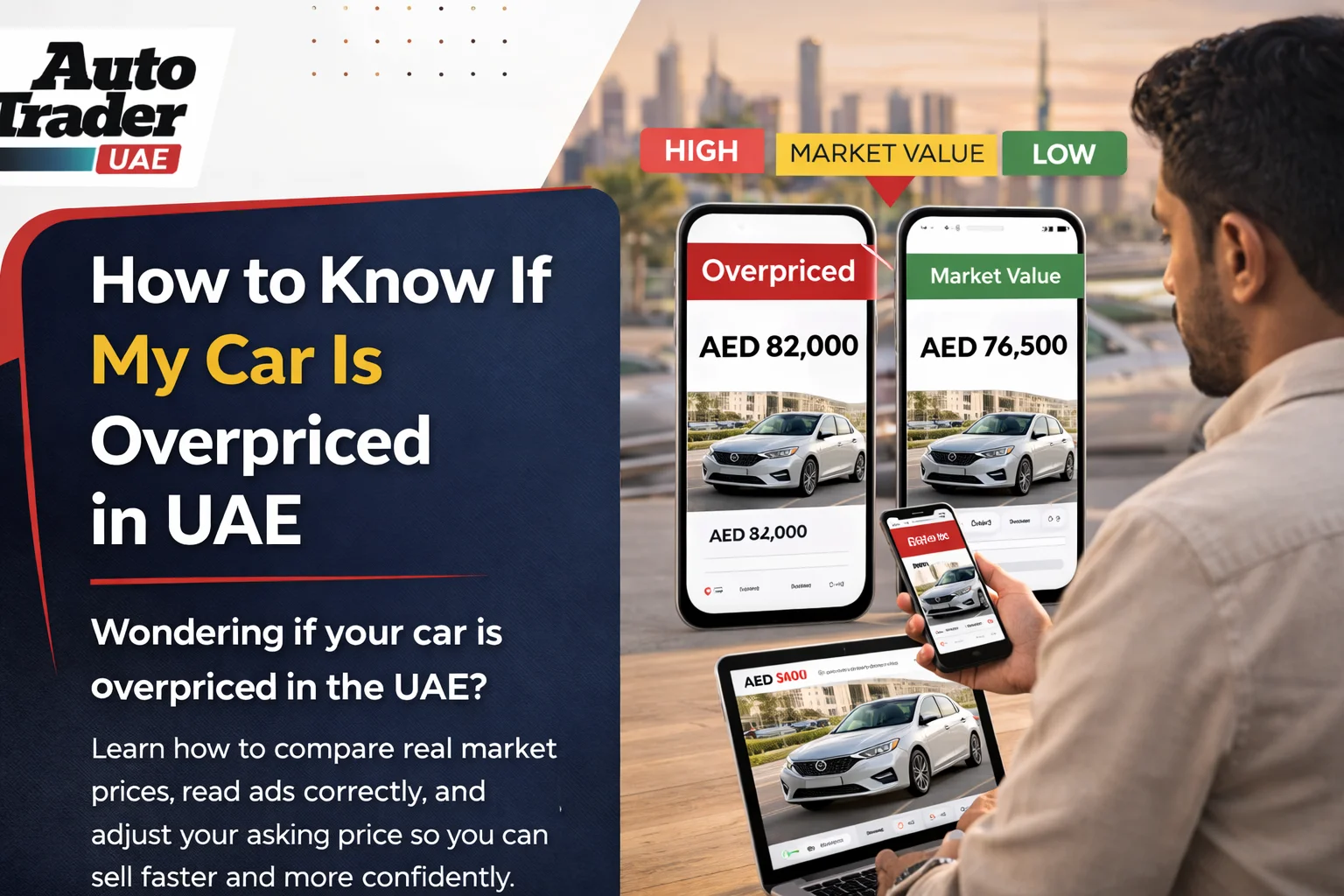
How to Know If My Car Is Overpriced in UAE
If your car ad has been online for weeks with few calls or low offers, there’s a good chance your price is too high. In the UAE’s competitive used car market, buyers compare dozens of listings in seconds—so if your price doesn’t match real market value, they simply move on. This guide from Auto Trader UAE explains how to tell if your car is overpriced and what to do about it, whether you’re selling or checking if you paid too much.
Overview
Pricing a car correctly in the UAE depends on several factors:
- Real-time market prices from online listings
- Car condition, mileage, and service history
- Specification (GCC vs import), trim, and options
- Age, accident history, and ownership records
- Timing and demand in the UAE market
If you ignore these and simply pick a price you "want" or what you "paid before", your car is very likely overpriced.
1. Compare with Real Market Prices in UAE
The fastest way to see if your car is overpriced is to compare it with similar cars currently for sale.
Use trusted UAE marketplaces
Go to Auto Trader UAE and search for:
- The same make and model
- Similar model year (±1 year)
- Similar mileage range
- Same engine and trim if possible
Then:
- Write down 8–10 similar listings
- Note asking price, mileage, and condition notes
- Calculate an approximate average price
Red flag your car is overpriced: if your asking price is more than 5–10% higher than the average of similar UAE listings with similar condition and mileage, buyers will usually skip it.
Look at actual selling behaviour, not just ads
High asking prices don’t always reflect what cars actually sell for. Signs that prices in your range are too high:
- Many similar cars listed for weeks with no “SOLD” or updated status
- Repeated price drops on the same car over time
- Dealers advertising “special offers” or “discount” on the same model
If ads similar to yours are not moving, buyers likely see those prices as unrealistic.
2. Check Mileage and Condition Against the Market
Two almost identical cars in the UAE can have very different values based on mileage and condition.
Mileage expectations in UAE
Typical annual mileage in the UAE is around 15,000–25,000 km. A rough guide:
- Well below average mileage: Often supports a higher price, if service history is strong
- Average mileage: Should sit close to the market average price
- High mileage: Needs a clear discount to attract buyers
Red flag: if your car has higher mileage than most similar listings but your price is equal or higher, it will look overpriced immediately.
Condition and service history
Ask yourself honestly:
- Does the car have full service history (ideally dealer or reputable workshop)?
- Has it had any major repairs (gearbox, engine, chassis, major accident)?
- Are there visible cosmetic issues—paint fade, dents, worn interior, cracked trim?
- Are tyres, brakes, and battery in good condition, with proof?
A car in average or below-average condition cannot realistically be priced like a “showroom condition” car. UAE buyers expect a visible discount if:
- Service history is incomplete or missing
- There are known issues to fix (AC, suspension, warning lights)
- The car needs tyres or major routine maintenance soon
3. Understand GCC Spec vs Imported Cars
In the UAE, GCC specification usually has stronger resale value than imported specs, especially from the US or Europe.
- GCC spec: Usually higher value because it is designed for regional climate and often has clearer local history.
- US / Euro imports: Often cheaper because many have previous accident or insurance history and may not be fully adapted to UAE conditions.
Red flag: If your imported car is priced close to or above equivalent GCC-spec cars of the same year and mileage, most UAE buyers will see it as overpriced.
4. Review Your Car’s Specification and Options
Trims and options can have a big impact on value in the UAE:
- Top trims (full option, limited, platinum, etc.) usually command a premium.
- Desirable options—sunroof/panoramic roof, leather seats, advanced safety tech, large infotainment screens—support higher pricing.
- Base-spec cars compete mainly on price and condition, not features.
Check your car’s trim against other listings:
- If your car is mid or base trim priced like a full-option, it will look overpriced.
- Be realistic about options that matter in the UAE: strong AC, parking cameras/sensors, sunroof, cruise control, safety features.
5. Factor in Age, Ownership, and Accident History
Age and depreciation
In the UAE, most cars lose a lot of value in the first 3–4 years, then depreciate more slowly. Signs of overpricing by age:
- You price a 5–7 year-old car almost the same as a 2–3 year-old model.
- Your 8–10 year-old car is priced near low-end dealer prices for much newer models.
Ownership and accident history
Buyers in the UAE are increasingly careful about history:
- Single owner, full service history: Can justify a stronger price.
- Multiple owners, gaps in history, or recorded accidents: Should be priced more aggressively.
Red flag: If your car has a known accident record or several owners but is priced like a clean, single-owner car with full dealer history, you are almost definitely overpriced.
6. Watch Buyer Reactions to Your Asking Price
The market often tells you more than your own expectations.
Signs your price is too high
- Very few calls or messages in the first 7–10 days of listing.
- Many people view the ad but don’t contact you.
- Almost everyone who calls asks immediately, “What is your last price?” and suggests a big discount.
- Serious buyers come to view the car but don’t return with offers.
If your ad has been live on Auto Trader UAE for two or more weeks, you’ve had good views but almost no serious interest, that’s a strong indicator your price is above market.
Are offers really too low?
Sellers often feel insulted by “low offers”, but sometimes those offers reflect real market value. Compare the average of offers you receive to:
- The average of similar listings
- The condition and history of your car
If most offers are in a similar range and that range sits close to the average price of similar cars, your asking price—not the buyers—is likely the problem.
7. Use Online Valuation and Professional Opinions
Online price checks
Use multiple sources:
- Search Auto Trader UAE for a broad view of live asking prices.
- Compare with other major platforms to see if your model is generally soft or strong in the market.
Don’t rely on a single tool or website; look for a pattern across several listings.
Professional inspections and valuations
For added confidence:
- Ask a trusted dealer what they would pay for your car today (trade-in price).
- Get a pre-sale inspection from a reputable workshop; use the report to understand condition-based pricing.
If dealer offers are far below your asking price, that doesn’t mean you must match them, but it’s a strong hint that your current number is optimistic.
8. Adjusting Your Price Smartly
If you conclude your car is overpriced, adjust your pricing strategy instead of just waiting.
Set a realistic asking price and negotiation margin
A practical approach for private sellers in the UAE:
- Set your asking price roughly 3–7% above the minimum you are willing to accept.
- Avoid pricing 15–20% above market just to “leave room”; serious buyers may never even contact you.
Example:
- Market value from comparison: AED 40,000
- You want at least: AED 38,000
- Reasonable ad price: Around AED 39,500–41,000, depending on condition
Use price drops strategically
If your ad has been live for more than two weeks with weak response:
- Review comparable listings again.
- Reduce your price by a clear, visible amount (not AED 100 or 200).
- Update photos and description to highlight any strengths—service history, GCC spec, new tyres, etc.
Multiple small price cuts over many weeks can make buyers assume you are desperate or hiding something. It’s better to make one or two meaningful adjustments.
9. Common Pricing Mistakes in the UAE
Avoid these typical errors that lead to overpriced ads:
- Basing price only on what you paid: Depreciation in the UAE is fast; your purchase price from years ago is not today’s value.
- Adding the full value of every accessory: Window tint, basic rims, or a sound system rarely return full cost in resale.
- Copying the highest ads: Those cars may be unsold for a reason, or may be showroom condition with better specs.
- Not considering urgent sale vs relaxed sale: If you need a quick sale, your price must be more competitive.
- Ignoring upcoming costs for the buyer: Registration renewal, tyres, pending major service—these reduce what buyers are willing to pay.
Buyer Takeaway: How to Spot an Overpriced Car in UAE
If you’re a buyer worried about paying too much, watch for these signals:
- Price is 5–10% higher than very similar listings (same year, mileage, spec, trim).
- The seller refuses to discuss any negotiation while similar cars are cheaper.
- High mileage or weak history but priced like low-mile, full-history cars.
- Imported spec priced like GCC spec with no clear advantages.
Always:
- Cross-check prices on Auto Trader UAE for the same model and year.
- Inspect or have the car inspected professionally before agreeing to a price.
- Use any negative findings (accidents, repairs, worn tyres) as arguments for a fair discount.
Seller Takeaway: How to Price to Sell, Not Just to Advertise
For sellers, the goal is not just listing your car—it’s actually selling it at a fair price in a reasonable time. To avoid overpricing:
- Research thoroughly on Auto Trader UAE before you decide your price.
- Be honest about your car’s condition, history, and spec.
- Place your price slightly above realistic target, not far above the market.
- Monitor interest for the first 1–2 weeks and be ready to adjust.
- Highlight genuine value—GCC spec, single owner, full history, new tyres—backed by documents.
Conclusion
Knowing whether your car is overpriced in the UAE comes down to facts, not feelings. Compare similar listings, be realistic about condition, mileage, and spec, and listen to the market response. If your phone is quiet and serious buyers walk away, your price is likely the issue. By using Auto Trader UAE to research, list, and adjust your asking price, you can position your car accurately in the market, attract more genuine buyers, and complete a smoother, faster sale. Whether you’re buying or selling, start by exploring live listings and related guides on Auto Trader UAE to understand true market value before you commit to any price.
If you are exploring used cars in Dubai or elsewhere in the UAE, Auto Trader UAE makes it easier to compare listings, prices, trims, mileage, and seller details in one place.