
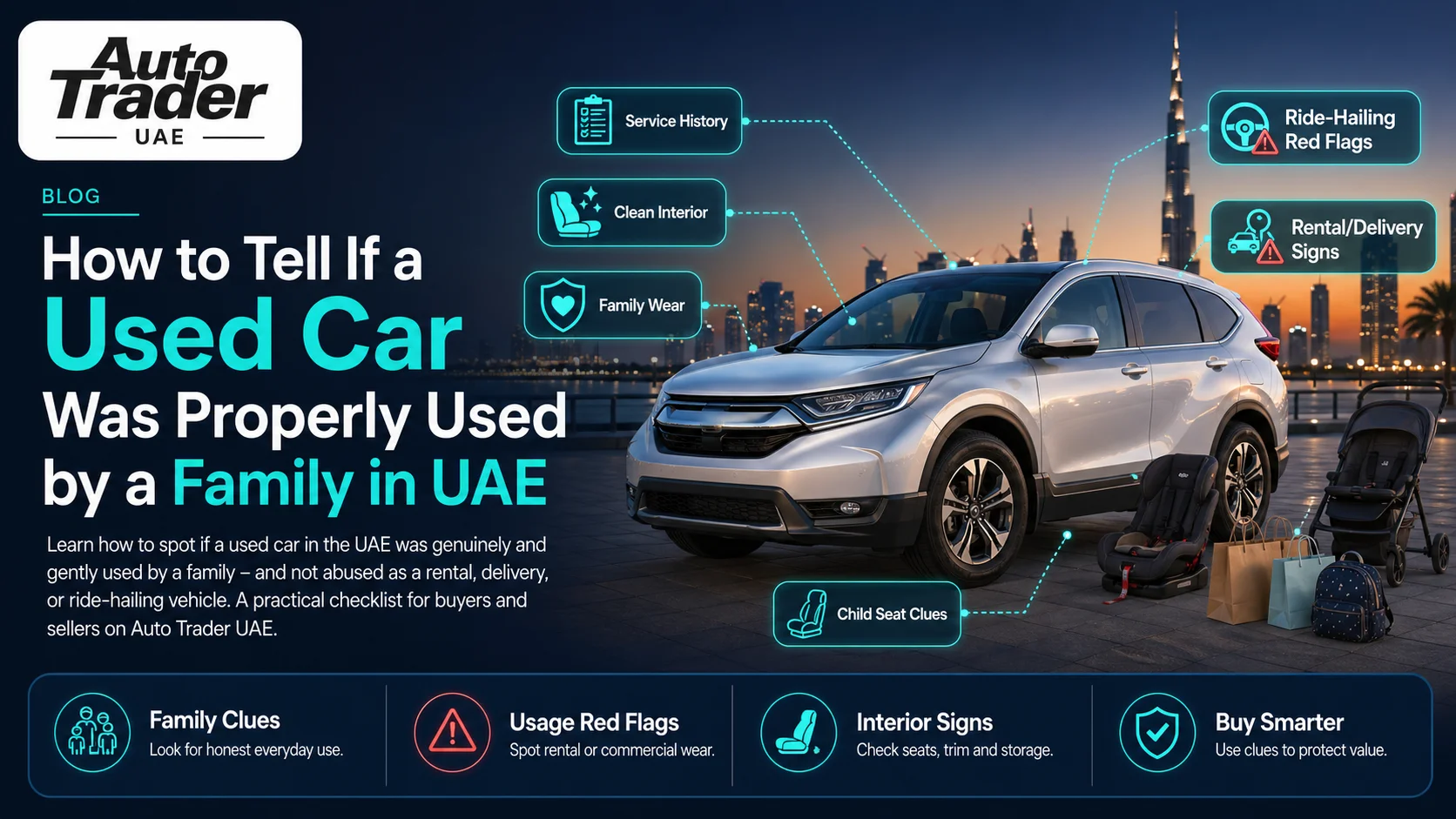
How to Tell If a Used Car Was Properly Used by a Family in UAE
Many buyers in the UAE actively look for “family‑used” cars, expecting careful driving, regular servicing, and no extreme abuse. But those two words in an advert are not proof. This guide explains how to tell if a used car was genuinely and properly used by a family in the UAE, and how both buyers and sellers on Auto Trader UAE can deal with this claim in a smart, transparent way.
Why Buyers Prefer a Genuine Family‑Used Car
A car that has truly been used by a single family often has:
- More predictable mileage and usage patterns
- Better maintenance and service records
- Less aggressive driving than corporate, rental, or delivery vehicles
- Fewer drivers (usually one or two adults in the household)
However, many listings in the UAE use “family car” or “lady driven” as marketing phrases. You need evidence, not slogans.
Step 1 – Check the Story Before You Check the Car
Start by asking the seller clear, calm questions. A real family owner should be able to answer naturally without sounding rehearsed.
Questions to Ask the Seller
- How long have you owned the car? Genuine family ownership is usually 3+ years, but shorter can still be fine if the story matches.
- How many primary drivers? One or two adults is typical. A long list of drivers suggests company or commercial use.
- What was the main use? School runs, commute to work, weekend mall trips, and family visits are normal answers.
- Where was it mainly driven? City (Dubai, Abu Dhabi, Sharjah), highway to other emirates, or mixed.
- Any use for delivery, rental, or ride‑hailing? Ask this directly. Honest sellers will say yes if it was ever used this way.
- Why are you selling? Common family reasons: upgrading to a bigger SUV, moving abroad, changing to electric, or no longer needing a second car.
Listen for a consistent, believable story that matches the car’s age, mileage, and condition.
Step 2 – Decode the Mileage vs Age in UAE Conditions
Mileage alone doesn’t prove family use, but in the UAE climate and lifestyle, it gives strong clues.
Rough Mileage Benchmarks
- Up to 10,000–15,000 km per year: Light use, often second family car or mostly city errand car.
- 15,000–25,000 km per year: Typical UAE daily‑driven family car, commuting plus school runs.
- Over 25,000–30,000 km per year: Heavy use – could still be family, but also common for fleet, rental, or ride‑hailing.
Compare the story to the odometer. A four‑year‑old car with 150,000 km and a claim of “only used for school runs” is unlikely. On the other hand, a five‑year‑old car with just 50,000–60,000 km and full records may be a spare family car or used mainly on weekends.
Step 3 – Inspect the Interior for Real‑Life Family Signs
The cabin usually tells you more than the outside. A truly family‑used car in the UAE will show some honest, age‑appropriate wear – but not abuse.
Positive Signs of Normal Family Use
- Consistent seat wear – front seats slightly more worn, with mild wear on driver’s side bolsters.
- Child seat marks on rear seats – light indentations, ISOFIX marks, or minor scuffs where children sat.
- Working seatbelts everywhere – all belts retract smoothly and aren’t twisted or frayed.
- Functioning AC vents – important in UAE; rear AC vents should blow cold if used regularly with kids.
- Original floor mats – may be worn but still present; heavy duty aftermarket mats are also common in family cars to protect the interior.
Warning Signs of Harsh or Commercial Use
- Heavily worn driver’s seat on a relatively low‑mileage car – could indicate high hours of city driving or odometer tampering.
- Multiple cigarette burns, strong smoke odour, or heavy perfume used to mask smells.
- Extreme wear on all seats – suggests constant passenger turnover typical of taxis or ride‑hailing.
- Broken or missing interior trim – cup holders, door handles, or vents snapped off.
- Seat belts that don’t retract properly, which can be common in overused fleet cars.
Look in the Boot (Trunk)
- Normal family signs: stroller scuff marks, some light scratches from luggage or shopping, maybe a baby sunshade or umbrella.
- Commercial‑use signs: very heavy scratches, dented boot floor, missing boot trim, or signs of heavy equipment being loaded regularly.
Step 4 – Examine Exterior Condition with UAE Use in Mind
In the UAE, sun and sand work on a car daily. Exterior condition shows how a family maintained the vehicle and where it was parked.
What Healthy Family Use Looks Like
- Minor parking scratches on bumpers or doors, especially in busy areas like Dubai Marina or Deira.
- Even paint colour on all panels, with no clear difference between doors, fenders, and bonnet.
- Headlights slightly dull but not yellowed – normal for age and climate.
- Small stone chips on the front bumper or bonnet from highway trips between emirates.
Warning Signs of Heavy or Uncared‑For Use
- Noticeably faded roof and bonnet compared to the rest – often parked outside without shade.
- Mismatched paint or overspray – indicates past accident repairs; not a dealbreaker if done properly but needs verification.
- Uneven panel gaps around the bonnet, boot, or doors – can signal structural repairs or poor accident fixes.
- Rust around door edges or underbody – rare in UAE but a red flag, possibly from flood damage or import from a harsher climate.
Step 5 – Service History and Records in the UAE
The strongest proof of proper family use is documented maintenance. In our climate, regular servicing is essential.
What to Ask For
- Service book or digital records – stamps from authorised dealers or reputable workshops in the UAE.
- Receipts for major work – brakes, tyres, battery, AC service, timing belt/chain, and suspension.
- RTA test reports – if available, can show consistent passing results over time.
Healthy Family‑Use Patterns
- Oil changes roughly every 8,000–15,000 km (depending on model and oil type).
- Tyre changes every 40,000–60,000 km or 3–4 years, which is important in UAE heat.
- AC service documented – families rarely ignore a weak AC in summer.
Long gaps with no records, especially early in the car’s life, could hint at fleet or careless use. Some independent imports may lack full history – in this case, rely more on mechanical inspection.
Step 6 – Check for Rental, Taxi, or Ride‑Hailing History
In the UAE, many cars start life in fleets before being sold as “family used”. Not all ex‑fleet cars are bad, but you should know what you’re buying.
Clues the Car Might Have Been in a Fleet
- Very high mileage for the age – e.g. a 3‑year‑old car with 120,000–160,000 km.
- Evidence of stickers or removed logos on doors, boot, or windscreen.
- Multiple paint shades or repainted panels on common taxi colours.
- Uniform but heavy wear on all seats, as passengers sat in every position regularly.
- Many previous owners in a short period on registration history.
Ask directly if it was used for rental, taxi, or ride‑hailing. A trustworthy seller should disclose this. If you suspect ex‑fleet history, factor it into your price negotiation and insist on a full inspection.
Step 7 – Mechanical Feel: How a Family‑Used Car Drives
A proper test drive on UAE roads will reveal how the car was treated mechanically.
On the Test Drive, Pay Attention To:
- Engine start‑up – should fire quickly without long cranking, knocking, or heavy smoke.
- Transmission – gear changes in automatics should be smooth; jerks or delays may indicate abuse or overdue servicing.
- Steering – should be straight, with no pulling to one side on Sheikh Zayed Road or other highways.
- Suspension – knock or clunk sounds over speed bumps suggest worn components.
- Brakes – strong and straight braking, no vibration through the pedal or steering wheel.
- AC performance – it should cool fast even in midday heat. A weak AC in a supposed “family car” is unusual.
Many families drive calmly and keep up with maintenance, so a genuine family‑used car often feels tight and predictable on the road.
Step 8 – Professional Inspection and RTA Checks
Even if the car appears to be a clean family vehicle, always verify with professionals.
What to Do Before You Decide
- Get a pre‑purchase inspection from a reputable workshop or testing centre. They will check for accidents, chassis damage, leaks, and hidden issues.
- Review the last RTA test (where available) to see if it passed emissions and safety checks smoothly.
- Use online VIN or chassis number checks where possible to see if it was registered as a taxi or rental in another region.
On Auto Trader UAE, using secure communication with sellers and arranging an independent inspection is standard good practice, especially for higher‑value SUVs and family MPVs.
Tips for Buyers: How to Protect Yourself
- Don’t pay extra just for the words “family used” – pay for condition, records, and verified history.
- Compare similar listings on Auto Trader UAE – look at other used SUVs, sedans, and crossovers of the same year and model to see realistic pricing.
- Use checklists – bring a simple printed list of what to inspect inside, outside, and mechanically.
- Walk away if the story, mileage, and condition don’t match – inconsistency is more important than a single scratch or repair.
Tips for Sellers: How to Prove Genuine Family Use
If you’re a genuine family owner in the UAE, you can stand out by being transparent and organised.
Strengthen Your Listing on Auto Trader UAE
- Gather your records – service book, invoices, and any warranty paper. Mention them clearly in your advert.
- Highlight real family details – for example: “second car, mainly used for school runs in Abu Dhabi” or “owned for 5 years, always parked in basement”.
- Show high‑quality photos – clean interior, boot, and engine bay. Potential buyers can quickly see genuine family‑level care.
- Be honest about scratches or minor repairs – most buyers expect a few marks; honesty builds trust and faster deals.
Best Types of Models Typically Used as Family Cars in UAE
While any car can be a family car, some body styles are more commonly used by households across the UAE:
- Compact and midsize SUVs – popular for school runs, groceries, and weekend trips.
- Seven‑seater SUVs and MPVs – favoured by larger families and those who regularly host relatives.
- Reliable sedans – often used as main commuter cars plus family duty in the evenings.
- Crossovers – blend of car‑like comfort and SUV practicality, highly popular with young families.
On Auto Trader UAE, you can browse a wide range of used cars in the UAE, including thousands of family‑friendly options.
How to Use Auto Trader UAE Smartly
For Buyers
- Filter for used SUVs, crossovers, and MPVs to focus on typical family cars.
- Look for adverts mentioning full service history, “single owner”, or “dealer maintained”.
- Save and compare multiple listings of similar year and spec to understand fair market value.
For Sellers
- Use clear, detailed titles and descriptions – for example: “2019 midsize SUV, single‑family owner, dealer serviced in Dubai”.
- Upload exterior, interior, boot, and service book photos to prove genuine family use.
- Price realistically by checking comparable used cars in UAE and, if relevant, used cars in Dubai.
Conclusion: Trust the Evidence, Not the Slogan
In the UAE, “family‑used” can describe an excellent, carefully maintained vehicle – or simply be a marketing phrase. To tell if a used car was properly used by a family, you need a complete picture: ownership story, mileage pattern, interior and exterior condition, service history, mechanical feel, and professional inspection.
Whether you’re buying or selling, Auto Trader UAE gives you the platform to present and evaluate this evidence clearly. Browse our wide selection of used cars in UAE – and if you’re shopping in the emirate, explore thousands of used cars in Dubai – to find or showcase a truly well‑cared‑for family car with confidence.
Browse used cars in UAE on Auto Trader UAE to compare live listings, prices, and current market activity more clearly.
Related Links
Buyer Takeaway
When buying a used car in the UAE, focus on vehicle condition, service history, inspection quality, paperwork, and total running costs rather than price alone. Compare options carefully and choose the option that best matches your budget and real needs.
Seller Takeaway
If you are selling a used car in the UAE, present the service history clearly, price the vehicle realistically, and highlight condition, specification, and ownership strengths honestly. A well-prepared listing with accurate details usually attracts more serious buyers.