
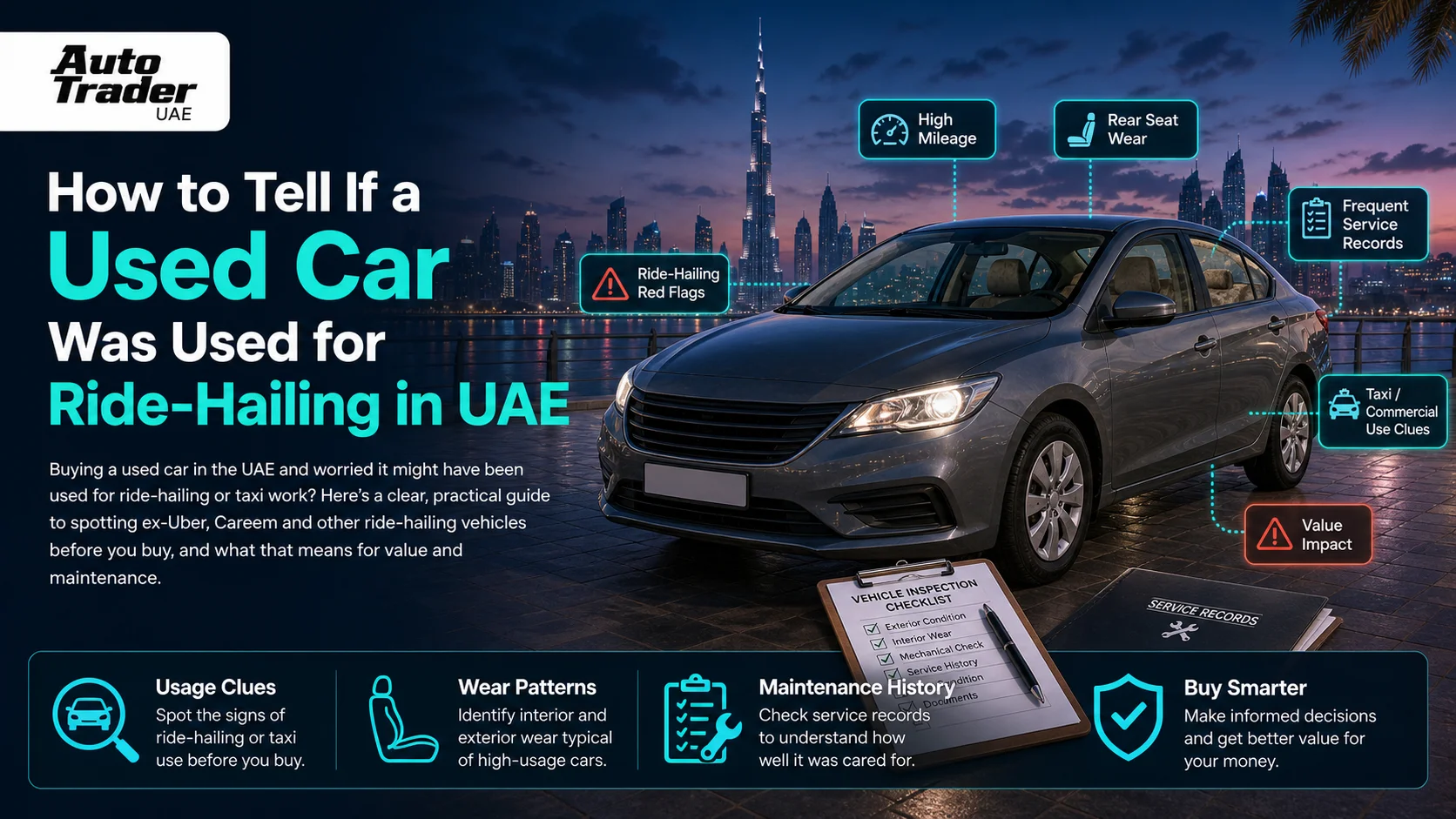
How to Tell If a Used Car Was Used for Ride-Hailing in UAE
Buying a used car in the UAE can save you a lot of money, but heavy previous use can affect reliability and resale value. One of the biggest concerns for buyers on Auto Trader UAE is whether a car has been used for ride-hailing services like Uber, Careem, or local limousine and corporate fleets. This guide explains how to tell if a used car was used for ride-hailing in the UAE, what risks to look for, and how buyers and sellers can handle disclosure honestly.
Why It Matters if a Car Was Used for Ride-Hailing
Ride-hailing cars typically:
- Cover far higher mileage than private cars in a short time
- Spend more time in stop‑start traffic (more wear on brakes, suspension, transmission)
- May have more cosmetic wear inside (seats, door handles, plastics)
- May have better-than-average servicing if used by professional drivers or fleets
An ex‑ride-hailing car is not automatically a bad buy. If it has been well serviced with full records and is priced fairly, it can still be good value. The key is to identify previous usage and factor that into your inspection, negotiation and long‑term ownership plans.
1. Check the Basics: Registration, Service History and Paperwork
A. Review the Mulkiya (Registration Card)
The Emirates vehicle registration card (mulkiya) can give early hints:
- Owner type: If the owner is a transport, limousine, car rental or fleet company, it may have been used commercially.
- Frequent ownership changes: Many owner changes in a short period can be a red flag for fleet or commercial use.
- Emirate: Dubai, Abu Dhabi and Sharjah are major ride‑hailing hubs, so a car registered there with high mileage deserves extra checks.
Always compare the name and details on the mulkiya with the seller’s Emirates ID or trade licence if you’re buying from a dealer.
B. Look at Service and Maintenance Records
Ask for a complete service history from:
- Official dealership service centres
- Reputable independent workshops
- Fleet or rental company records (if applicable)
Warning signs of ride‑hailing use include:
- Very frequent services in short time gaps (for example every 4–6 weeks).
- High mileage jumps between services (20,000–30,000 km or more in 3–4 months).
- Multiple identical cars listed on the same service account or company name (possible fleet).
A positive sign is a car with regular oil changes, brake services and major services done on time. Even if it was used commercially, strong maintenance can make it a safer buy.
C. Insurance and Accident History
Ask the seller if they can provide:
- Any insurance claim reports
- Any accident or repair history from authorised workshops
Multiple minor accidents or frequent body repair jobs in a short period may reflect intense city use such as ride‑hailing.
2. Inspect the Odometer and Compare to Age
Mileage is one of the clearest hints.
Typical Private Use vs Heavy Commercial Use
In the UAE, many privately owned cars average about 15,000–25,000 km per year, depending on commute and weekend use. A used car may have been used for ride-hailing if:
- The car is 3–4 years old with 200,000 km or more
- Annual mileage works out at 40,000–60,000 km or higher
- The odometer reading jumps quickly between service visits
High mileage is not a guarantee of taxi or ride‑hailing use, but when combined with other signs it becomes more likely.
Check for Odometer Tampering
Because high mileage can reduce value, some sellers may try to roll back readings. Look out for:
- Odometer digits not aligned or flickering on older analogue clusters
- Service records showing higher mileage than the dashboard
- Sticker reminders on the door or engine bay with conflicting mileage
- Wear and tear (worn pedals, seats, steering wheel) that looks inconsistent with low mileage
If anything looks suspicious, walk away or get an independent inspection before proceeding.
3. Look for Physical Signs of Ride-Hailing Use
A. Interior Wear Patterns
Ride-hailing cars transport many passengers every day. Common signs include:
- Rear seat wear: Rear seat cushions softer or more worn than the front.
- Seat belts: Frayed or heavily used rear seat belts.
- Door panels and handles: Scratches or scuffs on interior handles, especially in the rear.
- Rear floor mats and carpets: Heavier staining or wear compared to the driver’s side.
- Phone charging cables and mounts: Evidence of wiring, cable clips or holes from removed mounts.
B. Exterior Clues
Look around the bodywork and glass for:
- Residue or ghost outlines from removed stickers or magnets (typical of fleet numbers or commercial branding).
- Roof or rear window marks where small signage or permit stickers might have been fixed.
- Uneven paintwork where branding or decals were resprayed.
None of these alone prove ride-hailing use, but together they build a picture.
4. Technology and Mounting Evidence Inside the Cabin
Ride-hailing drivers rely heavily on smartphones and accessories. When inspecting the interior, check for:
- Marks or scratches on the windscreen or dashboard from suction-cup mounts.
- Aftermarket wiring or extra USB ports added for passenger charging.
- Bluetooth or hands‑free devices added on top of the factory system.
- Velcro strips or adhesive marks where meters, tablets or devices were attached.
If you see several of these alongside high mileage and fleet ownership, the car was likely used for some form of professional or ride-hailing work.
5. Suspension, Brakes and Mechanical Wear
Cars used for ride-hailing in the UAE often spend long hours in city traffic, carrying multiple passengers and luggage. This accelerates wear on key components.
A. Test the Suspension
During a test drive:
- Listen for knocking or squeaking noises over speed bumps and rough roads.
- Notice if the car feels floaty, bouncy or unstable at highway speeds.
- Check for uneven tyre wear, which can indicate suspension issues or misalignment.
B. Feel the Brakes
Frequent stop‑start driving wears out brake pads, discs and sometimes calipers more quickly.
- Does the steering wheel vibrate when braking at higher speeds? This may indicate warped discs.
- Is there a grinding or squealing noise? Pads may be worn out.
- Does the car pull to one side when braking? This could mean uneven wear or a sticking caliper.
C. Transmission and Engine Response
Ride-hailing cars can stack up high engine hours even at moderate speeds.
- Check for smooth gear changes in automatic gearboxes.
- Listen for whining noises from the transmission at constant speeds.
- Look for warning lights on the dashboard and run a diagnostic scan if possible.
For extra confidence, consider paying for a pre‑purchase inspection at a reputable workshop or testing centre in your emirate.
6. Ask Direct Questions About Previous Use
Sometimes the simplest approach is the most effective. Ask the seller:
- “Was this car ever used for Uber, Careem or other ride‑hailing services in the UAE?”
- “Was it ever part of a limousine, rental or corporate fleet?”
- “How many kilometres per year did you usually drive?”
Pay attention to:
- Whether their answers match the paperwork.
- Whether they’re willing to share service and inspection reports.
- Any hesitation or vague answers when you ask about commercial use.
A trustworthy seller, especially on a platform like Auto Trader UAE, should be open to these questions.
7. Legal and Regulatory Context in the UAE
Different emirates set rules around transport and commercial use, usually via authorities such as the RTA in Dubai and equivalent transport departments elsewhere. Key points to keep in mind:
- Some cars used as taxis or licensed limousines must adhere to specific inspection and maintenance standards while in service.
- When those cars are de‑fleeted and sold, they may pass through auctions or dealers with records of their previous status.
- Ride‑hailing through apps can include both professionally licensed fleet vehicles and privately owned cars (depending on emirate rules and partnerships at the time).
If you strongly suspect a car was a taxi or limousine, ask directly which company it worked for and request any documentation they can provide.
8. How This Affects Price, Negotiation and Ownership
Pricing a Suspected Ride-Hailing Car
If you confirm or strongly suspect ride-hailing use, you can:
- Compare the advertised price with similar used cars in the UAE that have lower mileage and known private use.
- Factor in the cost of upcoming wear items like tyres, brakes, shock absorbers and possibly suspension bushes.
- Negotiate a lower price to reflect the heavier usage, even if maintenance has been good.
When a High-Mileage Ex-Fleet Car Can Still Be Worth It
A car that has been used for ride-hailing or as part of a fleet can still be a smart purchase if:
- It has a full service history with no big gaps.
- It passes an independent inspection with no major issues.
- The price is significantly lower than similar privately used cars.
This can be attractive if you need a budget‑friendly daily driver and plan to keep the car for several years.
9. Tips for Sellers: How to Be Transparent and Still Get a Fair Price
If you are selling a car that was used for ride-hailing in the UAE, honesty is essential.
Disclose Previous Use Clearly
In your Auto Trader UAE listing and when meeting buyers:
- Openly mention if the car was used for ride-hailing, limousine or company fleet.
- Highlight the service history and maintenance that kept the car in good condition.
- Mention any recent major work such as new tyres, suspension overhaul or brake replacement.
Honesty builds trust and avoids problems later if a buyer discovers the usage through documents or inspection.
Set a Realistic Asking Price
Compare your car to similar models on:
Price slightly below equivalent privately used cars, but emphasise the value of:
- New or nearly new consumables (tyres, brakes, battery)
- Recent services and any warranty coverage
- Clean accident history where applicable
10. Using Auto Trader UAE Smartly When You’re Unsure
When browsing listings on Auto Trader UAE, you can reduce the risk of unintentionally buying an ex‑ride-hailing car by:
- Filtering for lower mileage ranges within your budget.
- Prioritising cars with full documented service history.
- Focusing on private sellers when you specifically want non‑fleet cars (while still checking paperwork carefully).
If you’re shopping for popular ride-hailing models like economical sedans and crossovers, give extra attention to usage patterns. For example:
- Used Toyota Corolla in UAE
- Used Nissan Sunny in UAE
- Used Hyundai Elantra in UAE
- Used Kia Cerato in UAE
These models are popular with both private owners and professional drivers, so inspecting each individual car carefully is essential.
Buyer Checklist: Signs a Car May Have Been Used for Ride-Hailing
Use this quick checklist when viewing a car:
- High mileage compared to age (e.g. 150,000–250,000 km in 3–4 years)
- Mulkiya previously in a company or fleet name
- Frequent services with large mileage jumps
- Worn rear seats, belts and door handles
- Marks from phone or meter mounts on dash/windscreen
- Sticker residue or ghost decals on body or windows
- Extra wiring or added charging points
- Heavier wear on suspension and brakes during test drive
- Seller is unclear or hesitant about usage history
The more boxes a car ticks, the more likely it was used professionally.
Conclusion: Make an Informed Decision, Not a Guess
A car that has been used for ride-hailing in the UAE is not automatically a bad purchase, but it should be judged differently from a low‑mileage, privately used car. By combining document checks, physical inspection and direct questions, you can quickly build a realistic picture of a vehicle’s past. When you’re ready to start shopping, explore:
On Auto Trader UAE you can compare mileage, service history notes and seller information side by side, helping you choose a car with a history you understand and a price that reflects it.
Browse used cars in UAE on Auto Trader UAE to compare live listings, prices, and current market activity more clearly.
Related Links
Buyer Takeaway
When buying a used car in the UAE, focus on vehicle condition, service history, inspection quality, paperwork, and total running costs rather than price alone. Compare options carefully and choose the option that best matches your budget and real needs.
Seller Takeaway
If you are selling a used car in the UAE, present the service history clearly, price the vehicle realistically, and highlight condition, specification, and ownership strengths honestly. A well-prepared listing with accurate details usually attracts more serious buyers.