
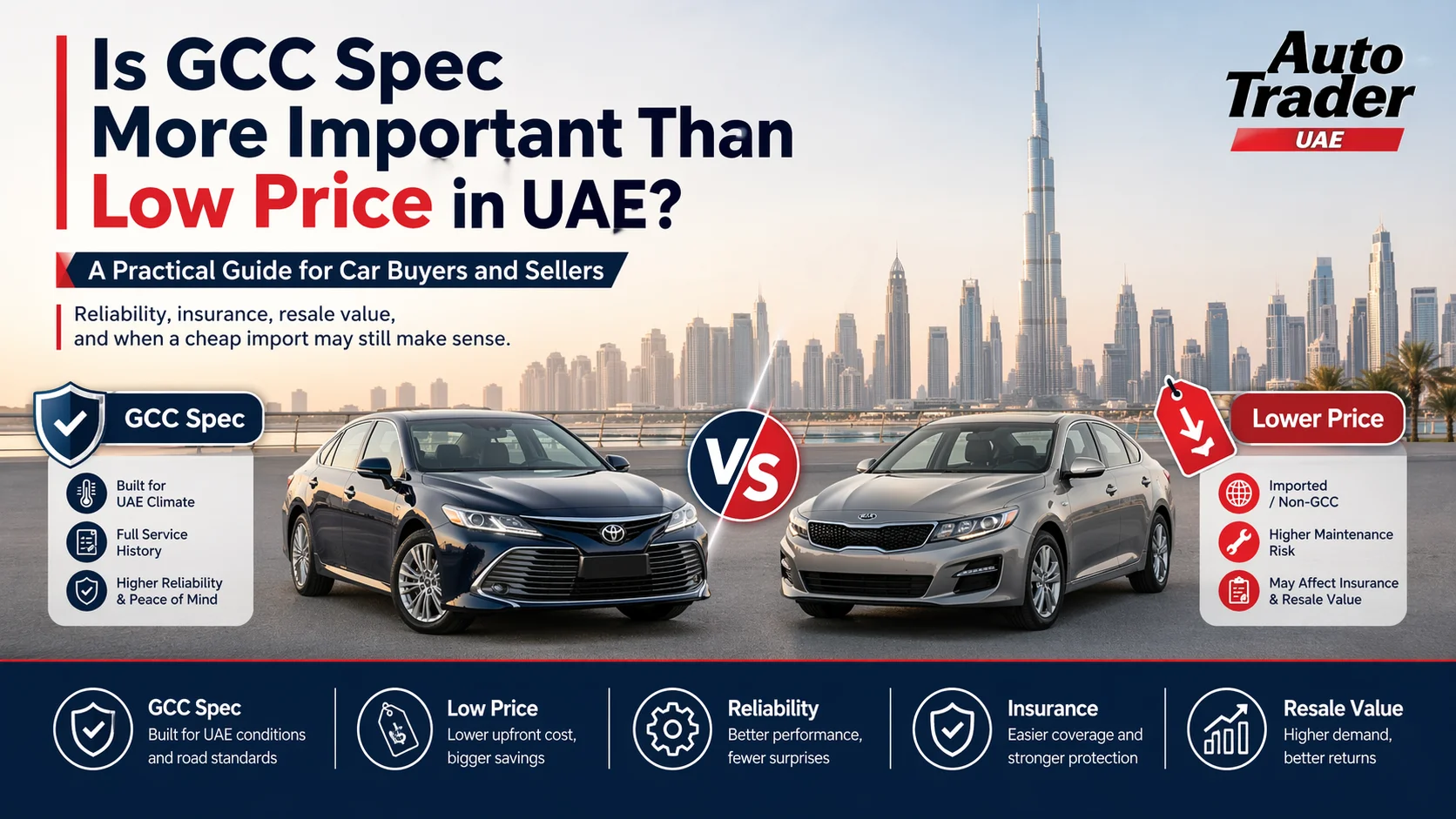
Is GCC Spec More Important Than Low Price in UAE?
When shopping for a used car in the UAE, one question keeps coming up: Is GCC spec more important than low price in UAE? Many listings on Auto Trader UAE highlight “GCC spec” in the title, while others advertise “best price” or “urgent sale”. Knowing how to weigh these two factors can save you money and future headaches.
This guide explains what GCC spec means, how it affects ownership in the UAE, and when it makes sense to prioritise specification over a low price – and when a non-GCC car can still be a smart deal.
Overview
GCC-spec cars are vehicles designed and equipped for the climate, fuel, and regulatory requirements of Gulf countries (UAE, Saudi Arabia, Kuwait, Qatar, Bahrain, Oman). They’re often seen as the safer, more reliable choice for UAE conditions, and many buyers are willing to pay more for them.
On the other hand, non-GCC or “American/Japanese/European spec” cars can look very attractive because of their lower prices and high option levels. But that lower price can come with trade-offs in heat durability, parts compatibility, insurance, and resale value.
For most everyday buyers in the UAE, GCC spec usually matters more than the lowest price, especially if you plan to keep the car for several years. Still, the right decision depends on the specific car, your budget, and how long you’ll own it.
What Does GCC Spec Actually Mean?
“GCC spec” is more than just a marketing term. For major brands, it typically includes:
- Cooling system upgrades: Larger radiators, higher-capacity fans, and stronger air-conditioning systems designed for extreme heat and humidity.
- Engine calibration for local fuel: Tuning and components optimised for the quality and octane of fuel commonly available in the Gulf.
- Dust and sand protection: Better sealing, different air filters, and sometimes modified intake systems to cope with sandstorms and dusty roads.
- Corrosion protection: Additional underbody and body protection to help resist salt and humidity, especially in coastal areas.
- Regional safety and legal compliance: Specifications that match GCC regulations for lights, speed warnings, odometers, and sometimes mandatory safety features.
- Manufacturer warranty and dealer support: Cars officially sold by UAE or GCC dealers are more likely to have warranty coverage honoured locally (especially when still within the warranty period).
Not every GCC-spec car will look different on the outside, but under the skin it’s usually better prepared for life in UAE weather.
GCC Spec vs Low Price: What Really Matters in the UAE?
When comparing a GCC-spec car with a cheaper non-GCC import, consider these factors:
1. Reliability in Extreme Heat
Summer temperatures in the UAE can sit above 45°C for weeks. In these conditions, differences in cooling and materials matter. Signs a non-GCC car might struggle include:
- Overheating in traffic, especially with the AC on full.
- Weak or inconsistent air conditioning on very hot days.
- Premature wear of rubber components, hoses, and plastics not designed for this climate.
A GCC-spec car is built with this environment in mind, which can reduce breakdowns and long-term repair costs.
2. Resale Value in the UAE Market
On Auto Trader UAE and other local platforms, GCC-spec cars generally command higher resale prices and sell faster. Buyers tend to trust them more, and dealers are often more willing to buy them in trade-in deals.
With non-GCC cars, expect:
- Lower resale prices compared with equivalent GCC-spec models.
- More negotiation pressure from buyers pointing out that it’s “not GCC spec”.
- A smaller pool of interested buyers, especially for higher-value cars.
3. Insurance and Registration Considerations
Insurance companies in the UAE usually insure both GCC and non-GCC cars, but they may view import specs as higher risk. That can mean:
- Stricter inspection before issuing full comprehensive coverage.
- Occasionally higher premiums or reduced coverage for certain high-value imports.
- More questions about the vehicle history, especially for US imports that may have been accident repaired.
For registration, most properly imported non-GCC cars can be registered without issues if they meet RTA standards and pass inspection. However, heavily modified or accident-rebuilt imports can face more scrutiny.
4. Parts, Maintenance, and Dealer Support
With GCC-spec cars:
- UAE dealerships and independent workshops are set up for these specifications.
- Parts are typically easy to source, whether genuine or aftermarket.
- Diagnostics and software updates match the regional configuration.
With non-GCC cars:
- Some parts may have different part numbers or specifications.
- Dealer service may be limited or more expensive for certain imports.
- Specialised workshops may be needed for US/Europe/Japan-spec electronics or options.
5. Purchase Price vs Total Cost of Ownership
A lower purchase price is tempting, especially if you’re buying on a tight budget. But a car is not just about what you pay today – it’s about what it costs over time.
When comparing GCC vs non-GCC, think in terms of total cost of ownership:
- Purchase price.
- Maintenance and potential repairs (especially cooling and AC).
- Fuel consumption differences (engine tuning and gearbox differences can affect this).
- Insurance costs.
- Resale value when you’re ready to sell.
Often, a slightly more expensive GCC car works out cheaper overall because it holds value better and is less likely to need expensive climate-related repairs.
When GCC Spec Is Worth Paying More For
In the UAE, GCC spec is particularly important if:
- You plan to keep the car for several years – the longer you keep it, the more climate- and maintenance-differences show up.
- You drive daily in heavy traffic – extended idling in heat is hard on cooling systems and AC.
- You live in hotter inland areas – temperatures and dust can be more extreme than coastal city centres.
- You want easier resale – especially if you’ll sell privately through platforms like Auto Trader UAE.
- You prefer dealer service – main dealers are usually more aligned with GCC specifications.
For mainstream family cars, SUVs, and work vehicles, GCC spec is usually the smarter long-term choice, even if it costs more upfront.
When a Low-Priced Non-GCC Car Can Still Be a Smart Buy
There are cases where a non-GCC car at a low price can make sense:
- Short-term ownership: If you plan to keep the car for 1–2 years only and the discount is significant, you may accept the risk and potential lower resale value.
- Well-documented history: A non-GCC car with a full, transparent service and accident history can be more attractive than a GCC car with unclear records.
- Enthusiast or rare models: Some performance models or trims are only available as imports; GCC options may not exist.
- Already adapted to GCC conditions: Some owners upgrade radiators, AC systems, and other components to handle UAE heat. A thorough inspection can confirm this.
In all these cases, a professional pre-purchase inspection is essential. On Auto Trader UAE, it’s wise to arrange a third-party inspection or visit a trusted workshop before committing to any non-GCC car, especially if it’s a US salvage import.
How to Check if a Car Is Truly GCC Spec
Because “GCC spec” is a selling point, it can sometimes be claimed loosely. To verify a car’s spec:
- Check the service book: Look for stamps from authorised UAE or GCC dealers.
- Inspect the VIN plate and stickers: These often show the original country of sale and region specification.
- Ask for the original purchase invoice: It should match a GCC dealer or distributor.
- Contact a dealer with the VIN: Many authorised dealers can confirm whether the car is GCC-spec in their system.
- Look for typical regional features: Some models have specific GCC equipment or labeling (e.g. Arabic/English cluster markings, specific warnings).
If a seller advertises “GCC spec” but cannot provide any proof, factor that uncertainty into your offer or consider other listings.
Red Flags With Cheap Non-GCC Cars
Low price plus non-GCC spec can sometimes indicate deeper problems. Watch out for:
- US salvage or rebuilt titles (if disclosed): These cars may have had significant accidents or flood damage before arriving in the UAE.
- Inconsistent mileage or history: Gaps in service records or mismatched odometer readings.
- Overly fresh paint on one side: Could indicate accident repairs done after import.
- Weak AC performance during a hot test drive: Can signal an under-specced or tired system not suited to UAE heat.
- Non-standard modifications: Makes future maintenance and registration more complicated.
Not every imported car has issues, but you need to be extra careful and realistic about why the price is low.
Buyer Takeaway: How to Decide What Matters More for You
To answer “Is GCC Spec More Important Than Low Price in UAE?” for your situation, ask yourself:
- How long will I keep the car?
Longer ownership generally favours GCC spec. - Can I afford potential extra repairs?
If unexpected AC or cooling repairs would be a big problem, GCC spec is safer. - Do I prioritise easy resale later?
GCC-spec cars usually sell faster and nearer to market value on Auto Trader UAE. - Is this car a common model or a rare import?
For everyday cars, choose GCC when possible. For unique models, non-GCC may be the only option. - Is the discount truly worth the compromise?
Compare the price gap against potential extra costs and lower resale.
Before you buy, use Auto Trader UAE to compare GCC and non-GCC listings side by side, check typical market prices, and shortlist cars with verified history and clear documentation.
Seller Takeaway: How GCC Spec and Price Affect Your Listing
If you’re selling a car in the UAE, understanding how buyers think about GCC spec and price helps you position your listing effectively.
If Your Car Is GCC Spec
- Highlight “GCC spec” clearly in the listing title and description on Auto Trader UAE.
- Show service history with photos of service stamps or invoices from local dealers/workshops.
- Price in line with GCC market value – don’t under-sell it by matching non-GCC prices.
- Mention AC performance and condition – buyers care deeply about climate comfort.
If Your Car Is Non-GCC
- Be transparent: Clearly state that it’s non-GCC (US spec, EU spec, etc.). Honesty builds trust.
- Focus on strengths: Options, mileage, condition, documented service, and any climate-related upgrades.
- Price competitively: Accept that most buyers will expect a discount vs an equivalent GCC-spec car.
- Prepare documentation: Have import papers, Carfax/vehicle history (if available), and recent inspection reports ready.
On Auto Trader UAE, well-presented listings with realistic pricing and full details tend to attract more serious buyers, regardless of spec.
Conclusion: Is GCC Spec More Important Than Low Price in UAE?
For most drivers in the UAE, yes – GCC spec is generally more important than simply getting the lowest price. The region-specific cooling, better compatibility with local conditions, smoother insurance and maintenance, and stronger resale value usually outweigh the savings from a cheaper non-GCC car.
However, a low-priced, non-GCC car can still be a good decision if:
- It has a clean, well-documented history.
- The discount compared with GCC options is substantial.
- You understand the potential risks and factor them into your budget.
Whether you are buying or selling, use Auto Trader UAE to:
- Compare GCC and non-GCC listings across different budgets and body types.
- Check typical market prices before negotiating.
- Discover more buying guides and model-focused articles to support your decision.
By balancing specification, condition, history, and price – not just chasing the cheapest deal – you’ll be better placed to choose the right car for life in the UAE.
If you are exploring used cars in Dubai or elsewhere in the UAE, Auto Trader UAE makes it easier to compare listings, prices, trims, mileage, and seller details in one place.