
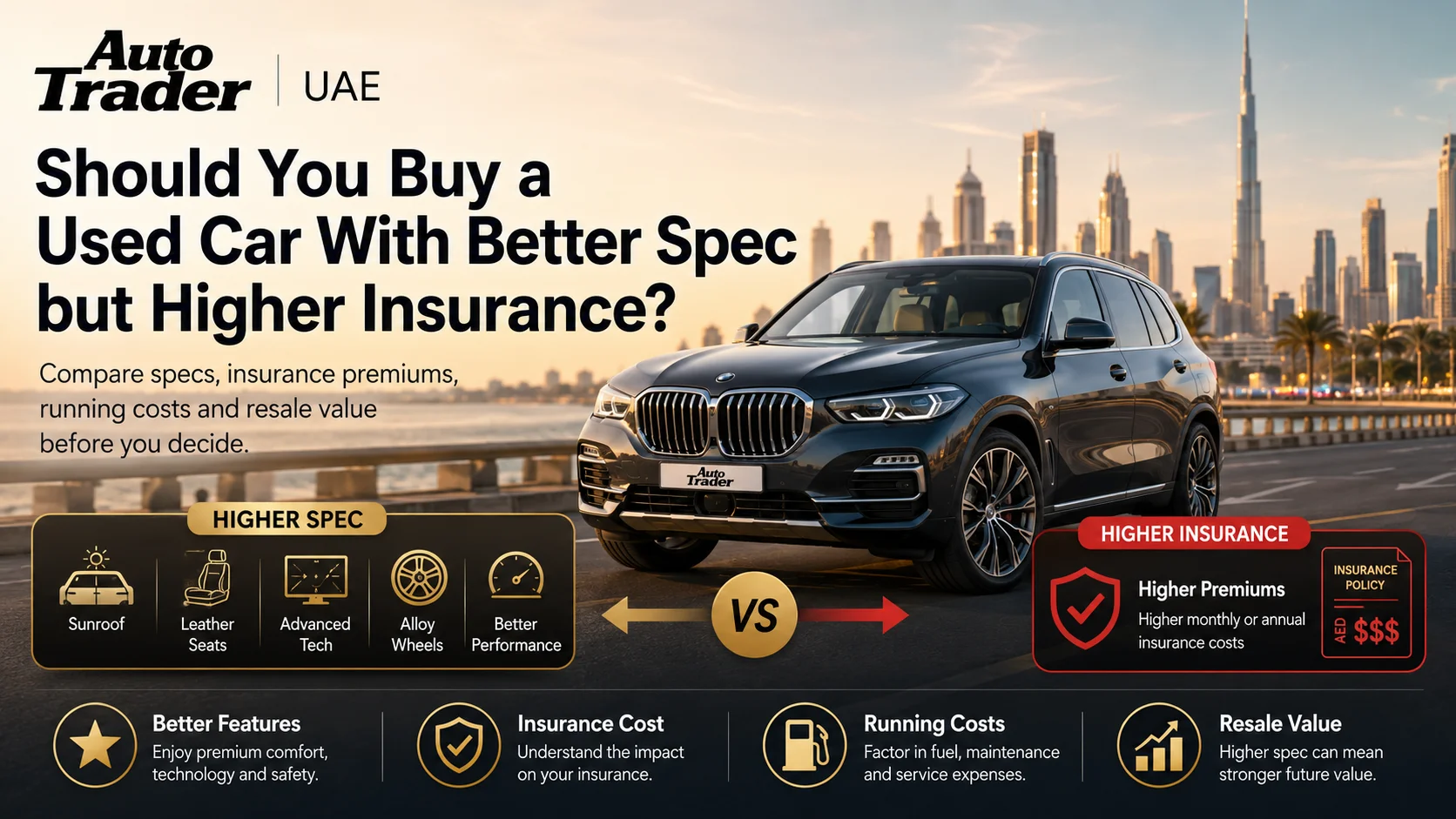
Should You Buy a Used Car With Better Spec but Higher Insurance?
In the UAE used car market, it’s common to find two very similar cars at the same price – but one has better spec and a noticeably higher insurance quote. Many buyers on Auto Trader UAE ask the same thing: is the extra specification really worth paying more for insurance every year?
This guide breaks down how to think about specs vs. insurance in the UAE, how insurers actually price policies, and a simple way to compare your options before you commit.
What Does “Better Spec” Really Mean in the UAE Market?
On Auto Trader UAE, you’ll often see trim names like “Full Option”, “GCC Specs”, “Premium”, “Sport”, or “Limited”. In practice, better spec usually means:
- More comfort and tech: leather seats, sunroof or panoramic roof, bigger infotainment screen, premium sound system, ambient lighting, digital cluster.
- More safety features: extra airbags, lane‑keep assist, blind‑spot monitoring, adaptive cruise control, automatic emergency braking.
- More performance: larger engine, turbo, sport suspension, bigger wheels.
- Better appearance: body kits, LED headlights, upgraded alloys, interior packages.
These upgrades can make the car nicer to live with and easier to sell later – but some of them can also push your insurance premium up.
Why Better Spec Can Mean Higher Insurance in the UAE
Insurance companies in the UAE look at risk plus replacement cost. A higher‑spec used car can trigger higher premiums for several reasons:
- Higher vehicle value: An expensive trim level or many factory options means the insured value is higher, so any claim costs more.
- Costly parts and repairs: LED headlights, panoramic roofs, 19–21 inch alloy wheels, and advanced driver assistance systems (ADAS) are expensive to repair or replace.
- More performance: Turbocharged or bigger‑engine variants sometimes attract slightly higher premiums because of perceived higher risk.
- Custom modifications: Aftermarket body kits, exhausts, or tuning can increase premiums – or sometimes be excluded from cover entirely.
However, some “better spec” items might reduce your risk profile, such as extra safety features or stronger security systems. These don’t always translate into a big visible discount, but they are viewed positively by many insurers.
How to Decide: Spec vs. Insurance in 5 Practical Steps
1. Separate “Nice to Have” from “Must Have”
Before looking at premiums, list what you genuinely need from your next used car in the UAE:
- Must haves: safety equipment for family use, proper GCC specs for UAE climate, reliable air‑conditioning, parking sensors or camera if you’re new to driving here.
- Nice to haves: panoramic roof, premium sound, bigger wheels, cosmetic body kits, interior colour options.
If the higher‑spec car only adds “nice to haves” and pushes your insurance cost up by a lot, it may not be worth it.
2. Compare Total Cost of Ownership, Not Just Insurance
Look beyond the insurance quote and calculate your total yearly cost for each car:
- Insurance premium
- Expected fuel consumption
- Service and maintenance (including costlier tyres or brakes on bigger wheels)
- Registration and testing fees
- Expected resale value after 3–5 years
A higher‑spec car might cost, for example, AED 600 more in insurance per year but save you on depreciation because it’s easier to sell later on Auto Trader UAE.
3. Get Real Quotes Before You Decide
Never assume the difference. Always get actual insurance quotes for the exact cars you’re considering. To do this:
- Use the plate number or chassis number (VIN) and exact trim listed on the Auto Trader UAE ad.
- Request quotes from at least two or three insurers or brokers.
- Make sure the sum insured (vehicle value) and coverage type are the same when you compare.
Sometimes the difference is surprisingly small – a few hundred dirhams per year – which could easily be worth it for better equipment and stronger resale.
4. Check How Spec Affects Resale Value
In the UAE, some options make a big difference to resale, especially on popular models:
- Sunroof or panoramic roof
- Full leather interior
- Advanced safety package
- Upgraded infotainment and digital dash
- GCC‑spec service history from main dealer
Search similar cars on Auto Trader UAE used cars and compare prices for high‑ and low‑spec versions. If higher spec consistently sells for more, the extra insurance can be seen as part of an investment you’ll recover when you sell.
5. Be Honest About How Long You’ll Keep the Car
Your planned ownership period matters:
- Short term (1–2 years): insurance cost is more important. You might not fully benefit from higher resale.
- Medium term (3–5 years): it can be worth paying extra each year for spec that keeps the car desirable.
- Long term (5+ years): prioritise comfort, safety, and durability. The enjoyment and safety benefits may outweigh the higher insurance.
When Paying Higher Insurance for Better Spec Makes Sense
It’s often smart to accept a slightly higher premium when the spec gives you:
1. Extra Safety for Family Use
If you’re buying a family SUV or sedan, paying more for features like additional airbags, blind‑spot assist, lane‑keep assist, and automatic emergency braking is usually worth it. These features can reduce accident risk and increase your confidence on highways like Sheikh Zayed Road or E311.
Explore family‑friendly options on:
2. Stronger Resale Appeal in the UAE
Certain trim levels are easier to sell in the UAE because buyers actively search for them on Auto Trader UAE. For example, “full option” trims with panoramic roof, leather, and big screens often move faster and at better prices than basic models.
If you know you’ll sell the car later, paying slightly more for insurance can translate into a quicker sale and stronger resale value.
3. Better Comfort for Daily Commutes
If you drive long distances between emirates or are often stuck in traffic, features like adaptive cruise control, ventilated seats, upgraded sound system, and better noise insulation directly improve your daily experience.
Over several years of ownership, spending a bit more on insurance can be justified by the comfort and reduced fatigue.
When Higher Insurance for Spec Is Probably Not Worth It
1. Large Aftermarket Modifications
Cars with heavy modifications – extreme body kits, very large custom wheels, engine tuning – often cost significantly more to insure, and some items may not be covered at all.
Unless you really want a modified car, it’s usually safer and more economical to buy a standard higher‑spec factory trim instead.
2. Spec That Only Adds Looks, Not Function
If the spec only adds cosmetic upgrades (for example, slightly larger wheels or body coloured arches) but noticeably increases the insurance premium, you might not feel the benefit day to day.
Prioritise functional upgrades – safety, comfort, tech – over purely visual changes when you’re on a budget.
3. Very Tight Monthly Budget
If your monthly budget is strict, choose the car that keeps your fixed costs under control: instalment (if financed), fuel, and insurance. A high‑spec car that stretches your monthly obligations can become stressful, even if it feels nice to drive.
How Insurance Companies in the UAE Actually Price Your Policy
Beyond spec and trim, insurers look at several factors:
- Car details: make, model, year, engine size, body type (sedan, hatchback, SUV, pickup), GCC spec status.
- Driver profile: age, driving experience, claim history, traffic fines.
- Location and parking: where the car is mainly parked (covered vs. street), city or emirate.
- Usage: private or business, annual mileage.
- Coverage level: comprehensive vs. third‑party, agency repair, add‑ons like roadside assistance or personal accident cover.
This means two similar‑spec cars can still have different premiums because of brand risk scores or parts prices. Always compare quotes model by model rather than assuming that all better‑spec cars are expensive to insure.
Questions to Ask Yourself Before You Decide
Use these questions to check if the higher‑spec, higher‑insurance car is right for you:
- Does the extra spec genuinely improve my safety, comfort, or daily use?
- How much more will I pay in insurance over the time I plan to keep the car?
- Is this spec popular and easy to resell in the UAE?
- Would I miss these features if I choose the lower‑spec, cheaper‑to‑insure car?
- Does the seller have full service history and clear details about all options?
Example: Two Similar Used Cars, Different Spec
Imagine you’re choosing between two used compact SUVs listed on Auto Trader UAE at the same price:
- Car A – Mid Spec: fabric seats, basic infotainment, standard safety, smaller wheels, lower insurance.
- Car B – High Spec: leather seats, panoramic roof, premium audio, advanced safety package, larger wheels, higher insurance.
You plan to keep the car for 4 years and the insurance difference is AED 500 per year. Over 4 years that’s AED 2,000. If you can reasonably expect the higher‑spec car to sell for at least AED 3,000–4,000 more at resale – and you benefit from better comfort and safety every day – then the higher insurance looks like good value.
Tips for Negotiating and Reducing Premiums
If you fall in love with a higher‑spec car but the premium seems high, try these steps:
- Increase your excess (deductible): A higher excess can reduce the annual premium, but only if you can afford the excess in case of a claim.
- Remove non‑essential add‑ons: Only keep the coverage you really need.
- Bundle with other policies: If your insurer also covers your home or other vehicles, ask for a multi‑policy discount.
- Ask about no‑claims discounts: If you have a clean history, make sure it’s recognised.
Where to Find the Right Balance on Auto Trader UAE
The UAE market has a huge choice of trims and specs, so it’s usually possible to find a car that balances equipment with running costs. Start by browsing:
Use filters for year, price, mileage, and features so you’re only comparing cars that match your must‑have spec level.
Buyer Takeaway: A Simple Rule of Thumb
As a general guide in the UAE:
- If the higher‑spec car adds real safety or comfort, is easy to resell, and the insurance difference is reasonable over your ownership period, it’s usually worth paying more.
- If the spec is mostly cosmetic, the premium difference is high, or your budget is tight, choose the lower‑spec car and enjoy lower running costs.
Next Steps with Auto Trader UAE
When you shortlist cars on Auto Trader UAE:
- Note the exact trim and key features for each car.
- Get like‑for‑like insurance quotes before you pay any deposit.
- Calculate your total yearly cost, not just the premium.
- Choose the car that gives you the best balance of spec, safety, cost, and resale.
Ready to compare real cars and real premiums? Start browsing used cars across the UAE or focus on used cars in Dubai, then use this guide to decide whether the higher‑spec, higher‑insurance option is the right move for you.
Browse used cars in UAE on Auto Trader UAE to compare live listings, prices, and current market activity more clearly.
Related Links
Seller Takeaway
If you are selling a used car in the UAE, present the service history clearly, price the vehicle realistically, and highlight condition, specification, and ownership strengths honestly. A well-prepared listing with accurate details usually attracts more serious buyers.
Conclusion
A careful used car purchase in the UAE starts with research, proper inspection, and clear paperwork before making the final decision.