
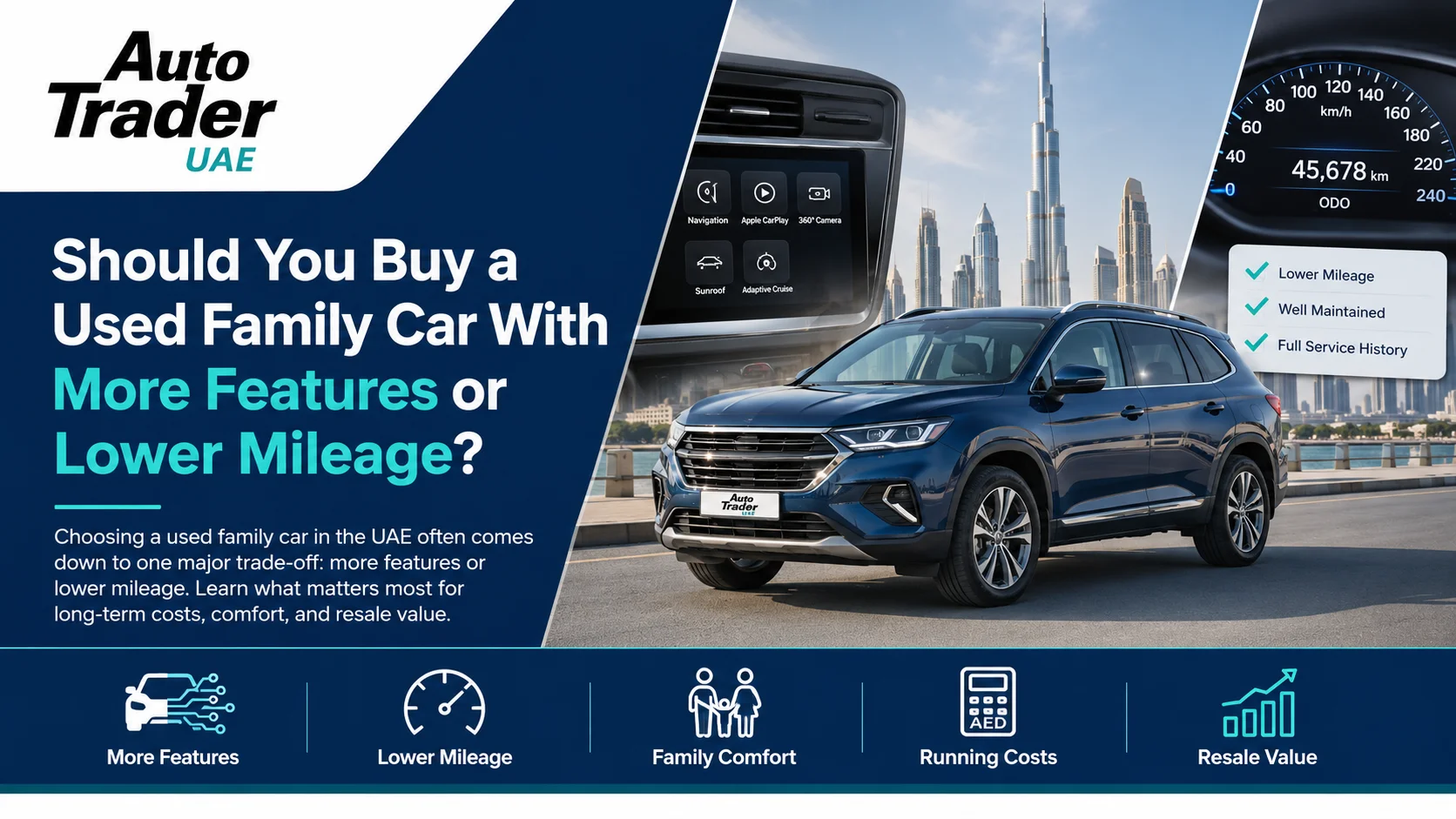
Should You Buy a Used Family Car With More Features or Lower Mileage?
When you’re shopping for a used family car in the UAE, you’ll often face the same dilemma: should you pick the car with more features, or the one with lower mileage? Both options can look tempting on Auto Trader UAE, especially when prices are similar.
This guide breaks down how to choose the better car for your family, budget, and driving style in the UAE.
What Matters More: Features or Mileage?
There’s no one answer that fits everyone. Instead, think of it like this:
- Lower mileage usually means less wear, potentially fewer repairs soon, and better resale value.
- More features usually means more comfort, convenience and safety tech, but possibly higher running and repair costs.
For most UAE families, the best choice is the car with the better overall condition and service history, then weigh mileage and features based on how long you plan to keep it and how much you drive.
Understand Your Family’s Real Needs
Before comparing two cars, be clear on how you actually use your vehicle in the UAE.
Key questions to ask yourself
- How many kilometres do we drive per year?
- Do we do more city driving, school runs and mall trips, or long-distance Abu Dhabi–Dubai–Northern Emirates runs?
- How long do we plan to keep the car? 2–3 years or 5+ years?
- How important is resale value when we upgrade?
- Which features do we truly need every day, and which are just nice to have?
If you drive a lot and keep cars for a long time, lower mileage and strong mechanical condition usually matters more. If you change cars every 2–3 years and drive mostly in the city, features and comfort may have a higher priority.
Pros and Cons of Choosing Lower Mileage
Let’s say you’re choosing between:
- Car A: 35,000 km, basic trim, fewer features
- Car B: 95,000 km, full option, lots of features
Here’s what the lower-mileage choice (Car A) usually means.
Advantages of lower mileage
- Less wear on major components – engine, gearbox, suspension and steering are likely in better condition.
- Lower immediate repair risk – key parts are less likely to need replacement in the short term if the car is serviced properly.
- Better resale value – in the UAE, buyers strongly prefer lower mileage, especially for family SUVs and crossovers.
- Peace of mind for long trips – better if you regularly drive between Emirates or travel on weekends.
Disadvantages of lower mileage
- Fewer comfort and safety features – you might miss things like parking sensors, 360 cameras, adaptive cruise control, or a better infotainment system.
- Less enjoyable daily experience – if you spend long time in traffic, better seats, sound insulation and driver aids can make a big difference.
- Sometimes higher price – two cars of the same model/year can be priced quite differently mainly because of mileage.
Pros and Cons of Choosing More Features
Now consider the higher-mileage, higher-spec car (Car B).
Advantages of more features
- Greater comfort for the family – features like rear AC vents, leather seats, sunshades, and better sound systems improve daily use.
- Convenience in UAE traffic – adaptive cruise control, blind spot monitoring, parking sensors and cameras are very useful in busy city driving.
- Potentially better safety tech – higher trims may offer extra airbags, lane assist, collision warning, and ISOFIX child seat anchors.
- More attractive when reselling – higher trim levels can still appeal strongly in the used market, especially if mileage is reasonable and the car is well maintained.
Disadvantages of more features
- Higher risk of wear-related repairs – at higher mileage, items like suspension, engine mounts, AC components and brakes are more likely to need attention.
- More things that can break – electric seats, panoramic roofs and advanced infotainment systems can be expensive to fix if they fail.
- Lower resale value compared with low-mileage cars – even a full-option car loses appeal if the odometer is high.
How UAE Conditions Change the Equation
Driving and climate in the UAE are unique, and that affects the decision.
Heat and AC load
- The AC system works very hard for most of the year, especially in Dubai, Abu Dhabi and Sharjah.
- In a higher-mileage car, check AC performance carefully; AC repairs can be significant.
- Features like ventilated seats and rear AC vents are genuinely useful in this climate, not just luxury extras.
Highway vs city driving
- Many UAE cars do higher mileage but mostly on highways between Emirates – this is generally less stressful for the car than stop-start city traffic.
- A 100,000 km car with mainly highway use and full service history can be a better buy than a 60,000 km car with heavy city use and patchy maintenance.
Sand, dust and parking
- Look underneath and under the bonnet for sand build-up or rust.
- Parking sensors and cameras are very useful in tight apartment parking and malls; don’t underestimate their daily value.
Which Features Actually Matter for a Family Car?
Not all features are equal. Some are must-haves for many UAE families; others are nice but optional.
High-priority safety and family features
- ISOFIX child seat anchors
- Multiple airbags (front, side, curtain where available)
- ABS and stability control
- Rear parking sensors and reversing camera
- Blind spot monitoring (very helpful on multi-lane highways)
High-priority comfort and usability features in the UAE
- Strong AC with rear vents (crucial if you have kids in the back)
- Apple CarPlay / Android Auto for navigation and calls
- Cruise control for long highway drives
- Good seat adjustment for the driver and front passenger
Nice-to-have luxury features
- Panoramic roof / sunroof
- Leather seats and ambient lighting
- Premium audio system
- Powered tailgate
If choosing between a low-mileage car without some of these and a higher-mileage one with them, ask: will this feature really change our daily experience, or is mileage and reliability more important?
How Long You Plan to Keep the Car
Your ownership period changes what matters most.
If you’ll keep the car 2–3 years
- You may not feel the long-term mechanical wear as much.
- Greater comfort and convenience now can matter more than slightly lower mileage.
- However, remember that when you sell, UAE buyers will still prefer lower mileage, so check expected resale values.
If you’ll keep the car 5+ years
- Mechanical condition and mileage become more important than a few extra features.
- Major services and wear items will come due, so starting with fewer kilometres can delay big bills.
- A slightly simpler, lower-spec car can be cheaper to maintain long-term.
Mileage Ranges: What to Expect in the UAE
Below are rough guidelines; actual condition matters more, but these ranges help frame decisions.
- Under 40,000 km: Low mileage for a used family car. Good for buyers wanting longer-term use and strong resale.
- 40,000–80,000 km: Normal for a 3–5 year-old car in the UAE. Many good options here if service history is complete.
- 80,000–140,000 km: Higher mileage but still fine if well maintained. Expect more wear-related items to need attention.
- Above 140,000 km: Choose mainly if price is very attractive, service history is excellent, and inspection is clean.
How to Compare Two Used Family Cars Step by Step
When you’ve shortlisted options on Auto Trader UAE, use this simple comparison approach.
1. Start with basic checks
- Model year and generation
- Trim level and engine size
- Mileage
- Accident history (if available)
2. Look at service history
- Prefer cars with full or mostly complete service records.
- Check if they were serviced at dealer or reputable garages.
- Confirm major services (like timing belt/chain, transmission oil) were done when due.
3. Inspect condition, not only the odometer
- Check tyres, brakes, suspension behaviour, and any warning lights.
- Test all features: AC, infotainment, cameras, sensors, electric seats, sunroof.
- Look for signs of hard use: worn seats, scratched interior, mismatched body panels.
4. Estimate future costs
- Ask a trusted mechanic for rough costs of common repairs for that model.
- Balance purchase price + expected repairs over the next 2–3 years.
- Sometimes a slightly higher purchase price for a low-mileage, well-kept car is cheaper overall.
5. Decide based on your priorities
Use this simple rule:
- Daily comfort and features are top priority? Choose the better-equipped car, but only if its mileage and condition are still reasonable and verified.
- Long-term cost and resale are top priority? Choose the lower-mileage, mechanically stronger car, even if it’s missing some nice-to-have features.
Examples: When to Choose Features vs Lower Mileage
Scenario 1: Young family, city use, 2–3 years ownership
You mostly do school runs, office commutes and mall trips within Dubai or Abu Dhabi, 10,000–15,000 km per year.
- Prioritise comfort (rear AC, parking sensors, good infotainment).
- Moderate mileage (50,000–80,000 km) with strong service history is acceptable.
- A better-equipped car could be the smarter choice.
Scenario 2: Long highway commutes, 5+ years ownership
You drive regularly between Emirates and plan to keep the car for a long time, 20,000+ km per year.
- Prioritise lower mileage and proven reliability.
- Choose a car known for durable engines and gearboxes, even if it’s not full option.
- Focus on strong AC, cruise control and core safety features; luxury extras are secondary.
Scenario 3: Budget-conscious upgrade from an older car
You’re upgrading from a much older car and want something safer and more modern, but the budget is tight.
- Look for a mid-mileage car with crucial safety and family features.
- A well-maintained 90,000 km car with modern safety tech can be better than a 50,000 km car that’s very basic.
Don’t Ignore Total Ownership Cost
When choosing between more features or lower mileage, think beyond the sticker price.
- Insurance: Higher trim or higher value can slightly increase premiums.
- Fuel: Larger engines or heavy SUVs with many features may consume more fuel.
- Maintenance: Advanced electronics and luxury equipment cost more to repair.
- Depreciation: High mileage reduces value faster; very basic trims may also be less desirable.
Choose the car that offers the best balance of purchase price, running costs, and daily satisfaction for your family.
Using Auto Trader UAE to Find the Right Balance
On Auto Trader UAE, you can easily filter and compare used family cars by mileage, price, body type and features. This makes it easier to see how much extra you’d pay for certain features versus saving on lower mileage.
- Filter by body type (SUV, crossover, sedan, MPV) to see family-friendly options.
- Set a mileage range that fits your comfort zone.
- Compare trim levels and feature lists side by side.
- Shortlist cars with clear photos and detailed descriptions, especially mentioning service history and accident status.
You can browse a wide range of used cars in the UAE, including family-friendly used SUVs, practical used crossovers, and comfortable used sedans.
Buyer Checklist: Features vs Mileage
When viewing a car in person, use this quick checklist:
- Does the mileage match the car’s age and usage?
- Is the service history complete and verifiable?
- Do the essential safety and family features meet our needs?
- Are all major features (AC, sensors, cameras, infotainment) working properly?
- What repairs are likely in the next 1–2 years based on mileage and condition?
- Is the price fair compared to similar cars on Auto Trader UAE?
Seller Tips: How to Position Your Car
If you’re selling a used family car in the UAE, understand how buyers think about features and mileage.
- Highlight strengths: If your car has low mileage, make it clear in the title and description. If it’s full option, list key features clearly.
- Show maintenance proof: Upload service records and mention major recent work (tyres, brakes, battery, AC).
- Be realistic on price: High-mileage cars need to be priced competitively, even if they’re fully loaded.
- Present the car well: Clean photos, tidy interior and exterior, and an honest description build trust.
Listing your car properly on Auto Trader UAE helps you reach serious buyers looking specifically for used family cars in the UAE.
Final Verdict: Should You Choose More Features or Lower Mileage?
For most UAE buyers, the priority order should be:
- Overall condition and service history
- Reasonable mileage for the age
- Essential safety and family features
- Comfort and convenience extras
If you find two similar cars:
- Choose the lower-mileage one if you value long-term reliability, lower future repair risk and better resale.
- Choose the better-equipped one if mileage is still reasonable, you’ll keep it for a shorter period, and those features significantly improve your daily driving.
Ready to compare real options? Start browsing used cars in the UAE on Auto Trader UAE, or explore popular family choices among used SUVs and used cars in Dubai to find the right balance between features and mileage for your next family car.
Browse used cars in UAE on Auto Trader UAE to compare live listings, prices, and current market activity more clearly.
Related Links
Buyer Takeaway
When buying a used car in the UAE, focus on vehicle condition, service history, inspection quality, paperwork, and total running costs rather than price alone. Compare options carefully and choose the option that best matches your budget and real needs.
Seller Takeaway
If you are selling a used car in the UAE, present the service history clearly, price the vehicle realistically, and highlight condition, specification, and ownership strengths honestly. A well-prepared listing with accurate details usually attracts more serious buyers.
Conclusion
A careful used car purchase in the UAE starts with research, proper inspection, and clear paperwork before making the final decision.