
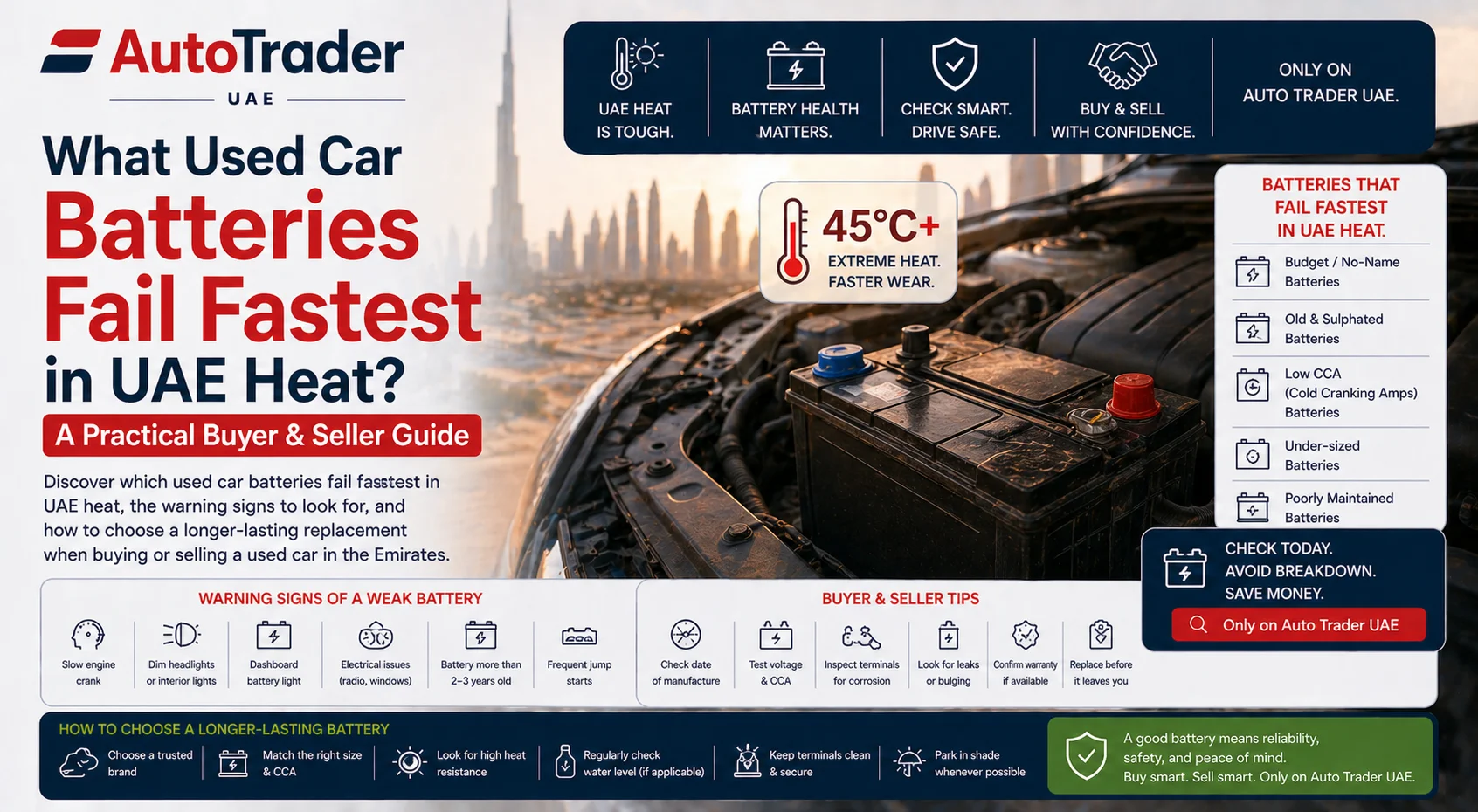
What Used Car Batteries Fail Fastest in UAE Heat?
Buying or selling a used car in the UAE means dealing with one brutal reality: extreme heat is tough on car batteries. If you ignore battery condition, you risk breakdowns, failed RTA tests, and unhappy buyers. This guide explains which used car batteries tend to fail fastest in UAE heat, how to spot a weak battery before you pay for the car, and how sellers can avoid losing value over a simple battery issue.
Why Car Batteries Die Faster in UAE Heat
High temperatures are the main enemy of car batteries in the UAE. Here’s why they fail faster here than in cooler countries:
- Heat accelerates chemical reactions – the battery works harder, ages faster and loses capacity sooner.
- Electrolyte evaporation – in traditional flooded batteries, fluid levels drop faster, exposing plates and causing permanent damage.
- High cabin and under‑bonnet temperatures – long idling with A/C on, traffic and parking in direct sun all keep the battery in a hot zone.
- Short urban trips – common in Dubai, Abu Dhabi and Sharjah, these don’t give the alternator enough time to recharge the battery fully.
In UAE conditions, even a good battery may only last 2–3 years, and weaker or older batteries can fail much sooner.
Which Used Car Batteries Fail Fastest in UAE Heat?
Different battery types and histories behave very differently once exposed to UAE summer. Below are the types of used batteries that typically fail the fastest.
1. Old Flooded Lead‑Acid Batteries (Over 3–4 Years)
Standard flooded lead‑acid batteries are the cheapest, but they are also the most vulnerable to heat when they age. They usually fail fast when:
- The battery is older than 3–4 years in UAE conditions.
- Electrolyte levels are low or uneven.
- The casing shows swelling or warping from overheating.
For buyers, a very old flooded battery is a strong clue you’ll be paying for a replacement soon.
2. Cheap No‑Name Batteries with Unknown History
Ultra‑low‑cost, unbranded or poorly known batteries often struggle in the UAE for two reasons:
- Lower build quality – thinner plates and weaker materials are more likely to deform and sulphate in extreme heat.
- Poor QC and storage – they may have already self‑discharged in a hot warehouse before even being installed.
If a used car has a very cheap replacement battery, assume a shorter remaining life unless you can verify recent installation and proper specs.
3. Under‑Spec Batteries (Wrong Capacity or CCA)
Batteries that don’t meet the manufacturer’s recommended specifications tend to fail quickly in hot weather. Examples:
- Battery with lower Ah (amp‑hour) rating than specified.
- Low Cold Cranking Amps (CCA) in vehicles with bigger engines.
- Inadequate battery in cars with start‑stop systems or heavy electronics.
These batteries are constantly overworked, and in UAE heat that usually means early failure.
4. Heavily Discharged or Frequently Boosted Batteries
Any battery that has been fully drained or jump‑started many times is likely to die faster, especially in high temperatures. Red flags:
- Owner mentions repeated “no start in the morning” issues.
- Evidence of frequent jump‑start use (leads in the boot, booster pack always present).
- Warning messages about battery, start‑stop, or electrical system on the cluster.
In hot climates, deep discharges damage the plates more quickly than in cooler regions.
5. Incorrectly Installed or Poorly Mounted Batteries
Heat plus vibration is a bad combination. Batteries that are loosely installed or of the wrong size for the tray face more stress. Look out for:
- Battery moving when you try to gently rock it by hand.
- Improvised clamps, cable ties, or wood/plastic wedges.
- Cables stretched or bent unnaturally to reach the terminals.
Vibration can break internal connections, and heat speeds up the internal damage.
6. AGM Batteries Misused in Non‑AGM Systems (or Vice Versa)
Absorbent Glass Mat (AGM) batteries are more heat‑tolerant in the right application, but they need the correct charging profile. Fail‑fast scenarios include:
- AGM battery installed where the alternator isn’t calibrated for AGM.
- AGM or EFB battery used in a start‑stop car but not registered or coded to the ECU when replaced.
Incorrect charging in UAE heat leads to overcharging, undercharging, and early failure.
7. Parked‑for‑Long‑Periods or Storage‑Damaged Batteries
Used cars that sat unused for months in outdoor lots, especially during summer, often hide weak batteries. Typical issues:
- Battery left partially discharged for a long time.
- Extreme heat in closed garages or outdoor parking.
- No maintenance charging while the car was off the road.
These batteries might still start the car today but usually fail much sooner than expected.
Battery Types: Which Last Longer in UAE Heat?
While any battery can fail early if abused, some types consistently handle UAE conditions better when correctly specified.
Flooded (Conventional) Lead‑Acid
- Pros: Cheapest, widely available.
- Cons: Most sensitive to heat and fluid loss; typical life is shorter in Gulf climates.
- Best for: Older, simpler cars with fewer electronics and no start‑stop system.
Maintenance‑Free & Calcium‑Enhanced Flooded Batteries
- Pros: Better resistance to corrosion and water loss than basic flooded types.
- Cons: Still vulnerable to extreme heat and overcharging.
- Best for: Daily drivers where budget matters but reliability is still a priority.
AGM (Absorbent Glass Mat) Batteries
- Pros: Generally more vibration‑ and heat‑resistant; handle deep discharges better.
- Cons: Higher cost; must be used with the right charging system.
- Best for: Premium vehicles, SUVs, and cars with start‑stop or high electrical load when specified by the manufacturer.
EFB (Enhanced Flooded Battery)
- Pros: Stronger than standard flooded batteries; designed for mild start‑stop systems.
- Cons: Still not as robust as AGM under extreme stress.
- Best for: Modern cars with basic start‑stop where AGM is not required.
In the UAE, a correctly specified AGM or high‑quality EFB often delivers the most reliable service in hot conditions when paired with the right charging system.
How to Spot a Weak Used Battery Before You Buy the Car
When viewing a used car, the battery is one of the easiest components to check. Here’s a simple, practical checklist.
1. Check the Battery Age
- Look for a date code sticker on the battery (month/year).
- If the battery is over 3 years old in the UAE, budget for replacement soon.
- No date sticker? That’s a signal to be cautious and negotiate on price.
2. Visual Inspection
Look for:
- Swelling or bulging of the case – often caused by overheating or overcharging.
- Corroded terminals – white or green build‑up can indicate long‑term neglect.
- Cracks or leaks in the casing.
- Loose or non‑original clamps and brackets.
Any of these signs suggest reduced life and future problems.
3. Cold Start Behaviour
Ask the seller not to warm up the car before you arrive. Then:
- Turn the key or push start: engine should crank strongly and quickly.
- Listen for slow, laboured cranking or multiple attempts to start.
- Watch for flashing or dimming lights on the dashboard as you start.
Weak cranking equals a weak battery or possible charging system issue.
4. Test Electrical Load
With the engine running, switch on:
- Air conditioning (max)
- Headlights
- Rear defogger (if equipped)
- Radio / infotainment
If you notice flickering lights, fluctuating idle, or warning messages, the battery or alternator may be struggling.
5. Ask for a Battery Test Report
Professional battery testers can provide a printout showing:
- State of health (SOH)
- State of charge (SOC)
- Measured CCA versus rated CCA
If you’re serious about the car, consider doing a pre‑purchase inspection at a workshop, and ask them to include a battery and charging system test.
When Should a Used Car Battery Be Replaced in the UAE?
While there’s no exact rule, these guidelines work well in local conditions:
- 2–3 years: Normal replacement window for many batteries in daily use.
- 3–4 years: High risk of failure; replacement is strongly recommended before summer.
- Over 4 years: In UAE heat, consider the battery on borrowed time.
If you are buying a used car and the battery is older than 3 years, it’s reasonable to:
• Ask the seller for a new battery, or
• Negotiate the price to cover installing a new, correct‑spec replacement yourself.
Tips for Buyers: Avoid Cars with Fast‑Failing Batteries
1. Prioritise Service History
A car with regular dealer or specialist maintenance is more likely to have the correct battery type and size installed and the charging system checked.
2. Avoid Electrical “Projects”
Cars with many non‑factory electrical modifications (heavy sound systems, extra lights, aftermarket accessories) often impose extra load on the battery and alternator. In hot weather, this accelerates battery wear.
3. Inspect for Heat‑Related Wear Under the Bonnet
Look at nearby plastics, hoses and wiring. Excessive discolouration, brittleness or melting around the battery area can indicate prolonged overheating.
4. Budget for a New Battery When the Deal Is Good
If the car is otherwise excellent but the battery is marginal, factor a new, high‑quality battery into your total cost. In the UAE, that’s often the smartest way to gain reliability from day one.
Tips for Sellers: How to Avoid Losing Value Over a Battery
1. Replace a Weak Battery Before Listing
If your battery is old or unreliable, replacing it before you advertise the car can:
- Improve first impressions during test drives.
- Prevent no‑start situations when buyers arrive.
- Support a higher and firmer asking price.
Keep the invoice; buyers appreciate proof of a new battery.
2. Be Transparent About Battery Age
Honesty builds confidence:
- Mention the installation date in your ad if the battery is relatively new.
- If it’s older, acknowledge it and reflect that in the price instead of risking a deal‑breaker later.
3. Choose the Correct Battery Spec
When replacing before sale:
- Match the Ah rating, CCA, and type (AGM/EFB/flooded) recommended by the manufacturer.
- Avoid undersized or cheaper‑than‑spec batteries – buyers who know cars will notice.
How to Extend Battery Life in UAE Heat
Whether you’re keeping the car or preparing it for sale, these habits help any battery last longer:
- Park in shade or covered parking whenever possible.
- Avoid repeated short trips; combine errands so the battery can recharge properly.
- Turn off lights and accessories before switching off the ignition.
- Service the charging system – check alternator output and drive belt condition regularly.
- Before long storage, use a smart trickle charger or disconnect the negative terminal if appropriate.
Buyer Takeaway: Smart Battery Decisions Save Money
For used car buyers in the UAE:
- Avoid very old, cheap or under‑spec batteries – they fail fastest in our climate.
- Inspect the battery age, condition and cranking performance during your viewing.
- Use battery replacement as a negotiation point if the rest of the car is solid.
Factoring in the real cost of a quality, heat‑resistant battery helps you compare used cars more fairly.
Seller Takeaway: A Healthy Battery Makes Your Car Easier to Sell
For used car sellers in the UAE:
- Don’t let a failing battery ruin test drives or delay RTA tests.
- A recently replaced, high‑quality battery is a strong selling point.
- Keep documentation to reassure buyers your car is ready for everyday UAE driving.
Next Steps with Auto Trader UAE
If you’re ready to upgrade or sell, a solid understanding of what used car batteries fail fastest in UAE heat will help you price, inspect and negotiate more confidently. On Auto Trader UAE, you can:
- Browse a wide range of used cars across all budgets and body types.
- List your car for sale and highlight recent maintenance like a new battery to attract serious buyers.
For more money‑saving advice on running and maintaining your car in the Emirates, explore the finance and ownership tips in our money and advice resources on Auto Trader UAE, and stay updated with the latest guides on the Auto Trader UAE blog. A little attention to the battery today can prevent a costly breakdown tomorrow – and make your next used‑car deal in the UAE smoother and smarter for both sides.
Browse used cars in UAE on Auto Trader UAE to compare live listings, prices, and current market activity more clearly.
Related Links
Conclusion
A careful used car purchase in the UAE starts with research, proper inspection, and clear paperwork before making the final decision.