
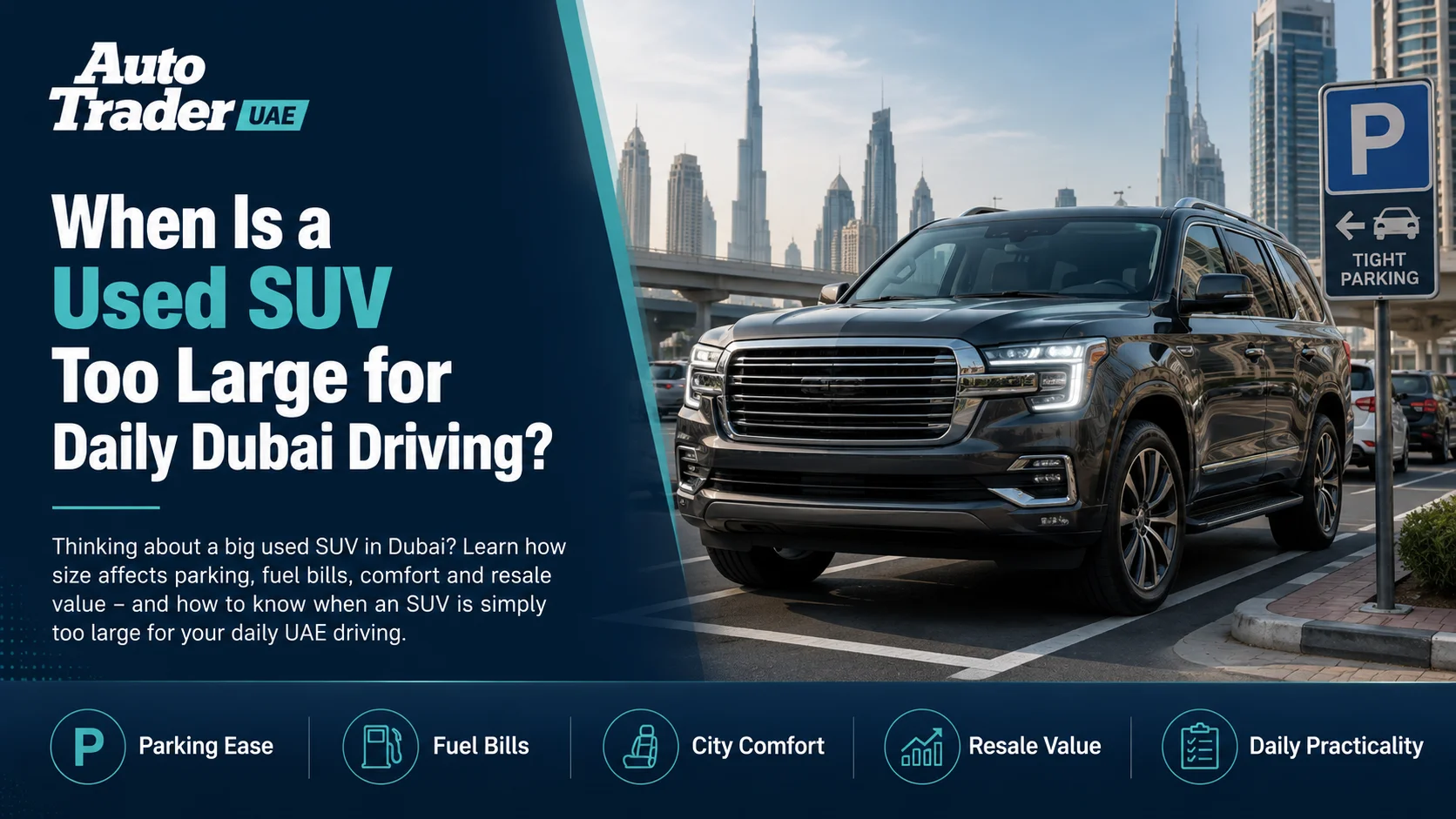
When Is a Used SUV Too Large for Daily Dubai Driving?
In Dubai, big SUVs feel right at home: wide highways, long-distance commutes, family trips to Abu Dhabi or Fujairah, and plenty of desert to explore. But there’s a point where a used SUV can become more of a headache than a help in daily driving – especially in busy areas, tight parking and older buildings.
This guide from Auto Trader UAE explains how to know when a used SUV is too large for your daily Dubai driving, what to check before you buy, and how to choose the right size SUV for your lifestyle and budget.
Why SUV Size Matters More in Dubai
Dubai is friendly to SUVs, but daily reality isn’t just Sheikh Zayed Road. You’ll deal with narrow ramps in older buildings, crowded school pickup zones, busy mall car parks on weekends, and peak-hour traffic around Business Bay, Deira and Jumeirah.
Oversizing your SUV can create problems in five key areas:
- Parking and manoeuvrability
- Fuel economy and running costs
- Comfort in traffic and daily use
- Insurance and maintenance bills
- Resale appeal in the UAE used market
Finding the sweet spot – enough space and capability without unnecessary bulk – is the key to a smart SUV purchase.
What Counts as a “Too Large” SUV in Dubai?
There’s no single measurement that makes an SUV too big, but several practical signs tell you when a vehicle is oversized for daily Dubai use:
1. It Doesn’t Fit Your Building’s Parking
This is the most common problem in Dubai, especially in older towers and villas with tight garages.
- Tight ramps and pillars: Long-wheelbase, full-size SUVs can struggle with steep or spiral ramps and narrow turns.
- Short parking bays: If the SUV hangs out of your assigned bay, you’ll be fighting with building management and neighbours.
- Low ceilings: Extra-tall SUVs with roof racks may be too high for some basement car parks.
Red flag: If you have to reverse and correct more than once every time you enter or exit your parking, the SUV is too large for your daily environment.
2. You Struggle to Manoeuvre in Common Dubai Situations
Ask yourself how this SUV will feel in real life, not just on a test drive:
- School drop-offs with double-parked cars
- Business Bay, Marina or JVC basement car parks
- Old neighbourhood streets in Deira, Satwa, Karama, Bur Dubai
- Parallel parking on busy roads
If the turning circle is huge and the SUV feels like a bus in tight spaces, it may be overkill unless you truly need the extra size.
3. It Has More Seats and Space Than You Ever Use
Big 7–8 seat SUVs are tempting, but paying for unused capacity adds up:
- You drive mostly alone or with one passenger
- Third row is almost always folded and empty
- You rarely go on long road trips with many passengers
- You don’t actually need to tow a boat, trailer or caravan
Rule of thumb: If you regularly use only 50–60% of the space, you’re probably driving more SUV than you need.
4. Fuel Stops Become Too Frequent
Larger, heavier SUVs with big engines consume more fuel, especially in stop-start traffic and with Dubai’s frequent short trips between communities, malls and offices.
Watch for:
- Very low real-world fuel economy reported by owners
- Needing to fill up more than twice a week for normal commuting
- Feeling forced to drive slower or less just to manage fuel spend
If your fuel bill starts to feel like a second car payment, the SUV is likely oversized for your daily routine.
5. You Feel Stressed Driving or Parking It
Confidence matters. If your SUV feels intimidating to drive, it’s probably too large for your comfort level.
- Constantly nervous about hitting curbs or other cars
- Avoiding certain malls or areas because of parking difficulty
- Fatigue after short commutes from constant corrections and mirror checking
A daily driver should feel easy and relaxing, not like piloting a truck.
How to Test If a Used SUV Size Suits Your Dubai Lifestyle
Before committing to a big used SUV, simulate your daily life as closely as possible.
1. Take a Real-World Test Route
Don’t just drive around the dealership. Test the SUV through:
- A busy arterial road (for example, Al Khail Road or Sheikh Mohammed bin Zayed Road)
- Narrower community streets (e.g., JVC, JLT, older parts of Deira)
- A mall car park with ramps and tight turns
Notice how easy it is to change lanes, U-turn, and park.
2. Physically Check Your Home and Work Parking
If possible, ask the seller or dealer to allow a test fit:
- Drive into your building’s parking entrance and ramps
- Park in your bay and open all doors and the tailgate
- Check clearance with pillars, walls, and neighbouring cars
If you can barely squeeze in, it may not work long term.
3. Measure and Compare Dimensions
Look up the SUV’s length, width, height, and turning radius. Compare them with:
- Any SUV you currently drive comfortably
- Dimensions listed for mid-size alternatives you are considering
Even a 10–15 cm increase in width or length can make a big difference in older car parks.
4. Sit in All Three Rows (If It Has Them)
Check whether you actually need the extra seating:
- Is the third row comfortable for adults or only children?
- What happens to boot space when the third row is up?
- Can you load strollers, luggage or sports equipment easily?
Sometimes a well-packaged 5-seater SUV or crossover is more practical than a very large 7-seater you rarely fill.
Running Costs: When Big SUVs Hurt Your Dubai Budget
In the UAE, fuel is cheaper than many regions, but costs still add up. Larger used SUVs can also bring higher maintenance and insurance bills.
1. Fuel Economy in Real Dubai Traffic
Published fuel consumption figures rarely reflect daily Dubai driving with AC on full most of the year. Larger SUVs with V6 or V8 engines are particularly sensitive in city traffic.
Before you buy, read owner reviews in similar driving conditions, and consider whether you’re comfortable with a higher monthly fuel spend.
2. Tyres, Brakes and Suspension
Bigger, heavier SUVs usually mean:
- Larger and more expensive tyres
- More expensive brake components
- Suspension parts that work harder over time
On Dubai’s hot roads, these parts can wear quicker on heavy SUVs, especially if you tow or drive off-road.
3. Insurance and Registration
Insurers may price larger, more powerful SUVs higher, especially if they are expensive to repair or import. Always get an insurance quote on the specific SUV (by VIN or plate) before finalising a deal.
When a Large Used SUV Makes Sense in Dubai
There are many cases where a big SUV is exactly the right choice in the UAE.
1. Large Families and Group Transport
A large SUV is justified if you regularly:
- Carry 5–7 people daily to school and work
- Take weekend trips with extended family or friends
- Need space for car seats, strollers and luggage all together
2. Desert Trips and Off-Road Use
If you enjoy regular camping and dune drives, a large SUV with proper 4x4 hardware can be ideal. Just make sure the off-road capability matches the size – some giant SUVs are more comfortable cruisers than true desert tools.
3. Towing and Heavy Loads
For boats, trailers or heavy cargo, a full-size SUV can be a safe workhorse, especially if paired with a suitable engine and cooling package for UAE heat.
Choosing the Right Size SUV: Compact vs Mid-Size vs Full-Size
Rather than asking if SUVs are too big for Dubai, focus on what category fits your needs.
Compact SUVs / Crossovers
Best for:
- Singles and couples
- Small families
- Mostly city use, occasional road trips
Pros: Easier to park, lower fuel costs, great for tight Dubai car parks.
Cons: Less cargo and rear-seat space, not ideal for big groups or heavy towing.
Mid-Size SUVs
Best for:
- Growing families
- Mix of city and highway use
- Occasional long trips and light off-roading
Pros: Good balance of space and manoeuvrability, often with optional 7 seats.
Cons: Higher running costs than compact SUVs, still can feel big in older buildings.
Full-Size SUVs
Best for:
- Large families or regular group travel
- Serious off-road and towing workloads
- Drivers who are comfortable with large vehicles
Pros: Maximum space, comfort and capability.
Cons: Higher purchase and fuel costs, harder to park, may not fit some basement car parks or narrow ramps.
Common Mistakes Dubai Buyers Make With SUV Size
1. Buying for the Once-a-Year Trip
Many buyers choose a huge SUV just for an annual road trip to Salalah or the desert. For the rest of the year it’s oversized in the city. It may be smarter to choose a smaller daily SUV and rent a larger one when truly needed.
2. Ignoring Parking and Access
Some buyers only think about engine, features and price, then discover they can barely access their building’s basement parking. Always test-fit if you live in an apartment.
3. Overestimating Future Family Needs
Planning ahead is good, but buying a full-size SUV “just in case” when you’re still a couple can mean years of unnecessary costs. You can always upgrade later if your family grows.
Signs You Should Consider Downsizing Your SUV
If you already own a big SUV in Dubai, you might be wondering whether it’s time to move to something smaller.
- You constantly complain about parking, especially in Dubai Marina, JLT, Business Bay or old Dubai
- You barely use the third row and boot space
- Your fuel and maintenance costs feel too high for your current income
- You’ve had minor scrapes in car parks due to size and limited visibility
- Family situation changed – children moved out, or commute became longer
In such cases, selling your large SUV and switching to a mid-size or compact SUV can lower your running costs and stress level while keeping you in a practical, comfortable vehicle.
Practical Checklist Before Buying a Large Used SUV in Dubai
Use this quick checklist before you sign:
- Parking fit: Tested in your home and (if possible) work parking
- City manoeuvrability: Comfortable in U-turns, ramps, narrow turns
- Space actually needed: Seats and boot space used at least weekly, not yearly
- Fuel budget: You’ve estimated realistic monthly fuel usage
- Service and tyres: You’ve checked typical service costs and tyre prices
- Insurance: You’ve obtained a quote for this specific SUV in Dubai
- Comfort level: You feel relaxed, not stressed, during a long test drive
Buyer Takeaway: Matching SUV Size to Your Dubai Reality
Ask yourself:
- Where do I drive most days – wide highways or tight communities and basements?
- How many people do I carry regularly, not occasionally?
- Is my parking and access suited to a long, wide SUV?
- Am I comfortable with the fuel and maintenance bills of a large 4x4?
If your daily use is mostly urban with limited passengers, a compact or mid-size SUV will often serve you better – and cost less – than a full-size model.
Seller Takeaway: Marketing a Large Used SUV in the UAE
If you’re selling a big SUV in Dubai, emphasise where its size is a benefit, not a weakness:
- Highlight third-row space, boot capacity and comfort on long trips
- Mention any features that make size easier to live with, such as 360° cameras, parking sensors and automatic parking assist
- Be transparent about fuel economy and service history
- Photograph the SUV parked cleanly in tight spaces to reassure buyers
Well-presented large SUVs with clean service records remain popular with families, expats and off-road enthusiasts across the UAE.
Next Steps: Find the Right-Size Used SUV on Auto Trader UAE
When Is a Used SUV Too Large for Daily Dubai Driving? The answer depends on your parking, passengers and budget. The key is to be honest about how you live and drive in the UAE – then choose an SUV that fits that reality, not just your wishlist.
On Auto Trader UAE, you can compare compact, mid-size and full-size used cars in the UAE, filter by body type, engine size and price, and shortlist models that suit your daily life in Dubai, Abu Dhabi, Sharjah and beyond.
Ready to upgrade or downsize? Browse a wide selection of used cars in Dubai, check detailed photos and specs, and contact sellers directly through Auto Trader UAE to test-drive your next SUV and make sure it’s the right size for you.
Browse used cars in UAE on Auto Trader UAE to compare live listings, prices, and current market activity more clearly.
Related Links
Conclusion
A careful used car purchase in the UAE starts with research, proper inspection, and clear paperwork before making the final decision.