
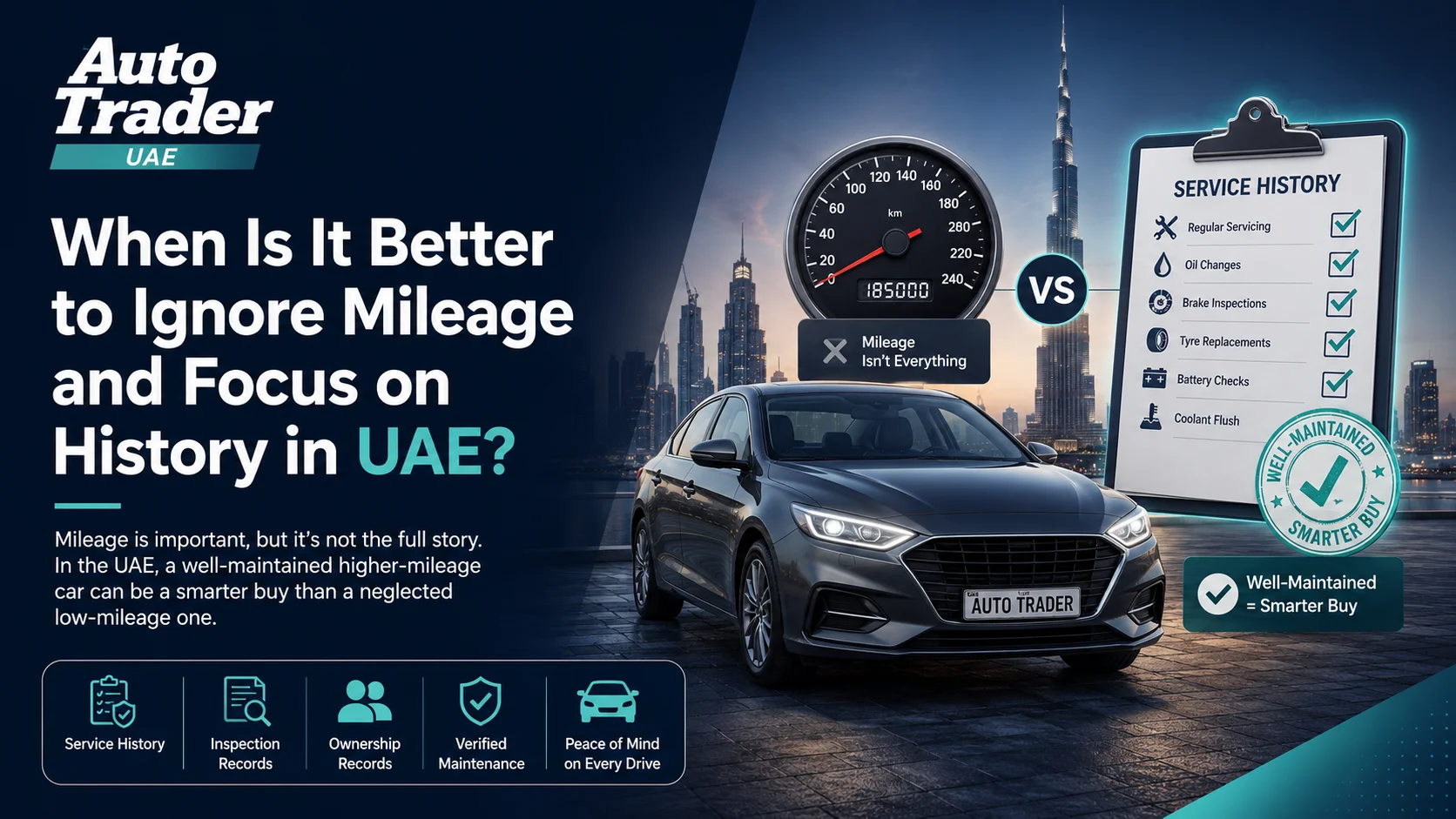
When Is It Better to Ignore Mileage and Focus on History in UAE?
Many buyers in the UAE filter used cars by mileage first and almost everything else second. But that can mean walking away from excellent, well‑looked‑after cars – and overpaying for low‑mileage vehicles with hidden issues.
This guide explains when it’s better to ignore mileage and focus on history instead, and how to use Auto Trader UAE listings, service records, and inspection reports to protect yourself whether you’re buying or selling.
Why Mileage Isn’t Everything in the UAE
Mileage is only a rough indicator of wear. In the UAE, how a car has been driven, maintained, and stored often matters more than the number on the odometer.
Key UAE factors that change how you should view mileage
- Highway vs city driving: Many Dubai and Abu Dhabi commuters do long, steady highway runs that are relatively gentle on engines and gearboxes.
- Hot climate stress: Heat, dust, and constant A/C use can age a low‑mileage car quickly if maintenance is skipped.
- Stop–start and short trips: Low‑mileage cars used only for short errands can suffer from carbon build‑up, battery issues, and more frequent wear.
- Long periods parked: Cars that sit unused can develop flat spots on tyres, dried seals, and weak batteries even with very low mileage.
That’s why an 8‑year‑old car with 180,000 km and full dealer history can often be a safer buy than a 5‑year‑old car with 60,000 km and patchy records.
When You Can Safely Worry Less About Mileage
There are situations where a higher‑mileage car is perfectly sensible – and sometimes the best value in the market.
1. When the Service History Is Complete and Verifiable
A complete, documented service history in the UAE is worth more than a low odometer reading. Favour cars that show:
- Stamped service book or digital records from the main dealer or a reputable specialist garage.
- Regular intervals (e.g. every 10,000 km or annually – whichever comes first).
- Major services documented (timing belt/chain checks, transmission services, coolant and brake fluid changes).
- Invoices with clear descriptions of work done and genuine parts used where possible.
On Auto Trader UAE, many sellers highlight “Full service history” or upload images of the service book and invoices. Take time to review these carefully or ask the seller for copies before viewing the car in person.
2. When the Car Has Mainly Highway Mileage
In the UAE, highway mileage between Emirates can actually be relatively gentle on a car compared to short, stop–start city trips. A higher‑mileage car used for daily Sharjah–Dubai or Abu Dhabi–Dubai commuting may be fine if:
- Tyre wear is even and suspension feels tight (indicating smooth, consistent driving).
- The engine idles smoothly and there are no transmission jerks or slips.
- The car tracks straight and brakes feel strong and stable on a test drive.
3. When the Car Has 1–2 Long‑Term Owners
Ownership history can tell you a lot. In many cases, it’s better to choose:
- A higher‑mileage car with one or two long‑term owners and a clear paper trail
- Instead of a low‑mileage car that has changed hands multiple times in a short period
Multiple owners in a short time can be a sign that people are passing along a problem car. Ask the seller for the Emirates ID name match on the registration card and any previous ownership documents if available.
4. When the Car Has Passed a Recent Independent Inspection
An independent inspection in the UAE can be more meaningful than mileage alone. Consider a car seriously – even with higher mileage – if it has:
- A recent, detailed inspection report from a recognised inspection centre or workshop
- Clear photos of the underbody, suspension, and engine bay
- Compression tests or diagnostic scan reports for complex models
When browsing Auto Trader UAE, you can filter for cars in excellent condition and then ask the seller if an inspection report is available or if you can arrange one before finalising the deal.
5. When Wear Items Have Already Been Replaced
On higher‑mileage used cars in the UAE, there are common “big ticket” items. If these have already been replaced, the car may be a smart buy:
- Tyres and brake pads/discs
- Suspension components (bushings, shocks)
- Battery and alternator
- Cooling system parts (radiator, water pump, hoses)
- Timing belt or timing chain related work (where applicable)
A seller who can show invoices for this work gives you more confidence than one who only points to a low odometer reading.
When Mileage Should Still Matter in the UAE
There are also clear cases where mileage remains a crucial factor and you should be extra careful with higher‑mileage cars.
1. Luxury Cars with Complex Technology
High‑end European luxury cars and performance models often have:
- Advanced air suspension
- Complex infotainment and driver assistance systems
- Turbocharged or high‑output engines
On these cars, very high mileage can mean expensive repairs soon – especially past 150,000 km if service history is incomplete. In this category, aim to balance reasonable mileage with a complete service history, not one or the other.
2. Vehicles Used for Commercial or Heavy Duty Work
Some SUVs, pickups, and vans in the UAE are used heavily for work, towing, or off‑road use. High mileage here usually reflects heavy loads and tougher usage cycles. Look closely at:
- Chassis and suspension condition
- Gearbox performance under load
- Signs of frequent off‑road use (scrapes, sand packing, underbody damage)
With these vehicles, both mileage and history matter. A working vehicle with very high mileage and no detailed history is often a risk.
3. Cars with Gaps in Service Records
A car that shows 90,000 km but has missing service stamps between, for example, 40,000 km and 80,000 km is a red flag. You may be looking at:
- Skipped vital maintenance (oil changes, coolant, transmission fluid)
- Unauthorised workshops with poor‑quality parts
- Potential odometer tampering if mileage jumps or dates don’t align
Even if the mileage is low, gaps in service records should push you to either investigate deeply or walk away.
How to Read and Verify a Car’s History in the UAE
If you’re going to give more weight to history than mileage, you need to know how to read that history properly.
1. Service Book and Invoices
Ask to see the physical or digital service book plus any invoices. Check:
- Dates vs mileage: Do they progress logically? Are there missing years?
- Workshop details: Dealer, respected specialist, or unknown garage?
- Type of service: Oil change only or full scheduled maintenance including filters, fluids, and checks?
- Big jobs recorded: Timing components, transmission servicing, major repairs.
2. RTA and Insurance History
You can request or ask the seller for reports that may show:
- Previous accident history and major repairs
- Odometer readings captured during previous inspections
- Any total‑loss or salvage records
Consistent mileage readings over time help you trust the odometer and the general story of the car.
3. Visual and Mechanical Inspection
Mileage and paperwork must still be backed by the current condition of the vehicle. During viewings:
- Check pedal rubbers, steering wheel, and driver’s seat for wear – do they match the mileage?
- Inspect paint and panel gaps for signs of accident repairs.
- Look underneath for oil leaks, rust (less common but possible with coastal use), or bent metal.
- Start the car cold and listen for rattles, smoke, or rough idle.
For higher‑mileage cars, a professional inspection is strongly recommended before committing.
Common UAE Scenarios: History vs Mileage
Scenario 1: Commuter Sedan vs Low‑Use “Weekend” Car
- Car A: 5‑year‑old sedan, 160,000 km, full dealer history, used daily for Dubai–Abu Dhabi highway commuting.
- Car B: 5‑year‑old sedan, 48,000 km, partial history, mostly short city trips and months of storage in open parking.
Better choice: Often Car A. Despite higher mileage, its consistent servicing and gentle highway use can mean less real wear and fewer future surprises.
Scenario 2: Family SUV with Two Owners vs Low‑Mileage, Many Owners
- Car C: 7‑year‑old family SUV, 140,000 km, two owners, detailed service records, used for school runs and occasional trips.
- Car D: 7‑year‑old SUV, 70,000 km, four owners, incomplete records, multiple adverts online over two years.
Better choice: Often Car C. Stability in ownership and a consistent history outweigh the lower mileage of Car D, which may be hiding recurring problems.
Scenario 3: Performance Car with Very Low Mileage
- Car E: 8‑year‑old performance coupe, 35,000 km, “weekend car”, long storage periods, limited documentation.
Risk factors: Old tyres, dried seals, weak battery, flat spots on suspension components, and potential issues from regular hard use on short drives. Here you can’t rely on mileage alone – a thorough inspection and strong service record matter more.
Tips for Buyers: How to Prioritise History Over Mileage
- Shortlist by condition first, mileage second.
On Auto Trader UAE, filter for cars in “excellent” or “very good” condition, then compare service history and mileage inside that short list. - Always request service history photos.
Ask the seller to upload or share clear images of the service book and invoices before you travel to view the car. - Be willing to pay more for a well‑maintained high‑miler.
A slightly higher price for a thoroughly maintained car can still be cheaper than a bargain price followed by major repairs. - Budget for an inspection.
Factor a professional inspection into your total cost, especially for higher‑mileage or complex vehicles. - Walk away from gaps you can’t explain.
If the story of the car’s use and servicing doesn’t add up, move on. There are plenty of alternatives in the market.
Ready to compare real cars? Explore a wide range of used cars in the UAE on Auto Trader UAE and refine your search until you find a car with the right mix of mileage, history, and price.
Tips for Sellers: How to Make History Matter More Than Mileage
If you’re selling a car with higher mileage, you can still achieve a strong price if you prove how well you’ve looked after it.
- Organise your paperwork.
Gather the service book, invoices, warranty work orders, and any inspection reports. Mention “Full service history” or “Comprehensive service history” clearly in your Auto Trader UAE advert. - Highlight major maintenance.
If you’ve replaced tyres, brakes, suspension, timing components, or major electronics, say so in the description and upload invoice photos. - Be transparent about usage.
Explain whether the car was mainly a highway commuter, family car, or occasional city runabout. Buyers respond well to honest, complete stories. - Get a pre‑sale inspection.
An independent inspection report can reassure buyers and help you justify your asking price. - Price realistically.
Use similar listings on Auto Trader UAE as a guide. A higher‑mileage car with great history can price similarly to some lower‑mileage examples, but there is still a ceiling.
Balancing Mileage and History: A Simple Rule of Thumb
When browsing used cars in the UAE, use this simple framework:
- Low mileage + strong history: Usually the best (and most expensive) option.
- High mileage + strong history: Often the best value; inspect carefully, but don’t dismiss on mileage alone.
- Low mileage + weak history: Approach with caution; investigate why the history is incomplete.
- High mileage + weak history: Generally avoid unless the price is very low and you fully understand the risks.
Next Steps with Auto Trader UAE
Understanding When Is It Better to Ignore Mileage and Focus on History in UAE? can save you money and help you buy with confidence. Whether you’re searching for a first car, upgrading your family SUV, or selling a trusted daily driver, the right information matters more than the odometer alone.
Browse thousands of used cars in UAE and refine by make, budget, body type, and condition. If you’re based in the emirate, you can also focus your search on used cars in Dubai to find options close to you.
On every listing, look beyond the mileage: read the description, review the photos, and ask for service history and inspection reports. That’s how you turn Auto Trader UAE into your most powerful tool for finding a car you can trust.
Browse used cars in UAE on Auto Trader UAE to compare live listings, prices, and current market activity more clearly.
Related Links
Buyer Takeaway
When buying a used car in the UAE, focus on vehicle condition, service history, inspection quality, paperwork, and total running costs rather than price alone. Compare options carefully and choose the option that best matches your budget and real needs.
Seller Takeaway
If you are selling a used car in the UAE, present the service history clearly, price the vehicle realistically, and highlight condition, specification, and ownership strengths honestly. A well-prepared listing with accurate details usually attracts more serious buyers.
Conclusion
A careful used car purchase in the UAE starts with research, proper inspection, and clear paperwork before making the final decision.