
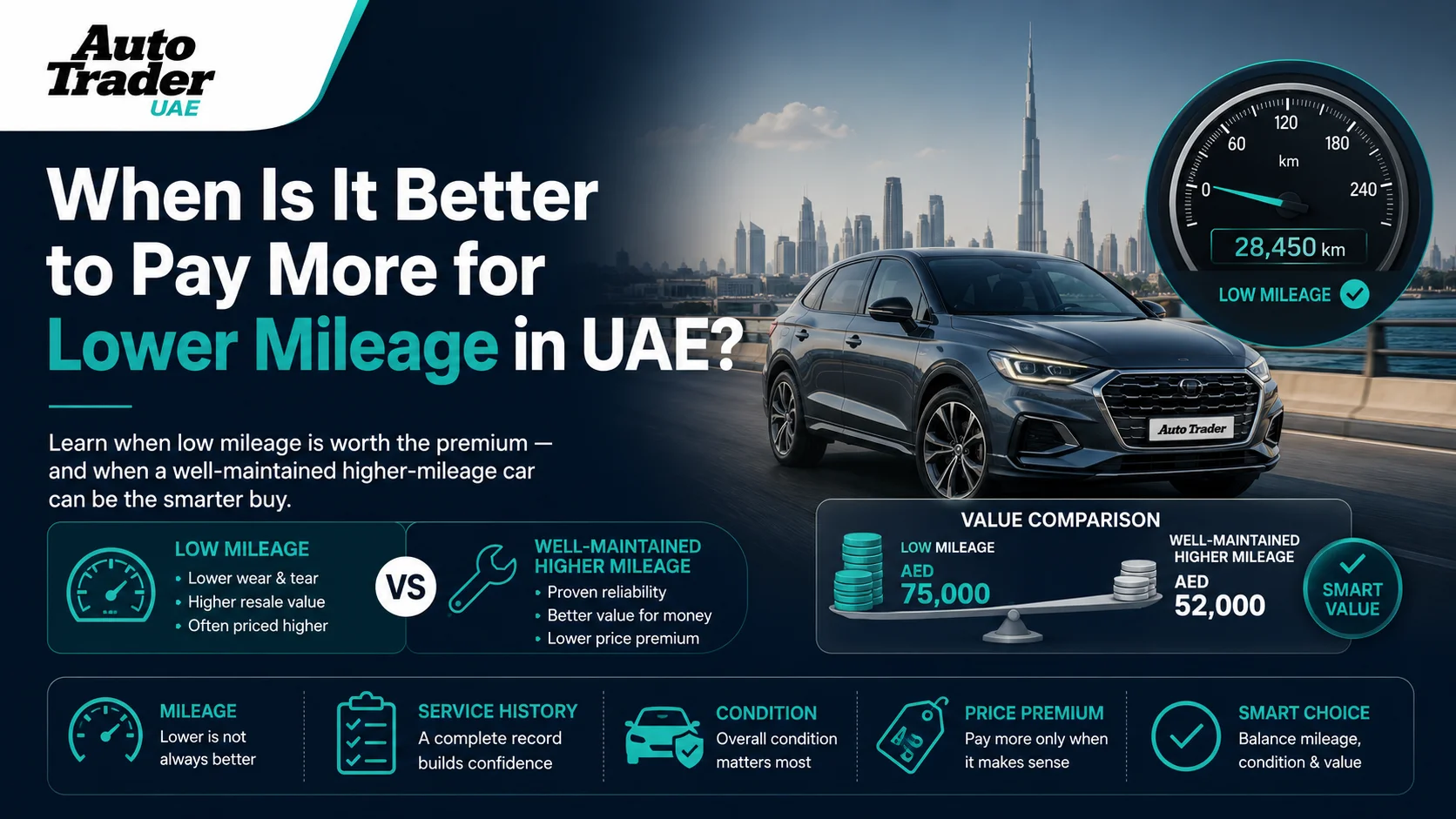
When Is It Better to Pay More for Lower Mileage in UAE?
Mileage is one of the first things UAE buyers check on a used car listing. But a lower odometer reading doesn’t always mean a better deal. Sometimes it makes sense to pay more for lower mileage – and sometimes you’re just paying a premium for a number on the dashboard.
This Auto Trader UAE guide explains when low mileage is truly worth the extra money, and when a well-maintained higher‑mileage car can be the smarter buy.
What Does ‘Low Mileage’ Mean in the UAE?
Average annual mileage in the UAE is often higher than in many other markets because of long commutes, frequent Dubai–Abu Dhabi trips, and highway driving. A rough guide:
- Very low mileage: under 10,000 km per year
- Normal mileage: 15,000–25,000 km per year
- High mileage: 25,000+ km per year
So a 5‑year‑old car with 50,000 km in the UAE is genuinely low mileage, while the same car with 150,000 km would be considered high mileage.
Why Do Low‑Mileage Cars Cost More?
On Auto Trader UAE, you’ll usually see a visible price gap between similar cars with different mileage. Sellers ask more for low mileage because buyers associate it with:
- Less wear on the engine, transmission and suspension
- Fewer big repairs in the near future
- Higher resale value later
- A perception that the car has been “babied”
These assumptions can be true – but they are not guaranteed. Whether it’s worth paying the premium depends on the age, brand, usage, and your plans for the car.
When It Is Better to Pay More for Lower Mileage
1. When You Plan to Keep the Car for Many Years
If you’re buying a car you expect to own for 5–8 years, starting with lower mileage often makes financial sense. You’ll have more “usable life” before expensive wear‑and‑tear items become an issue.
Low mileage is often worth the premium if:
- You drive a lot each year (e.g. Dubai–Abu Dhabi commuting)
- You want to avoid major repairs like engine, gearbox, or suspension overhauls for as long as possible
- You prefer to keep the same car instead of changing every 2–3 years
2. When You’re Buying Luxury or Performance Cars
High‑end models from German, British, or premium Japanese brands can be expensive to maintain as mileage increases. On performance cars and luxury SUVs, components like air suspension, turbos, complex gearboxes, and electronics are more likely to cause costly issues at higher mileage.
Here, paying extra for lower mileage can be justified because:
- It delays big-ticket repairs
- Luxury buyers in the UAE usually prefer lower mileage, helping your resale value
- Warranty coverage (if still active) is more likely to remain valid when mileage is low and history is complete
3. When the Car Is Still Under Manufacturer or Extended Warranty
For relatively new used cars, mileage affects how long you remain under warranty. A lower‑mileage car might give you extra months or years of coverage before hitting the mileage limit printed in the warranty booklet.
Paying more can make sense if:
- The low‑mileage car keeps you in warranty for a significantly longer period
- Dealer service history is complete, with all stamps and invoices
- Powertrain or extended warranty is still available to purchase or transfer
4. When You Want Strong Resale Value in the UAE
Mileage is one of the main filters UAE buyers use when browsing on Auto Trader UAE. If you plan to resell within 2–4 years, starting with lower mileage can help you stay within “sweet spot” ranges (for example, below 100,000 km) when you list your car.
It’s often worth paying more for lower mileage if:
- You’re buying a popular, in‑demand model
- The market clearly prices low‑kilometre examples higher
- You plan to keep the car only a short to medium time, then upgrade
5. When the Car Has a Clean, Documented Service History
Low mileage is most valuable when it’s backed up by evidence. A car with low kilometres and complete service records from the dealer or reputable workshops in the UAE is usually worth a premium.
Look for:
- Stamped service book or digital service records
- Invoices showing oil changes, filters, fluids, and recall work
- Regular servicing at reasonable intervals (time or mileage, whichever comes first)
When Low Mileage Is Not Worth Paying Extra
1. When the Car Is Old but Barely Driven
An older car with very low mileage can sometimes be a red flag. Dubai and UAE heat is hard on rubber, plastics, seals, and fluids even if the car is not driven much. Cars that sit unused for long periods may develop:
- Dry, cracked tyres
- Hard, brittle rubber seals and bushings
- Battery and electrical problems
- Fluids that have aged by time, not distance
Pay attention if you see a 10‑year‑old car with, for example, only 40,000 km. It might be fine, but don’t pay a high premium just because of the number on the odometer. Condition and service history matter more.
2. When the Service History Is Weak or Missing
A low‑mileage car that hasn’t been serviced properly can be worse than a higher‑mileage car that was maintained by the book.
Be cautious about paying extra for low kilometres if:
- Service records are missing or incomplete
- The owner cannot explain where and when it was serviced
- Oil changes were done very infrequently “because the mileage was low”
In the UAE climate, time‑based servicing (for example, every 12 months) is just as important as mileage.
3. When You Only Plan to Keep the Car Short‑Term
If you just need a car for 1–2 years, paying a large premium for low mileage often doesn’t add up. A slightly higher‑mileage car in good condition can cost less upfront and still be easy to resell on Auto Trader UAE.
In this case, it can be smarter to:
- Choose a car with average mileage but full history
- Spend the savings on preventative maintenance and inspection
- Price it competitively when you sell, accepting normal depreciation
4. When the Price Premium Is Too High
Sometimes the market pushes prices for low‑mileage examples unrealistically high. For instance, if a 5‑year‑old car with 60,000 km is 20–30% more expensive than the same model with 110,000 km, the extra cost may not be justified by the reduced mileage alone.
Compare listings on Auto Trader UAE and ask:
- How many years of extra “peace of mind” am I getting?
- How much will mileage actually influence the resale price at the age I plan to sell?
- Could I use the price difference to fund maintenance on a slightly higher‑mileage example instead?
5. When Higher‑Mileage Cars Are Mostly Highway‑Driven
In the UAE, a lot of kilometres may be easy highway driving between emirates, which is often gentler than stop‑start city traffic. A documented highway‑driven car with higher mileage can be a better buy than a low‑mileage car that has seen only short city trips.
During inspection and discussions with the seller, try to find out the typical use:
- Highway‑focused use: usually less wear on brakes, gearbox, and engine
- Short city trips: more wear on brakes, engine (cold starts), and transmission
Low Mileage vs Condition: What Matters More in the UAE?
For most mainstream cars (sedans, hatchbacks, crossovers and family SUVs), condition and maintenance history are often more important than mileage alone.
When comparing two cars on Auto Trader UAE:
- Car A: 70,000 km, full service history, no accidents, clean interior, new tyres
- Car B: 45,000 km, patchy history, signs of repainting, worn interior
Car A is usually the smarter purchase, even with higher mileage. You’re buying how the car was treated, not just how far it has travelled.
How Much Extra Should You Pay for Lower Mileage?
There is no fixed formula, but you can think in terms of ranges. The value of low mileage tends to be higher when the car is younger and more desirable.
As a practical approach:
- Check several similar listings on Auto Trader UAE (same model, year, trim)
- Note the price difference between, for example, 60,000 km and 120,000 km cars
- Calculate how much you’re paying per 10,000 km of difference
If the premium per 10,000 km is modest and you value lower mileage, it may be worth it. If the premium is very high, spending less on a higher‑mileage but well‑maintained car could be smarter.
Special Case: Hybrids and EVs in the UAE
For hybrid and electric vehicles, battery health is just as important as mileage:
- Low mileage & regular use: generally positive, batteries dislike long periods of disuse
- Very low mileage & long storage: may not be ideal if the car sat unused for long stretches
Pay extra attention to:
- Any remaining battery warranty
- Dealer checks or health reports on the battery pack
- How often the car was driven and charged
Tips for Buyers: Getting Value from Low Mileage
If you decide low mileage is worth paying more for, protect your investment with these steps:
- Verify mileage: Cross‑check odometer reading with service records, previous RTA test reports, and invoices.
- Get an independent inspection: Use a reputable workshop or inspection service in the UAE, especially for luxury or performance cars.
- Check age‑related wear: Even with low mileage, inspect tyres, rubber parts, belts, hoses and interior condition.
- Confirm service intervals: Ensure services were done by time, not just kilometres.
Tips for Sellers: How to Maximise a Low‑Mileage Advantage
If you own a low‑mileage car in the UAE, you can often achieve a better selling price by presenting it correctly on Auto Trader UAE:
- Gather records: Service book, invoices, warranty documents, and any inspection reports.
- Highlight usage: Explain that the car was mostly highway‑driven or used lightly, if true.
- Mention time‑based servicing: Point out that services were done regularly even with low mileage.
- Price realistically: Research similar low‑kilometre listings and avoid overpricing; serious buyers are well‑informed.
Should You Choose Low Mileage or Save Money?
In the UAE, the right choice depends on your priorities:
- Choose lower mileage and pay more if: you want longer ownership, lower risk of major repairs, better resale appeal, and you are buying a premium or complex car.
- Choose higher mileage and save money if: you’re buying a simple, reliable model, plan short‑term ownership, or find a car with outstanding maintenance history and condition.
Next Steps on Auto Trader UAE
Use filters on Auto Trader UAE to compare prices across different mileage bands and see how big the premium is for lower kilometres on the models you’re considering. Pay close attention to photos, descriptions, and service details in each listing, and arrange an inspection or test drive before committing.
Whether you decide that lower mileage is worth paying more for, or you spot a higher‑mileage bargain, taking a structured approach will help you get the best value from your next used car in the UAE.
Browse used cars in UAE on Auto Trader UAE to compare live listings, prices, and current market activity more clearly.
Related Links
Buyer Takeaway
When buying a used car in the UAE, focus on vehicle condition, service history, inspection quality, paperwork, and total running costs rather than price alone. Compare options carefully and choose the option that best matches your budget and real needs.
Seller Takeaway
If you are selling a used car in the UAE, present the service history clearly, price the vehicle realistically, and highlight condition, specification, and ownership strengths honestly. A well-prepared listing with accurate details usually attracts more serious buyers.
Conclusion
A careful used car purchase in the UAE starts with research, proper inspection, and clear paperwork before making the final decision.