
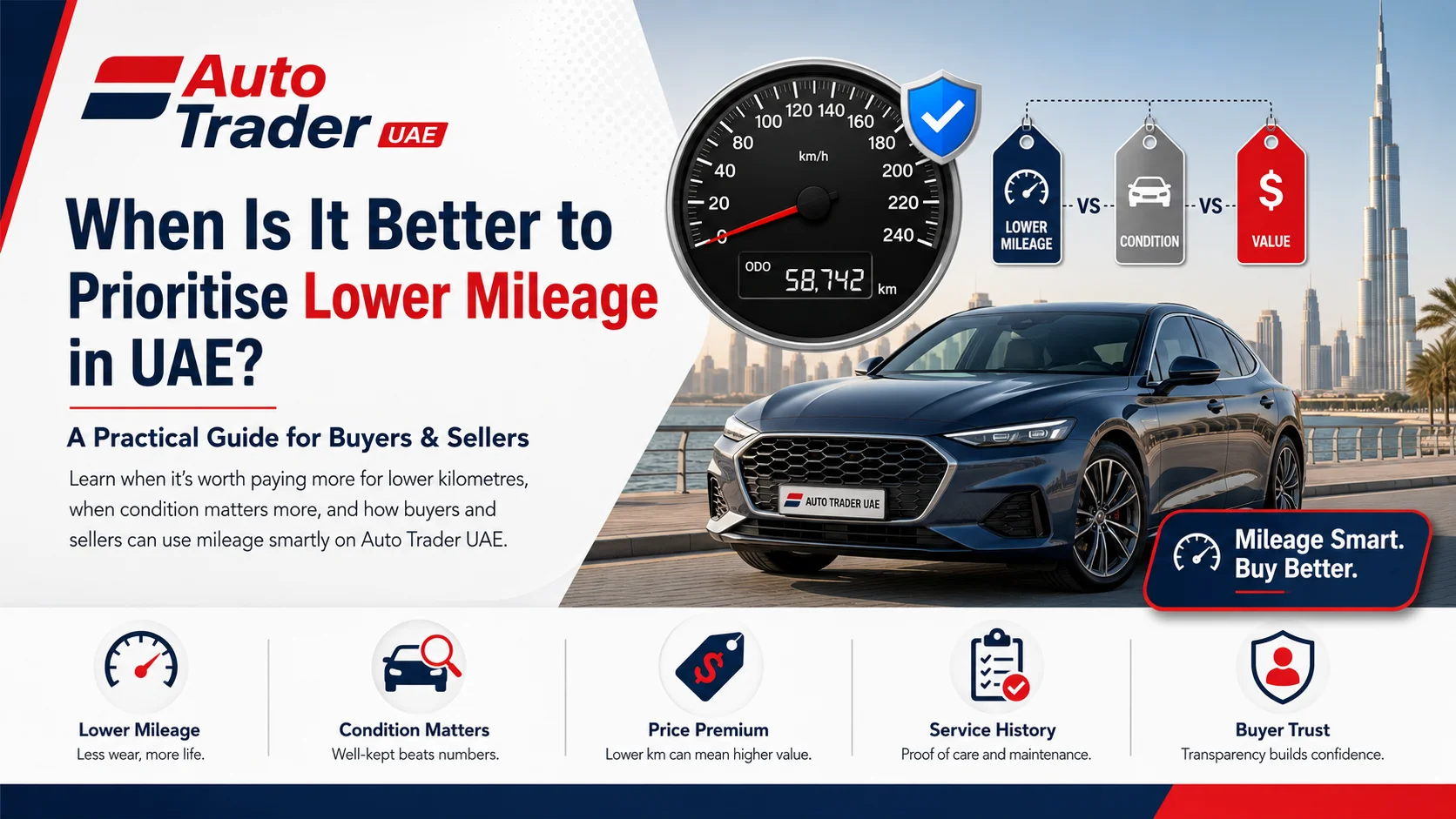
When Is It Better to Prioritise Lower Mileage in UAE?
Mileage is one of the first things buyers in the UAE check when browsing used cars. But should you always pay more for lower mileage? Not necessarily.
This guide explains when it’s genuinely better to prioritise lower mileage in the UAE, when condition and service history matter more, and how both buyers and sellers on Auto Trader UAE can use mileage smartly during a deal.
What Does “Low Mileage” Mean in the UAE?
Because of long highway commutes, hot weather and regular Dubai–Abu Dhabi driving, annual mileage in the UAE is often higher than in many other markets.
As a simple reference (not a strict rule):
- Low mileage: under 15,000 km per year
- Average mileage: 15,000–25,000 km per year
- High mileage: over 25,000 km per year
So a 5-year-old car at 60,000 km may be considered low mileage for the UAE, while the same car at 150,000 km would be high mileage.
When It’s Better to Prioritise Lower Mileage in the UAE
You don’t always need the lowest kilometre car, but there are specific situations where lower mileage is worth paying extra.
1. When You Plan to Keep the Car for Many Years
If you expect to keep the car for 5+ years, starting with lower mileage gives you a longer “usable life” before big components typically wear out.
In the UAE, prioritise lower mileage when buying:
- Family SUVs and crossovers you’ll keep long term
- Daily commuters running high annual mileage (e.g., Dubai–Abu Dhabi)
- First cars for new drivers you want to last many years
Explore long-term friendly options on:
2. When Buying Premium or Luxury Models
Luxury cars can be expensive to repair once major parts start to age. Prioritising lower mileage can minimise the risk of big repair bills on:
- High-end German sedans and coupes
- Luxury SUVs used for family and business
- Performance models with complex engines and electronics
On luxury cars, a difference of 40,000–60,000 km can significantly affect resale value and perception, especially in cities like Dubai and Abu Dhabi where buyers expect clean, low-kilometre examples.
3. When Buying for Heavy Daily Use
If your weekly driving in the UAE is high (business visits, delivery, sales, school runs across emirates), starting with lower mileage helps you stay in the “acceptable” mileage band longer.
Prioritise lower mileage for:
- Ride-hailing or chauffeur business cars
- Sales representatives driving across multiple emirates
- School run and family shuttle vehicles
4. When Resale Value Is a Top Priority
In the UAE, two similar cars with a mileage gap of 40,000–60,000 km can have a noticeable price difference on the used market.
Choose lower mileage when you know you will:
- Sell within 2–3 years and want a strong resale price
- Trade in regularly to upgrade models
- Advertise to mileage-conscious buyers who filter listings by kilometres on Auto Trader UAE
5. For 4x4s and SUVs Used Off-Road
Many UAE drivers use their SUVs for desert trips, camping and off-road adventures. This can be tougher on suspension, drivetrain and cooling systems.
If you need a 4x4 that will see regular off-road use, lower mileage is helpful if it’s backed by:
- Documented servicing
- Evidence of proper off-road use (no serious abuse)
- Clear inspection report (no underbody damage or leaks)
6. When the Car Has a Complex Powertrain
Hybrid systems, turbocharged engines, dual-clutch gearboxes and advanced driver assistance systems can be more sensitive to wear and heat. In the UAE climate, lower mileage can be an extra layer of reassurance.
Prioritise lower mileage if you’re buying:
- Plug-in hybrids with ageing batteries
- High-boost turbo engines
- Sports models with performance-focused gearboxes
When Condition Matters More Than Mileage
A very low odometer reading is not a guarantee of a better car. In many UAE used car deals, a well-maintained car with higher mileage can be a smarter buy than a low-mileage car with poor history.
1. When the Service History Is Excellent
A higher-kilometre car with:
- Full dealer or specialist service history
- Regular oil changes suitable for UAE heat
- Documented replacement of wear-and-tear items
can be more reliable than a low-mileage car with missing records. Always ask for invoices and stamps, not just verbal promises.
2. When the Car Has Mostly Highway Kilometres
Highway kilometres between Dubai, Abu Dhabi, Sharjah and other emirates are typically gentler on a car than short urban trips with heavy stop-start traffic.
A car with “high” but mostly highway mileage can show:
- Less wear on brakes
- Less strain on gearbox
- Smoother engine operation
3. When the Car Has Been Garaged and Protected from Heat
UAE heat and sun can damage paint, interior, rubber seals and electronics. A slightly higher mileage car that has been garaged and shaded can be better than a low-mileage car parked outside every day.
During viewing, check:
- Dashboard and trim for cracks or fading
- Headlights for yellowing
- Paint for clear coat damage
4. When the Price Gap Is Too Big
You may find two similar cars on Auto Trader UAE:
- Car A: 60,000 km, higher price
- Car B: 90,000 km, significantly cheaper
If Car B has strong history and passes inspection, it can offer better total value, especially if you don’t plan to keep it very long.
Red Flags on Ultra-Low Mileage Cars in the UAE
It’s tempting to jump at an extremely low odometer reading, but some ultra-low mileage cars need extra checks.
- Very low mileage for age: Example: a 10-year-old car with 20,000 km. It might have sat unused for long periods, which can cause issues with seals, fluids and rubber parts.
- Inconsistent service books: If the kilometres in the service records don’t match the displayed odometer, investigate further.
- Long gaps between services: Even with low mileage, oil and fluids should be changed regularly due to time and UAE heat.
Always consider a pre-purchase inspection, especially when the mileage seems “too good to be true” for the age.
How to Judge Mileage in the Context of UAE Driving
Mileage doesn’t exist in isolation. In the UAE, you should always judge it alongside:
1. Age vs. Kilometres
Divide total kilometres by the car’s age to get an average annual mileage. Compare that to the typical UAE ranges mentioned earlier. Very high or very low averages deserve extra questions.
2. Service Records and Invoices
Look for:
- Consistent service intervals (every 10,000–15,000 km or annually)
- Timing belt or chain services (if applicable)
- Gearbox oil changes, especially on automatic and dual-clutch cars
- Cooling system and A/C maintenance (critical in UAE)
3. Type of Use
Ask the seller specific questions:
- Was the car used mainly in city traffic, or on highways?
- Was it used for off-road trips, towing, or heavy loads?
- Was it a personal family car, fleet vehicle, or company car?
4. Accident and Repair History
A low-mileage car that has had major accident repairs can be less desirable than a clean, higher-kilometre example. Request inspection reports and, where possible, body shop invoices.
Mileage Tips for Used Car Buyers in the UAE
1. Decide Your Mileage Priority Before Browsing
Before you start searching on Auto Trader UAE, decide:
- How long you’ll likely keep the car
- How many kilometres you drive per year
- How important resale value is to you
This helps you filter listings realistically instead of only chasing the lowest odometer reading.
2. Use Filters Smartly on Auto Trader UAE
On Auto Trader UAE used cars, combine mileage filters with:
- Price range
- Model year
- Location (Dubai, Abu Dhabi, Sharjah, etc.)
- Body type (sedan, SUV, hatchback, etc.)
This lets you see whether paying extra for lower mileage makes sense for your budget.
3. Inspect Beyond the Odometer
During viewing and test drives, check:
- Seat and steering wheel wear vs. claimed kilometres
- Pedal rubber condition
- Door handles and buttons
- Service stickers under the bonnet and on the windscreen
If visible wear looks much higher than the mileage suggests, ask for more proof.
4. Get a Professional Inspection
For higher-value or low-mileage cars, a professional inspection in Dubai, Abu Dhabi or Sharjah is worth the cost. It can confirm whether the condition matches the odometer and reveal heat-related issues common in the UAE.
Mileage Strategies for Sellers in the UAE
As a seller, using mileage honestly and strategically can help you get stronger offers on Auto Trader UAE.
1. Be Transparent and Precise
When listing your car:
- Enter the mileage accurately
- Update it if you continue using the car
- Mention if the mileage is mostly highway kilometres
2. Highlight Maintenance, Not Just Mileage
Even if your mileage is higher, you can still attract serious buyers if you:
- Upload clear photos of the service book
- Mention recent major services (timing belt, tyres, brakes)
- Explain how the car was used (family car, company car, etc.)
3. Price Competitively for Your Mileage Band
Compare your car with similar listings on:
Note price differences between low, average and high mileage cars of the same year and spec, then position yours realistically.
4. Prepare for Buyer Questions
Buyers in the UAE commonly ask:
- Is this genuine mileage?
- Do you have full service history?
- Is it mostly city or highway driving?
Having clear answers and documents builds trust and helps your advert stand out.
Examples: When to Pay More for Lower Mileage vs Save Money
Scenario 1: Commuter from Sharjah to Dubai
You drive 25,000 km per year. Two similar sedans:
- Car A: 40,000 km, higher price
- Car B: 110,000 km, cheaper
If both are in good condition, Car A (lower mileage) is often the better pick because you’ll quickly add high kilometres and still want a reasonable resale in 2–3 years.
Scenario 2: Second Car for Short City Trips
You only drive 6,000–8,000 km per year in Dubai or Abu Dhabi. Two similar hatchbacks:
- Car A: 30,000 km, premium price
- Car B: 80,000 km, significantly cheaper, full service history
Here, Car B may be smarter value. You won’t add big mileage quickly, and good history matters more than having the absolute lowest kilometres.
Scenario 3: Family SUV for Long-Term Use
You plan to keep a family SUV for 6–7 years. Two options:
- Car A: 50,000 km
- Car B: 130,000 km
If the budget allows, prioritise lower mileage (Car A). Over long-term ownership, starting with 50,000 km gives more buffer before wear becomes significant.
Key Takeaways for UAE Buyers and Sellers
- Mileage is important, but it must be judged with age, service history and UAE-specific usage in mind.
- Prioritise lower mileage for long-term ownership, premium cars, heavy daily use and strong resale goals.
- Sometimes a higher-kilometre car with excellent history and clean condition is the better deal.
- Sellers should use mileage honestly and support it with documents and clear descriptions.
Next Steps on Auto Trader UAE
Whether you’re buying or selling, use mileage as a smart filter—not the only decision factor. On Auto Trader UAE you can:
- Browse thousands of used cars in UAE with mileage, service and price details
- Focus on city-specific deals, including used cars in Dubai
- Compare low- and higher-mileage examples side by side to see which offers better overall value
Start your search today, set realistic mileage expectations, and use the tools on Auto Trader UAE to find a car that fits your budget, your driving style and your future plans.
Browse used cars in UAE on Auto Trader UAE to compare live listings, prices, and current market activity more clearly.
Related Links
Buyer Takeaway
When buying a used car in the UAE, focus on vehicle condition, service history, inspection quality, paperwork, and total running costs rather than price alone. Compare options carefully and choose the option that best matches your budget and real needs.
Seller Takeaway
If you are selling a used car in the UAE, present the service history clearly, price the vehicle realistically, and highlight condition, specification, and ownership strengths honestly. A well-prepared listing with accurate details usually attracts more serious buyers.
Conclusion
A careful used car purchase in the UAE starts with research, proper inspection, and clear paperwork before making the final decision.