
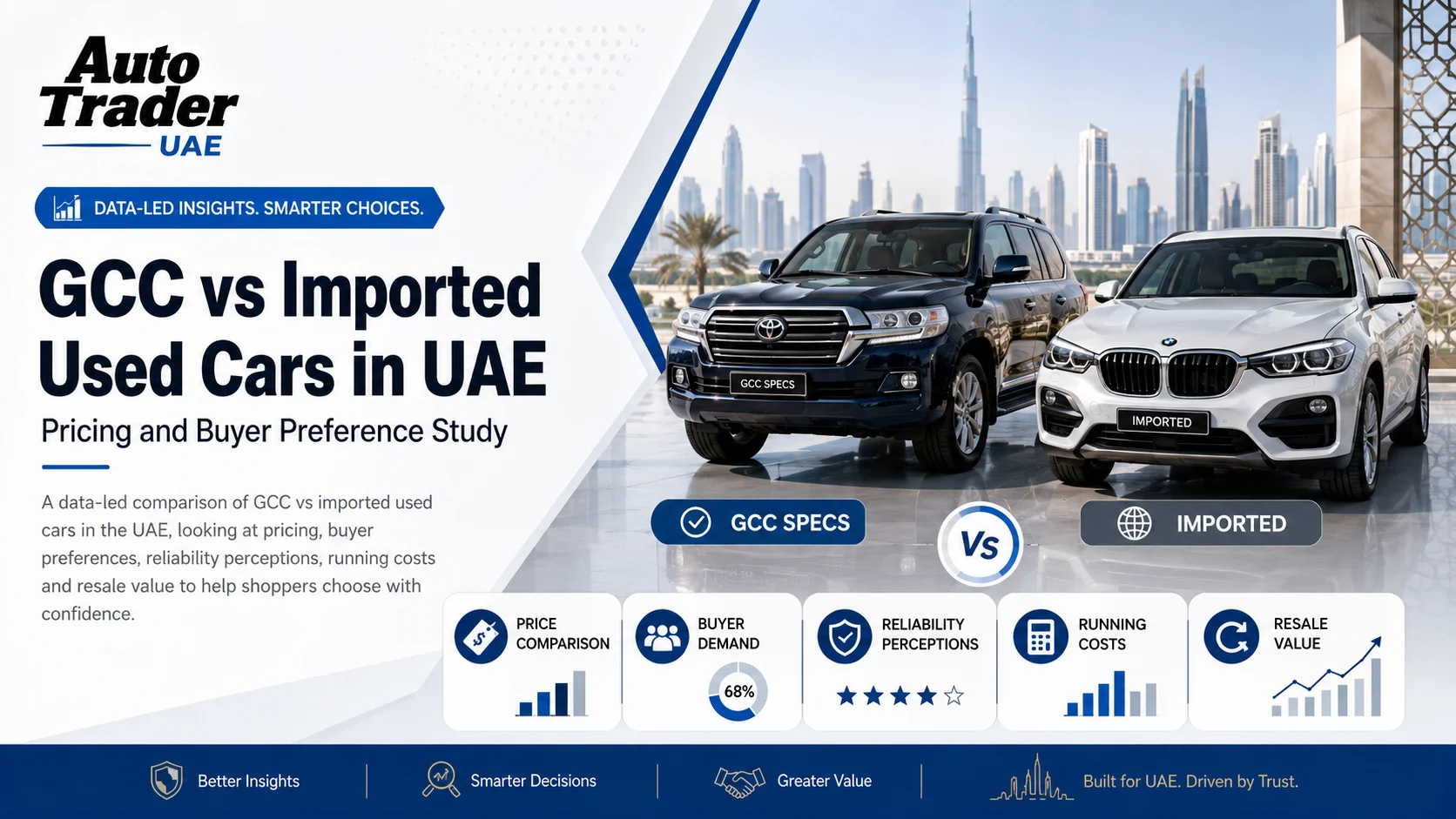
Choosing between a GCC-spec used car and an imported used car is one of the biggest decisions buyers face in the UAE. Both options can look similar in photos, but their pricing, running costs and long‑term ownership experience can be very different.
This comparison study for Auto Trader UAE looks at real buyer preferences, pricing patterns and market behaviour to understand how GCC vs imported used cars perform in the UAE. The focus is on everyday buyers shopping popular segments like saloons, hatchbacks and used SUVs, rather than rare classics or high-end exotics.
- Used Toyota – especially Land Cruiser, Prado and Corolla
- Used Nissan – Patrol, X‑Trail and Sunny
- Used Mitsubishi – Pajero and Outlander
- Used Lexus – LX and RX
- Used BMW – 3 Series and X5
- Used Mercedes-Benz – C‑Class, E‑Class and GLE
- Used Audi – A4 and Q5
- Used Hyundai – Elantra, Tucson and Santa Fe
Introduction
In the UAE, GCC-spec used cars are vehicles originally sold by authorised dealers in the Gulf region, built to Gulf Cooperation Council specifications. Imported used cars typically come from markets such as the US, Europe, Japan or Korea and are registered in the UAE after being shipped in.
Both choices can offer value. GCC cars are often associated with stronger resale and better adaptation to local heat, while imports are popular for lower purchase prices and higher option levels. This article compares GCC vs imported used cars across pricing, design and features, practicality, performance, running costs, resale value and buyer fit, based on market behaviour observed on Auto Trader UAE and wider regional trends.
Overview
The UAE used‑car market is highly competitive and price sensitive. Buyers routinely cross‑shop GCC and imported examples of the same model on platforms like Auto Trader UAE, comparing odometer readings, service history and condition.
Across mainstream segments, GCC‑spec cars often carry a visible price premium over comparable imported cars, especially for popular models such as the Toyota Land Cruiser, Nissan Patrol and Lexus LX. Yet imported vehicles can attract buyers who prioritise initial savings or rare trims not officially sold in the region.
Understanding how GCC vs imported stock differs helps buyers avoid overpaying for badges and marketing, and helps sellers price realistically in line with current demand.
Methodology
This study is a qualitative and directional look at the UAE used‑car market using publicly observable patterns and typical buyer behaviour. It is not a statistical report and does not rely on confidential transaction data.
- Market scope: Popular used passenger cars and used SUVs in the UAE, from economy hatchbacks to large 4x4s.
- Data sources: Listing patterns and asking prices visible on Auto Trader UAE, typical dealer practices, and widely reported regional trends around GCC vs imported vehicles.
- Comparison focus: GCC‑spec vs non‑GCC (imported) cars of similar model years and segments, not including heavily modified or track‑only vehicles.
- Buyer behaviour: Analysed through how buyers compare prices, mileage, accident history, options, and service records across GCC and imported cars.
All pricing and preference commentary is indicative only; actual deals vary with condition, specification, negotiation and timing.
Key Differences
When shoppers compare GCC vs imported used cars in the UAE, they’re effectively comparing two ownership philosophies: factory‑matched to the region versus globally sourced value. Key distinctions include:
Climate and specification
- GCC‑spec used cars: Typically built or configured with high‑capacity air‑conditioning, cooling systems designed for extreme heat, different radiator and sometimes upgraded alternator/fan setups. Head units and navigation are often localised for the Middle East.
- Imported used cars: Configured for the original market’s climate and regulations. Cooling packages may be lighter, and infotainment/navigation may be set up for another region, sometimes requiring software or hardware changes after arrival in the UAE.
Service and warranty history
- GCC‑spec cars: More likely to have a verifiable dealer service history within the UAE or wider GCC, which is easy for buyers or agencies to check. Some nearly‑new GCC cars may still be under regional warranty.
- Imports: Service records may exist in another country and not always transfer clearly. US imports may come with Carfax‑type reports; European and Japanese imports vary more in documentation quality.
Pricing behaviour
- GCC cars: Often priced higher for the same model year and mileage because of perceived suitability for local conditions and stronger resale value.
- Imported cars: Generally cheaper on entry, sometimes significantly so, especially for higher‑spec trims or powerful engines that are pricey as GCC‑spec.
Regulatory and insurance considerations
- Registration: Both GCC and imported cars can be registered with UAE authorities when paperwork is in order. Accident or salvage histories abroad can complicate the process.
- Insurance: Some insurers may price coverage differently for heavily accident‑repaired imports or branded‑title vehicles. A clean history is key for both categories.
Key Findings
- Price premium for GCC cars: GCC‑spec vehicles frequently command a clear asking‑price premium over imported equivalents, particularly in the SUV and luxury segments.
- Imports offer visible savings: Many imported used cars list at lower prices or with more options for the same money, drawing budget‑focused and feature‑driven buyers.
- Heat and cooling remain central concerns: Buyers in the UAE still strongly associate GCC cars with better performance in extreme temperatures, especially for larger engines and turbocharged models.
- Resale confidence favours GCC‑spec: Resale value and ease of re‑marketing tend to favour GCC cars, particularly for mainstream family cars and used Toyota SUVs.
- Well‑inspected imports can be smart buys: When properly inspected and transparently documented, imported cars can offer excellent value and attract enthusiasts looking for unique specifications.
- Buyer fit matters more than origin alone: Driving pattern, budget, climate exposure (desert/off‑road vs urban), and ownership horizon are often more important than simply “GCC vs import”.
Pros
Advantages of GCC-spec used cars in the UAE
- Engineered for local conditions: Cooling, AC performance and sometimes suspension tuning are set up for high ambient temperatures and long highway runs across the Gulf.
- Stronger market trust: Many UAE buyers instinctively prefer GCC‑spec cars, especially for family SUVs and 4x4s such as used Nissan Patrol and used Lexus SUVs.
- Easier resale: Because demand is broader, GCC cars can be easier to sell later, often with less negotiation on price.
- Service network familiarity: Local workshops are used to GCC‑spec variants, and parts availability tends to be more straightforward.
- Potential remaining warranty: Late‑model GCC cars may still enjoy regional manufacturer warranty and roadside assistance.
Advantages of imported used cars in the UAE
- Lower purchase price: One of the biggest attractions. Many imported cars undercut GCC‑spec pricing, allowing buyers to step up a class or trim level.
- Richer specifications: Imports often bring upgraded safety tech, premium audio, panoramic roofs or driver‑assist packages that are optional or unavailable on GCC models.
- Wider model choice: Enthusiasts can access variants not officially sold here – for example certain performance trims, diesel engines or niche body styles.
- Good value for city driving: For mainly urban, low‑mileage use, the full GCC cooling package may not be critical, making well‑chosen imports a rational choice.
Cons
Drawbacks of GCC-spec used cars
- Higher upfront cost: The trust and demand they enjoy means GCC cars often carry steeper asking prices than comparably equipped imports.
- Less equipment for the money: In some cases a GCC base or mid‑spec car may cost as much as a fully loaded imported version of the same model.
- More competition when buying: Desirable GCC SUVs and luxury sedans can sell quickly, giving buyers less room to negotiate.
Drawbacks of imported used cars
- Climate suitability questions: While many imports cope fine, cooling systems designed for milder climates may age faster in UAE heat if not upgraded or maintained well.
- History transparency: Some imported cars have accident or flood damage in their original country. If documentation is incomplete, buyers take more risk.
- Resale resistance: Many buyers immediately ask whether a car is GCC or import. Imports can be harder to resell or may require more discounting.
- Compatibility and parts: Certain spec‑specific parts, infotainment systems or safety features may differ from GCC versions, making diagnosis and repair more complex.
Which Suits Which Buyer
Because both GCC and imported used cars can be good choices in the UAE, the right answer depends on the buyer’s profile.
GCC-spec used cars: best for risk‑averse and long‑term owners
GCC‑spec cars typically make more sense if you:
- Plan to keep the vehicle for several years and clock high mileage in UAE conditions.
- Regularly drive long distances in peak heat, or go off‑road and desert camping.
- Value straightforward resale and want to appeal to the widest pool of buyers later.
- Are choosing a primary family vehicle, especially a large family SUV or MPV.
For example, shoppers comparing used Toyota Land Cruiser options will often lean GCC‑spec if they intend heavy use, frequent off‑road trips and long‑term ownership.
Imported used cars: best for value seekers and enthusiasts
Imported cars can be a smart fit if you:
- Are primarily city‑based with shorter daily commutes and regular indoor parking.
- Want more features or a higher segment without stretching the budget.
- Are comfortable investing in a thorough pre‑purchase inspection and background checks.
- Plan a shorter ownership period and are prepared to price competitively when reselling.
Buyers browsing used BMW 3 Series or used Audi A4 often consider imports to access higher trims, bigger engines or advanced driver assistance at a lower purchase price.
Buyer Takeaway
When comparing GCC vs imported used cars in the UAE, the most practical approach is to assess total value, not just origin. On Auto Trader UAE you can shortlist both GCC and imported listings of the same model, then compare:
- Price vs mileage: How much are you paying per kilometre, once you adjust for specification and condition?
- Service and accident history: Are there complete records, clear import papers and independent inspection reports where possible?
- Intended usage: City driving and shaded parking place less stress on the car than desert and towing use.
- Ownership horizon: The longer you keep the car, the more important robustness and resale confidence become.
Use platform filters to highlight used cars in the UAE that match your budget, then read each listing carefully for “GCC spec” or “imported” notes, chassis reports and service details.
Seller Takeaway
For private sellers and dealers, aligning price and presentation with buyer expectations around GCC vs imported cars is essential.
- GCC sellers: Document dealer service history, recent maintenance and genuine parts. Emphasise heat‑ready spec and any remaining warranty to justify a higher asking price.
- Import sellers: Be transparent about import origin, accident history, and any cooling or specification upgrades done in the UAE. Competitive pricing and clear documentation help overcome buyer hesitation.
- Photos and descriptions: High‑quality images and detailed, accurate descriptions build trust for both GCC and imported listings.
- Market‑aligned pricing: Compare your car to similar live listings on Auto Trader UAE – not just your purchase cost – when setting an asking price.
Conclusion
In the UAE’s active used‑car market, both GCC‑spec and imported used cars have a clear place. GCC vehicles usually win on local suitability, buyer confidence and resale strength, which explains their price premium. Imported cars typically appeal on upfront value and richer equipment, rewarding buyers who are detail‑oriented and comfortable with inspections.
The smartest move is to stay open to both options, then narrow your shortlist based on condition, documentation and how you will actually use the car. Whether you end up in a GCC‑spec family SUV, a value‑packed imported sedan or a premium European import, Auto Trader UAE makes it easy to compare asking prices, specifications and histories side by side.
Start exploring used cars in UAE across every brand and segment, or focus your search on high‑demand hubs like used cars in Dubai. With clear filters for budget, mileage, body style and more, you can quickly see how GCC vs imported options stack up and choose the car that fits your life – and the UAE road – best.
To compare both options properly, browse used cars in Dubai and across the UAE on Auto Trader UAE and check prices, mileage, trim levels, and seller details side by side.