
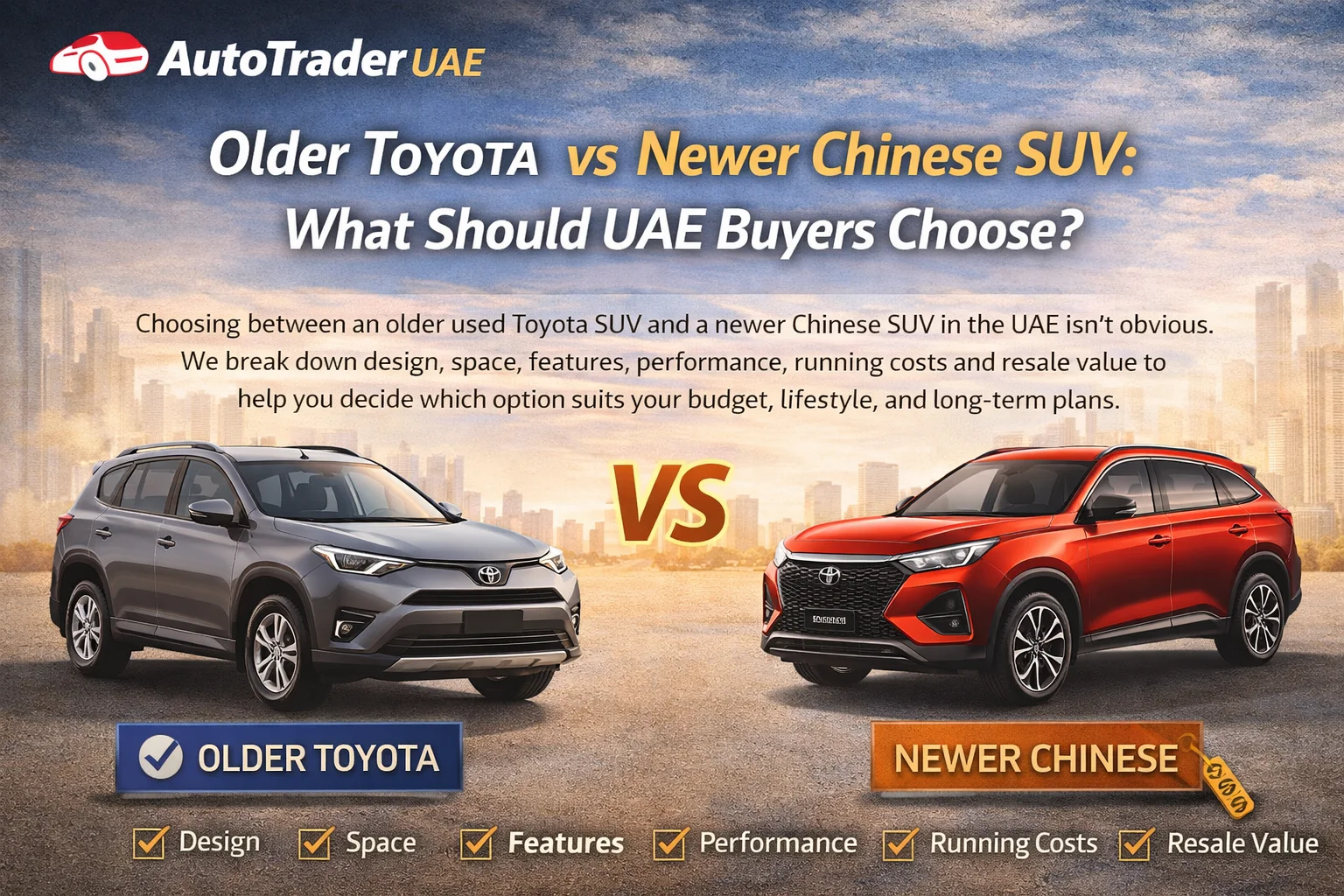
Older Toyota vs Newer Chinese SUV: What Should UAE Buyers Choose?
For many UAE buyers, the real-life dilemma is simple: spend your money on an older, proven Toyota SUV, or go for a newer Chinese SUV packed with features and tech. Both options are easy to find on Auto Trader UAE, and both can make sense depending on your needs, budget, and how long you plan to keep the car.
This comparison looks at the typical used Toyota SUV (usually 5–10 years old) versus a newer Chinese SUV (often 0–4 years old), focusing on what really matters for UAE driving: reliability, comfort, fuel costs, warranty, and resale value.
Design & Road Presence
Older Toyota SUV: Familiar and Understated
- Look & feel: Mature, conservative design that still looks acceptable, even if not very modern.
- Perception: Strong brand image in the UAE. An older Toyota often signals practicality and reliability.
- Aging factor: Exterior may show sun fade, minor dings, or worn trim if it’s lived outdoors, which is common here.
Newer Chinese SUV: Modern and Feature-Led
- Look & feel: Sharp lines, big LED lights, large screens, and eye-catching alloy wheels are common.
- Perception: Growing acceptance in the UAE, especially among younger buyers and first-time SUV owners.
- Freshness: Paint, lights, and trim look newer, which helps if you care about a modern, stylish presence.
Design verdict for UAE buyers: If you prefer a modern look and lots of visible tech, a newer Chinese SUV wins on showroom appeal. If you value a trusted image over style, the older Toyota still carries strong respect on UAE roads.
Interior Space & Practicality
Cabin Space
- Older Toyota SUV: Typically offers solid headroom and legroom, especially in midsize and larger models. Practical layouts and plenty of storage spaces are common.
- Newer Chinese SUV: Often very competitive on interior space for the price, with clever packaging, wide-opening doors, and flat rear floors in some models.
Seat Comfort & Everyday Use
- Older Toyota SUV: Seats are usually durable and supportive, although foam and upholstery may be worn on higher-mileage cars. Controls are simple and easy to use.
- Newer Chinese SUV: Softer materials, more stylish design, and features like electric seats, panoramic roofs, and ambient lighting are common, but long-term durability is still proving itself in the UAE climate.
Cargo & Family Practicality
- Older Toyota SUV: Often offers wide cargo openings, split-fold seats, and tried-and-tested practicality for strollers, sports gear, and luggage.
- Newer Chinese SUV: Competitive boot sizes and flexible seating, plus powered tailgates on many models, but some designs prioritise style over maximum cargo volume.
Practicality verdict: For pure usability and proven durability with kids, cargo and rough use, an older Toyota often feels more robust. For a fresh-feeling family cabin and modern features at a lower price point, the newer Chinese SUV is hard to ignore.
Technology, Features & Comfort
Infotainment & Connectivity
- Older Toyota SUV: Expect simpler screens, older navigation systems, and sometimes no Apple CarPlay/Android Auto in earlier models. Aftermarket upgrades are common in the UAE.
- Newer Chinese SUV: Big touchscreens, digital clusters, 360° cameras, smartphone mirroring, and connected features are a major selling point.
Safety & Driver Assistance
- Older Toyota SUV: Basic but solid safety: multiple airbags, ABS, stability control. Advanced driver aids may be limited or absent on older model years.
- Newer Chinese SUV: Many recent models offer adaptive cruise control, lane-keeping assist, blind-spot monitoring, and automatic emergency braking at attractive prices.
Comfort Features
- Older Toyota SUV: Manual seats on lower trims, older climate control systems, and fewer luxury touches, but functional AC performance is usually strong.
- Newer Chinese SUV: Ventilated seats, multi-zone climate, wireless charging and more are commonly offered, making them feel very premium for the money.
Tech & comfort verdict: The newer Chinese SUV clearly wins on features and modern comfort. If you want the latest screens and safety tech without spending luxury money, this side of the comparison is very compelling.
Performance, Ride & Driving in the UAE
Engine & Powertrain
- Older Toyota SUV: Generally larger, naturally aspirated engines with a reputation for reliability. Power delivery is smooth and predictable, ideal for daily use and occasional off-road.
- Newer Chinese SUV: Often uses smaller turbocharged engines or efficient naturally aspirated units. They can feel lively around town but may be less proven in long-term UAE heat and heavy use.
Ride, Handling & Noise
- Older Toyota SUV: Suspension is usually tuned for comfort and toughness, especially on rough roads. Cabin noise may be higher due to age, worn bushings, or older insulation.
- Newer Chinese SUV: Many are tuned for comfort and city use, with quiet cabins and smooth rides, though suspension and tyre quality can vary by brand.
Off-Road & Desert Use
- Older Toyota SUV: If you’re looking at body-on-frame or 4x4 models, capability in sand and mild off-road conditions is a known strength, provided the car has been maintained well.
- Newer Chinese SUV: Many are front-wheel drive crossovers, focused on highways and city streets. Light off-road or graded tracks are fine, but they’re not usually designed for serious dune bashing.
Performance verdict in UAE conditions: For regular city and highway driving, both can work well, with the Chinese SUV often feeling newer and more refined inside. If off-road ability and proven reliability in extreme heat matter, the older Toyota generally offers more peace of mind.
Running Costs & Maintenance
Fuel Economy
- Older Toyota SUV: Larger engines and older transmissions can mean higher fuel use, especially on heavy 4x4 models. However, driving style and maintenance have a big impact.
- Newer Chinese SUV: Smaller, often turbocharged engines and newer gearboxes usually provide better official fuel economy, especially for city commuters.
Service & Parts in the UAE
- Older Toyota SUV: Excellent parts availability, strong dealer network, and many independent garages familiar with common repairs. Genuine and aftermarket parts are easy to source.
- Newer Chinese SUV: Dealer networks are expanding, and parts availability is improving, but it can vary by brand. Some models rely mainly on dealer servicing, especially while under warranty.
Reliability & Unexpected Costs
- Older Toyota SUV: Proven reliability record, but age-related wear (suspension, rubber parts, AC system, electronics) can generate bills if the previous owner neglected maintenance.
- Newer Chinese SUV: Comes with a newer car’s advantage: lower immediate risk of major repairs and usually a valid factory warranty. Long-term reliability in UAE heat is still being built up, though many owners report decent experiences.
Running cost verdict: If the older Toyota has a full service history and has been well looked after, it can be cost-effective to run. If you want predictable costs, fixed-price servicing and a warranty, the newer Chinese SUV is the safer budgeting choice.
Price, Depreciation & Resale Value
Initial Purchase Price
- Older Toyota SUV: You often pay more than you would for an equivalent-age competitor because of brand strength. However, buying older lets you access higher segments (larger SUV, more capable 4x4) for the same money.
- Newer Chinese SUV: Usually offers more car (features, size, tech) for your dirham when new or nearly new, making them attractive to value-focused buyers.
Depreciation
- Older Toyota SUV: Has already taken much of its initial depreciation. Prices tend to stabilise, and drops are slower compared with many rivals.
- Newer Chinese SUV: Stronger depreciation in the first few years is common. This is a downside if you buy brand new, but a big advantage if you buy nearly new on the used market.
Resale Value in the UAE
- Older Toyota SUV: Historically strong resale, with high demand across the UAE and GCC, especially for well-maintained, GCC-spec cars with clean history.
- Newer Chinese SUV: Resale is improving for some brands but remains weaker overall. Buyers may expect lower prices when you sell, even if the vehicle is relatively new.
Resale verdict: If protecting your money and future resale is a top priority, the older Toyota usually has the advantage. If you plan to keep the car for many years and care more about upfront value and features, the newer Chinese SUV can still make financial sense.
Which Type of Buyer Suits Each Option?
How to Use Auto Trader UAE to Compare Both
On Auto Trader UAE, you can directly compare older Toyota SUVs and newer Chinese SUVs side by side:
- Filter by year and mileage: Look at Toyotas that are 5–10 years old versus Chinese SUVs that are 0–4 years old to match typical budget comparisons.
- Check service history: Favour listings with documented maintenance, especially for older Toyotas and early ownership years of Chinese SUVs.
- Compare features: Use listing details to see exactly what safety and comfort equipment you get for the same price.
- Review asking prices: Look at similar listings to understand market value and likely resale for both sides.
Exploring used car listings, make/model pages and related comparison articles on Auto Trader UAE will also help you understand how specific Toyota models stack up against particular Chinese brands in your price range.
Conclusion: Older Toyota vs Newer Chinese SUV in the UAE
Choosing between an older Toyota SUV and a newer Chinese SUV in the UAE comes down to your priorities.
- Choose an older Toyota if you value proven durability, easier resale and, in many cases, stronger off-road or heavy-duty ability. It suits buyers who think long-term and don’t mind owning a car that looks and feels a bit older inside.
- Choose a newer Chinese SUV if you want a modern, comfortable daily driver packed with features and safety tech, mostly for city and highway use, and you prefer the peace of mind of a newer car with warranty support.
The best way to decide is to shortlist both an older Toyota and a newer Chinese SUV within your budget on Auto Trader UAE, compare their specs, history and prices, and test-drive both. Seeing and driving them back-to-back will quickly reveal which option feels right for your lifestyle on UAE roads.
To compare both options properly, browse used cars in Dubai and across the UAE on Auto Trader UAE and check prices, mileage, trim levels, and seller details side by side.
Related Links
Buyer Takeaway
When buying a used car in the UAE, focus on vehicle condition, service history, inspection quality, paperwork, and total running costs rather than price alone. Compare options carefully and choose the option that best matches your budget and real needs.