
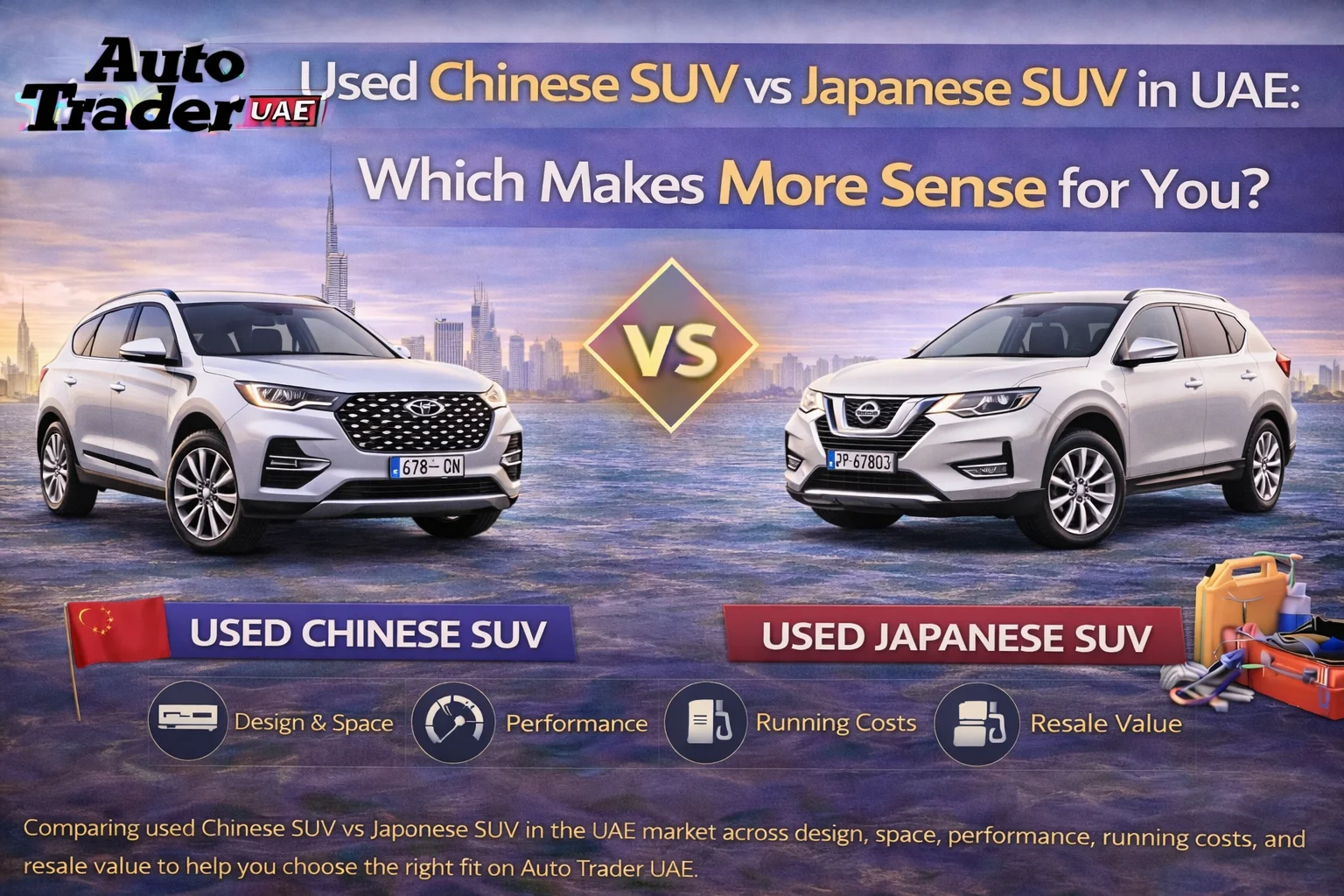
Choosing between a used Chinese SUV and a used Japanese SUV in the UAE is no longer a simple decision. Chinese brands have moved far beyond their budget-only image, while Japanese SUVs still carry a strong reputation for reliability and resale value. On Auto Trader UAE, you’ll now see both sitting side by side in every price bracket, from compact family crossovers to seven-seat SUVs.
This comparison looks at how used Chinese SUVs and used Japanese SUVs stack up in real UAE conditions – from Dubai’s traffic and Sharjah’s parking challenges to Abu Dhabi highway runs and occasional desert trips. The aim is to help you decide which direction suits your budget, lifestyle, and long‑term plans.
Introduction
The used SUV segment in the UAE has shifted quickly in the last few years. Chinese brands have entered strongly with modern designs, long equipment lists, and aggressive pricing. Japanese manufacturers continue to offer proven reliability, conservative but practical cabins, and strong aftersales support.
For a buyer searching on Auto Trader UAE, this usually becomes a choice between:
- Used Chinese SUVs – newer shape for less money, high tech, longer warranties (when still valid), but weaker resale and sometimes patchy parts availability.
- Used Japanese SUVs – more expensive for similar age and size, often simpler spec, but excellent durability, service network, and resale value.
Both choices can make sense in the UAE – but for different kinds of buyers.
Key Differences
When comparing a used Chinese SUV vs Japanese SUV in the UAE, seven core areas matter most: design, interior space, practicality, performance, running costs, resale value, and buyer fit.
1. Design and Technology
Used Chinese SUVs in the UAE tend to stand out visually. Many offer bold styling, large grills, LED lighting, panoramic roofs, and big alloy wheels as standard, even on mid-grade models. Inside, you’ll often find:
- Large tablet-style infotainment screens
- Digital instrument clusters
- Ambient lighting and soft-touch trims in higher trims
- Advanced driver assistance tech on newer models
Chinese brands have moved quickly to match or exceed the in-car tech you see in mainstream brands, especially on models only a few years old.
Used Japanese SUVs usually take a more conservative approach. Designs are clean and practical, with a focus on visibility and ease of use rather than drama. Inside, you’ll usually find:
- Simpler infotainment systems with physical buttons
- Proven, intuitive ergonomics
- High build quality and hard-wearing materials
- Safety tech that may be less flashy but is well tested
One clear pattern in the UAE used market: a two- or three-year-old Chinese SUV can feel more modern and high-tech than a Japanese SUV of the same age and price, but the Japanese cabin often feels better screwed together.
2. Interior Space and Practicality
Chinese SUVs often offer generous exterior size and good cabin space for the money. Brands frequently build slightly larger bodies to attract family buyers, which means:
- Roomy back seats, often with good legroom
- Competitive boot space for strollers, luggage, and shopping
- Many models available with seven seats or flexible folding layouts
Cabins are frequently designed with family use in mind, with multiple USB points and rear AC vents – important for UAE summers.
Japanese SUVs are known for smart packaging rather than just size. Even compact used Japanese SUVs often feel more practical than the numbers suggest:
- Good headroom and clever storage spaces
- Flat-folding rear seats and wide-opening doors
- Generally excellent air-conditioning performance and durability
For day-to-day UAE use – school runs, mall trips, and mixed driving – both Chinese and Japanese used SUVs can work well. The Chinese option may give you more sheet metal for your dirham, while Japanese models often feel more user-friendly and robust inside.
3. Performance and Driving Experience
In the UAE, performance is not just about speed; it’s also about how the car copes with heat, heavy AC use, and long-distance highway driving.
Used Chinese SUVs often use small turbocharged engines paired with automatic or dual-clutch transmissions. The advantages:
- Good low-end torque for city driving
- Respectable acceleration for overtaking on highways
- Decent fuel efficiency on paper
However, on the used market, turbocharged engines and complex gearboxes can be sensitive if previous owners skipped proper servicing or used lower-quality fluids. Warranty coverage may still apply on newer examples, but this depends on age, mileage, and service history.
Used Japanese SUVs often rely on naturally aspirated petrol engines and conventional or CVT gearboxes. In UAE conditions, this usually translates to:
- Smoother, predictable power delivery
- Proven heat resistance and long engine life
- Less stress on components over high mileage
The trade-off is that some Japanese SUVs may feel slower and less exciting to drive, especially when loaded with passengers and luggage. But for most UAE buyers, the predictable and durable nature of Japanese drivetrains is a strong selling point.
4. Running Costs and Maintenance
Running costs in the UAE include fuel, maintenance, parts, insurance, and unexpected repairs.
Used Chinese SUVs can be appealing because of lower purchase prices. However, you should consider:
- Fuel economy: Small turbo engines can be efficient when driven gently but may consume more fuel if driven hard or heavily loaded in summer heat.
- Maintenance costs: Service prices vary by dealer, but parts and labour can sometimes surprise buyers, especially if parts need to be ordered.
- Independent garages: In major UAE cities, more workshops are becoming familiar with Chinese SUVs, but the network is still growing compared to Japanese brands.
Used Japanese SUVs benefit from decades of presence in the UAE:
- Wide availability of genuine and aftermarket parts
- Many independent workshops familiar with common models
- Predictable service costs, with plenty of competition among garages
- Generally strong reliability, reducing the risk of big surprise bills
Over a 3–5 year ownership period, many UAE buyers find that the total cost of owning a Japanese SUV (purchase, maintenance, and resale) is easier to predict, even if the initial buying price is higher.
5. Resale Value in the UAE
Resale value is where used Chinese SUVs vs Japanese SUVs in the UAE differ sharply.
Used Chinese SUVs usually depreciate faster. That means:
- Very attractive prices on the used market, especially for second or third owners
- But weaker resale when you decide to sell or upgrade
For a buyer planning to keep the car for a long time, this can be an advantage – you benefit from someone else’s depreciation. For short-term ownership, it can be a disadvantage.
Used Japanese SUVs have some of the strongest resale values in the UAE. Benefits include:
- Higher asking prices when you sell on Auto Trader UAE
- Demand from both individual buyers and exporters
- Often easier and quicker to sell compared with less-known brands
If resale is important – for example, if you change cars every 2–3 years – a used Japanese SUV usually makes more financial sense in the UAE.
6. Comfort and Daily Usability
Used Chinese SUVs often focus on initial showroom appeal, which can mean:
- Soft suspension for a comfortable ride over bumps
- Feature-rich cabins (ventilated seats, large screens, sunroofs)
- Quiet cabins at city speeds
However, some models may feel less refined at highway speeds, with more road or wind noise, or less polished suspension tuning on rougher roads.
Used Japanese SUVs are typically tuned for comfort and stability over long distances:
- Well-balanced suspension suitable for UAE highways
- Strong AC systems that cope well with extreme heat
- Simple, intuitive controls – useful for drivers who prefer minimal distraction
For daily commuting and family use, both segments can work, but Japanese SUVs tend to feel more consistent and predictable after years of use.
7. Suitability for Off-Road and Desert Use
Not every SUV in the UAE sees off-road use, but many buyers still want the option.
Used Chinese SUVs in the mainstream price range are usually soft-roaders – front-wheel drive or basic AWD crossovers. A few models offer off-road modes and reasonable ground clearance, but most are aimed at urban and light gravel-road use.
Used Japanese SUVs are more likely to include traditional body-on-frame 4x4 models alongside soft-road crossovers. These body-on-frame SUVs are often preferred for:
- Camping trips and light desert driving
- Towing trailers or boats
- Driving on rough tracks and farm roads
For serious desert driving, experienced UAE drivers still overwhelmingly favour Japanese 4x4s due to proven durability, easier parts availability, and specialist knowledge among workshops. For primarily urban use, both Chinese and Japanese crossovers can be adequate.
Pros
Advantages of Buying a Used Chinese SUV in the UAE
- Lower purchase price: You typically get a newer model year, more equipment, or a larger size for the same budget compared with Japanese equivalents.
- Modern design and tech: Large screens, advanced connectivity, and contemporary styling appeal to buyers who prioritise a high-tech feel.
- High specification levels: Features like panoramic roofs, leather seats, 360° cameras, and advanced safety systems are common in mid- to high-trim Chinese SUVs.
- Good value for long-term keepers: If you plan to keep the car for many years, initial depreciation matters less, and you benefit from the lower entry price.
Advantages of Buying a Used Japanese SUV in the UAE
- Proven reliability: Many Japanese models have a long history in UAE conditions, with engines and gearboxes known to handle high mileage and heat.
- Strong resale value: Easier to sell later, often at strong prices, especially for popular models and well-maintained examples.
- Extensive service network: Wide coverage of authorised dealers, independent workshops, and readily available parts across the Emirates.
- Predictable ownership experience: Fewer surprises over long-term use, which suits buyers who value peace of mind.
Cons
Drawbacks of Buying a Used Chinese SUV in the UAE
- Faster depreciation: Resale values are generally weaker, which can hurt if you plan to sell within a few years.
- Brand perception: Some buyers remain cautious about long-term durability, which can limit demand when you resell.
- Parts and expertise: While improving, some areas may still have limited parts in stock or fewer workshops with deep experience on specific Chinese models.
- Unknown long-term track record: Many models are relatively new to the market, with less data on performance beyond high mileage.
Drawbacks of Buying a Used Japanese SUV in the UAE
- Higher upfront price: You often pay more for the same year, mileage, or size compared with a similar Chinese SUV.
- More basic features at the same price: For a set budget, you may need to accept a simpler interior, smaller screen, or fewer premium options.
- Conservative design: Styling and cabin design can feel less exciting, especially compared with the latest Chinese models.
Which Suits Which Buyer
Because both options have clear strengths, the choice between a used Chinese SUV vs Japanese SUV in the UAE comes down to your priorities and how you plan to use the car.
When a Used Chinese SUV Makes More Sense
A used Chinese SUV may be the better choice if you:
- Have a tight budget but still want a relatively new, well-equipped SUV.
- Value features and design – large screens, panoramic roof, and modern cabin feel are priorities.
- Plan to keep the car long term (5+ years), so resale is less important than low purchase price.
- Drive mainly in the city and on paved roads, with no need for heavy off-roading.
- Are comfortable checking service history carefully and potentially using a specialist workshop familiar with your chosen brand.
When a Used Japanese SUV Makes More Sense
A used Japanese SUV may be the better choice if you:
- Prioritise reliability and peace of mind above the latest tech or styling.
- Change cars every few years and care about strong resale value in the UAE market.
- Drive long distances between Emirates, often with family and luggage.
- Need occasional off-road ability or want a 4x4 that can handle desert use when driven carefully and correctly equipped.
- Prefer easier servicing with many garages and parts suppliers able to support your model.
Buyer Takeaway
On Auto Trader UAE, you will find hundreds of listings for both used Chinese SUVs and used Japanese SUVs. To make a smart choice, consider these practical steps:
- Set a realistic budget: Include registration, insurance, and a maintenance buffer for the first year.
- Shortlist both types: For your budget, compare a few Chinese SUVs and a few Japanese SUVs side by side in terms of year, mileage, and features.
- Check service history: Prioritise cars with documented services at recognised workshops or dealers, especially for turbocharged Chinese models.
- Inspect carefully: Use a trusted inspection centre or mechanic to check engine, gearbox, AC performance, tyres, and suspension before buying.
- Think about your exit plan: If you intend to sell within 2–3 years, factor expected resale value into your decision.
For some buyers, a well-maintained used Chinese SUV will deliver excellent value and high comfort for the money. For others, a used Japanese SUV’s predictable reliability and resale will feel worth the extra upfront cost.
Conclusion
The choice between a used Chinese SUV vs Japanese SUV in the UAE is no longer about good vs bad – it is about which strengths match your lifestyle.
Used Chinese SUVs offer standout value, modern styling, and generous equipment, making them attractive to buyers who want the newest feel for the lowest price and who are comfortable keeping the car for several years. They can be a smart option for city-focused families, first-time SUV buyers, or anyone upgrading from a smaller car on a tight budget.
Used Japanese SUVs continue to deliver what the UAE market trusts most: reliability, strong resale, and an ownership experience that is easy to live with over high mileage and harsh weather. They suit buyers who drive more, plan to resell sooner, or simply want minimal surprises during ownership.
Whichever direction you lean, the key is to compare specific models, inspect carefully, and base your decision on the real condition of the car in front of you. On Auto Trader UAE, you can browse used Chinese SUVs and used Japanese SUVs side by side, filter by budget, year, and mileage, and shortlist the options that truly fit your needs. With a clear understanding of how both segments perform in UAE conditions, you can use the marketplace to negotiate confidently and secure an SUV that matches your expectations today and holds its value for tomorrow.
To compare both options properly, browse used cars in Dubai and across the UAE on Auto Trader UAE and check prices, mileage, trim levels, and seller details side by side.
Related Links
Seller Takeaway
If you are selling a used car in the UAE, present the service history clearly, price the vehicle realistically, and highlight condition, specification, and ownership strengths honestly. A well-prepared listing with accurate details usually attracts more serious buyers.