
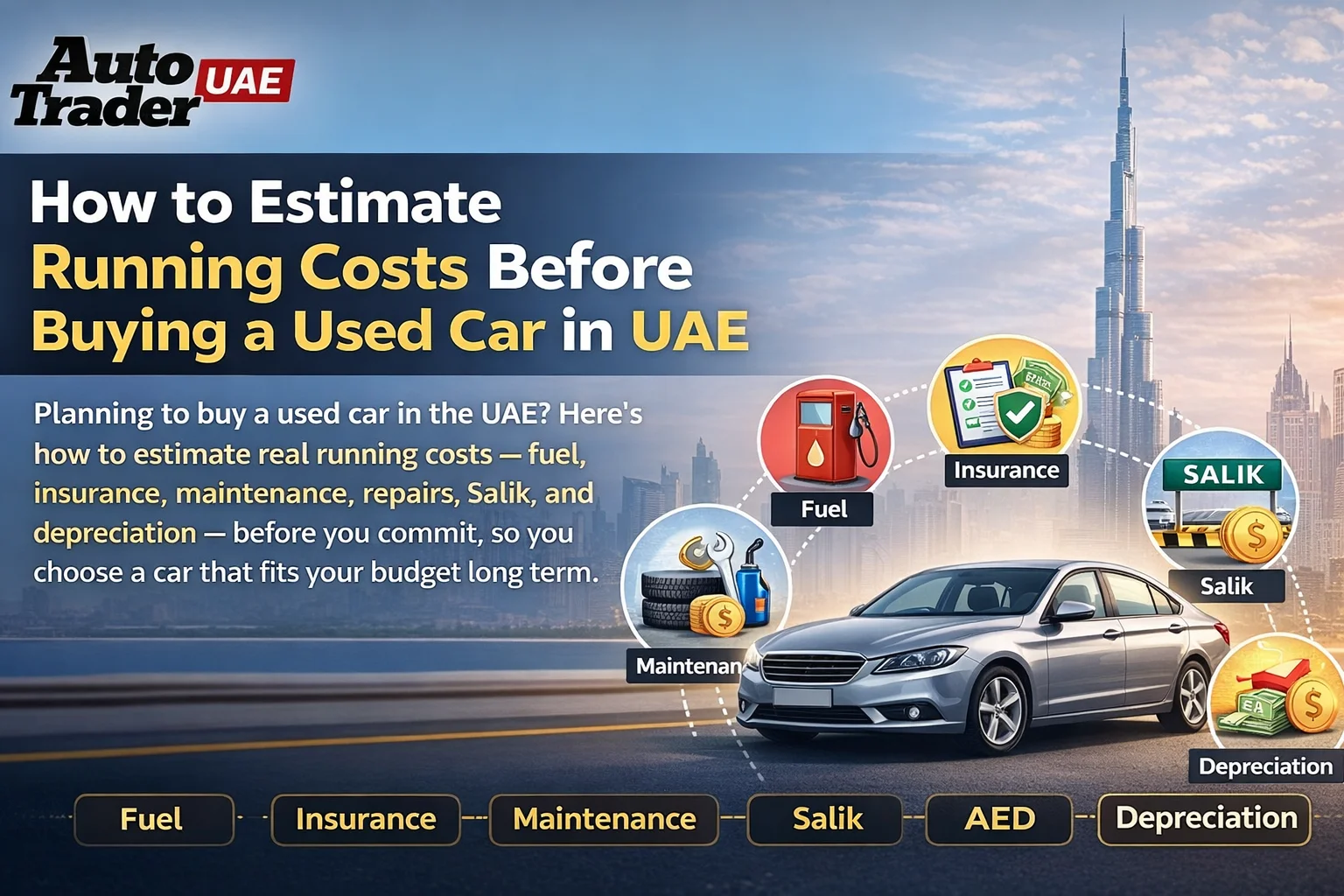
How to Estimate Running Costs Before Buying a Used Car in UAE
Buying a used car in the UAE isn’t just about the purchase price. The bigger financial impact comes later: fuel, insurance, maintenance, repairs, Salik, and depreciation. If you’re planning to keep your car for several years, understanding these running costs is essential. This guide walks you through how to estimate real ownership costs before you buy, so you can compare cars properly and avoid surprises once you’re on the road.
1. Start With a Realistic Annual Mileage
Before you calculate anything, estimate how much you actually drive:
- Daily commute: Home to work and back (in km), multiplied by working days per week.
- Weekend trips: Rough idea of extra driving (mall runs, school, beach, visits).
- Occasional long trips: Drives to other emirates, road trips, etc.
Add these up to get an approximate annual mileage (e.g., 15,000–25,000 km per year). Use this number consistently for all your cost estimates.
2. Estimate Fuel Costs in the UAE
Fuel will likely be one of your biggest ongoing expenses.
Step 1: Find the car’s fuel consumption
Look up the car’s fuel economy from trustworthy sources:
- Manufacturer websites
- Owner reviews and forums
- Auto Trader UAE model pages and reviews
In the UAE, you’ll usually see fuel consumption as litres per 100 km (L/100 km).
Step 2: Use a simple formula
Use this rough calculation:
Annual fuel cost ≈ (Annual km ÷ 100) × L/100 km × Average fuel price per litre
You don’t need exact numbers. Use a recent average fuel price and compare different cars using the same assumptions. This shows you which cars are genuinely cheaper to run.
What affects fuel costs?
- Engine size and type: Smaller engines and modern turbo-petrols or hybrids usually use less fuel than big V6/V8 engines.
- Gearbox and drive type: AWD/4WD and heavy SUVs generally consume more than front-wheel-drive sedans or hatchbacks.
- Driving style: Hard acceleration, heavy city traffic, and high speeds on Sheikh Zayed Road all increase fuel use.
When comparing cars on Auto Trader UAE, check fuel economy figures or owner feedback to get a realistic idea, not just brochure numbers.
3. Understand Insurance Costs in the UAE
Insurance premiums can vary widely between models, even with the same driver and coverage.
What affects your premium?
- Car value: Higher-value and luxury cars cost more to insure.
- Age of the car: Very new cars may attract higher comprehensive premiums, while very old cars may be limited to third-party coverage.
- Type of car: Sports cars, large SUVs, and high-performance models usually cost more to insure.
- Driver profile: Age, driving experience, previous claims, and sometimes nationality.
- Usage: Private vs commercial use; high annual mileage may impact cost.
How to estimate insurance before you buy
- Shortlist a few cars on Auto Trader UAE.
- Note the year, make, model, trim, and approximate value.
- Request quick online quotes from a couple of UAE insurers or brokers.
You’ll get a realistic annual insurance range for each car. Use this figure when comparing options. Sometimes, a cheaper car can be more expensive to insure than a slightly pricier but safer and easier-to-repair model.
4. Budget for Routine Maintenance and Servicing
Routine maintenance includes engine oil, filters, brake pads, tyres, fluids, and periodic checks.
Key things to check by brand and model
- Service interval: Is it every 10,000 km, 15,000 km, or 20,000 km?
- Typical service cost: Ask dealers and independent workshops for ballpark prices on minor and major services.
- Parts availability: Common Japanese and Korean models tend to have cheaper and more readily available parts; some European luxury brands can be significantly more expensive.
How to get real numbers
Before buying a used car:
- Call two or three independent garages and ask for rough prices for a minor and major service for the exact model and engine.
- Ask for typical prices of brake pads, discs, battery, and suspension components.
- Check Auto Trader UAE’s reviews and ownership guides for model-specific maintenance expectations.
Then estimate an annual maintenance budget based on your mileage:
- Lower mileage (under 15,000 km/year): One minor service, maybe one additional oil change.
- Higher mileage (20,000–30,000 km/year): One minor and one major service in many cases.
5. Plan for Repairs and Unexpected Costs
Used cars in the UAE can be very reliable if well maintained, but age, heat, and harsh conditions can accelerate wear.
Key wear points in the UAE
- Cooling systems: Radiators, fans, and hoses work harder in UAE heat.
- AC systems: Air-conditioning compressors and condensers are heavily used.
- Suspension: Speed bumps, rough roads, and off-road use can wear out bushings and shocks.
- Tyres and batteries: Heat shortens their lifespan.
How to estimate realistic repair costs
- Check owner forums: Search for common issues for that model and typical repair costs in the region.
- Ask a trusted mechanic: Get a general idea of typical repair bills for a 5–8-year-old version of that car.
- Set aside a contingency: Many long-term owners budget an extra annual reserve for unexpected repairs, especially for older cars.
For older or premium cars, that repair reserve should be larger. A single major repair on a European luxury model can exceed a full year of running costs on a simple Japanese sedan.
6. Don’t Ignore Depreciation and Resale Value
Even with a used car, depreciation is still one of your biggest costs. In the UAE market, resale value can vary a lot by brand and model.
How to judge resale strength
- Search the same model on Auto Trader UAE across different years.
- Compare asking prices of, for example, a 3-year-old vs 7-year-old version.
- Brands and models with small price drops over the years usually have strong resale.
Also consider:
- Brand reputation: Reliable, mainstream brands generally hold value better.
- Fuel type: Demand for economical petrol or hybrid models is strong; some large, thirsty engines may lose value faster.
- Market demand: Popular family SUVs and compact crossovers tend to resell faster than niche models.
If you plan to sell again in 3–5 years, a car with good resale value can reduce your overall cost of ownership significantly, even if its purchase price is slightly higher today.
7. Calculate Registration, Testing, Parking, and Salik
Beyond fuel and maintenance, there are recurring legal and city-driving costs.
Registration and testing
In all emirates, you’ll pay for:
- Annual registration renewal
- Vehicle testing (RTA or equivalent)
The amounts are generally modest compared to fuel or insurance but should still be included in your annual budget.
Parking costs
If you live or work in busy areas:
- Account for paid parking (RTA/Mawaqif) during working hours.
- Consider mall and private parking charges if they apply regularly.
Salik and tolls
If your daily route crosses toll gates (e.g. Dubai’s Salik):
- Estimate how many gates you pass each day.
- Multiply by working days and toll rate to get a monthly and annual figure.
For some commuters, tolls can add up to more than insurance over a year, so include this when comparing where you live and work versus what you drive.
8. Tyres, Batteries, and Other Consumables in UAE Climate
Heat and high-speed highway driving in the UAE mean some parts wear out faster.
- Tyres: Larger tyres for SUVs and performance cars cost more to replace than small sedan tyres. You’ll typically need to change them every few years depending on use.
- Battery: Due to heat, car batteries may last a shorter time than in cooler climates. Factor in a replacement every couple of years as a realistic expectation.
- Brakes: Heavy city driving and frequent braking wear pads faster; larger and performance-oriented cars tend to have more expensive brake components.
Ask tyre shops and parts suppliers for typical replacement costs for the exact tyre size and battery type used by the model you’re considering, then spread that cost over the expected lifespan to get an annual figure.
9. Reliability, Service History, and Pre-Purchase Inspection
Even a model with a strong reputation can become expensive if it has been neglected. Before you buy, focus on the specific car, not just the badge.
Service history
- Look for complete service records (stamps, invoices, or digital history).
- Verify where servicing was done (main dealer vs specialist vs general garage).
- Check if major scheduled items (timing belt, transmission service, coolant, etc.) have been done on time.
A car with full, verifiable history may cost a little more to buy but usually saves you money in the long run.
Pre-purchase inspection
Always budget for a full inspection before committing:
- Use an independent inspection centre or trusted workshop.
- Ask specifically about accident damage, engine health, gearbox condition, leaks, and chassis.
- Use the report as a bargaining tool or to walk away if the car has serious issues.
Spending a small amount upfront on an inspection can save you thousands in unexpected repairs later.
10. Practicality: Does the Car Suit Your Daily Life?
Running costs are not just money; they’re also about how easy the car is to live with every day in UAE conditions.
- Size and parking: Large SUVs may be harder to park in older buildings and tight city spaces.
- Fuel tank range: Economical cars with bigger tanks reduce how often you visit the petrol station on long commutes.
- Interior comfort: Good AC, ventilated seats (if available), and heat-resistant interiors matter in summer.
- Family needs: Boot space for strollers, school bags, groceries, and weekend luggage.
- Driving pattern: If you mostly drive in the city, a compact, fuel-efficient car will usually cost less overall than a heavy SUV.
Choosing a car that fits your lifestyle reduces the urge to upgrade early, which protects your budget in the long term.
11. Put It All Together: Build a Simple Running Cost Comparison
When shortlisting cars on Auto Trader UAE, create a basic annual cost table for each model. For each car, estimate:
- Fuel (based on your annual km and fuel economy)
- Insurance (using real quotes)
- Routine servicing (average of minor and major services per year)
- Repairs reserve (especially for older or premium models)
- Tyres and battery (annualised)
- Registration, testing, parking, and tolls
- Estimated depreciation (difference between what you pay now and likely resale in 3–5 years)
You don’t need exact figures; even rough, consistent estimates will show clear differences. Two cars with a similar purchase price can differ by thousands of dirhams per year in running costs.
Conclusion: Use Running Cost Estimates to Buy Smarter
Estimating running costs before buying a used car in the UAE helps you:
- Avoid budget shocks after purchase
- Choose between models based on total ownership cost, not just the price tag
- Select cars that match your real daily use, commute, and family needs
- Plan for long-term ownership with fewer financial surprises
Once you know your annual budget, you can browse used car listings on Auto Trader UAE with confidence, filter by make, model, price, and body type, and use our reviews and guides to compare reliability, maintenance expectations, and resale strength. Take your time, shortlist a few options, get insurance quotes, and arrange inspections. With a clear view of running costs, your next used car in the UAE can be both enjoyable to drive and sensible for your wallet.
Before deciding, browse used cars in Dubai and across the UAE on Auto Trader UAE to compare condition, mileage, pricing, and seller details for models that fit your ownership goals.
Related Links
Buyer Takeaway
When buying a used car in the UAE, focus on vehicle condition, service history, inspection quality, paperwork, and total running costs rather than price alone. Compare options carefully and choose the option that best matches your budget and real needs.
Seller Takeaway
If you are selling a used car in the UAE, present the service history clearly, price the vehicle realistically, and highlight condition, specification, and ownership strengths honestly. A well-prepared listing with accurate details usually attracts more serious buyers.