
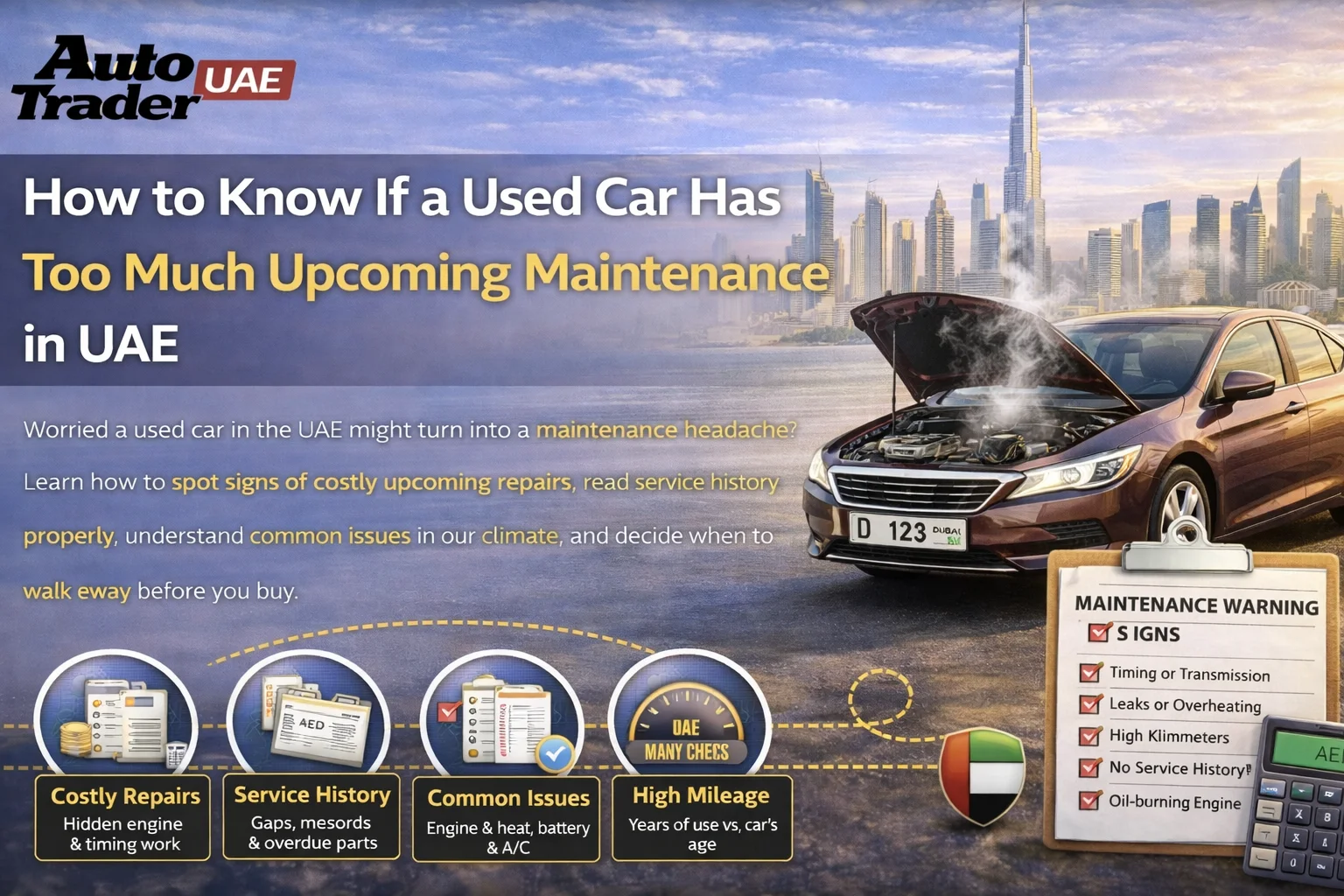
How to Know If a Used Car Has Too Much Upcoming Maintenance in UAE
Buying used in the UAE can save you serious money, but only if the car doesn’t come with a long list of upcoming repairs. With our heat, sand, and stop‑start city driving, some cars age faster here than in other markets. This guide explains how to judge if a used car has too much upcoming maintenance, what to inspect, what paperwork to review, and when it’s smarter to walk away and keep browsing Auto Trader UAE listings.
Why Upcoming Maintenance Matters More in the UAE
The UAE driving environment is tough on cars:
- Extreme heat stresses engines, cooling systems, AC, rubber hoses, and plastics.
- Dusty conditions clog filters and wear out suspension and window regulators.
- Frequent short trips in city traffic are harder on engines and gearboxes than long highway drives.
- High speeds on highways highlight any weakness in tyres, suspension, and brakes.
A car that looks fine today may be one service away from major bills. Your job as a buyer is to read the clues before you commit.
1. Start With the Service History
Service history is your first filter. Ask for:
- Stamped service book from dealer or specialist workshop.
- Printed invoices showing what was done, when, and at what mileage.
- Any warranty/extended warranty papers, even if expired — they show the car was once maintained to a standard.
Key things to look for:
Regular service intervals
In the UAE, most cars should be serviced every 10,000 km or 12 months (some recommend 5,000–7,500 km for tough use). Red flags:
- Gaps of 20,000 km+ between services.
- Missing records for the last 2–3 years.
- Only basic oil changes, no other items ever replaced.
These usually mean the car is overdue for catch‑up maintenance — which you will pay for soon after purchase.
Evidence of major scheduled items
Depending on brand and engine, you should see some or all of these done by certain mileage:
- Timing belt (if applicable): typically 80,000–120,000 km or every 4–6 years.
- Transmission service: ATF and filter for automatics, DSG/dual‑clutch oils, CVT fluids.
- Coolant replacement every 60,000–100,000 km.
- Brake fluid change every 2–3 years.
- Spark plugs (especially for turbo engines) typically at 60,000–100,000 km.
- Drive belts and sometimes pulleys/tensioners.
If the car is at 120,000 km and none of this appears in the history, you can assume a large maintenance bill is coming.
2. Mileage vs Age: What Should Be Done Already?
A 5‑year‑old car with 75,000 km in the UAE is normal. But you must match mileage to typical wear items. Below is a rough guideline (always check the specific brand’s schedule):
At around 60,000 km
- Brake pads (maybe once or twice by now).
- Transmission fluid for some brands.
- AC service (filter, check for gas leaks).
- Spark plugs on some engines.
At around 100,000–120,000 km
- Timing belt (if the engine uses one), sometimes water pump.
- Major transmission service (especially CVT/DSG).
- Suspension components start to wear (bushes, shocks, mounts).
- Engine mounts may require replacement in harsh use.
At around 150,000+ km
- Second round of many items above.
- Higher chance of AC compressor, radiator, power steering components, and alternator issues.
If a car’s mileage suggests all of this should have been done, but the paperwork shows almost nothing, you’re looking at a backlog of work.
3. Visual and Basic Checks You Can Do Yourself
Even without tools, you can spot signs of upcoming maintenance.
Engine bay
- Oil level and colour: Very dark, thick oil may indicate long intervals between changes. Low oil on the dipstick can mean neglect or consumption.
- Coolant level and colour: Should be coloured (usually green, pink, or blue), not rusty brown or oily.
- Leaks: Check under the engine and gearbox for oil or coolant drips and around the radiator hoses for residue.
- Belts: Listen for squealing when starting the engine or turning the steering wheel fully.
Tyres and brakes
- Tyre age: Check DOT date on sidewall. Over 4–5 years old in UAE heat is not ideal, even if tread looks good.
- Uneven wear: Signals alignment or suspension issues.
- Brake feel: Spongy pedal, vibration under braking, or grinding noises point to upcoming brake work.
Interior and electrics
- AC performance: In the UAE, weak AC is a big issue. Test in the middle of the day if possible.
- All buttons and switches: Windows, locks, mirrors, infotainment, seat adjustments.
- Warning lights: Check that all lights appear on ignition and go off after start (especially check engine, ABS, airbags). A missing light may have been tampered with.
Multiple small faults often indicate overall poor care and more issues under the surface.
4. Signs the Car Has Been Neglected
A single issue can be fixed; a pattern of neglect usually means endless maintenance. Watch for:
- Different brands of tyres on each corner, or very cheap tyres on a premium car.
- Low‑quality modifications: cut wiring for accessories, non‑OEM suspension, or remapped/tuned engines with no paperwork.
- Overdue basic maintenance: filthy air filter, clogged cabin filter, black brake fluid.
- Bodywork shortcuts: mismatched paint, poorly aligned panels, rattles inside doors.
In the UAE market, there are plenty of used cars available. If a car looks heavily neglected, it’s usually smarter to move on and keep searching on Auto Trader UAE rather than trying to “rescue” it.
5. Common UAE‑Specific Wear Areas to Check
Certain systems suffer more in our climate. Pay extra attention to these.
Air conditioning system
Must‑check in the UAE:
- Does it cool quickly, even after the car sits in the sun?
- Any hissing sounds or bad smells from vents?
- Any AC‑related work in history (compressor, evaporator, condenser)?
AC jobs can be expensive. A car with weak AC and no records might need major repairs soon.
Cooling system
Heat kills engines. Look for:
- Coolant leaks or stains around radiator and hoses.
- History of radiator, water pump, or thermostat replacement.
- Temperature gauge: ensure it sits where it should and doesn’t creep up in traffic.
Suspension and underbody
Speed bumps, rough construction sites, and occasional off‑road use can damage suspension.
- Listen for clunks, knocks, or squeaks over bumps.
- Check for uneven tyre wear and steering pulling to one side.
- Look under the car (or ask the inspector) for worn bushes, leaking shocks, or bent arms.
6. Parts Availability and Workshop Costs
Even if a car needs work, it may still be a good buy if parts are easy to find and reasonably priced in the UAE. Consider:
- Brand presence in UAE: Well‑represented brands typically have better parts availability and more workshop options.
- Age of the car: Very old or rare imports may have long waiting times for parts and higher prices.
- Aftermarket vs genuine: For common models, high‑quality aftermarket parts can significantly reduce running costs.
- Specialist systems: Air suspension, advanced driver assists, dual‑clutch gearboxes, and hybrid systems can be costly to repair if out of warranty.
Before buying, you can:
- Call a trusted workshop and ask for rough prices for major items (timing belt job, transmission service, AC compressor, suspension refresh).
- Search Auto Trader UAE for similar cars to see typical pricing — if the car you’re viewing is cheap because it needs big work, that may be why.
7. When Upcoming Maintenance Is Acceptable — and When It Isn’t
Almost every used car will need something. The key is deciding what is reasonable.
Usually acceptable
If the car is otherwise clean and fairly priced, these are manageable:
- Tyres near end of life (budget for a new set).
- Standard service items due soon (oil, filters, spark plugs, brake pads).
- Minor cosmetic fixes (small dents, scratched alloys).
Warning zone
Be cautious if you see several of these at once:
- No clear service history past 80,000–100,000 km.
- Timing belt status unknown on a belt‑driven engine.
- Transmission never serviced but mileage over 120,000 km.
- Weak AC plus engine temperature creeping up in traffic.
- Multiple dash warning lights or electrical gremlins.
- Suspension noises and visibly uneven tyres.
Often better to walk away
If you find a combination like this, think twice:
- Car is due (or overdue) for major items: timing belt, gearbox work, AC compressor, and suspension all at once.
- Parts are expensive or hard to find in the UAE for that model.
- Seller is unwilling to allow independent inspection or won’t negotiate on price.
In these cases, there are usually many better‑maintained alternatives on Auto Trader UAE that will cost less to own over time.
8. The Role of a Pre‑Purchase Inspection in the UAE
A professional pre‑purchase inspection (PPI) is often the best money you can spend before buying a used car. What a good PPI should include:
- Full diagnostic scan for hidden error codes.
- Lift inspection of underbody and suspension.
- Leak checks (engine, gearbox, diff, coolant, AC).
- Brake measurement and tyre assessment.
- Test drive including highway and slow traffic.
Ask the workshop to clearly list:
- Urgent repairs (safety or risk of breakdown).
- Recommended soon items.
- Advisories that may be needed in 6–12 months.
Use this report to negotiate price on Auto Trader UAE listings — or to justify walking away if the estimated upcoming maintenance is too high.
9. How to Estimate Upcoming Maintenance Cost
To know whether the car has "too much" upcoming maintenance, you need a rough total. Steps:
- List all upcoming items from history + your checks + PPI (for example: tyres, front brakes, timing belt kit, transmission service, AC compressor, suspension bushes).
- Call 2–3 workshops for approximate prices for each job (parts + labour).
- Add a 10–20% buffer for surprises.
- Compare the total to:
- The car’s price.
- Its market value based on similar cars on Auto Trader UAE.
As a rule of thumb, if immediate and near‑term maintenance will cost more than 20–30% of the car’s value, you should ask for a major discount or consider a different car.
10. Practical Checklist Before You Decide
Use this quick checklist when viewing any used car in the UAE:
- ✓ Full service history available and consistent.
- ✓ Major services (timing belt/chain check, transmission, coolant, brake fluid) done at correct intervals.
- ✓ AC blows very cold, no strange noises or smells.
- ✓ Engine bay clean, no obvious leaks or overheating signs.
- ✓ Suspension quiet, car drives straight, tyres wear evenly.
- ✓ No warning lights on dash, all electronics working.
- ✓ Parts and typical repairs for this model are reasonably priced and available in UAE.
- ✓ Professional inspection doesn’t reveal a long list of expensive upcoming work.
If you’re ticking many boxes in the negative column, that car likely has too much upcoming maintenance.
Conclusion: Use Upcoming Maintenance as a Negotiation and Selection Tool
In the UAE, the difference between a smart used‑car buy and a money pit usually comes down to upcoming maintenance. A car with clear service history, handled by reputable workshops, and with manageable future work can be a bargain. A cheap car with hidden or delayed maintenance can quickly cost more than a newer, better‑maintained alternative. Use service records, visual checks, a professional inspection, and real‑world quotes from workshops to estimate what’s coming. If the total feels too high, keep browsing used car listings, make/model pages, and ownership guides on Auto Trader UAE until you find a car with a cleaner mechanical future. Taking this disciplined approach will help you enjoy your next car in the UAE with fewer workshop visits and more worry‑free kilometres on the road.
Before deciding, browse used cars in Dubai and across the UAE on Auto Trader UAE to compare condition, mileage, pricing, and seller details for models that fit your ownership goals.
Related Links
Buyer Takeaway
When buying a used car in the UAE, focus on vehicle condition, service history, inspection quality, paperwork, and total running costs rather than price alone. Compare options carefully and choose the option that best matches your budget and real needs.
Seller Takeaway
If you are selling a used car in the UAE, present the service history clearly, price the vehicle realistically, and highlight condition, specification, and ownership strengths honestly. A well-prepared listing with accurate details usually attracts more serious buyers.