
Overview
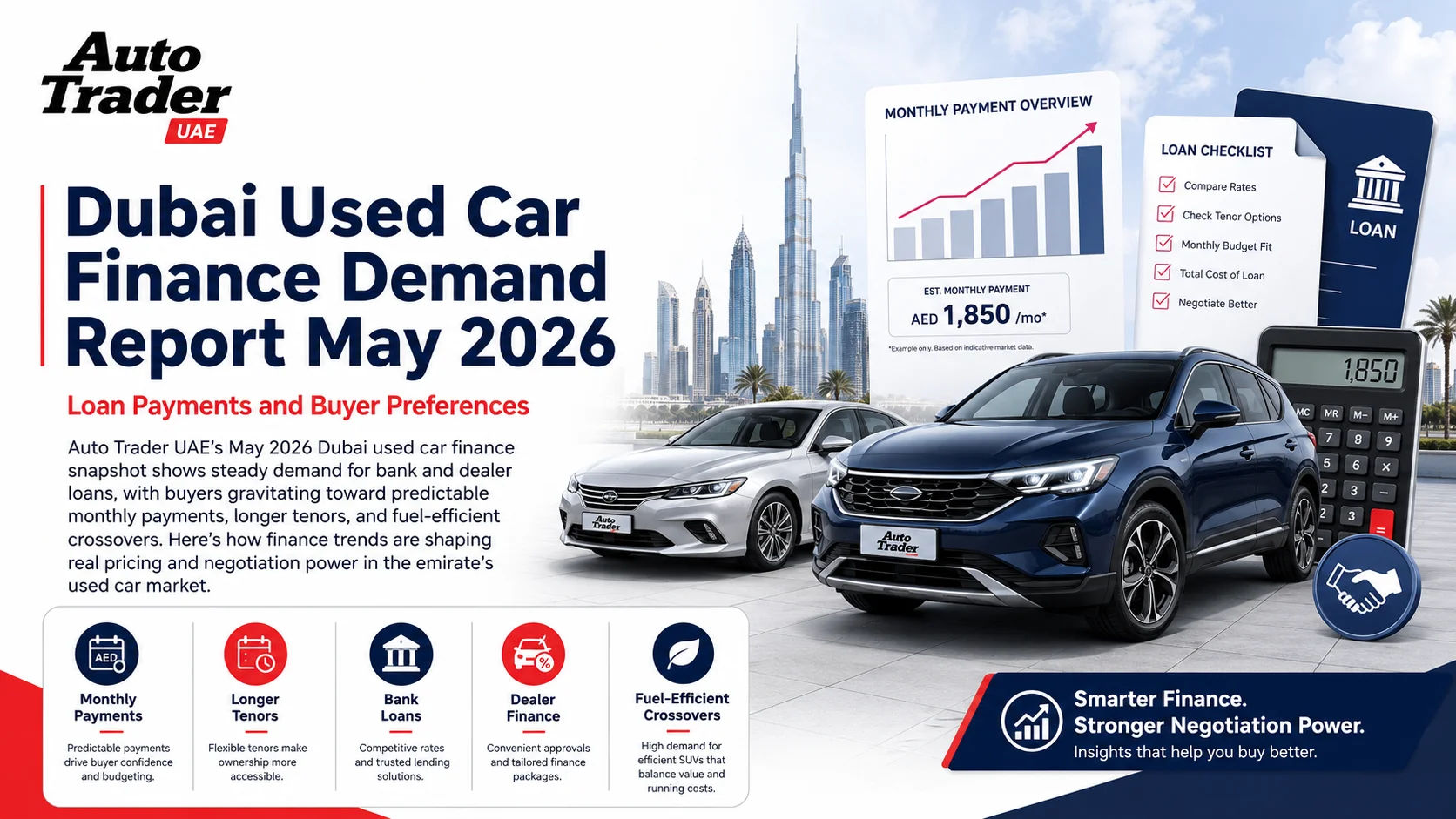
Dubai’s used car market in May 2026 continues to be driven by finance, not cash. Most serious buyers arriving on used cars in Dubai listings are shopping by monthly payment first, total price second. Rising living‑cost awareness, transparent bank offers, and more competitive dealer finance are reshaping which models move quickly and which sit on forecourts. Crossovers and compact سيارة SUV models with manageable instalments are gaining traction, while thirsty V8s and older luxury sedans increasingly need sharper pricing or aggressive finance campaigns to sell.
- Most buyers short‑list cars by target instalment bands (for example, AED 1,200–1,800 per month).
- Preference for longer tenors (up to five years) when upgrading to newer, higher‑spec models.
- Growing interest in fuel‑efficient and hybrid options to offset monthly fuel bills.
- Listings that highlight estimated monthly payments attract more enquiries.
- Dealers partnering with multiple banks report faster stock turnover.
- Well‑priced Japanese and Korean crossovers remain the easiest units to finance and move.
- Toyota Prado used in Dubai – family سيارة SUV with strong bank approval appetite.
- Nissan Patrol used in Dubai – high‑ticket, often taken on longer tenors.
- Hyundai Tucson used in Dubai – popular with budget‑conscious expatriate families.
- BMW X5 used in Dubai – prestige سيارة SUV where buyers negotiate down to an affordable EMI.
- Tesla Model 3 used in Dubai – niche but growing interest from tech‑oriented buyers.
Methodology
This May 2026 report is based on directional signals rather than precise statistical measurement. Auto Trader UAE reviewed a mix of platform activity, partner feedback, and public information to identify how finance is influencing buyer behaviour and seller strategy in Dubai’s used car market.
- Search and enquiry patterns on used cars in UAE, with emphasis on Dubai finance‑filter usage.
- Asking‑price and time‑on‑market trends across key segments: hatchbacks, sedans, crossovers, سيارة SUV, and EVs.
- Anecdotal feedback from Dubai‑based dealers and finance brokers on approval ratios and preferred models.
- Publicly available information from UAE banks on common auto finance structures and indicative tenors.
- Macroeconomic context from official UAE sources (income, fuel price, and transport‑policy signals).
Relevant official references include:
- Dubai Roads & Transport Authority (RTA) – registration, inspection, and transport policy updates.
- Dubai Statistics Center – population and income‑related indicators.
- UAE Ministry of Interior – federal traffic and licensing framework.
- UAE fuel price announcements – monthly petrol and diesel price movements.
- DEWA EV charging information – charging‑network growth relevant to EV finance appetite.
Key Findings
- Monthly payment bands are the primary decision filter
Most buyers arriving on Dubai inventory set a mental budget in terms of EMI rather than total car price. For many salaried residents, the question is, “Can I keep this under a fixed monthly cap while still covering rent and schooling?”
In practice, this favours models that can fit into mid‑range payment brackets once deposit, tenor, and interest are factored in. Well‑priced Japanese and Korean crossovers – such as the Toyota RAV4 used in Dubai and Kia Sportage used in Dubai – often land in these sweet spots. - Longer tenors are enabling upgrades into newer سيارة SUV models
Directional feedback from dealers indicates that many Dubai buyers are willing to extend tenors up to five years to step into late‑model سيارة SUV and crossovers rather than older sedans. For families, the perceived safety, space, and status of سيارة SUV ownership often outweigh the higher total finance cost.
Large, desirable nameplates such as the Toyota Prado and Nissan Patrol are typical beneficiaries of this trend, especially when paired with competitive down‑payment campaigns. - Fuel efficiency and operating cost are now integral to finance decisions
With fuel prices in the UAE adjusted monthly, buyers are more conscious of ongoing running costs when committing to multi‑year finance. Many households now look at total monthly car cost – instalment plus fuel, Salik, servicing, and parking – rather than the EMI in isolation.
This benefits efficient four‑cylinder crossovers and modern turbo engines, including the Hyundai Tucson, Honda CR‑V, and Mitsubishi Outlander. In parallel, some older, larger‑capacity engines see reduced finance demand unless heavily discounted. - EV and hybrid finance interest is growing from a small base
The combination of expanding DEWA charging coverage and frequent Dubai commutes is nudging a subset of buyers toward hybrids and EVs, especially those who can charge at home or work. While still a minority, these buyers tend to be well‑researched and sensitive to total lifetime cost.
Models like the Toyota Corolla Hybrid used in Dubai, Lexus UX hybrid, and Tesla Model 3 increasingly appear in finance‑focused searches, particularly among urban professionals with predictable city driving patterns. - Premium German models remain aspirational but depend heavily on structured offers
Demand for used German luxury cars in Dubai persists, but finance approvals and instalment levels are decisive. Buyers targeting a BMW X5 or Mercedes‑Benz GLE often negotiate intensively around price to bring the EMI in line with income‑based bank guidelines.
Well‑documented service history and clean RTA inspection reports can materially improve bank appetite for these units, allowing dealers to justify slightly firmer pricing while still closing financed deals. - Deposit flexibility is becoming a competitive tool for dealers
Rather than just discounting sticker prices, many dealers are experimenting with lower upfront deposits, bundled warranties, or registration support to get buyers through bank approval. For some expatriate buyers with limited savings but stable income, this is the key enabler of purchase.
This pattern is visible across popular mass‑market sedans such as the Toyota Corolla used in Dubai and Nissan Sunny used in Dubai, where modest deposits and predictable EMIs make these cars attractive first purchases in the city. - Clean documentation and RTA compliance are central to fast finance approvals
Banks typically insist on full documentation, up‑to‑date registration, and a clear inspection trail before releasing funds. Cars with incomplete service records, pending fines, or unresolved inspection notes can face slower approvals or stricter terms.
Conversely, units with complete files – including RTA inspection certificates, service history, and clear title – are easier for buyers to finance and often move faster, particularly in mainstream segments like Toyota Land Cruiser used in Dubai and Mitsubishi Pajero used in Dubai.
Buyer Takeaway
For Dubai buyers in May 2026, the key to smart used‑car finance is treating the EMI as one component of a broader affordability picture.
- Start with a realistic monthly cap based on salary, existing commitments, and probable fuel spend at current UAE price levels.
- Compare tenors, not just EMIs; a lower monthly figure over a much longer term can mean paying significantly more overall.
- Favour models with strong resale and bank appetite, such as mainstream Toyota, Nissan, Hyundai, and Kia crossovers, which often achieve smoother approval and more balanced instalments.
- Check documentation upfront – RTA test status, fines, and service records – to avoid approval delays and last‑minute bank re‑pricing.
- Use online inventory intelligently by filtering for finance‑friendly price brackets on platforms such as used cars in Dubai and cross‑checking similar units on used cars in UAE.
For buyers considering EVs or hybrids, ensure you have convenient charging access (home, work, or DEWA public points) so that low running costs genuinely offset the finance commitment.
Seller Takeaway
For Dubai dealers and private sellers, aligning listings with finance behaviour is now a core part of demand generation.
- Advertise indicative monthly payments alongside total price where possible, using realistic deposits and tenors to frame expectations.
- Keep paperwork immaculate: RTA transfer readiness, clean inspection records, and complete history can materially improve finance approval chances.
- Position stock into clear payment bands (for example, pricing a car just below a psychological EMI threshold) to capture more search traffic and enquiries.
- Leverage bank and broker relationships to offer multiple finance options rather than relying on a single provider.
- Curate inventory around finance‑friendly models such as Hyundai Tucson, Toyota Corolla, and Nissan X‑Terra, which tend to match bank preferences and buyer budgets.
Sellers of higher‑value سيارة SUV and luxury models should be prepared to support buyers with valuation justification, inspection reports, and realistic negotiation to bring EMIs into acceptable ranges.
Conclusion
Dubai’s used car finance landscape in May 2026 is shaped by monthly‑payment thinking, longer tenors, and heightened sensitivity to fuel and running costs. Crossovers and mid‑size سيارة SUV models that balance practicality, efficiency, and bank acceptance remain at the centre of demand, while premium and high‑consumption units increasingly depend on tailored finance solutions and sharper pricing. For buyers, the opportunity lies in using finance to access newer, safer cars without overextending household budgets. For sellers, the advantage goes to those who present finance‑ready stock with transparent documentation, realistic EMIs, and strong online visibility. Auto Trader UAE provides a broad view of this market in real time, connecting buyers and sellers across segments and budgets. To see how these finance trends translate into actual listings, explore the latest used cars in UAE and focused used cars in Dubai inventory, and refine your search around the payment and model profile that fits your needs.
For a closer view of how these market shifts are playing out, Browse used cars in UAE on Auto Trader UAE to compare live listings, prices, and current market activity more clearly.
Explore Live Inventory
- Browse used cars in UAE
- See used Toyota Land Cruiser listings
- See used Nissan Patrol listings
- See used Toyota Prado listings
- See used Toyota Corolla listings
- See used Tesla Model 3 listings
- See used Tesla Model Y listings
- See used Hyundai Tucson listings
- See used Kia Sportage listings
- See used Toyota RAV4 listings
- See used Nissan X-Trail listings
- Read more Auto Trader UAE market studies